
Your Office Furniture Superstore Guide to Timeless Design

You’re probably doing what most thoughtful homeowners and business owners do first. You type office furniture superstore into a search bar because you need a desk, a chair, storage, and some sense of order. Maybe your spare bedroom still feels temporary. Maybe your firm has outgrown mismatched workstations. Maybe the room works on paper but doesn’t feel settled, focused, or worthy of the hours you spend there.
That search term is useful, but it points many people in the wrong direction.
A typical superstore promises volume. Endless options. Fast decisions. What it often delivers is visual noise, generic scale, and furniture that solves one problem while creating three more. The desk is too deep. The chair looks clinical. The storage unit belongs to another style entirely. The room ends up assembled, not designed.
A better approach starts with a different question. Not “What can I buy today?” but “What kind of workspace do I want to live with for years?”
That’s where a heritage-minded, design-forward point of view matters. A family-run furnishing destination with roots going back to 1914 brings a different standard to the process. Longevity matters. Materials matter. Proportion matters. The room has to function beautifully, but it also has to feel grounded, personal, and lasting. If you’re investing in a workspace you’ll see every day, that’s the only standard worth using.
Introduction A New Perspective on the Modern Office
The modern office isn’t just a place to answer emails. It’s where decisions get made, projects take shape, and long days unfold. If the room is awkward, loud, poorly scaled, or physically uncomfortable, you’ll feel it quickly.
The typical approach begins with product categories. Desk. Chair. File cabinet. Lamp. That’s understandable, but it’s backwards. A well-made office starts as a complete room concept. It considers movement, light, storage, acoustics, posture, and visual calm before a single piece is selected.
Why the superstore mindset falls short
The usual office furniture superstore model treats the room like a checklist. You collect separate items and hope they cooperate once they reach your home or workplace. Sometimes they do. More often, the space looks pieced together because it was pieced together.
A refined workspace needs more than inventory. It needs curation.
That means choosing fewer pieces, but choosing them well. It means selecting a desk that suits the room’s architecture, a chair you can sit in for hours, storage that doesn’t dominate the wall, and materials that age with dignity instead of wearing out in plain sight.
A good office should support concentration without feeling sterile. The best ones feel composed, settled, and quietly confident.
What an elevated office looks like
A superior office has three qualities that generic retail rarely delivers:
- Purposeful scale so furniture fits the room rather than crowding it
- Material integrity so wood, leather, wool, and metal feel substantial in daily use
- Design continuity so every piece belongs to the same visual conversation
That’s the difference between outfitting a room and shaping one.
For clients across St. Catharines, the Greater Niagara region, Hamilton, and Toronto, the goal isn’t more furniture. It’s a workspace with presence. That’s where timeless craftsmanship, professional guidance, and a curated selection change the result entirely.
Beyond the Big Box The Curated Showroom Experience
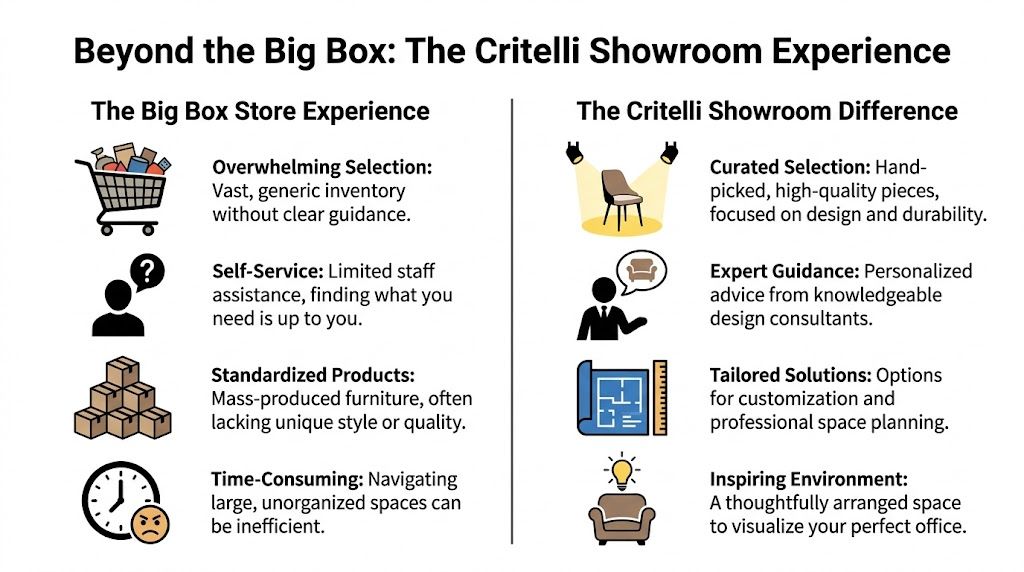
A big box office furniture superstore gives you quantity. A curated showroom gives you judgement.
That distinction matters more than people think. When you walk through aisles of isolated desks and stacked chairs, you’re forced to imagine the finished room on your own. Most buyers aren’t struggling because they can’t find a desk. They’re struggling because they can’t see how the desk, chair, rug, lighting, storage, and surrounding architecture should work together.
Mass-market browsing versus design-led seeing
In a warehouse-style setting, furniture is usually presented as isolated stock. You compare price tags, basic finishes, and dimensions. That can work for a temporary setup. It’s a poor method for building a room with character.
A showroom built around fully styled vignettes does something much more useful. It lets you assess scale, texture, comfort, and mood in real time. You can see how a wood desk sits against a wool rug. You can judge whether a leather chair adds warmth or visual heaviness. You can notice whether open shelving creates elegance or clutter.
Here’s the practical difference:
| Approach | What you’re asked to do | What you actually learn |
|---|---|---|
| Big box store | Sort through inventory alone | Price and rough dimensions |
| Curated showroom | Experience complete room settings | Proportion, palette, comfort, and cohesion |
That’s why the showroom model is stronger for anyone creating a lasting office. It gives context, and context prevents expensive mistakes.
Why curated selection beats endless selection
Too much choice isn’t a luxury. It’s often a burden.
A curated selection removes weak options before you ever see them. That’s the point. Instead of filtering through rows of interchangeable pieces, you work from a smaller group of furnishings chosen for construction, design integrity, and long-term usefulness.
For office projects, that often means looking at writing desks, executive desks, task seating, storage, accent lighting, and occasional pieces as a family, not as separate purchases. If you’re exploring dedicated office interiors, the full-line office interiors collection is one example of how this category can be approached through coordinated design rather than random accumulation.
Practical rule: If a piece only works because it’s on sale, it probably doesn’t belong in a room you want to keep.
The value of two distinct showroom moods
One of the smartest ways to shop for a workspace is to compare different design languages in person. A traditional environment may give you the warmth, gravitas, and craftsmanship you want for a library-like office. A cleaner, more contemporary presentation may suit a glass-walled business setting or a modern home renovation.
That’s where separate showroom experiences matter. One setting can speak to timeless detailing, richer woods, and classic upholstery. Another can lean into sleek silhouettes, lighter profiles, and modern restraint. Neither is “better.” The right one is the one that fits your architecture, daily work style, and personal taste.
A strong showroom also finishes the room properly. It doesn’t stop at desks and chairs. It layers art, lighting, occasional seating, and Art for your Floor so you can read the office as a complete environment.
This is a genuine upgrade from the office furniture superstore idea. You stop shopping by aisle and start making decisions by atmosphere.
Foundations of a Productive and Elegant Workspace
The backbone of a proper office is simple. You need a desk with presence, seating that respects your body, and materials that still look good after years of use. Skip any one of those and the room starts to feel compromised.
Many buyers make an expensive mistake by spending on visible size instead of invisible quality. A large desk made poorly is still a poor desk. An oversized chair with weak support is still a bad chair.

Start with the chair, not the desk
If you work long hours, your chair is the first decision, not the last. Comfort isn’t a decorative feature. It determines whether you can stay focused without constantly shifting, slumping, or abandoning the room altogether.
Brands such as Stressless have earned attention because they treat seated comfort as engineering, not an afterthought. The right office chair supports upright work while still feeling refined enough for an elegant interior. If you want a useful outside perspective on fit, posture, and adjustability, this guide on how to choose an office chair is a sensible starting point.
For readers comparing modern seating options, a modern office task chair shows the kind of refined profile worth looking for when you want performance without a corporate look.
Choose craftsmanship you won’t outgrow
A serious office should contain at least one piece with genuine permanence. Often that’s the desk.
Stickley is a good example of why joinery matters. A desk built with care has visual authority before you place a single object on top of it. The grain reads differently. The edges feel intentional. The proportions hold the room. This isn’t nostalgia. It’s construction quality you can see and use every day.
Look for these signals when assessing a desk or cabinet:
- Material depth that feels substantial, not hollow or thin
- Joinery and finish that look considered up close, not only from across the room
- Scale that suits the room so the piece anchors the space without dominating it
A workspace should never feel disposable. If you’re replacing key pieces every few years, you didn’t save money. You delayed the right purchase.
Use materials that mature well
Office furniture takes abuse. Hands on armrests. Bags against table legs. Sunlight across the same surface every afternoon. Cheap materials show stress early. Good ones develop character.
That’s why premium upholstery and finish selections matter. Hancock & Moore is a strong reference point here. Well-chosen leather brings depth, warmth, and a sense of permanence to an office in a way synthetic surfaces rarely do. The same logic applies to wood finishes, woven textures, and metal detailing. A room used daily needs materials that can handle real life gracefully.
Don’t judge office furniture only by how it looks on day one. Judge it by how it will wear in, not wear out.
The result you’re after is balanced, not flashy. Ergonomic where it counts. Artisanal where it shows. Organised enough to support your work, but elegant enough to feel like part of your home or brand identity.
Professional Space Planning for Your Home or Business
Most office problems aren’t furniture problems. They’re layout problems.
People blame the desk when the actual issue is circulation. They blame storage when the issue is wall placement. They blame the chair when the desk height, monitor position, lighting, and floor coverage were never considered together. That’s why DIY shopping so often stalls out. The room becomes a collection of decent pieces arranged with no real plan.
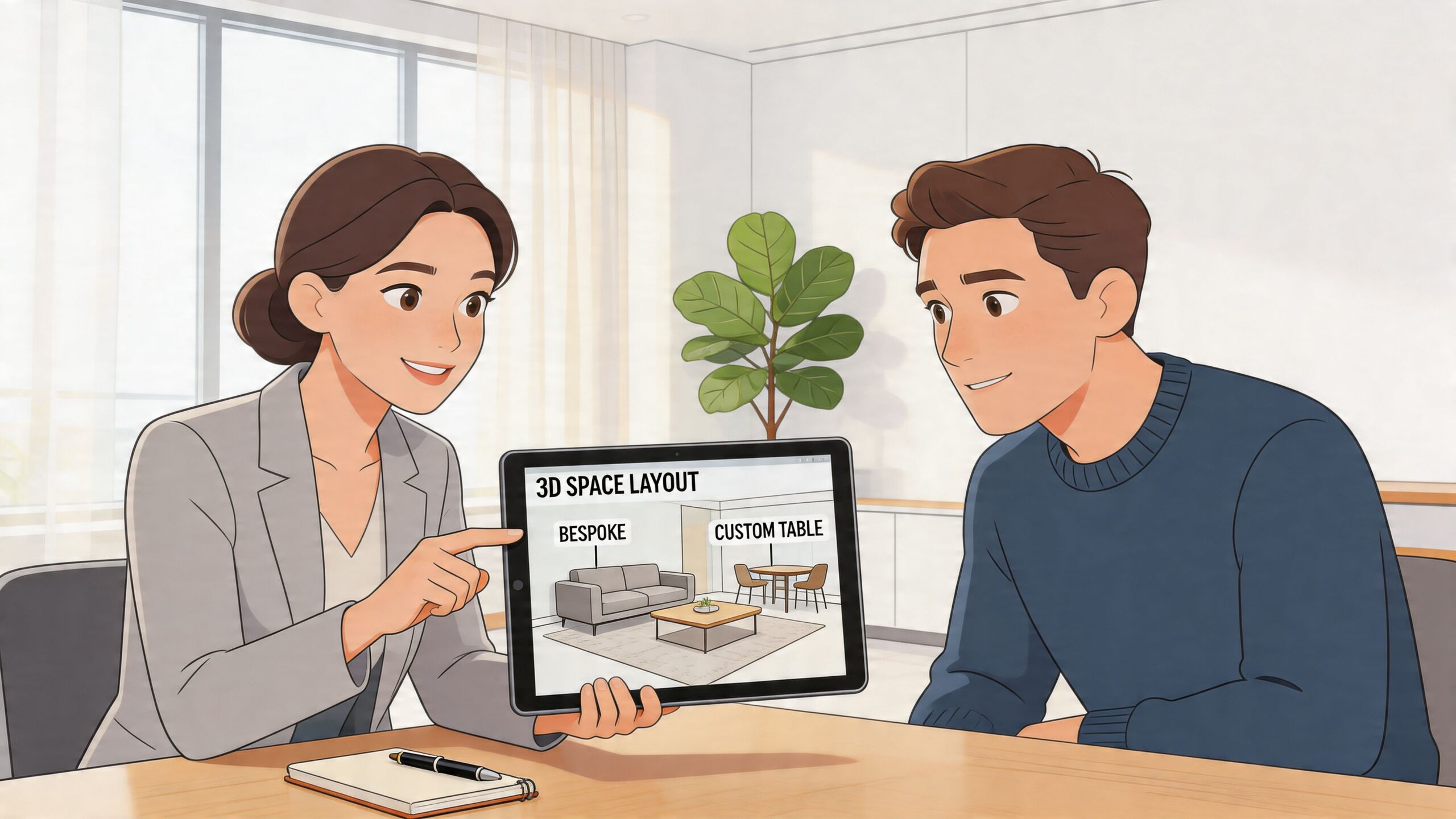
Why professional planning matters more now
Hybrid work changed what an office needs to do. It’s no longer enough for a room to hold a desk and a chair. It often has to support focused solo work, video calls, shared household use, storage, and visual order within the same footprint.
With Statistics Canada reporting that 20% of Southern Ontario's workforce remains in a hybrid model post-pandemic, and a 2025 Ontario Home Office Survey showing 65% of these workers seek multifunctional furniture, the need for expert space planning to integrate professional needs into personal spaces has never been greater. Critelli's Interior Design Studio directly addresses this demand, which is underserved by mass-market retailers via this cited background source.
That fact confirms what designers see every day across Southern Ontario. People don’t need more pieces. They need better integration.
What a design consultation actually solves
Good space planning is practical. It isn’t decorative fluff.
A professional consultation looks at the room the way an architect or designer would. Entry points, window lines, focal walls, natural light, sightlines from adjoining spaces, power access, storage requirements, and how the room has to feel at different times of day. In a business setting, the same logic applies to circulation, client-facing presentation, collaboration zones, and quiet work areas.
Useful design planning often addresses issues like these:
- Proportion problems where a desk is too large for the wall or too small for the room
- Flow conflicts where drawers, doors, and seating interfere with movement
- Visual imbalance where heavy casegoods sit against bare walls with no counterweight
- Mixed-use tension where a home office has to feel professional without becoming cold
If you want that level of guidance, interior design services in St. Catharines give you a framework for making decisions in the right order.
Designer’s Insight
Designer’s Insight
Our designers suggest pairing a bold Hancock & Moore leather with a neutral hand-knotted wool rug to balance the room’s energy. The leather gives the office authority. The rug softens acoustics and ties the composition together.
That kind of decision sounds small. It changes the whole room.
The real cost of guessing
A poorly planned office usually reveals itself in habits. You avoid the room. You move things constantly. You add storage after the fact. You keep tweaking instead of finishing.
Professional planning shortens that cycle because someone experienced can identify what the room is asking for before you buy the wrong thing. That’s especially important in older Southern Ontario homes, where alcoves, trim, radiator placement, and window proportions can make standard furniture sizes awkward. It’s just as important in newer open-concept homes, where the office has to relate to adjacent living spaces rather than feel cut off from them.
There’s also the emotional value. When the room is properly planned, work feels more settled. You sit down faster. You find what you need. You stop negotiating with the space.
For business owners, the stakes are higher
In a commercial office, layout communicates competence. Clients notice whether a room feels composed, whether seating is welcoming, and whether the workspace reflects care. Employees notice whether the furniture supports concentration or creates friction.
A DIY approach can still furnish the room. It rarely gives the office the authority it should have.
The office furniture superstore mindset asks, “What’s available?” Professional design asks, “What belongs here?” The second question leads to better workspaces every time.
Creating Bespoke Furniture Through Customization
The moment you stop shopping only from what’s on the floor, your office gets better.
Customization isn’t about making a room fussy. It’s about making it correct. The right depth on a desk. The right wood tone against your millwork. The right leather that complements the rug instead of fighting it. Those choices are what turn a respectable office into one that feels authored.
How bespoke choices come together
A bespoke office piece usually begins with a silhouette. You choose the form first. Clean-lined and architectural. More traditional and grounded. Perhaps something with a library sensibility, or a lighter modern profile for a brighter room.
Then the true tailoring begins. Wood finish, hardware, leather or fabric, nailhead treatment if appropriate, scale adjustments where available, and the supporting pieces around it. A reading chair may need to echo the desk finish. A cabinet may need a quieter stain so the room doesn’t become too dark. A writing surface may need a finish that can handle daily use without looking precious.
That process is far more rewarding than grabbing a standard item off a shelf because every decision solves an actual design problem.
A bespoke office feels composed because it is
Consider a familiar scenario. A client has a handsome room with good bones but awkward dimensions. The wall that should hold the desk is slightly narrower than standard executive options allow. The client wants storage, but not visual bulk. They also want the office to feel connected to the rest of the home, which uses warmer woods and soft neutrals.
An off-the-rack solution usually forces compromise. The desk is too wide, the storage feels commercial, and the finish misses the tone of the home.
A custom order changes that. The client starts with a frame they like, refines the finish, narrows the footprint where the manufacturer allows it, chooses a leather or performance fabric for a companion chair, and builds a room that fits both the architecture and the way they work. If you want to explore that route, custom furniture options show how the process can move from standard inventory to customized selection.
Bespoke doesn’t have to mean ornate. Often it means quieter, cleaner, and much more precise.
Where customization adds the most value
Not every item needs to be custom. The smartest offices use customization selectively.
Here are the places where it usually matters most:
- The desk finish because it sets the room’s tone immediately
- The seating upholstery because comfort and visual warmth depend on it
- Storage pieces when standard dimensions create bulk or wasted space
- Accent items such as occasional chairs or ottomans that connect the office to the rest of the home
This is also where custom furniture Southern Ontario becomes more than a search phrase. It becomes a practical design tool. A room with unusual trim details, heritage architecture, or a very specific palette benefits enormously from made-to-order thinking.
The best part is that bespoke work doesn’t feel intimidating once someone guides the selections. You’re not being asked to design furniture from scratch. You’re being invited to refine something excellent until it belongs specifically to you.
Grounding Your Workspace with The Rug Market
Most offices are designed from the desk up. I think that’s a mistake.
The room should often begin from the floor. A rug defines territory, softens sound, introduces material richness, and gives the furniture something to belong to. Without it, even beautiful office pieces can feel as though they’re floating in a temporary arrangement.
Art for your floor changes the room immediately
A rug is not an accessory in a thoughtful workspace. It’s the visual foundation.
That’s especially true in home offices, where the room must often connect with adjoining bedrooms, hallways, or living spaces. A hand-knotted rug gives continuity. It also prevents the office from feeling like a hard-edged insertion into an otherwise warm home.
The strongest offices use rugs to do four jobs at once:
- Define the zone so the workspace feels intentional
- Absorb sound and soften the sharper acoustics of desks, screens, and flooring
- Anchor scale so furniture looks placed rather than scattered
- Carry colour and texture in a way that doesn’t rely on clutter
Why hand-knotted rugs belong in a serious office
A hand-knotted rug offers complexity that machine-made pieces often don’t. The variation in colour, the subtle irregularities, the density underfoot, and the sense of craftsmanship all support a more refined room. That’s why Hand-knotted rugs Ontario isn’t just a decorative category. It’s a real design decision.
If you’ve never built a room around a rug before, start by looking at it as Art for your Floor. The right piece can guide everything else. It can quiet a dark desk, warm a modern chair, or pull together wood tones that otherwise feel unrelated.
For anyone exploring that approach, The Rug Market is where the search becomes less about generic décor and more about finding a foundation with depth, origin, and presence.
A rug should do more than fill an empty floor. It should organise the room visually before a single accessory is added.
Practical notes people forget
Office rugs do need practical consideration. Chair movement, pile height, desk leg placement, and furniture weight all matter. If you’re working with carpet underneath or heavier pieces on top, this guide on using coasters for furniture on carpet to prevent dents is worth a quick read.
There’s also a proportion rule I give clients often. The rug should be large enough to make the office feel settled. If it’s too small, the room looks timid and unfinished. If you’re placing a desk and chair on the rug, at least the main visual footprint should feel intentionally contained within it.
The office feels better when the floor is resolved
People tend to notice a handsome desk first. They feel a good rug first, even if they can’t name why.
The room becomes quieter. More complete. More expensive in the right way. The chair doesn’t echo as sharply. The wood looks warmer. The whole office takes on a sense of deliberateness.
That’s why I’d rather see a smaller number of excellent furnishings anchored by the right rug than a room packed with casegoods and no foundation at all. Start with the floor, and the office stops feeling improvised.
The Seamless Transition of White-Glove Delivery
Delivery is where many furniture purchases lose their polish.
You spend weeks selecting pieces, refining finishes, and planning the room. Then the final step is handled like freight. Boxes at the door. Hardware in bags. Protective wrap everywhere. Assembly left to the client. That’s not a finished experience. It’s a handoff.
Why delivery should feel like completion
A proper white-glove service treats delivery as the last design step. The team handles more than furniture transportation. They bring it in carefully, place it where it belongs, assemble it properly, remove packaging, and leave the room ready to use.
That matters for obvious reasons. Fine furniture can be damaged in careless handling, and large office pieces are rarely simple to manoeuvre through stairs, hallways, or tight doorways. It also matters because placement affects the final look. A desk shifted a few inches can improve circulation. A chair angled correctly can make the office feel more welcoming. A rug aligned properly can settle the whole composition.
What clients should expect
For clients in the Greater Niagara, Hamilton, and Toronto markets, white-glove delivery should include several basics:
- Careful inspection before pieces are placed in the room
- Professional assembly of desks, seating, and storage where required
- Precise positioning so the layout reflects the original plan
- Packaging removal so the space is clean and usable immediately
That level of service protects the investment, but it also preserves the feeling of confidence that should accompany a design-led purchase.
The final impression matters
A well-delivered office changes the emotional end of the project. You don’t spend the evening sorting hardware or flattening cartons. You walk into a room that feels complete.
That’s especially important when the office is part of a larger renovation, a move, or a business upgrade. You’ve already made enough decisions. The final stage should reduce friction, not create it.
White-glove delivery sounds like a luxury term. In practice, it’s the common-sense way to finish a room built with care.
Conclusion Your Enduring Legacy of Style and Function
The search for an office furniture superstore often begins with convenience. It should end with discernment.
A workspace you use every day deserves more than generic stock and isolated purchases. It deserves thoughtful scale, heirloom quality materials, professional space planning, and finishing details that make the room feel resolved. That’s how an office becomes productive without turning cold, and elegant without losing function.
The strongest rooms aren’t assembled in haste. They’re curated. They reflect the architecture around them, the work being done within them, and the standards of the person using them. A century-old family perspective, a design studio that thinks in complete room concepts, Art for your Floor, and an impeccable white-glove finish all contribute to that result.
If you’re in St. Catharines, the Greater Niagara region, Hamilton, or Toronto, take the office seriously enough to do it properly. The room will give that care back to you every single day.
Experience the craftsmanship in person at Critelli Furniture. Book your complimentary design consultation today, or visit the Rug Market to find your room’s foundation.