
Interior Design Services Toronto


A great many Toronto homeowners arrive at the same point. The architecture is strong, the address is right, and several individual pieces are beautiful, yet the home still doesn't feel resolved. One room is too sparse, another is overfilled, lighting feels accidental, and the furnishings don't quite speak to one another.
That's usually when interior design stops being a matter of shopping and becomes a matter of orchestration. The most successful homes aren't built from random finds. They're shaped through a clear point of view, careful planning, and a willingness to treat each room as part of a complete whole.
That approach has only become more relevant as the profession has expanded. The Canadian interior design market is projected to reach CA$2.8 billion in 2026, and a separate Canadian source notes that 73% of interior designers are based in Ontario and British Columbia, with Ontario described as the country's interior design capital, which gives Toronto homeowners access to a deep talent pool and a mature design culture (Canadian interior design market statistics). For a family-run business with roots dating back to 1914, that growth doesn't change the fundamentals. It reinforces them. Timeless rooms still come from thoughtful curation, not speed.
A well-designed home also depends on decisions that many people underestimate at the start. Natural light, drape weight, privacy, and proportion all change how a room feels, which is why it helps to understand how window treatments influence interiors before final selections are made. For those beginning their search for Toronto furniture and design guidance, the strongest starting point is not a product list. It's a clear vision for how the home should live.
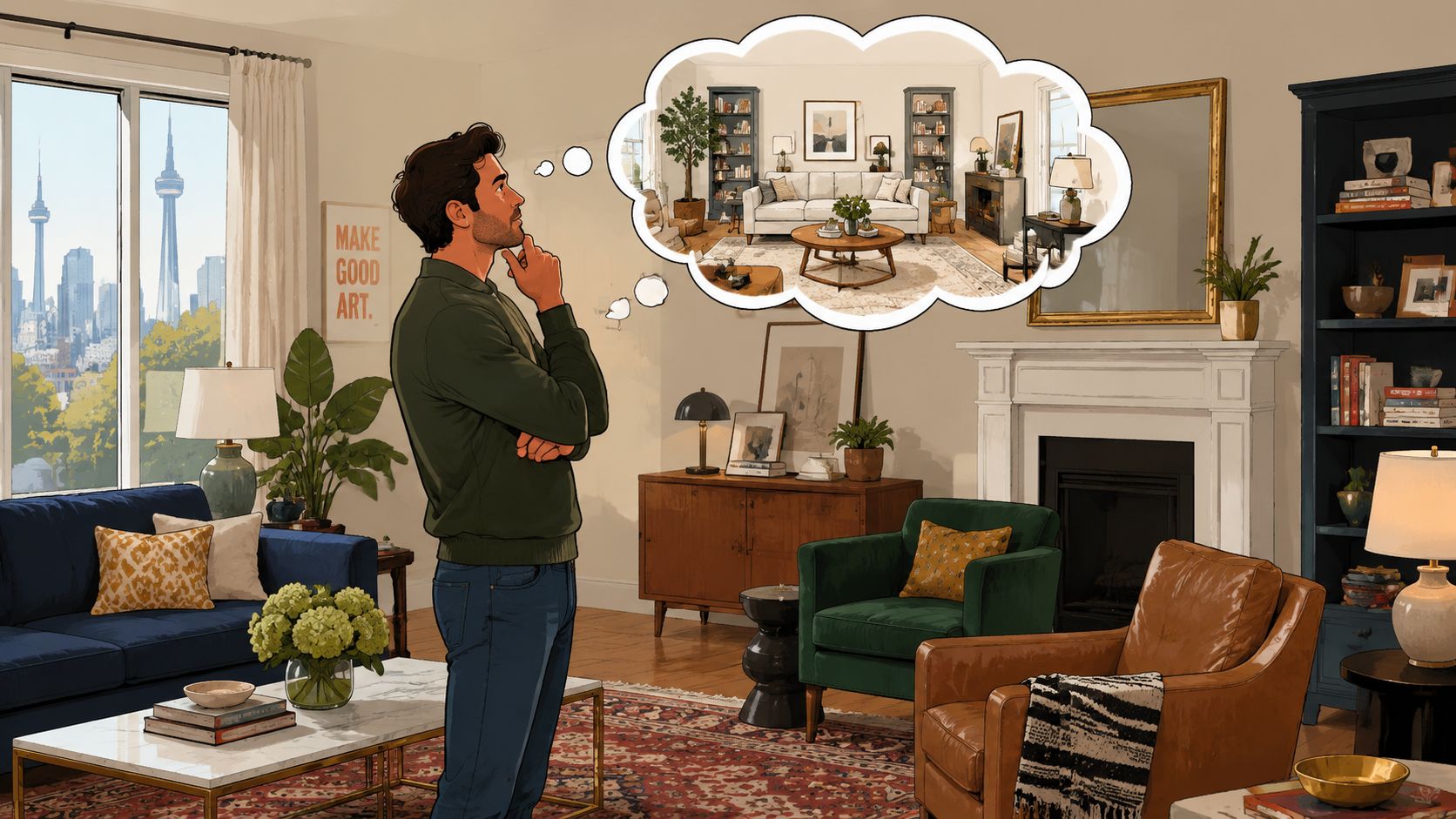
Table of Contents
- Embarking on Your Design Journey
- Preparing for Your Design Consultation
- Understanding Design Service Models in Toronto
- Navigating Budgets Timelines and Total Investment
- The Art of Curation Creating Your Bespoke Space
- From Showroom to Sanctuary The White-Glove Experience
Embarking on Your Design Journey
The early phase of a project is rarely about style labels alone. It's about recognising what the home is missing. In Toronto, that often means balancing architectural character with daily life. A formal living room needs to welcome real use. A condominium needs calm and storage without feeling compressed. A renovated older home needs continuity, so the original details and newer additions feel intentional together.
Professional interior design services in Toronto work best when the relationship begins with honesty. What's functioning well should stay. What isn't serving the household should be reconsidered without sentimentality. A room can be elegant and still be practical enough for children, guests, pets, and ordinary Tuesday evenings.
The difference between decorating and designing
Decoration adds beauty. Design creates order. The distinction matters because many costly mistakes happen when homeowners start purchasing before proportion, layout, circulation, and use have been resolved.
A refined room doesn't begin with the sofa or the chandelier. It begins with scale, movement, and purpose.
That is why heritage design houses still favour a slower, more deliberate approach. A complete room concept considers the relationship between architecture, upholstery, rugs, lighting, art, storage, and finishing details. It treats the room as one composition rather than a series of separate purchases.
A better first expectation
The first stage should feel collaborative, not intimidating. The strongest client relationships are built when the homeowner brings aspirations, routines, and preferences, and the designer translates those into selections that can live well over time.
Timeless interiors rarely announce themselves loudly. They feel settled. They hold quality materials, good lines, and enough restraint to let artisanal pieces breathe. That's the standard worth aiming for, whether the project is a single sitting room in Toronto or a larger residence serving the Greater Niagara and Hamilton markets as well.
Preparing for Your Design Consultation
A productive consultation depends less on having all the answers and more on bringing the right kind of information. Too many first meetings begin with broad statements such as “something modern but warm” or “we want it to feel luxurious.” Those instincts are useful, but they aren't enough to build a room.
Preparation gives the conversation shape. It helps the designer separate lasting preferences from passing impulses, and it keeps the project from drifting into expensive revisions later.
What to gather before the first meeting
A practical consultation package doesn't need to be elaborate. It does need to be organised.
- Inspiration that repeats a pattern: Save images from magazines, travel photos, or digital folders, then look for common threads. Repeated details matter more than isolated favourites. The client may notice a preference for lower profiles, richer wood tones, custom upholstery, or quieter palettes.
- Basic room information: Include measurements, ceiling height, doorway widths, window placement, and any architectural constraints. Even rough dimensions are more helpful than memory.
- Existing pieces worth keeping: List the items that must stay. That might be a dining table, inherited cabinet, artwork, or a hand-knotted rug with sentimental value.
- Functional priorities: Identify how the room must work. Entertaining, reading, television viewing, hosting overnight guests, homework, or quiet conversation each call for different planning.
- A realistic decision-maker list: If more than one person needs approval power, that should be clear from the beginning.
For clients seeking a more personal design-led process, complimentary consultation guidance with Julia Critelli offers a useful example of how a conversation can move from taste to practical direction.
Questions worth answering in advance
The most revealing answers are often about dislikes, not favourites.
Designer's Insight
A “love” and “loathe” list saves time. Knowing which silhouettes, finishes, colours, and fabrics feel wrong is often more clarifying than a long list of things that merely seem acceptable.
A strong pre-consultation brief usually answers questions like these:
- What feels unresolved in the room now? Be specific. Poor lighting, awkward scale, lack of storage, and no focal point are very different problems.
- How should the room feel at the end? Calm, collected, inviting, refined, layered, or formal all point in different directions.
- What level of maintenance is acceptable? Some households want relaxed durability. Others are comfortable with more delicate finishes and textiles.
- Is this a refresh or part of a larger renovation? The answer affects sequencing, lead times, and procurement choices.
This stage shouldn't be rushed. The more clearly a homeowner can describe how they want to live, the easier it becomes to create a room with heirloom quality instead of one that photographs well for a moment.
Understanding Design Service Models in Toronto
Toronto offers a broad range of design service structures, and that variety can be useful or confusing depending on how a client approaches it. Some households need a single consultation and a clear plan. Others need full coordination from concept to installation. Problems begin when the service model doesn't match the project.
Why process matters in a crowded market
Ontario is not a fringe design market. Statistics Canada reported that specialized design services generated $4.5 billion in operating revenue in 2023, that interior design services accounted for 46.3% of sales, and that Ontario represented 50.9% of that revenue, or about $2.3 billion (Statistics Canada reporting on specialized design services). That scale tells homeowners something important. Interior design services in Toronto sit inside a mature and competitive environment. Proven process matters.
A polished portfolio isn't enough on its own. Clients should look for evidence of coordination, revision discipline, and clear documentation. On renovation work especially, design choices affect trades, timelines, and approvals. Homeowners considering related work such as Toronto kitchen renovation services often discover quickly that design quality and project coordination are inseparable.
Choosing the right service model
Different project types suit different structures.
Consultation-led support
This model works well when the homeowner wants professional direction but intends to manage much of the execution personally. It can be effective for paint palettes, furniture layouts, room refreshes, or solving one difficult area. It tends to work less well when custom pieces, multiple trades, or phased procurement are involved.
Full-room furnishing and specification
This approach sits between advice and total project management. The designer develops a coherent scheme, sources furnishings, helps with finishes, and aligns selections into one design-forward composition. It's often the strongest fit for clients who want a complete room concept without overseeing every procurement detail themselves.
Full-service design and coordination
This is the most extensive path. It usually includes planning, specifications, purchasing, tracking, and final installation oversight. For busy professionals in Toronto, Hamilton, and Greater Niagara, it reduces the need to act as their own traffic controller.
Practical rule: Choose the service model that matches the amount of coordination the project demands, not the amount of coordination a client hopes to avoid.
Some clients also need a custom-order process rather than immediate retail selection. In those cases, getting started with custom furniture orders becomes part of the design conversation because dimensions, fabric, finish, comfort, and placement all need to be resolved together.
A mature market rewards clarity. The right designer doesn't just offer options. They create a process that protects the room from becoming a collection of near-misses.
Navigating Budgets Timelines and Total Investment
The budget question deserves a direct answer. Most homeowners don't struggle with the idea that design costs money. They struggle because the visible price is rarely the total price. A room isn't funded only by a design fee or by the upholstery line on a quote. It's funded by layers of decisions that stack together.
That is why vague language such as “full-service” or “turn-key” can feel unhelpful if no one explains what the total investment includes. In Toronto, where many households weigh renovation and furnishing decisions carefully, clarity is not a luxury. It is part of good service.
The full cost stack
For most furnishing or renovation-adjacent projects, the overall investment includes several categories working together.
- Design services: Concept development, space planning, sourcing, revisions, specification work, and client communication.
- Furniture and décor procurement: Upholstery, case goods, rugs, lighting, art, accessories, and any finishing elements selected for the room.
- Customisation: Bespoke dimensions, artisanal finishes, custom upholstery, custom-fit cushions, or made-to-order detailing.
- Logistics and placement: Receiving, inspection, delivery coordination, assembly, installation, and white-glove placement.
- Taxes and incidentals: The final amount should always allow for the ordinary costs that accompany real purchasing and installation.
A useful budget doesn't only state what can be spent. It assigns priorities. If heirloom quality seating matters most, then the room may call for simpler side tables or a quieter accessory plan. If a statement rug is the foundation, then that decision should shape the rest of the allocation.
A sample way to think about allocation
Percentages can be a practical planning tool when they are treated as flexible guides rather than rigid formulas.
| Expense Category | Sample Allocation (%) |
|---|---|
| Design Services | 10-20% |
| Furniture and Upholstery | 35-50% |
| Rug and Soft Furnishings | 10-20% |
| Lighting and Accent Pieces | 5-15% |
| Delivery Installation and Incidentals | 5-15% |
This kind of planning helps clients ask better questions. Not “How much is the sofa?” but “How much of the room should the seating group represent if the goal is balance and longevity?”
Budgets work best when they reflect the room's hierarchy. Spend where the room carries visual and daily weight, then simplify elsewhere.
Timelines deserve the same realism. Custom pieces take longer than in-stock pieces. Renovation work introduces dependencies. Decision delays can slow procurement even when the design itself is settled. A calm project usually comes from early approvals, concise revision rounds, and a shared understanding that quality craftsmanship is seldom immediate.
For homeowners comparing paths, understanding the furniture buying journey from first research to final decision is often helpful because it places the purchase inside a broader furnishing process rather than treating it as a single transaction.
The strongest outcome is rarely the cheapest room or the fastest room. It is the room that still feels right years later because the investment was made with discipline.
The Art of Curation Creating Your Bespoke Space
Once the planning is sound, the project becomes more tactile and far more personal. At this stage, clients often expect endless choice. In practice, endless choice usually weakens a room. Good curation narrows the field, sharpens the vision, and protects the home from becoming visually noisy.

Why fewer better choices lead to stronger rooms
A bespoke room rarely comes from selecting the most dramatic item in every category. It comes from knowing where to place emphasis. A beautifully shaped sofa may need a calmer fabric. A richly figured wood finish may call for quieter surrounding forms. A bold leather can be superb, but only when balanced by texture and restraint elsewhere.
Material literacy matters. Not every linen suits heavy use. Not every performance textile has the hand a formal room requires. Not every wood tone complements the home's flooring. A curated selection protects the client from making isolated decisions that compete with one another once everything arrives.
Partner collections such as Stickley and Stressless often enter these conversations because they represent different strengths within a room. One might speak to timeless craftsmanship and architectural presence. Another might satisfy ergonomic comfort without sacrificing refinement. The point isn't to collect recognisable names. It's to select pieces with a clear job to do.
A room feels luxurious when every element looks as though it belongs there, not when every element asks for attention.
Starting from the floor and building upward
Many of the most successful rooms begin with the rug. The Rug Market approach treats rugs as Art for your Floor, and that phrase is more than poetic. A hand-knotted rug establishes palette, scale, movement, and mood before a single cushion is chosen.
From there, the room gains structure. Upholstery takes its place. Wood finishes introduce warmth or contrast. Metals and lighting add polish. Art and objects complete the atmosphere without overcrowding it. Homeowners interested in how designers curate unique spaces with art often find that the same principle applies here. The strongest spaces aren't filled indiscriminately. They are edited.
A bespoke interior also allows for deeply personal details:
- Customized upholstery: Adjusted depth, arm profile, cushion comfort, or fabric selection to suit the household.
- Meaningful materials: Leather that gains character, wool that softens a room, wood finishes that echo the architecture.
- Collected contrast: Traditional forms beside cleaner silhouettes, or contemporary lines grounded by artisanal textiles.
- Heirloom intent: Pieces chosen because they can stay with the family, not because they answer a fleeting trend.
A design-led furnishing process can be especially useful. Critelli Furniture offers design services tied to furniture and décor selection, which allows clients to make room-level decisions rather than treating each purchase separately. Done properly, curation makes a home feel composed, individual, and memorable.
From Showroom to Sanctuary The White-Glove Experience
The final phase is often underestimated. Clients devote energy to layout, textiles, finishes, and approvals, then assume delivery is the simple part. It isn't. The last stage determines whether the design arrives as intended or dissolves into avoidable stress.

What white-glove delivery actually includes
White-glove service is not the same as bringing boxes to the door. Proper execution usually includes inspection before placement, careful handling inside the home, assembly where required, positioning according to the design plan, and full removal of packaging materials.
For many projects, that final distinction matters as much as the furniture itself. A sectional placed a few inches incorrectly can disrupt circulation. A rug set without proper alignment can weaken the room's geometry. Lighting and occasional pieces need visual spacing, not random placement.
Homeowners looking into professional furniture assembly and setup support are often responding to this exact concern. They don't only want the pieces delivered. They want the room completed.
Why the final placement matters
A successful installation should leave the home feeling settled on day one. That means the furniture is where it belongs, the proportions read correctly, and the room doesn't require the homeowner to spend the evening shifting heavy pieces by trial and error.
The emotional value here is often overlooked. A home that moves cleanly from selection to installation feels cared for. There is no pile of discarded wrapping, no uncertainty about assembly, and no lingering sense that the last ten percent still needs to be solved.
That refined finish is one of the signatures of luxury. Not excess. Ease.
For homeowners seeking interior design services in Toronto with a focus on timeless craftsmanship, bespoke curation, and a unified finish from concept to final placement, Critelli Furniture offers a design-led path shaped by heritage, complete room thinking, and white-glove care. Experience the craftsmanship in person at the King Street Showroom, visit the Rug Market to find your room's foundation, or book your complimentary design consultation today.