
Timeless Transitional Style Furniture for 2026

A familiar design problem appears in many well-appointed homes. The architecture may be classic, the lifestyle modern, and the furniture needs to feel refined without becoming formal or severe. A room can't feel overworked, but it also shouldn't look anonymous.
That's where transitional style furniture earns its place. Not as a middle-ground solution, but as a deliberate design choice for households that want comfort, elegance, and staying power in the same room. It answers a practical question that trend-driven interiors often avoid. How does a home feel current now, and still feel right years from now?
For discerning homeowners across St. Catharines, the Greater Niagara region, Hamilton, and Toronto, that question matters. Transitional rooms tend to hold their composure through changing paint colours, evolving artwork, new lighting, and the ordinary shifts of family life. Done well, the style doesn't read as cautious. It reads as settled, curated, and quietly confident. Readers who want a broader look at the decorating approach itself may find this guide to transitional style interior design useful before choosing individual pieces.
Table of Contents
- An Introduction to Timeless Transitional Design
- The Heritage Behind Transitional Style Furniture
- The Visual Language of Transitional Interiors
- Hallmark Pieces for a Curated Transitional Home
- Styling Transitional Furniture with Sophistication
- Creating Your Bespoke Transitional Interior
An Introduction to Timeless Transitional Design
Many articles describe transitional style as a simple blend of traditional and contemporary elements. That description is technically correct, but it misses the more useful idea. In a well-designed home, transitional style furniture works as a longevity strategy.
That distinction matters in Canada, where buyers are increasingly leaning toward fewer, better purchases rather than frequent style turnover, as noted in this discussion of transitional design as an intentional long-term choice. A sofa, dining table, or upholstered chair chosen in this spirit isn't selected because it offends no one. It's selected because it can hold visual relevance for years while still supporting daily living.
Why the style lasts
Transitional interiors succeed when restraint is matched with quality. The silhouettes are edited. The palette is often quiet. The ornament is reduced. If the materials aren't strong enough, or the tailoring isn't precise enough, the room slips from elegant to forgettable very quickly.
That's the trade-off many homeowners sense but don't always name:
- Lower ornament needs stronger materials. When carving, pattern, and decorative trim are reduced, the eye goes straight to shape, finish, and upholstery.
- Neutral rooms need contrast in texture. Without that contrast, the space can feel flat.
- Timelessness needs intention. A room doesn't become timeless by removing personality. It becomes timeless by organising personality with discipline.
Practical rule: Transitional style furniture should feel composed, not generic. The room needs at least one element with depth, such as figured wood, tailored leather, hand-finished metal, or a richly woven textile.
What works and what doesn't
The strongest transitional rooms usually share a few habits. They invest in line, proportion, and craftsmanship first, then build character through rugs, lighting, and accents. They don't rely on novelty to make the room feel alive.
What tends to work well:
| Approach | Why it works |
|---|---|
| Clean-lined upholstery with generous comfort | It feels polished without turning stiff |
| Wood furniture with visible grain or artisanal finish | It adds warmth to a restrained palette |
| Curated neutrals with a few deeper notes | It keeps the room calm but not washed out |
| Bespoke details such as custom fabric or finish | It prevents the room from feeling like a showroom set |
What usually falls short:
| Misstep | Why it weakens the room |
|---|---|
| Matching every piece too closely | The room loses depth and individuality |
| Choosing only pale, smooth surfaces | The space can feel bland and under-layered |
| Oversized furniture in edited interiors | The room becomes heavy instead of balanced |
| Decorative clutter added at the end | It fights the style's core discipline |
Transitional design remains one of the most reliable ways to create a home that feels both elevated and livable. The key isn't mixing old and new for its own sake. The key is selecting pieces with enough timeless craftsmanship to carry the room gracefully through changing tastes.
The Heritage Behind Transitional Style Furniture
Transitional style furniture has deeper roots than many homeowners realise. It isn't a passing category invented for modern retail floors. It's better understood as a design bridge with a long history of returning whenever people want interiors that feel refined, but not rigid.
A style built for longevity
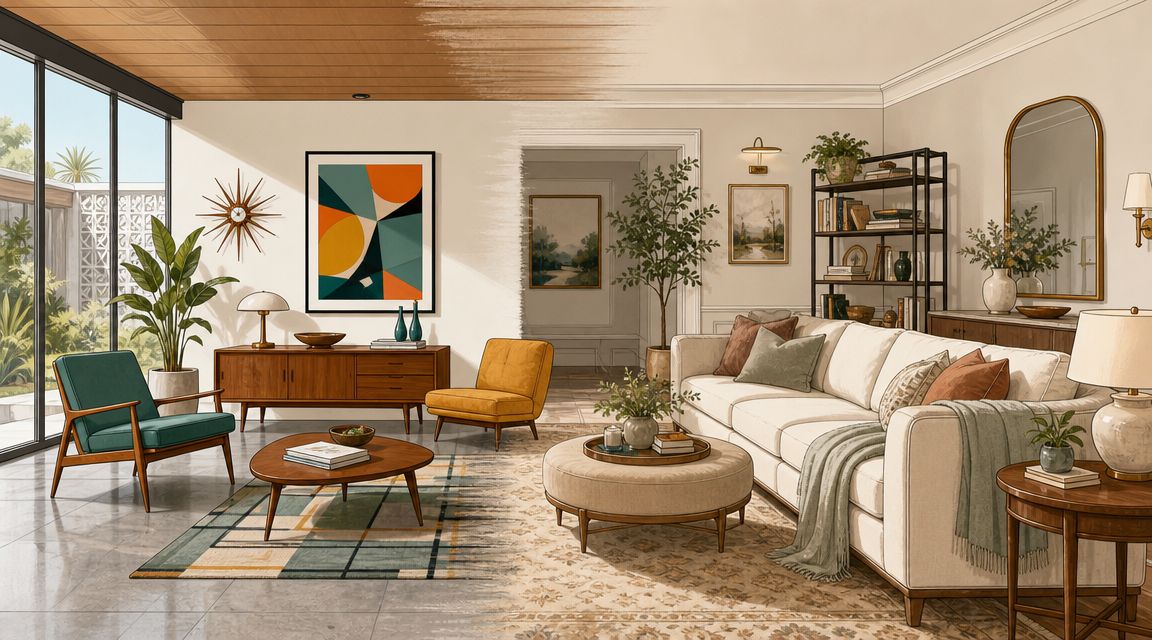
The style became widely popular in the 1950s as a response to pure modernism, while drawing warmth from 18th-century French and English forms such as Queen Anne and Chippendale, according to this history of transitional design as a bridge between classic and modern traditions. That lineage explains why transitional pieces often feel familiar even when they look current. Their proportions and silhouettes carry a memory of historical furniture, but the surface treatment is quieter.
This is one reason the category continues to reappear across generations. It solves a recurring design problem. Many households want rooms with softness and grace, but they don't want heavy period reproduction. Transitional design answers that need by preserving structure while simplifying presentation.
A sofa in this language may keep a classic arm profile, but the line is cleaner. A dining chair may echo traditional proportion, but without excess ornament. A console may feel rooted in furniture history, yet still sit comfortably beneath contemporary art.
Heritage matters because it gives the room a design lineage. A well-chosen transitional piece doesn't need to announce its reference to feel grounded.
Why heritage matters in practice
For a family business founded in 1914, the appeal of this style is easy to understand. Homes are rarely furnished once and left untouched forever. They evolve. Children grow, rooms change purpose, and decorative preferences become more edited over time. Furniture with a balanced design language adapts more gracefully than furniture tied to a narrow moment.
That's why heritage-focused homes in Southern Ontario often respond so well to transitional pieces. The style can live beside original millwork, newer renovations, and even modern glazing without creating tension. It's flexible, but it still has dignity.
A century-old business also tends to notice something that fast-moving trend cycles often miss. Investment furniture needs more than immediate visual appeal. It needs durability of style. Pieces chosen for a primary bedroom, formal dining room, or principal living area should still feel believable when the surrounding accessories change.
For readers interested in how legacy and craftsmanship shape a broader furnishing philosophy, heritage lifestyle home furnishings offers a useful reference point.
Three historical lessons continue to shape strong transitional rooms today:
- Classical proportion still matters. Even simplified furniture looks more expensive when the underlying scale is correct.
- Warmth is never accidental. Historical forms bring familiarity, and that familiarity keeps edited rooms from feeling cold.
- Restraint is a discipline. The style depends on knowing what to remove, not only what to include.
That balance between continuity and adaptation is exactly what gives transitional style furniture its staying power. It has history behind it, but it doesn't live in the past.
The Visual Language of Transitional Interiors
The easiest way to recognise transitional style furniture is to stop looking for decoration and start looking for discipline. The style is built on a measured visual compromise. It keeps the poise of traditional furniture, then pares back the details so the piece feels calm, current, and easy to live with.
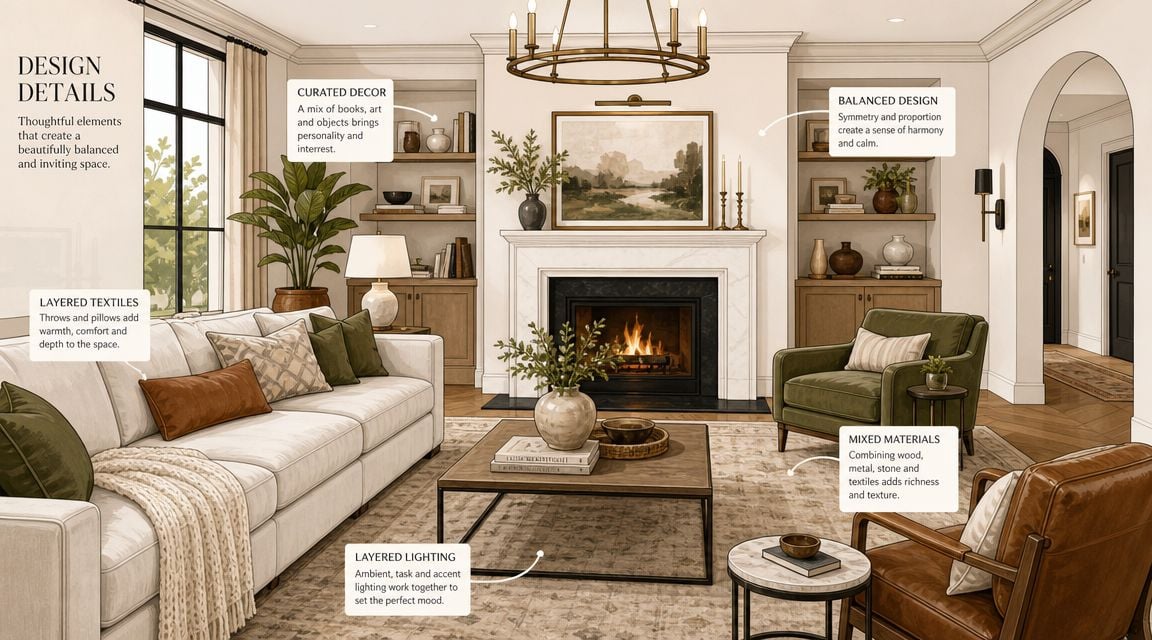
That principle is often described as a form-language compromise, where traditional proportion and structure are retained while ornament is reduced through subtle curves and neutral colour palettes, allowing the furniture to sit naturally in both classic and contemporary homes, as explained in this overview of traditional and transitional form language.
What the eye notices first
Most transitional rooms rely on a visual rhythm that feels settled rather than dramatic. Straight lines appear, but they're softened. Curves appear, but they're controlled. Nothing shouts for attention, yet everything feels intentional.
Key traits usually include:
- Balanced silhouettes. Pieces tend to have enough presence to anchor a room, but they avoid extremes.
- Subtle curves. A softened arm, tapered leg, or gentle chair back keeps the room from becoming too hard.
- Reduced ornament. There may be moulding, trim, or detail, but it is edited rather than elaborate.
- Medium visual weight. Furniture doesn't look spindly, and it shouldn't look overbuilt.
A useful test is this. If a piece feels as though it belongs only in a formal room, it's often too traditional. If it feels visually cold or thin, it's often too modern. Transitional style furniture lives in the middle with purpose.
Materials and colours that keep the room composed
Material selection carries more responsibility in transitional interiors because the style doesn't lean on heavy pattern or ornament to create richness. Wood grain, leather texture, metal sheen, and woven surfaces do much of the visual work.
The most dependable combinations often look like this:
| Element | Strong transitional choice | Usually less successful |
|---|---|---|
| Wood finish | Warm, visible grain, softly finished | Overly distressed or high-gloss novelty finishes |
| Upholstery | Tailored neutrals, tactile weaves, refined leather | Busy prints that overpower the silhouette |
| Metal | A restrained accent in lamps or tables | Too many competing finishes in one room |
| Glass and stone | Used selectively to lighten the composition | Overuse that makes the room feel cold |
The colour story also matters. Transitional rooms usually sit on a neutral foundation. Cream, taupe, tan, warm grey, charcoal, and soft black all belong here. The point isn't to strip the room of colour. It's to let colour arrive through control, not noise.
A quiet palette doesn't create elegance on its own. Texture, finish, and proportion have to carry the room.
Designer's Insight
Designer's Insight: A tailored leather chair paired with a neutral hand-knotted wool rug often creates more depth than adding another accent colour. Texture gives transitional rooms their richness.
Another frequent mistake is confusing simplicity with plainness. Plain rooms look unfinished. Transitional rooms look edited. The difference usually comes down to material quality, seam placement, trim restraint, and whether every piece contributes to a complete room concept.
That's also why isolated purchases can disappoint. A single handsome sofa may still look adrift if the surrounding tables, lighting, and floor covering don't share the same visual discipline. Transitional style furniture works best when the whole room agrees on line, scale, and restraint.
Hallmark Pieces for a Curated Transitional Home
A curated transitional home rarely begins with accessories. It begins with a few anchor pieces that establish the room's posture. Once those are right, the supporting elements can add polish without fighting for control.
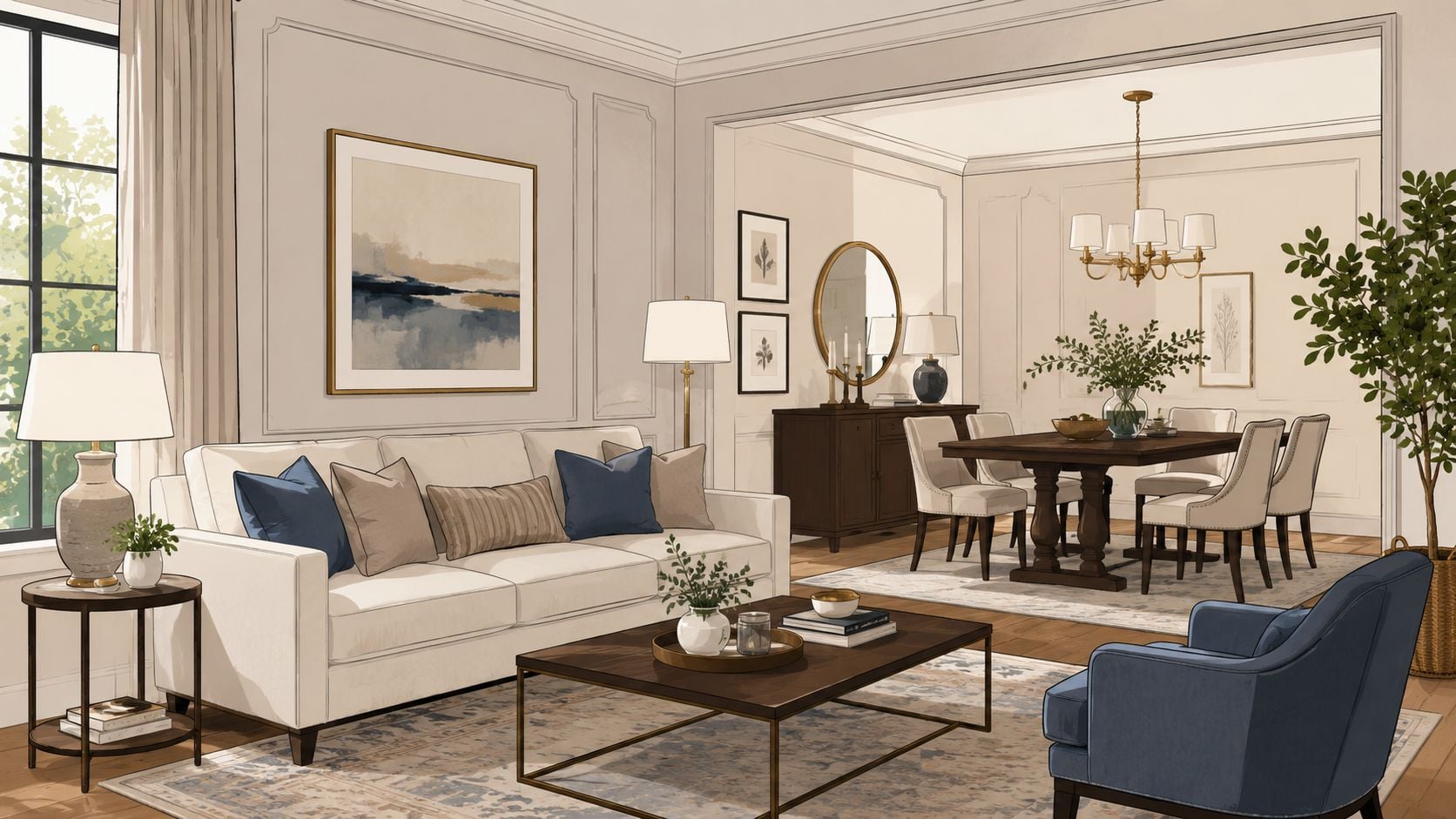
For room planning, transitional furniture is commonly built at a medium scale and often uses mixed materials such as wood, metal, and glass. Its cleaner lines also make it easier to layer textiles and décor without visual clutter, according to this guide to transitional furniture design trends and room planning.
The anchor pieces that set the tone
In the living room, the sofa is usually the first commitment. A strong transitional sofa has shape, but not fuss. Arms may be gently rolled or squared with softness. The seat should look inviting, not stiff, and the upholstery should feel well-fitted rather than overstuffed.
The coffee table and side tables then sharpen the room's character. Mixed materials often contribute to this effect. A wood frame with a stone or glass top can lighten the composition. A metal accent table can bring a cleaner note beside a more classic upholstered form.
A transitional dining room often depends on contrast handled with restraint:
- Dining table. A familiar silhouette with simplified detailing tends to age well.
- Dining chair. Upholstered comfort keeps the room from becoming too formal.
- Sideboard or console. This is often where artisanal finish and storage meet.
- Lighting. It should clarify the mood, not dominate it.
Accent seating deserves equal care. A well-made leather chair can add gravity. A more sculptural occasional chair can soften the room if the upholstery remains quiet. Tables with excessive ornament, however, usually pull the room back toward traditional formality.
How a complete room concept comes together
The most successful transitional interiors are arranged as a complete room concept, not a series of unrelated purchases. A sofa should speak to the rug. The rug should support the wood tone. The case goods should respect the architecture. Once that chain breaks, the room begins to feel assembled instead of composed.
A practical sequence often looks like this:
- Choose the largest upholstered piece first. It sets comfort, line, and colour direction.
- Add grounding case goods. These supply structure and material contrast.
- Introduce the bridge pieces. Console tables, lamps, and accent chairs connect the room's language.
- Finish with textiles and art. These personalise the room without disrupting it.
For homeowners moving high-quality furniture between addresses, careful handling matters as much as good selection. A practical reference on professional furniture transport London shows the kind of planning required when investment pieces need protection in transit.
Well-proportioned occasional tables are especially valuable in this style because they help maintain openness while adding functionality. Readers comparing shapes and sizes may find console and sofa tables useful when balancing wall space and circulation.
One piece can be handsome on its own. A room becomes memorable when every piece knows its role. That's the difference between buying furniture and curating a home.
Styling Transitional Furniture with Sophistication
Styling determines whether transitional style furniture feels intentional or merely safe. The furniture may already have the right bones, but a room still needs tension, contrast, and grounding. Without those elements, the result becomes polite rather than distinguished.
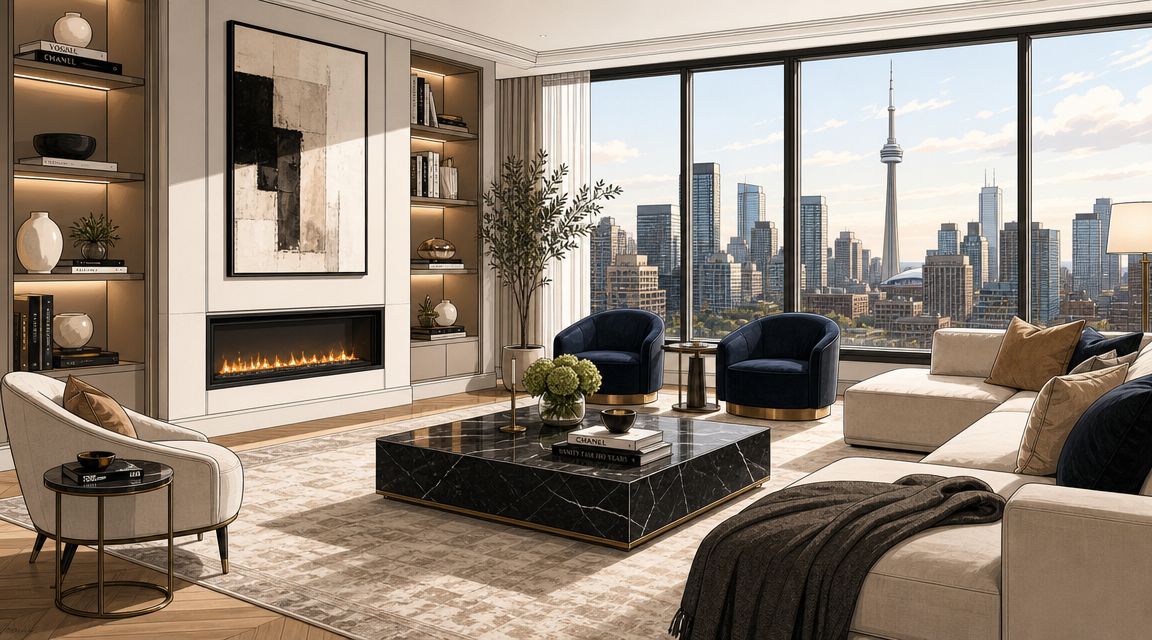
In compact urban homes, that discipline becomes even more important. Statistics Canada reported that 58% of Toronto households lived in apartments in 2021, and design guidance for those settings notes that exposed legs, shallower depths, and lighter upholstery help create visual openness in smaller rooms, as outlined in this article on transitional design choices for compact homes.
How to avoid a room that feels too safe
An elegant transitional room usually contains a deliberate contrast in each of these areas:
| Design layer | What adds sophistication |
|---|---|
| Scale | A balance of substantial anchor pieces and lighter secondary forms |
| Surface | A mix of matte, polished, soft, and textured finishes |
| Tone | Neutrals with a few deeper notes for definition |
| Shape | Straight lines moderated by controlled curves |
What often works in Southern Ontario homes, especially in condos and townhomes, is furniture that sits slightly off the floor. Exposed legs create breathing room. Shallower sofas preserve circulation. Upholstery in lighter tones helps the room reflect available light rather than absorb it.
What doesn't work is shrinking everything. Small rooms still need visual authority. The answer isn't miniature furniture. The answer is edited scale.
A few styling rules hold up well:
- Let one material lead. If the room begins with warm wood, keep supporting finishes disciplined.
- Use leather carefully. It adds polish and permanence, but too much can make the room feel hard.
- Limit decorative repetition. Matching every cushion, lamp, and frame weakens the collected effect.
The room should feel calm at first glance and richer on a second look. That second look is where craftsmanship earns its value.
A helpful companion read for homeowners who want to create a personalized living space is to think in layers rather than isolated purchases. That mindset aligns well with transitional styling because the room depends on relationships between pieces, not stand-alone statements.
The rug as the room's foundation
In refined interiors, a rug isn't an afterthought. It's Art for your Floor. It sets the room's temperature, softens the architecture, and often determines whether the furniture looks anchored or adrift.
Hand-knotted rugs are especially effective in transitional rooms because they bring pattern through craftsmanship rather than noise. A restrained wool field, a faded traditional motif, or a softly geometric composition can all work. The key is proportion. The rug should support the furniture grouping, not float beneath only the coffee table.
Designer's Insight
Designer's Insight: In a transitional room, the rug should carry complexity so the upholstery doesn't have to. A nuanced hand-knotted piece can hold the palette together while keeping the seating quiet and elegant.
Lighting and accessories should finish the room with restraint. Table lamps with sculptural bases, framed art with breathing room around it, and a small number of meaningful objects will usually do more than a crowded collection of decorative fillers.
For readers refining layout along with styling, guidance on how to arrange furniture in a living room can help align circulation, sightlines, and scale.
Creating Your Bespoke Transitional Interior
The final step in a transitional home is often the most important. It's the moment when a room moves beyond a category and becomes personal. Bespoke choices are what prevent the style from feeling generic. They give the room its authority.
Where customisation makes the difference
Customisation matters most where the eye rests longest. Upholstery, wood finish, scale, cushion depth, and rug selection all change how transitional style furniture reads in a room. A standard silhouette can become markedly more architectural with the right fabric. A familiar chair can look far richer in a quieter leather. A beautiful table can miss the mark entirely if its finish fights the floor.
Design services earn their keep. A professional plan considers more than the item itself. It accounts for natural light, wall colour, adjoining rooms, circulation, and the visual weight of every major piece. In a heritage home near Niagara, that may mean softening strong millwork with lighter upholstery and a refined rug. In a newer Toronto condominium, it may mean selecting cleaner profiles and custom dimensions that preserve openness.
For readers considering made-to-order seating, custom couches in Toronto illustrate how fabric, scale, and configuration can be adapted to suit a particular room.
From showroom planning to final placement
A bespoke transitional interior is usually built through a careful sequence rather than impulse decisions.
- First comes space planning. The room's architecture, traffic flow, and focal points determine what belongs and what doesn't.
- Then materials are narrowed. Woods, textiles, leather, and finishes need to relate to one another before a single accent is chosen.
- After that, the room is edited. Not every appealing item deserves a place. Transitional rooms depend on restraint.
- Finally, placement is handled with precision. The last few inches often matter more than expected.
This is also the point where service quality affects the outcome. Investment furnishings deserve proper delivery, careful assembly, and exact placement. White-glove handling protects both the pieces and the design plan behind them.
A room of this kind shouldn't feel decorated for a season. It should feel settled, intentional, and capable of lasting through the next chapter of the home. That is the promise of transitional style furniture when it is chosen well.
Experience heirloom quality and timeless craftsmanship at Critelli Furniture. Homeowners seeking luxury furniture Niagara, interior design services St. Catharines, custom furniture Southern Ontario, or hand-knotted rugs Ontario can explore a curated selection designed as complete room concepts, not isolated purchases. Experience the craftsmanship in person at our King Street Showroom. Book your complimentary design consultation today. Visit the Rug Market to find your room's foundation.