
Ceiling Pendant Lights: A Design-Forward Guide for 2026

A great room can be beautifully furnished and still feel unresolved. The sofa is elegantly designed, the rug is handsome, the dining table has presence, yet the room doesn't quite settle. In many Southern Ontario homes, the missing piece isn't another chair or accessory. It's the light overhead, chosen with the same care as every other element in the room.
That's where ceiling pendant lights earn their place. They do more than brighten a surface. They define it, anchor it, and give the eye a resting point. In a kitchen, they can make an island feel purposeful. In a dining room, they can turn a table into a destination. In an entry, they can offer a gracious first impression that carries through the rest of the home.
For families furnishing homes across Niagara, Hamilton, and the Greater Toronto market, this is rarely just a question of wattage or trend. It's a question of finish, proportion, architecture, and how each choice supports a complete room. That kind of thinking has guided family-run design houses for generations, and it still matters now.
Table of Contents
- The Finishing Touch Your Room is Missing
- Understanding Pendant Styles From Classic to Contemporary
- Choosing Materials That Complement Your Home
- The Mathematics of Perfect Pendant Placement
- Lighting Solutions for Vaulted and Sloped Ceilings
- Creating a Complete Room Concept with Layered Lighting
- Installation Care and Frequently Asked Questions
The Finishing Touch Your Room is Missing
A familiar scene appears often in well-appointed homes. The cabinetry is beautifully made. The chairs have strong lines. The palette feels calm and considered. Yet when evening falls, the room still reads as flat because the ceiling hasn't joined the conversation.
Ceiling pendant lights solve that problem with elegance. They act much like heirloom quality jewellery in an elegant ensemble. They introduce shape, rhythm, and glow at eye level and above, which is exactly where many rooms need visual balance most. In an open-plan home, that suspended point of light can also help organise space without adding a wall or changing the architecture.
Southern Ontario homes often ask more of lighting than a simple builder fixture can provide. A renovated century home in St. Catharines may need warmth and softness. A newer home near Hamilton may need stronger definition between kitchen, dining, and living zones. A downtown condominium may need every fixture to pull double duty as both task light and decorative statement. That's why many homeowners begin their search by studying ideas for pendant lighting for living rooms, even if the final fixture lands elsewhere in the home.
A room rarely feels finished when the eye has nowhere to land above the furnishings.
There's also a deeper reason pendants remain so enduring. They don't fight the room. They clarify it. When chosen properly, they reinforce the architecture, flatter the furnishings, and give the entire space a more curated, design-forward character.
For a family business founded in 1914, that principle still feels timeless. Good lighting doesn't call attention to itself first. It helps every other thoughtful choice in the room make sense.
Understanding Pendant Styles From Classic to Contemporary
A form with a long design lineage
Pendant lighting feels current, but its story is much older. The history of pendant lighting traces its roots to ancient Egypt, Greece, and Rome, where hanging oil-and-wick vessels provided illumination. By the 1920s–1930s, industrial pendant forms had emerged and would later influence mid-century design. That long lineage explains why pendants feel so natural in both traditional and contemporary interiors. The form has always been useful, focused, and visually legible.
That history matters because style isn't only about fashion. It's about recognising which forms have endured because they solve design problems gracefully.
The main pendant families
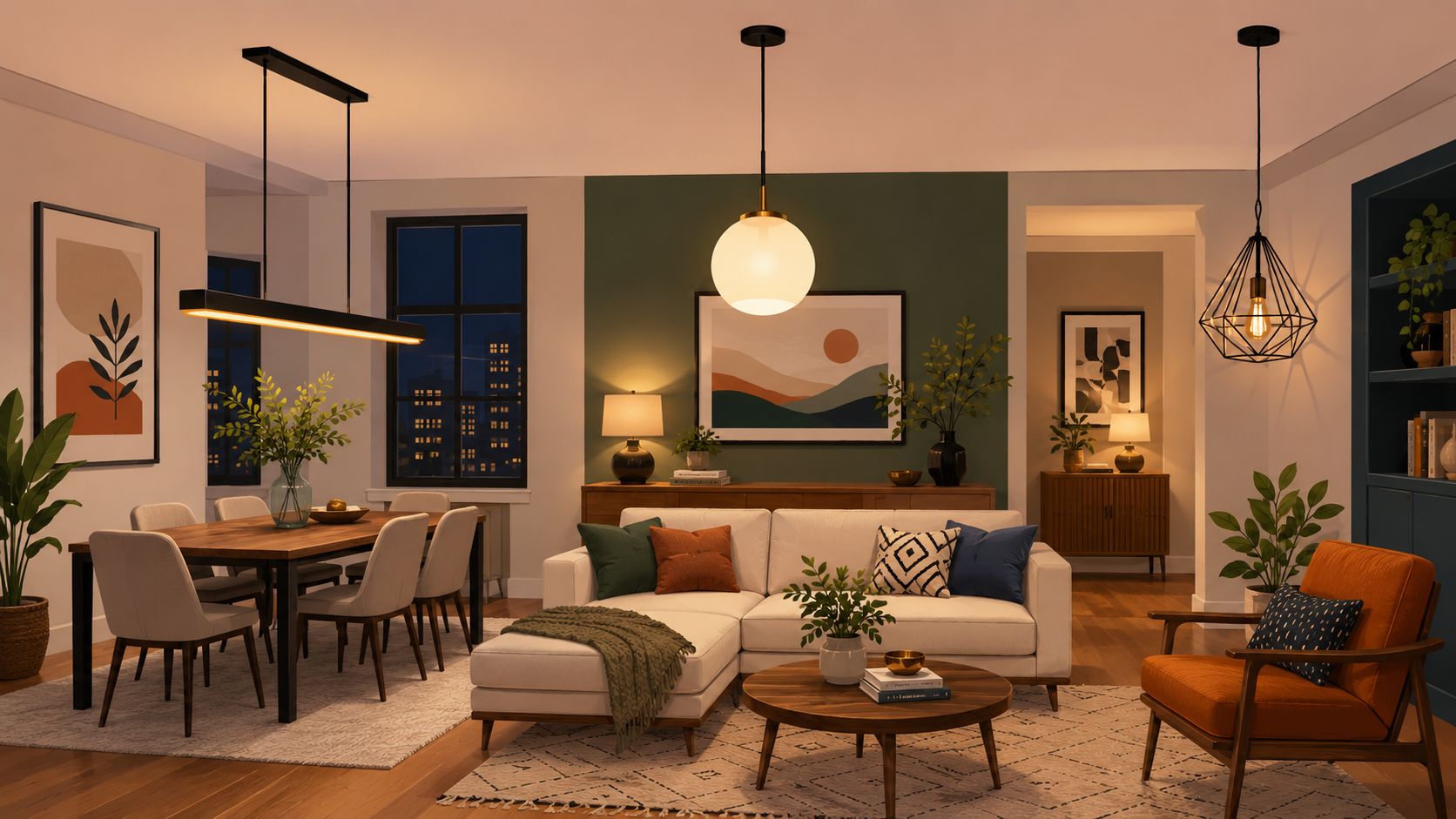
Some pendant styles whisper. Others announce themselves. Most fall into a few broad families.
- Single pendants work well when one fixture needs to mark a clear focal point. A single pendant over a breakfast table or in a front hall can feel composed and architectural.
- Linear pendants suit longer surfaces. They often bring order to a rectangular island or dining table, especially in homes with cleaner contemporary lines.
- Globe pendants soften a room. Their rounded silhouette can temper sharp cabinetry, angular furniture, or a room with many straight edges.
- Drum pendants offer visual substance. They're especially useful where a room needs a broader, quieter shape rather than a narrow point of light.
A good way to think about style is to match the fixture's personality to the room's role. A formal dining room may welcome a fixture with more ceremony. A family kitchen often benefits from something simpler and easier on the eye day after day.
For homeowners building a design vocabulary, a curated collection of modern pendant lights can help distinguish which silhouettes feel crisp, sculptural, relaxed, or refined. It also helps to review practical examples of choosing and styling pendant lights when comparing shapes in real rooms rather than in isolation.
Practical rule: A pendant should feel related to the architecture and furnishings around it, not merely attractive on its own.
Readers often get tripped up here. They assume style is the first decision. It usually isn't. The more useful question is this. What job must the pendant do in the room? Once that answer is clear, the right style tends to narrow itself.
Choosing Materials That Complement Your Home
Why finish changes the mood of a room
Shape gives a pendant its outline. Material gives it its voice.
A hand-forged iron fixture has gravity. Brass brings warmth and a certain quiet glow, especially in evening light. Glass feels lighter and can keep a room from looking visually crowded. Wood introduces an organic note that softens kitchens and dining spaces that might otherwise feel too hard or polished.
Ceiling pendant lights become part of the room's storytelling. The same silhouette in a dark metal may feel precise and architectural. In clear glass, it may feel airy and understated. In linen or textured fabric, it may feel more intimate and settled.
How to pair materials with furnishings
Material choices work best when they echo something else in the room.
A few dependable pairings often help:
- Warm metals with walnut or oak create continuity. This pairing often suits rooms with timeless craftsmanship and a collected look.
- Glass with lighter upholstery and refined casegoods keeps the visual field open, especially in smaller dining areas or compact city homes.
- Matte black or iron with structured leather seating can sharpen the room's structure and suit more design-forward interiors.
- Natural textures with soft rugs and organic finishes make large open-concept spaces feel more grounded.
A homeowner considering Stickley may lean toward pendants with visible workmanship and a grounded material presence. Someone furnishing around Stressless seating might prefer cleaner lines and quieter finishes that don't overcompete with the room's comfort-driven silhouette. The key isn't matching everything exactly. It's creating resonance.
For rooms that need a refined bridge between classic and current, collections of contemporary ceiling lighting can help homeowners compare finishes in a more complete context.
Designer's Insight
Mixed metals can look sophisticated when one finish leads and the second plays support. If the pendant is making the stronger statement, smaller details in the room should echo rather than compete.
Readers often worry about whether every metal in a room must match. It doesn't. What matters is hierarchy. One finish should feel intentional and dominant, while others appear as accents. When every finish tries to lead, the room loses its calm.
Material also affects how a room feels at night. Heavy opaque shades direct light more tightly. Clear or translucent materials tend to feel lighter and more atmospheric. Neither is better. Each tells a different story.
The Mathematics of Perfect Pendant Placement
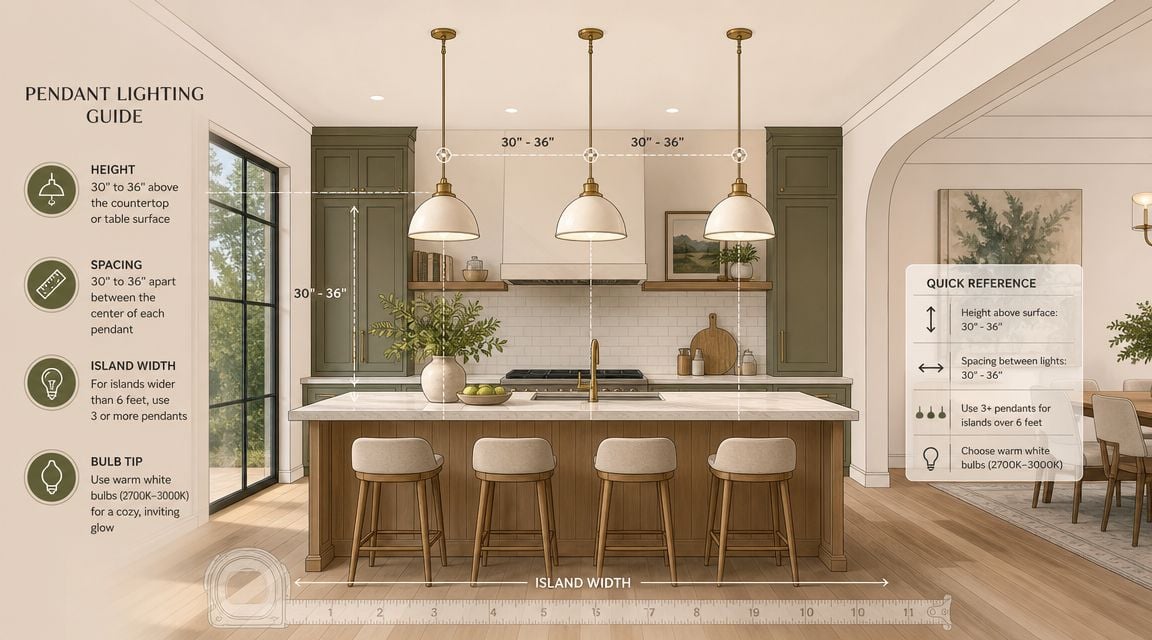
Beautiful fixtures fail all the time because they're hung badly. A pendant that is too high loses intimacy. Too low, and it interrupts sightlines, creates glare, or feels awkward.
The most useful measurements are pleasantly straightforward. Guidance for pendant lighting dimensions notes that, for kitchen islands, a common rule is to subtract about 12 inches from the counter width to determine the maximum pendant diameter. The same guidance recommends hanging the fixture roughly 30–36 inches above the work surface, with at least 6 inches of clearance on each end.
Dining tables and counters
Those numbers matter because they protect both function and proportion.
For a dining surface, that 30–36 inch hanging range tends to balance visibility with comfort. Guests can still see each other across the table, and the fixture remains low enough to create a sense of occasion. Over an island or counter, the same range usually keeps light where chopping, serving, and conversation happen most.
For homeowners selecting dining room lighting pendants, three questions usually clarify placement quickly:
- What is the width of the surface below? This determines how broad the pendant can be without crowding the room.
- Will people look through or across the fixture often? Dining rooms and open kitchens need careful sightline control.
- Is the pendant decorative, functional, or both? A dramatic fixture can still work beautifully if it respects the room's practical needs.
Hang for the people using the room, not for the ceiling height alone.
A quick placement checklist
A simple checklist helps prevent the most common mistakes:
- Measure the surface first: The island or table should guide the fixture size more than the room itself.
- Protect the edges: Leaving at least 6 inches at each end helps avoid a cramped, overstuffed look.
- Respect the working zone: The 30–36 inch range above the surface generally keeps task light useful without harsh glare.
- Check the view from adjoining rooms: In open-concept homes, pendants are seen from multiple angles, not just directly below.
Readers often ask whether larger pendants are always more luxurious. Not necessarily. Overscale can feel confident in the right room, but only when the architecture and furnishings can support that weight. In many homes, restraint looks more expensive because it feels composed.
Another common point of confusion is whether multiple pendants are always better than one. Again, not always. One strong fixture can look more elegant than several smaller ones if the surface and room proportions support it. The answer lives in the geometry, not in a formula copied from another house.
Lighting Solutions for Vaulted and Sloped Ceilings
Why standard rules fall short
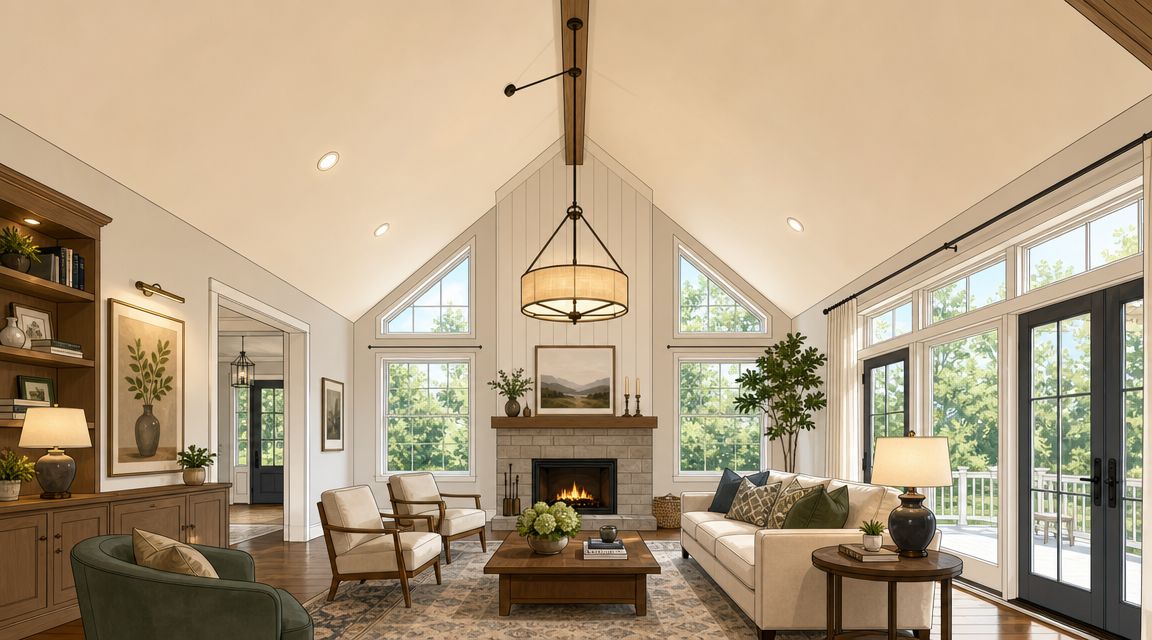
Many lighting guides assume a flat, ordinary ceiling. Southern Ontario homes rarely make life that simple. A renovated farmhouse, a great room addition, or a newer home with a dramatic vault introduces sightlines and shadow patterns that standard hanging advice doesn't fully solve.
A sloped ceiling changes more than the angle of attachment. It changes how the pendant reads from across the room, how light falls on nearby walls, and whether the fixture feels elegantly suspended or oddly adrift. Homeowners weighing broader architectural details often find it useful to review Understanding luxury home ceiling choices before committing to a lighting plan, because the ceiling form itself shapes what will feel balanced.
What works on angled ceilings
The practical rules are clear. Guidance for lighting sloped ceilings recommends using adjustable canopies or cords so the fixture hangs straight. It also notes that fixtures should sit about 3 feet from walls to reduce harsh shadows, and that a minimum 7-foot clearance from the floor is needed in open areas.
Those details make an enormous difference in real homes.
- Adjustability matters first: A pendant must hang straight, or it will always look unresolved.
- Wall distance affects mood: Too close to a wall, and the light can produce sharp, distracting shadows.
- Floor clearance protects comfort: In open circulation areas, the fixture should never feel like an obstacle.
A corded pendant light often suits this kind of architecture because adjustability can be part of the solution, not an afterthought. Still, the fixture must be selected in concert with the room's proportions and use.
Vaulted ceilings call for judgement, not just measurement.
Readers often assume tall ceilings always require a dramatically long drop. Sometimes that works. Sometimes it pulls the light too far into the room and interrupts views across connected spaces. In a great room that opens to kitchen and dining areas, the right answer often comes from visual alignment. The pendant should relate to the room's main gathering plane, not fill vertical emptiness for its own sake.
That's where generic advice breaks down. A sloped ceiling isn't a complication to work around. It's part of the design composition, and the pendant has to behave accordingly.
Creating a Complete Room Concept with Layered Lighting
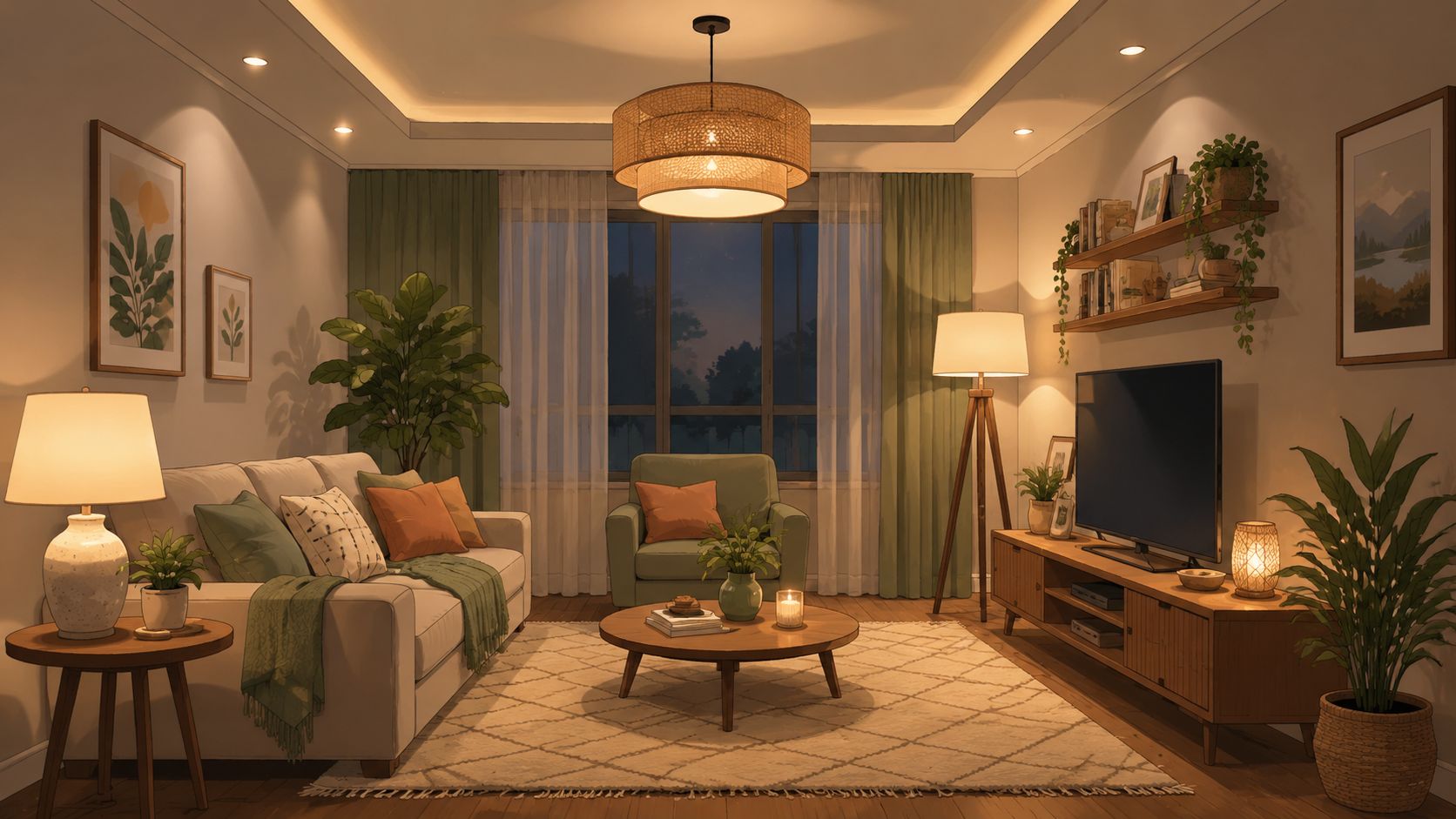
A pendant can be exquisite and still not be enough. That's one of the most important truths in residential lighting.
Current lighting guidance for inclined and complex ceiling plans emphasises combining pendants with recessed, track, or accent lighting for a balanced scheme. It also notes the central question. When should a pendant be the hero, and when is it one layer in a broader, more energy-conscious plan?
When the pendant is the hero
In some rooms, the pendant deserves the lead role.
A dining room with a strong table centred beneath it often benefits from one memorable overhead statement. An entry with generous height may call for a fixture that sets the tone immediately. In those spaces, the pendant can carry much of the room's identity while other lighting remains quieter and supportive.
But in many living areas and open kitchens, pendant-only schemes underperform. The room may have bright spots and dim corners. Art disappears. Shelving reads flat. Seating areas feel disconnected after dark.
Starting with the rug and building upward
A complete room concept usually starts lower than many people expect. The rug often establishes the palette, softness, and spatial boundaries first. In a design studio context, that's why the Rug Market is often described as Art for your Floor. A hand-knotted rug can decide whether a pendant should feel warm, crisp, delicate, or bold.
Once that foundation is chosen, the rest becomes more coherent:
- Ambient light gives the room its general glow.
- Task light supports work, reading, preparation, or dining.
- Accent light draws attention to art, millwork, or architectural moments.
- The pendant adds identity and helps organise the room visually.
Designer's Insight
A strong pendant should finish the room, not carry it alone. The most successful spaces layer light the same way they layer upholstery, rugs, wood tones, and art.
This is where a design studio earns its place. Rather than treating lighting as a last-minute purchase, the room is considered as a whole. Furniture scale, rug pattern, ceiling height, window placement, and circulation all influence whether the pendant should be quiet, sculptural, artisanal, or overtly architectural. Critelli Furniture offers interior design consultation as one route for clients who want lighting considered within a full-room plan rather than as a standalone fixture choice.
For homeowners seeking Luxury furniture Niagara, Interior design services St. Catharines, Custom furniture Southern Ontario, or Hand-knotted rugs Ontario, that integrated approach often saves a room from feeling pieced together. It also creates a smoother path from showroom decisions to the finished home, especially when white-glove delivery and placement are part of the process.
Installation Care and Frequently Asked Questions
Care and installation notes
Even the finest pendant looks ordinary if installation is careless. Professional installation helps protect the fixture, the ceiling finish, and the room's final alignment. It also matters for cord length, canopy placement, and dimmer compatibility. Those small technical details have a strong effect on how refined the finished result feels.
Maintenance is simpler than many homeowners expect. Dust shades and hardware gently, clean glass carefully, and avoid harsh cleaners on specialty finishes. If a ceiling is being refreshed before installation, homeowners may also find practical value in CS1 Real Interiors' guide for smooth ceilings, especially when an older texture would compete with a more bespoke fixture.
White-glove delivery matters here as well. The transition from showroom to home should feel organised, with placement decisions supporting the room rather than interrupting it at the last moment.
Frequently asked questions
Can a pendant be the main light source in a small room?
Yes, it can, if the room's function is simple and the light distribution suits the space. Many rooms still feel better with at least one additional layer of light.
Should every pendant in an open-concept space match?
No. They should relate, but they don't need to be identical. Shared finishes, shapes, or proportions often create enough continuity.
Are dimmable bulbs worth considering?
Usually, yes. They help a room shift from task-focused brightness to a softer evening atmosphere.
How does a homeowner know if a pendant is too visually heavy?
If the fixture dominates the sightline, interrupts conversation across the room, or makes adjacent furnishings feel small, it may be carrying too much weight for the space.
Experience the craftsmanship in person at the Critelli Furniture King Street Showroom, book your complimentary design consultation today, or visit the Rug Market to find your room's foundation.