

Bedroom Pendant Lights: A Design-Forward Guide

A bedroom often reaches a point where the furniture is right, the bedding is right, and the room still feels unfinished. The usual culprit is the lighting. A pair of table lamps may do the job, but they rarely shape the room with intention. They sit where they must, not where they belong.
That's where bedroom pendant lights become more than a fixture choice. They change the architecture of the room visually. They free the bedside surface, draw the eye upward, and give a bedroom the composed, polished feeling most homeowners are after, especially in Southern Ontario homes where room sizes, ceiling heights, and renovation styles vary from one neighbourhood to the next.
In a family business that has worked with homes since 1914, we've seen the same pattern repeatedly. People start by asking for lighting. What they usually need is a more complete room concept. The pendant is rarely the whole answer on its own. It works best when it's considered alongside the bed, the nightstands, the rug, the ceiling line, and the way the room is used when winding down for the evening.
Beyond the Bedside Lamp An Introduction
A well-designed bedroom should feel settled. Not crowded, not improvised, and not dependent on whatever lamp happened to fit the nightstand years ago. Many homeowners come to this decision after living with a room that functions well enough but never quite feels resolved.
The most common scenario is familiar. The bed is substantial, the dresser has presence, the bedding has been thoughtfully chosen, yet the bedside lighting still reads as temporary. Lamps take up useful surface space. Cords stay visible. The room's vertical space is ignored. In smaller homes and condos across Southern Ontario, that inefficiency becomes even more noticeable.
Bedroom pendant lights solve a practical problem and a visual one at the same time. Hung properly, they can act like a bedside lamp while looking far more intentional. They also bring a layer of design that feels architectural rather than accessory-based. That distinction matters in a refined room.
For homeowners exploring a more design-forward approach, a curated collection of modern pendant lights helps clarify the range, from restrained silhouettes to sculptural forms that act almost like jewellery for the room.
Why pendants change the room
The benefit isn't just that a pendant hangs from the ceiling. It's that the lighting becomes part of the room's composition. The eye reads symmetry differently. The headboard gains prominence. The bedside tables can remain cleaner and more useful.
Bedroom pendant lights work best when they're chosen as part of the room, not added after the room is finished.
That's also why some pendants disappoint in real homes. A beautiful fixture can still be the wrong fixture if it ignores reach, clearance, or the scale of the furniture below it. In practice, the strongest results come from balancing three things together:
- Function first. Can you read comfortably, move safely, and use the nightstand easily?
- Proportion second. Does the fixture suit the bed, the ceiling height, and the room's width?
- Material harmony. Does the finish relate to the hardware, textiles, and other surfaces nearby?
The best bedrooms always feel edited. Pendant lighting helps create that feeling, but only when it's chosen with the same care as heirloom quality furniture and the rest of the room's foundation.
Defining Your Aesthetic with Styles and Finishes
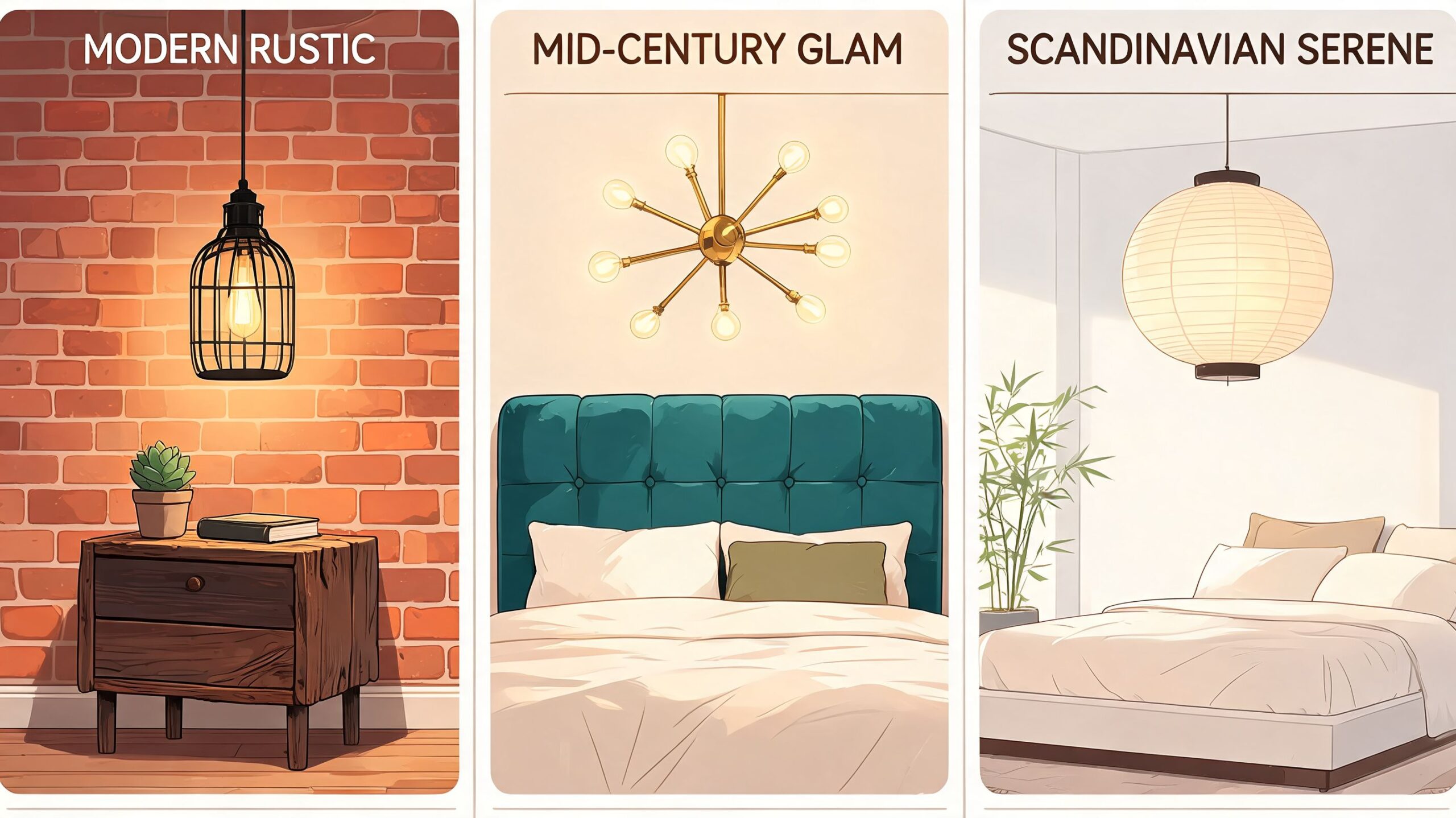
Style is where many people begin, and that instinct isn't wrong. A pendant is highly visible. It sets tone immediately. But style in a bedroom should never be treated as decoration alone. It should support the mood of the room and the language of the furnishings around it.
The minimalist approach
A minimalist pendant works best in rooms where form, line, and restraint carry the design. Think slim metal profiles, simple globes, or quiet geometric shapes. These pendants pair well with low-profile beds, custom upholstery, and bedrooms that rely on texture rather than ornament.
Matte black creates contrast and definition. Soft white disappears into the architecture. Brushed metals introduce warmth without fuss. In contemporary spaces, that simplicity often feels strongest when the rest of the room is equally disciplined. A pendant shouldn't be the only modern element in an otherwise traditional room unless that tension is deliberate.
The artisan approach
Some bedrooms need softness more than sharpness. In those spaces, artisanal materials do the heavy lifting. Hand-blown glass, woven textures, ceramic forms, and aged metal finishes bring tactility into the room without cluttering the bedside.
This approach suits homes with natural woods, layered linens, and hand-finished case pieces. It also works beautifully when the room includes subtle variation in texture through drapery, upholstery, and Art for your Floor in the form of a hand-knotted rug.
Designer's note: If the bedroom already contains several smooth surfaces, such as lacquered furniture, polished stone, or sleek hardware, an artisanal pendant can keep the room from feeling flat.
The traditional and transitional approach
Traditional bedrooms rarely benefit from lighting that feels too stark. Aged brass, bronze-toned finishes, pleated or softly diffused shades, and gently curved forms tend to sit more naturally with classic furniture profiles. In transitional rooms, the sweet spot is often a fixture that references tradition without becoming formal.
A useful test is to look at the bed first. If the headboard has strong tailoring, button tufting, carved detail, or a classic silhouette, the pendant should speak the same language. It doesn't need to match exactly. It does need to belong.
Choosing a finish that belongs
Finishes shouldn't be selected in isolation. They should echo the room's other details. A pendant can relate to drawer hardware, mirror frames, bed accents, or even the undertone of the flooring.
A practical way to assess the room:
- Warm metals suit rooms with walnut, oak, cream upholstery, and softer palettes.
- Dark finishes ground spaces with strong contrast or bolder architectural lines.
- Glass-heavy fixtures lighten the look of more substantial furniture.
- Textured or handmade finishes support bespoke interiors with visible craftsmanship.
For homeowners refining a full bedroom scheme, looking through modern bedroom furniture collections often makes the right fixture style more obvious because the light can be judged against the bed, nightstand, and dresser rather than as a standalone object.
If you're tracking broader material and finish directions, this 2026 interior design trends guide offers a useful outside perspective on the surfaces and moods currently shaping design conversations.
The Design Math Perfect Sizing and Hanging Height
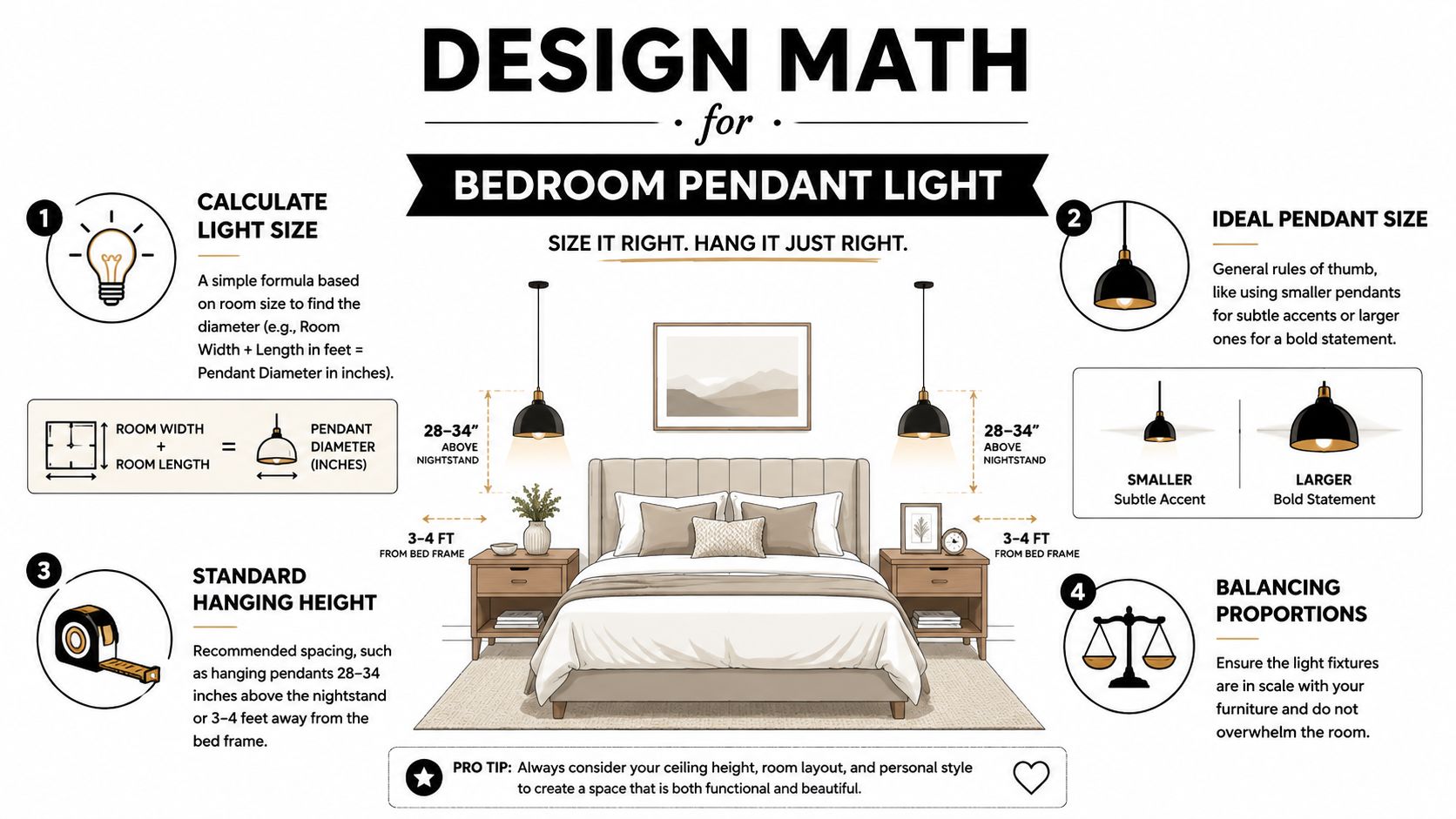
Good pendant lighting isn't guesswork. In bedrooms, the difference between elegant and awkward is usually measurement. A pendant can be beautifully made and still feel wrong if the drop is too short, the fixture hangs in the sightline, or the scale fights with the furniture below.
Start with hanging height
A widely used North American rule, reflected in Canadian retail guidance, is to hang bedroom bedside pendants about 35 to 50 cm above the bedside table. For fixtures over the bed or in walkways, at least 2.1 m above the floor is standard. For every 30 cm of ceiling height above 2.4 m, designers often add another 8 cm to the pendant's drop to keep the proportions balanced, as outlined in this Canadian-relevant hanging guide for pendant lights.
That guidance matters in Southern Ontario because bedroom ceiling heights vary widely. A fixture that feels perfectly resolved in an older home with a lower ceiling can look stunted in a renovated room with more vertical volume.
Scale matters as much as clearance
Homeowners often focus on whether a pendant will fit. A better question is whether it will look settled beside the bed. The fixture should feel in proportion to the width of the nightstand, the depth of the headboard wall, and the visual weight of the bed itself.
Use these practical checks before finalising a selection:
- Check the bedside relationship. A heavy, oversized pendant can overpower a slim nightstand.
- Review the sightline from the door. If the pendant interrupts the bed rather than framing it, the drop may be wrong.
- Judge both sides together. Matching pendants need to align with the furniture below, not just with the ceiling box location.
Designer's Insight
The pendant should support the bed, not compete with it. If your eye goes first to the fixture and only second to the bed, the scale is usually too assertive.
A simple decision table
| Bedroom condition | What usually works | What often fails |
|---|---|---|
| Lower ceiling room | Compact pendant with disciplined drop | Deep or bulky fixture shape |
| Taller renovated room | Longer suspension that respects the extra height | Fixture hung too high, leaving it visually disconnected |
| Wide bed with substantial headboard | Pair of pendants with enough visual presence to anchor each side | Tiny fixtures that look incidental |
| Narrow bedside zone | Slim pendant or alternative wall-mounted solution | Broad shades that intrude into movement space |
A pendant never exists alone. Its proportions should also relate to the rug and furniture footprint. If the bed sits on a rug that's too small, even a properly sized light can look off because the room lacks a stable visual base. That's why room planning often starts lower than people expect. A thoughtful guide to choosing an area rug size can help correct those proportion issues before the lighting is finalised.
Placement Strategies for Every Bedroom Layout
Placement is where bedroom pendant lights either become brilliantly useful or subtly irritating. The right location improves function every day. The wrong one creates visual clutter, awkward reach, or a fixture that seems to hover without purpose.

One pendant as a focal point
A single pendant can work beautifully in a bedroom with strong symmetry or a defined central zone. This approach is often most successful when the room has enough width for the fixture to read as intentional overhead lighting rather than a substitute for bedside lighting.
It tends to suit rooms with a strong ceiling plane, a centred bed, and a need for visual emphasis above the room rather than beside it. In homes with more architectural detail, a single pendant can also reinforce the room's centre line.
A pair beside the bed
This is the arrangement homeowners frequently imagine first, and for good reason. A pair of pendants brings structure to the bed wall and frees the tops of the nightstands. Beside a substantial wood bed or an elegant upholstered headboard, paired pendants often feel more integrated than table lamps.
They're especially effective when symmetry is important to the room's mood. That doesn't mean every detail must match perfectly, but the layout should feel balanced from left to right.
Pendants versus sconces in compact rooms
This is the decision many homeowners should spend more time on. In urban Canadian housing markets where primary bedrooms are often smaller, the choice between a pendant and a wall sconce becomes critical. Guides note that pendants free up nightstand space, but they often don't fully address the trade-offs in compact rooms, where a misplaced pendant can obstruct sightlines or create a hazard. In tighter quarters, sconces may be the more functional option for task lighting, as discussed in this overview of pendant lighting trade-offs in smaller rooms.
A quick comparison helps:
| If your room has | Pendants often suit | Sconces often suit |
|---|---|---|
| Adequate side clearance at the bed | Yes | Also possible |
| Very tight circulation beside the bed | Sometimes | Often better |
| Strong desire to free nightstand surface | Yes | Yes |
| Sloped reach or awkward wall conditions | Sometimes | Depends on wall access |
If the room is narrow, don't force a pendant because it looks sophisticated in photos. A wall-mounted fixture can be cleaner and safer. Homeowners comparing both options can browse wall mount lighting fixtures to evaluate whether the room wants a ceiling-hung solution or a wall-based one.
In a compact bedroom, the more sophisticated choice is often the one that disappears into daily life, not the one that announces itself.
Sloped and vaulted ceilings
Sloped ceilings add complexity quickly. Yes, pendant lights can work there, and sloped-ceiling-adaptable fixtures are designed for angled installations, as noted in this guide to sloped-ceiling-adaptable pendant lights. The challenge is rarely whether they can hang. It's how they align visually with the bed and the room.
In these rooms, decide what the pendant is centring to:
- The bed if the bed wall is the clear visual anchor
- The room if the architecture is symmetrical
- The slope line only when the ceiling itself is the dominant design feature
In many custom Niagara homes and upper-storey additions, the best answer is the bed. People experience the room from the furniture level, not from the roofline.
Creating Ambience with Bulbs Dimmers and Colour
A beautiful fixture can still produce disappointing light. That usually happens when the bulb specification is treated as an afterthought. In bedrooms, the quality of light matters as much as the fixture itself because the room must shift from practical use to restfulness without feeling harsh.
Get the brightness right
For bedrooms, lighting guides recommend warm white at 2700–3000K. For brightness, the target is typically 200–300 lumens for soft ambient light and 300–600+ lumens for task-focused zones like reading. Modern LEDs can deliver that output with low wattage. For example, an 8–12W LED can produce 800 lumens, roughly equivalent to a traditional 60W incandescent bulb, according to this bedroom pendant lighting guide on colour temperature and brightness.
That tells you something important. Most bedroom pendants don't need brute brightness. They need controlled, usable light.
Why dimmers matter
A bedside pendant usually has to do two jobs. It should support reading at one point in the evening and create a softer atmosphere later on. A dimmer is what makes that range possible.
Without dimming, homeowners often end up compromising in one of two ways. They install a bright bulb that's useful but unpleasant at night, or they choose a dim bulb that looks lovely but doesn't help when they want to read.
Practical rule: Choose the light level for the most demanding task, then use dimming to create ambience.
A practical specification checklist
Use this checklist before you order:
- For ambience. Stay within the softer lumen range so the room feels calm rather than exposed.
- For reading. Choose the higher task range if the pendant is meant to replace a bedside lamp.
- For mood. Keep to the warmer colour temperature range so whites don't turn cold or clinical.
- For comfort. Use LED sources where possible because they reduce heat output and use less electricity than incandescent lighting.
Professional installation is worth it here. Bedroom pendant lights are close to where people sit up, lean over, and move around at night. The fixture has to be secure, properly placed, and coordinated with the switching plan. That level of finish is part of why white-glove service matters. The best rooms feel effortless because the decisions behind them were not.
Completing the Room A Curated Approach
A pendant isn't the room. It's one note in the composition. The bedroom feels complete when the lighting speaks to the furniture, the textiles, the rug, and the architecture in the same voice.

The complete room concept
A bedroom with timeless craftsmanship doesn't come together through isolated purchases. The pendant's finish may echo hardware on a dresser. Its shape may soften a more structured bed. Its material may relate to the texture underfoot, especially when the rug is treated as the foundation rather than an afterthought.
That's why the most successful rooms are curated, not assembled. The bed establishes presence. The bedside tables create rhythm and utility. The rug defines the room's footprint. The pendant completes the vertical plane.
A well-chosen pair of modern bedside tables often clarifies the right lighting direction because the scale, storage needs, and surface proportions become obvious once the furniture is settled.
What a finished bedroom usually gets right
The strongest bedrooms tend to share a few qualities:
- They feel grounded. The rug, bed, and case goods establish a clear visual base.
- They feel edited. Lighting, hardware, and materials relate to one another instead of competing.
- They function subtly. Reading light is where it should be. Surfaces remain usable. Nothing feels precarious.
- They carry personality. Bespoke details and artisanal materials make the room feel lived in, not staged.
Critelli Furniture appears in this process as one practical source for furnishings and lighting within a broader room plan, especially for homeowners who want the bed, bedside pieces, and decorative lighting considered together rather than chosen separately.
Heritage matters when details matter
In a family-run business with roots going back to 1914, the enduring lesson is simple. Rooms last when they're designed with patience. Trends come and go, but proportion, comfort, and material integrity hold their value. That's as true for a pendant light as it is for a handcrafted bed or a hand-knotted rug.
For homeowners across Greater Niagara, Hamilton, and Toronto, that approach matters because bedrooms today often need to do more. They're places to rest, read, recover, and retreat. The lighting should support all of it, and it should do so gracefully.
If you're planning a bedroom with a more refined point of view, Critelli Furniture can help you shape the full picture, from lighting and heirloom quality furnishings to the rug that anchors the space. Experience the craftsmanship in person at our King Street Showroom. Or book your complimentary design consultation today to create a bespoke bedroom that feels fully resolved from the first selection to final white-glove delivery.