
The Curator’s Guide to Rug Runners Contemporary


A home can be beautifully furnished and still feel unresolved. The upholstery is right, the lighting is balanced, the cabinetry is expertly crafted, yet the movement from one space to the next feels abrupt. That missing layer is often underfoot.
In Southern Ontario homes, especially those with long corridors, defined entry sequences, and open-plan transitions, a contemporary runner does more than soften a floor. It guides the eye, steadies the architecture, and introduces pattern or texture exactly where the room needs continuity. For clients seeking rug runners contemporary in spirit, the strongest choices behave less like filler and more like a composed design gesture.
Since 1914, Critelli has helped families across St. Catharines and the broader Niagara, Hamilton, and Toronto markets furnish homes with that level of intention. In a complete room concept, the runner isn't an afterthought. It's often the element that makes the rest of the scheme feel finished.
Table of Contents
- The Unsung Hero of a Well-Designed Home
- Defining the Contemporary Style in a Runner
- Choosing the Right Size and Material
- Artful Placement and Layering Techniques
- Bespoke Runners and Timeless Craftsmanship
- Protecting Your Investment with Proper Care
The Unsung Hero of a Well-Designed Home
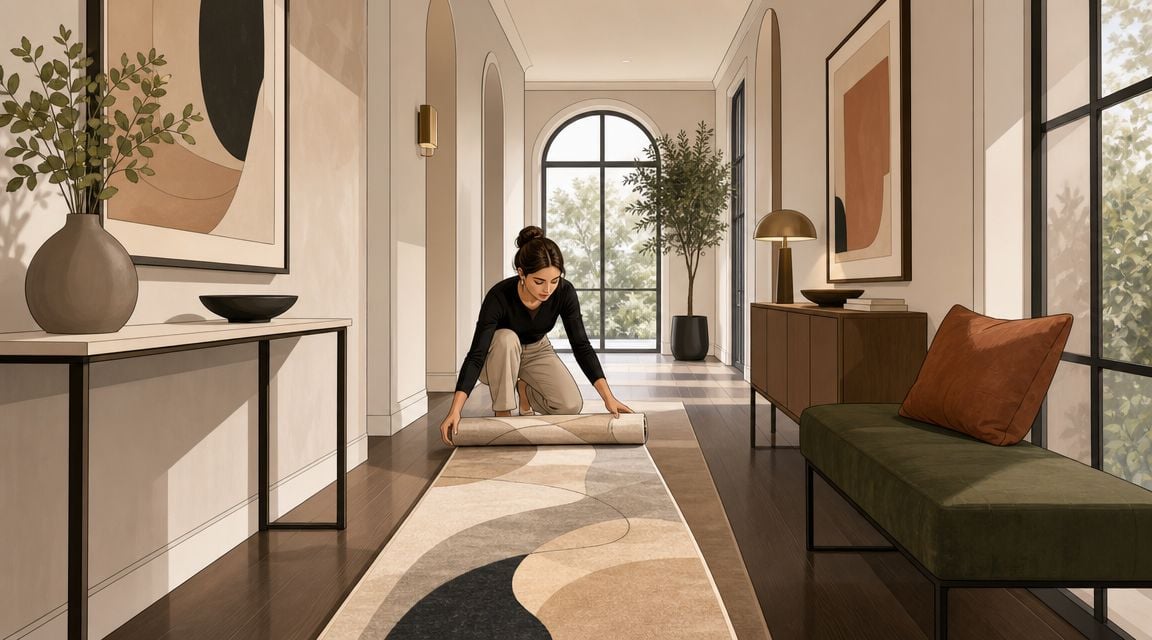
A hallway is rarely the room a homeowner thinks about first. Yet it's the place everyone experiences in motion. It introduces the home, links one room to another, and shapes the mood before a guest reaches the living space or kitchen. When that passage is bare, even a refined interior can feel slightly disconnected.
A contemporary runner solves that problem with elegance. It lengthens sightlines, adds softness where architecture can feel hard, and turns a simple route into part of the design story. In a narrow entry, it can make the home feel more composed. In a long upper hall, it can connect bedrooms with visual rhythm rather than leaving an empty strip of flooring to do all the work alone.
That is why many designers speak of rugs as Art for your Floor. A runner has the discipline of architecture and the presence of artwork. It doesn't need a large footprint to change how a home feels.
For households refining a complete room concept, the runner often relates directly to nearby pieces. The wood tone of a hallway console, the metal finish in a sconce, or the shape of a leg detail in occasional furniture all become part of the conversation. A well-chosen console or sofa table can reinforce that relationship, giving the runner a visual counterpart at eye level.
A strong runner doesn't merely occupy a corridor. It gives the corridor a reason to belong to the rest of the house.
In a century-old family business, that distinction matters. Heritage interiors and modern ones both benefit from a grounded path underfoot, but the best contemporary runners do more than provide comfort. They create order. They soften transitions. They allow the home to feel curated rather than assembled.
Defining the Contemporary Style in a Runner
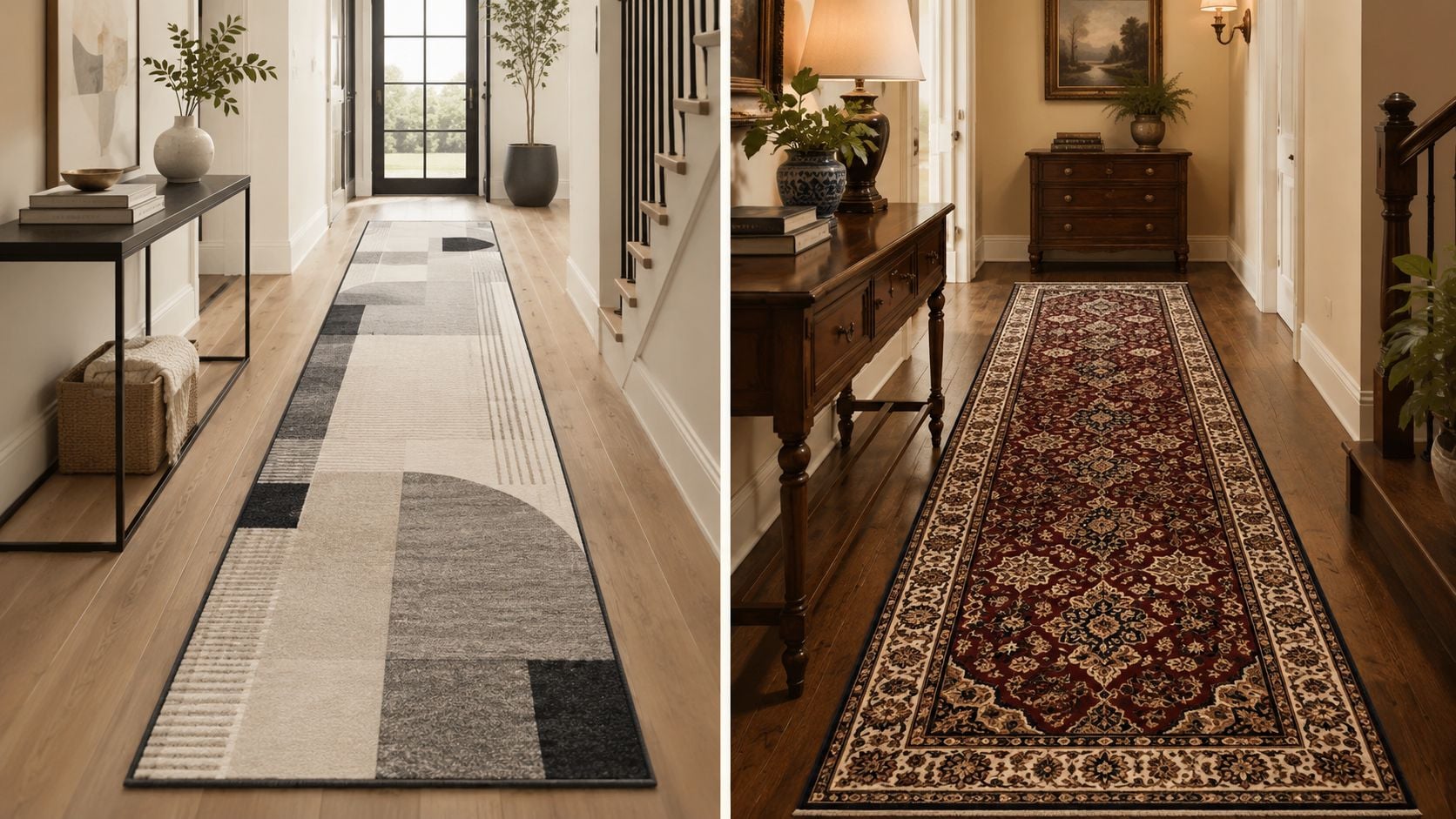
Contemporary style in a runner isn't defined by trend alone. It's defined by editing. The strongest pieces strip away excess ornament and focus on line, scale, texture, and colour relationships that feel current without becoming disposable.
What contemporary means underfoot
A traditional runner often relies on formal borders, repeated medallions, and a clearly historical reference. A contemporary runner tends to work differently. It may feature abstract movement, a geometric grid, tonal variation, broken stripes, or a surface that reads almost like a painting when viewed from above.
That's where many homeowners get clarity. A contemporary runner can be bold, but it doesn't have to be loud. Some of the most successful examples use restrained palettes and let texture carry the interest. Others introduce a precise graphic element that sharpens a transitional space without making it feel cold.
A useful way to evaluate rug runners contemporary in style is to look at them as one would look at wall art:
- Abstract patterns bring motion and softness to rigid architecture.
- Geometric forms add structure and work especially well with clean-lined furnishings.
- Minimalist textures create depth without visual clutter.
- Unexpected colour palettes can modernise a corridor even when the surrounding furnishings are more classic.
Practical rule: If the eye notices the runner first and the home second, the pattern is often too dominant for a circulation space.
Why restraint often looks more luxurious
Luxury in a contemporary runner usually comes from proportion and material nuance, not decoration layered on decoration. A softly variegated wool field, a subtle linear motif, or a disciplined contrast between warm neutrals and charcoal can feel far more refined than an overcrowded design.
This is especially true in homes that already have strong architectural features. Rich millwork, stone flooring, sculptural staircases, and statement lighting don't need competition. They need a companion.
For that reason, the most design-forward runners usually fall into one of three visual roles:
The quiet anchor
This type supports the room with tonal texture and little overt pattern. It's ideal when artwork, furniture silhouettes, or architectural detailing already carry the visual weight.The rhythmic connector
A repeated linear or geometric motif can link spaces that otherwise feel separate. It's particularly effective in long sightlines.The focal statement
The runner behaves like a contemporary canvas. It works best when the surrounding envelope is disciplined and the piece has room to be seen.
For collectors and design-led homeowners, the runner becomes part of a larger curated selection, not an isolated purchase. In that context, contemporary style is less about matching a category and more about selecting a piece that gives the home confidence, balance, and a clear point of view.
Choosing the Right Size and Material
A runner succeeds or fails on proportion first. If the scale is wrong, even a beautifully woven piece reads like an afterthought instead of part of the architecture.
Start with the room, not the standard size
Retail sizing is only a starting point. Many runners are made in narrow widths and long lengths because they are meant to direct movement through halls, entries, and transitional spaces, but those labels do not tell you whether the piece will suit your home.
Measure the corridor, then study the negative space around the runner. The visible border of flooring is what gives the installation definition. In a well-resolved hallway, the runner sits within the architecture rather than pressing against it. Designers commonly recommend leaving a margin of exposed floor at each side for that framed effect, a guideline echoed in hallway rug sizing advice from The Spruce.
That detail matters in Southern Ontario homes, where entries and connecting halls often open onto hardwood, stone, or tile worth seeing. Cover too much floor and the runner starts to feel heavy. Leave too much exposed and it can look undersized.
For room-by-room planning, Critelli's guide on how to choose an area rug size is a useful reference, especially when the runner needs to relate to adjoining rooms and not sit as an isolated purchase.
Contemporary Runner Material Comparison
| Material | Key Characteristics | Best Placement | Heirloom Quality |
|---|---|---|---|
| Wool | Resilient, tactile, naturally refined in appearance, excellent for layered texture | Hallways, living transitions, bedrooms | High when well made and properly maintained |
| Silk blend | Luminous surface, finer visual detail, elevated finish | Low-traffic passages, decorative transitional areas | High in the right setting, with careful use |
| Performance synthetic | Easier clean-up, practical for active households, often suited to moisture-prone areas | Entryways, mudroom-adjacent corridors, utility transitions | Moderate, chosen more for function than legacy value |
Choose fibre with your climate and traffic in mind
Material should match the way the house is used. In our practice, that usually means balancing beauty with salt, snow, damp boots, pets, and frequent cleaning.
Wool remains the strongest all-round specification for many contemporary runners. It has body, it wears in with character, and it gives a hallway the visual depth that flatter synthetic surfaces often miss. In a principal hall, upstairs landing, or bedroom passage, wool reads as art for the floor and holds its presence over time.
Silk blends have a different role. They catch light beautifully and can make a quieter design feel far more nuanced, but they ask for a protected setting. Use them where the traffic is controlled and the household will respect the material.
Performance synthetics earn their place near hardworking entries, mudroom-adjacent corridors, and utility routes. They are rarely the most poetic option, yet they can be the right specification where winter moisture and daily abrasion would shorten the life of a finer fibre.
Construction matters too. A low, dense pile usually performs better in circulation zones than a plush or shaggy surface. It keeps the profile crisp, reduces tripping risk, and stands up better to vacuuming and repeated foot traffic.
The best contemporary runner does two jobs at once. It sharpens the line of the room and lives well under real conditions for years. That is what turns a runner from a simple soft furnishing into a lasting design investment.
Artful Placement and Layering Techniques
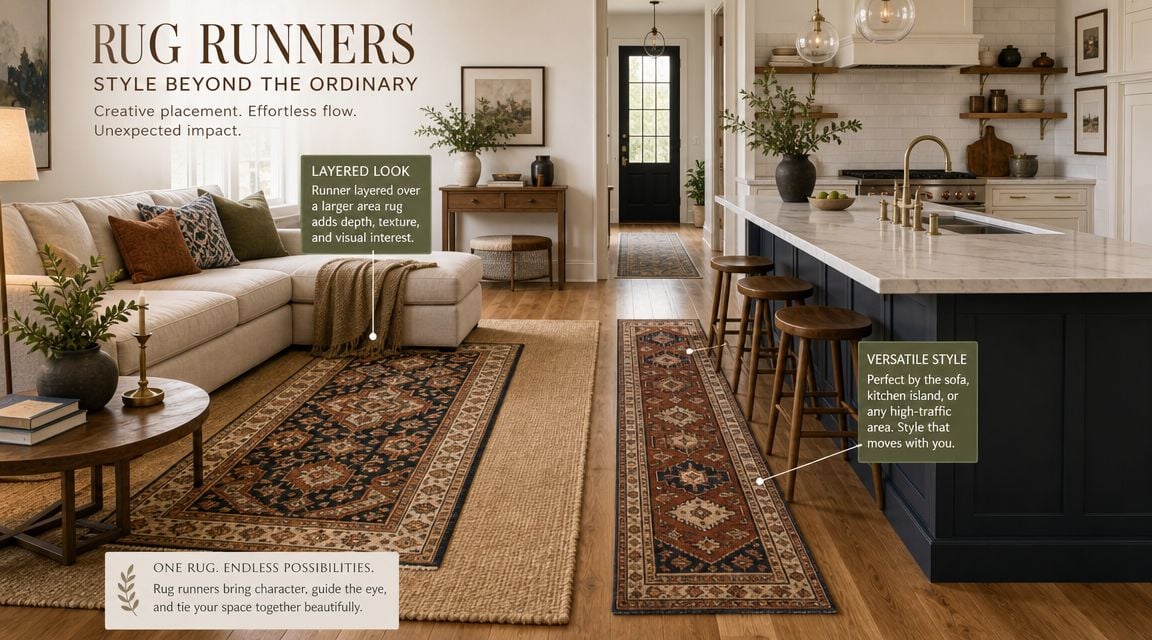
On a February afternoon in Southern Ontario, a front hall has to do more than look composed. It has to carry wet boots, shifting light, and the daily movement between rooms without losing its shape. A well-placed contemporary runner helps the architecture hold that traffic gracefully. It reads less like an accessory and more like a line drawn across the floor plan.
Where a runner earns its place
The best placements follow the room's built-in direction. Hallways are the obvious example, but the same principle applies beside a kitchen island, along one side of a bed, or through a long passage connecting an entry to a stair. In each case, the runner reinforces a line the architecture already suggests.
That is why proportion matters so much.
In a true hallway, leave a consistent border of visible floor at both sides so the runner feels framed rather than wall-to-wall. Design guidance from the National Wood Flooring Association on area rug placement supports maintaining exposed flooring around rugs to preserve balance and protect the floor's visual perimeter. In practice, a narrow reveal often looks sharper than a runner pushed too close to the baseboards.
Entries benefit from a second point of structure. A well-scaled console and sofa table for an entry hall gives the eye a vertical anchor, while the runner establishes the horizontal one. Together, they create a composed arrival instead of a strip of carpet with furniture added as an afterthought.
Layering for depth and definition
Layering works well in larger rooms, upper halls, and open-concept homes where a single rug can feel flat or oversized. The method is simple. Let the larger base rug establish the room's footprint, then use the runner to introduce rhythm, contrast, or a stronger graphic line.
The two layers should not compete.
A quiet base in wool, sisal, or another restrained texture gives the runner room to read as art for the floor. The runner can then carry the bolder move, whether that is abstract pattern, sharper colour contrast, or a more sculptural border. This approach is especially effective in contemporary interiors that need warmth but still want clean sightlines.
Furniture placement decides whether layering feels intentional. Repeat one or two cues from the runner in nearby finishes or forms. A black detail in a light fixture, a warm rust tone in artwork, or a curved profile echoed in upholstery is often enough. The room starts to feel designed as a whole rather than assembled in parts.
Designer's Insight
Designer's Insight
In our firm's work, the strongest contemporary runners are usually the ones that hold their own without asking every other piece to speak at the same volume. If the runner carries strong geometry or colour, keep the surrounding upholstery, case goods, and lighting disciplined. That restraint lets the floor plane do its job. It becomes part circulation guide, part artwork, and part long-term architectural finish.
The best rooms use runners to direct movement, sharpen proportion, and give the home a stronger sense of order. That is the difference between filling a passage and shaping one.
Bespoke Runners and Timeless Craftsmanship
A standard-size runner can solve many problems. A bespoke runner solves the whole room.
Why custom changes the result
Premium buyers increasingly view contemporary runners as an investment shaped by artisanal craftsmanship, custom sizing, and superior materials that help avoid frequent replacement, as described in guidance for premium runner selection. That shift matters because many homes don't conform neatly to stock dimensions. Historic properties, wider landings, unusual corridor lengths, and layered thresholds all benefit from a more exact response.
Custom sizing isn't indulgence for its own sake. It corrects the small visual compromises that make a space feel unresolved. A runner that ends too short of a doorway, crowds a turn, or fails to align with a stair opening can weaken an otherwise thoughtful interior.
For homeowners exploring custom options, getting started with a custom order helps clarify what can be adjusted, from dimension and edge finish to fibre and palette.
The difference between temporary décor and lasting value
Not every runner is meant to become an heirloom. Some are practical purchases for active zones and changing needs. Others deserve to be treated as long-term acquisitions.
The distinction often comes down to three questions:
Was it made with integrity of construction
Craft matters. A runner built with care generally holds its shape, presents more refined detail, and ages with greater dignity.Does it answer the architecture precisely
A piece that fits the space properly will look right for longer. Good proportion doesn't go out of style.Will the material improve through use or merely survive it
There is a difference between wearing in and wearing out.
One relevant example within this category is the Critelli Rug Market Afghan Tribal Runner, a runner product listed through the site. It represents the kind of specialised runner offering that can sit within a broader curated rug collection, depending on the aesthetic and architectural needs of the project.
Bespoke runners also carry emotional value. They become part of how a home is remembered. In a family residence, that matters. The runner in the front hall isn't only walked across. It becomes part of the visual memory of arrivals, celebrations, and everyday rituals. That's what timeless craftsmanship embodies.
Protecting Your Investment with Proper Care
A contemporary runner should be chosen with ownership in mind, not only installation day. In Southern Ontario, that's especially important. Freeze-thaw conditions, moisture, tracked slush, and winter salt place real stress on entryway and hallway surfaces. Guidance specific to Canadian conditions notes that fibre and backing choices matter as much as style when a runner needs to handle moisture, wear, safety, and cleanability in active spaces, as discussed in Canadian entryway runner considerations.
Care choices that suit Southern Ontario living
The most effective care plan is usually simple and consistent:
- Contain seasonal debris early with an exterior and interior mat strategy so the runner isn't the first surface to absorb moisture and salt.
- Vacuum with fibre sensitivity because aggressive settings can be hard on refined piles and edge finishes.
- Address residue promptly since dried slush and salt are easier to remove before they settle deep into the surface.
- Use an appropriate pad or backing so the runner stays secure and wears evenly in high-traffic lanes.
When professional support makes sense
Some homes need more than routine maintenance, especially when runners sit in busy entries or shared family corridors. For owners comparing cleaning standards and service expectations, resources on expert residential and commercial carpet care can help frame what professional handling should include, particularly when preservation matters as much as appearance.
Clients also benefit from selecting through a source that understands the full life of the piece, from specification to placement. Critelli's Rug Market collection supports that more complete approach, where the rug is treated as a foundation layer within the home rather than a standalone accessory. White-glove delivery completes that experience, ensuring the transition from showroom to residence is calm, precise, and properly finished.
A well-chosen contemporary runner can shape how a home feels every day. For homeowners seeking heirloom quality, bespoke guidance, and a curated selection grounded in timeless craftsmanship, Critelli Furniture offers a thoughtful starting point. Experience the craftsmanship in person at the King Street Showroom, book your complimentary design consultation today, or visit the Rug Market to find your room's foundation.