
Traditional Area Rugs: Your 2026 Buying Guide

A couple stood over a worn family rug and debated whether to replace it or restore the room around it. The answer became clear the moment the right hand-knotted piece was unrolled. The room finally had a centre, and the home gained something that felt meant to stay.
The Foundation of a Timeless Home
The best rooms rarely begin with a sofa. They begin with the piece that organises everything else under it. In traditional area rugs, that role is unmistakable. They anchor furniture, steady colour palettes, and give a room the kind of permanence that paint and accessories alone can't create.
A good traditional rug does more than fill floor space. It carries visual memory. An aged medallion, a disciplined border, or a field of softened florals can hold together old millwork, contemporary upholstery, and collected objects in a way few furnishings can. That's why so many designers still think of a fine rug as art for your floor rather than a finishing touch.
The heritage behind that approach matters. Critelli Furniture was founded in 1914 by Joseph Critelli and his son Thomas in Thorold, beginning a 112-year, fifth-generation family-run legacy tied to heirloom-quality furnishings and rugs, as noted in this Furniture World archive feature. That kind of continuity shapes how a traditional rug should be chosen. Not for a season. For a household.
Why the rug comes first
When a room feels unresolved, the problem is often underneath the furniture. A rug that's too small, too busy for the architecture, or too thin for the setting makes every surrounding piece work harder.
A well-chosen traditional rug does the opposite:
- It establishes order by defining the conversation area.
- It gives colour direction so wood tones, fabrics, and metals relate naturally.
- It creates inheritance value because a hand-knotted, artisanal piece can move from one home to the next with dignity.
A timeless room usually has one thing that looks as though it was chosen to outlast trends. In many homes, that's the rug.
That's also why the strongest interiors treat the rug as part of a complete room concept. The floor becomes the foundation, not the afterthought. From there, every other decision gets easier.
The Enduring Allure of Traditional Designs
Traditional area rugs have endured because they do something modern rooms still need. They add history without making a space feel heavy. They soften clean-lined furniture. They bring pattern into rooms that might otherwise rely too heavily on solid surfaces and straight edges.
In Canada, that preference isn't niche. The Canada area rugs market generated USD 411.2 million in 2024, and traditional area rugs are estimated to hold 55–65% of unit sales, making them the dominant style by volume according to Grand View Research's Canada area rugs outlook. That says something important. Homeowners still trust traditional design when they want a room to feel settled and complete.
Reading the language of traditional rugs
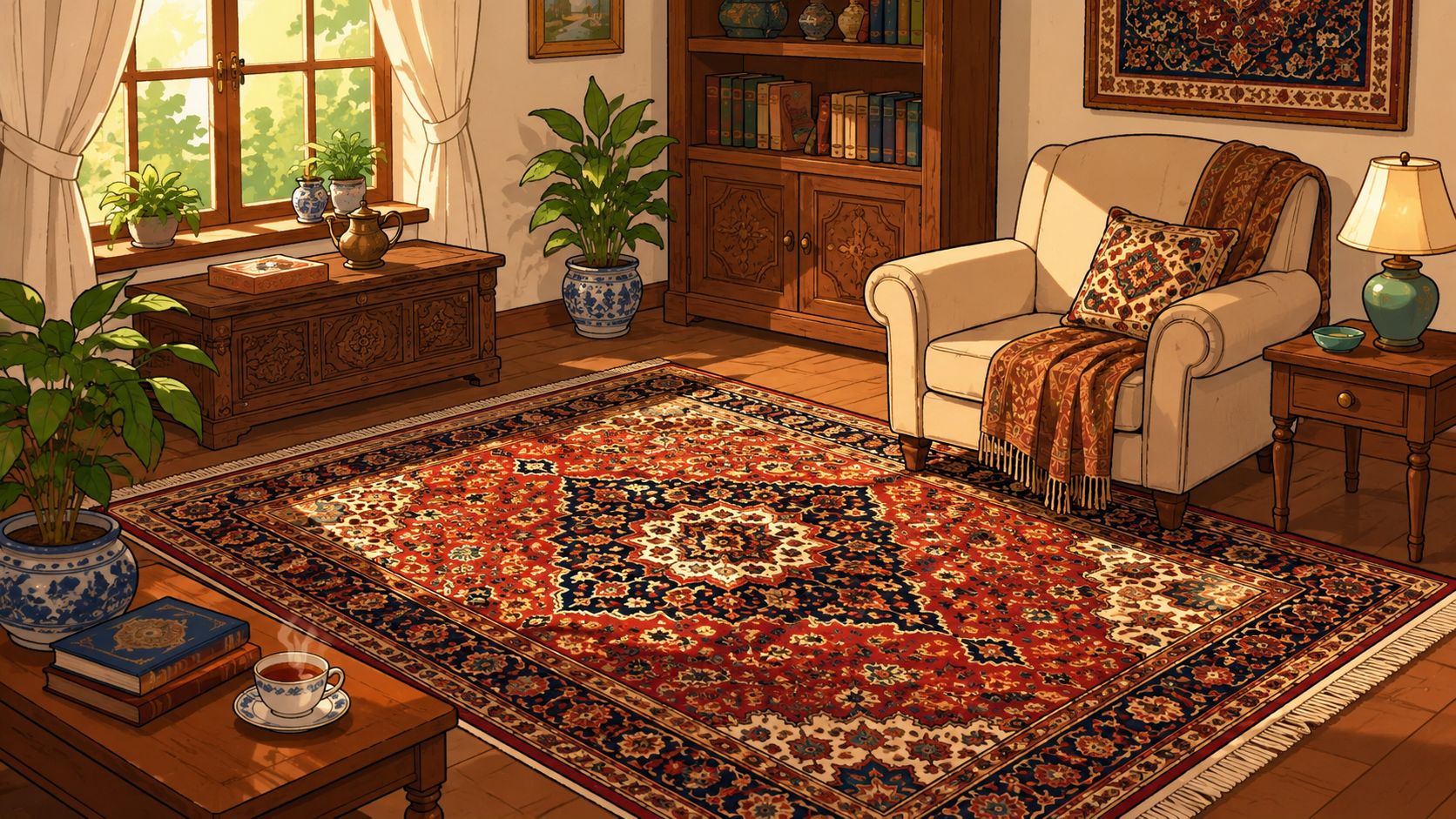
Not all traditional rugs say the same thing. Their visual language changes by region, motif, and structure.
Persian-inspired designs often feature layered medallions, scrolling vines, and floral fields. They suit rooms that need elegance and detail, especially when the architecture is simple and the furnishings are understated.
Turkish designs often feel bolder in outline. Repeated geometry, stronger borders, and a more architectural sense of pattern make them especially useful in rooms with substantial wood furniture or visible beams.
Caucasian-influenced looks tend to lean into geometry and contrast. They can sharpen a transitional space and work beautifully where a homeowner wants tradition without softness.
For those refining a broader classical interior, this guide to traditional design style helps connect rug character to the rest of the room.
Motifs that shape a room
A traditional rug isn't only decorative. Its motifs control how the eye moves through the space.
| Motif | What it tends to do in a room | Best use |
|---|---|---|
| Central medallion | Creates a focal point and formal balance | Living rooms, sitting rooms |
| All-over floral pattern | Softens the room and spreads attention evenly | Bedrooms, larger family rooms |
| Geometric field | Adds energy and structure | Offices, transitional spaces |
| Border-heavy design | Frames furniture and strengthens room edges | Dining rooms, defined seating areas |
Practical rule: The more ornate the rug, the more disciplined the surrounding furnishings should be. Traditional doesn't mean crowded.
The enduring appeal of traditional area rugs comes from that balance. They carry story, pattern, and craftsmanship, but they also perform a disciplined design task. They make a room feel composed.
Understanding Artisanal Craftsmanship
A rug can look traditional and still be built for short-term use. That's the divide buyers need to understand. Surface pattern alone doesn't create heirloom quality. Construction does.
The most important distinction is between hand-knotted, hand-tufted, and machine-made rugs. A hand-knotted rug is built knot by knot on a loom. Its structure is part of the design itself. A hand-tufted rug can look handsome at first glance, but it doesn't have the same underlying architecture or long-term character. Machine-made rugs can be practical for temporary needs, though they won't age with the same grace.
Knot type matters more than most buyers realise
Traditional area rugs rely on technical decisions that affect both appearance and wear. Two hand-knotting methods matter most. The Persian (Senneh) knot is asymmetrical and allows finer design complexity and detail, while the Turkish (Ghiordes) knot is symmetrical and creates a denser, sturdier pile, as described in this overview of Oriental rug art and construction.
That difference is practical, not academic.
- Senneh knot works beautifully when the design calls for delicate curves, layered florals, and refined line work.
- Ghiordes knot is often the stronger choice when the rug must tolerate a busier room and still hold its body.
- Neither is universally better. The right choice depends on where the rug will live and how the room will be used.
A helpful starting point is to browse examples of rugs and carpets with those differences in mind, paying attention to outline sharpness, pile character, and border definition.
What to examine by hand
The quickest way to separate a decorative purchase from an investment is to stop looking only at the top surface.
Check these details:
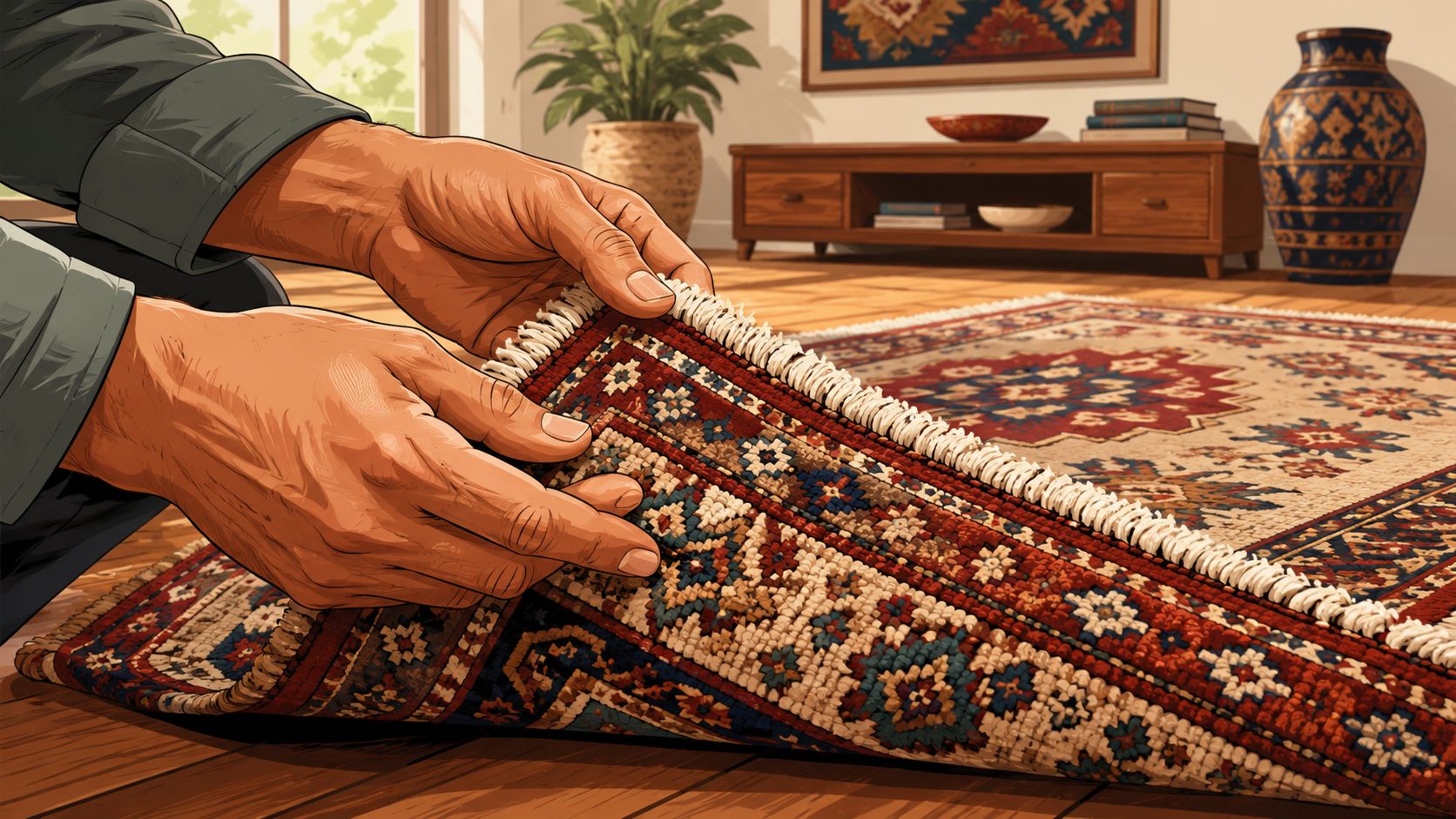
- Back clarity: On a hand-knotted rug, the pattern should remain visible on the back. It won't look identical, but it should look legible.
- Fringe construction: True fringe is part of the foundation, not something sewn on after the fact.
- Pile consistency: Slight variation is normal in artisanal work. Large weak patches or abrupt texture changes are not.
- Material honesty: Wool should feel resilient and alive, not plasticky or limp.
The hand often notices quality before the eye does. Weight, spring, and texture reveal far more than a showroom glance.
Value and longevity
The strongest traditional rugs don't merely survive wear. They develop character through it. Colours mellow. The pile settles. The room around them can change several times while the rug still makes sense.
That's why craftsmanship should always be judged in relation to use. A refined silk-highlighted rug might belong in a formal room. A denser wool hand-knot may be the better answer for everyday living. Good selection isn't about chasing the most elaborate piece. It's about matching structure to life.
Choosing Your Room's Foundation
Most rug mistakes start with the idea that the rug comes last. It doesn't. In a well-composed interior, the rug governs spacing, furniture grouping, and the visual weight of the room. It's part of a complete room concept, not a standalone decorative layer.
That's especially true in open living spaces across Greater Niagara, Hamilton, and Toronto, where one room often needs to do several jobs at once. The rug tells everyone where the conversation area begins and ends. Without that boundary, even beautiful furniture can appear disconnected.

Start with size, not pattern
For living rooms, the 8×10-foot dimension is the critical benchmark for anchoring the space, designed to place at least the front legs of all seating furniture on the rug and avoid the floating-rug effect, according to this rug sizing guide. That single rule solves a surprising number of layout problems.
For a practical sizing reference, this guide on how to choose an area rug size is worth keeping nearby when measuring.
A simple decision framework helps:
| Room condition | What works | What usually fails |
|---|---|---|
| Large seating group | Rug extends under the front legs of every main seat | Rug floats in the middle with wood floor exposed all around |
| Compact room | Pattern with some openness in the field | Dense border and dense upholstery competing at once |
| Formal room | Medallion or balanced all-over design | Casual scale mismatch between furniture and rug pattern |
Pattern and colour need discipline
Scale matters as much as size. A large room can hold a stronger medallion or broader motif. A smaller room often benefits from quieter pattern distribution, especially if the upholstery already carries texture or print.
Colour should also support the room's architecture.
- Warm wood furniture often pairs well with rugs that carry softened reds, sand, tobacco, or faded blue.
- Cooler painted interiors can handle sharper contrast, but the rug still needs one bridging tone that speaks to the upholstery.
- Highly patterned seating usually needs a calmer rug field beneath it.
Designer's Insight
Our designers suggest pairing a bold Hancock & Moore leather with a neutral hand-knotted wool rug to balance the room's energy. The leather provides presence. The rug provides calm.
The strongest rooms don't ask every piece to speak at once. They assign roles. The rug anchors, the upholstery comforts, and the lighting shapes mood.
Placement Tips for a Curated Home
Placement changes how a rug performs visually. The same hand-knotted piece can look collected and intentional in one room, then undersized or awkward in another because the furniture relationship is wrong.
A curated home asks more of placement than “fit what fits.” It asks whether the rug supports movement, proportion, and daily use.

Room-by-room guidance
In a dining room, the rug should extend far enough that chairs remain on the rug when pulled back. If chair legs catch the edge every time someone sits down, the size is wrong even if the table fits neatly in the middle.
In a bedroom, the rug should greet the feet where the body naturally lands. That usually means extending beyond the sides and foot of the bed, or using runners if the room calls for a more specific arrangement.
In a hallway, a traditional runner should feel proportional to the corridor rather than wall-to-wall. A little floor showing at the edges gives the piece room to breathe.
Layering for depth and softness
Layering is one of the most useful design-forward techniques for homes that need richness without visual clutter. A quieter base rug can hold the room together while a smaller, more intricate traditional rug supplies character.
A few combinations work especially well:
- Neutral base plus fine traditional accent for a collected sitting room
- Flat, understated layer beneath a silk-highlighted rug where the goal is softness and visual depth
- Muted wool beneath a more ornate piece when a treasured rug needs added presence in a larger room
This method also connects beautifully with lighting. Rooms with layered rugs respond especially well to low, warm illumination because the pile and pattern gain depth after sunset. For anyone refining that atmosphere, this guide to mastering soft ambient lighting offers useful ideas on how light changes texture and mood.
Good placement isn't only about symmetry. It's about what the room asks the body to do, sit, walk, pause, gather, and how the rug supports that rhythm.
What a curated room avoids
A thoughtful interior usually avoids three common rug-placement errors:
- Tiny rugs in large rooms that make every piece look adrift
- Overcrowded pattern stacking where drapery, upholstery, and rug all compete
- Perfect centring without functional logic such as aligning the rug to the room while ignoring the furniture group
Traditional area rugs reward considered placement. When they're positioned with intention, the whole home feels more organised.
Caring for Your Heirloom in Southern Ontario
Generic rug advice often assumes every climate behaves the same way. Southern Ontario proves otherwise. A traditional wool rug that performs beautifully in one region may need more thoughtful care in St. Catharines, Greater Niagara, Hamilton, or Toronto.
The overlooked issue is moisture. Most guides don't address the fact that wool fibres can absorb moisture during Southern Ontario's damp winters, which can lead to mould if the rug isn't properly ventilated, a concern highlighted in this discussion of handmade rug maintenance challenges. That matters because many homeowners buy for beauty first, then discover climate asks different questions.
What the climate changes
Freeze-thaw cycles, slush season, humid summer air, and tightly sealed homes all affect rug performance. A wool rug placed over a surface that traps moisture can hold more dampness than the room suggests on casual inspection.
That doesn't make wool a poor choice. It makes careless installation a poor choice.
Key habits help:
- Use a proper rug pad so air can move and the backing doesn't sit flat against the floor.
- Keep entry moisture in check by preventing wet footwear from reaching the main rug.
- Rotate thoughtfully so one area doesn't absorb all the seasonal stress from doors, sun, or heating vents.
- Call for professional cleaning when odour or persistent dampness appears, not months later.
For readers preparing a move or temporary storage, this guide on expert handling for delicate items is a useful reminder that fine textiles need careful wrapping, dry conditions, and thoughtful transport.
What doesn't work
A few common habits shorten the life of a good rug in this region.
| Common mistake | Why it causes trouble |
|---|---|
| Placing a wool rug on a damp-prone surface with no pad | Moisture can linger underneath |
| Ignoring winter ventilation | Indoor dampness has nowhere to escape |
| Using harsh spot treatments repeatedly | Fibres and dyes can suffer before the stain is fully removed |
| Rolling and storing before fully dry | Trapped moisture can create lasting damage |
Homeowners looking for a more local perspective on selection and care can also explore this Hamilton rug store resource for ideas suited to Southern Ontario homes.
A traditional rug doesn't need fragile treatment. It needs informed treatment.
Seasonal care that protects value
Spring and autumn are the right moments to inspect the underside, not just the visible surface. That's when hidden dampness, floor-contact issues, or early odour problems are easiest to catch.
Professional cleaning also works best as preservation, not rescue. Once a rug reaches the point of visible mould, stiffened fibres, or prolonged odour, the conversation has already shifted from maintenance to remediation. Heirloom pieces deserve attention earlier than that.
Acquiring Your Perfect Artisanal Rug
Buying a traditional rug well means balancing eye, hand, and judgement. The eye notices beauty first. The hand confirms material and construction. Judgement decides whether the piece fits the home, the climate, and the way the room will be used.
That final step matters most in Canada because the market is heavily dependent on imports. More than 95% of finished traditional rug sets are sourced from manufacturing hubs such as India and Turkey, making knowledgeable local retailers especially important for accessing authentic, high-quality hand-knotted pieces, according to this Canadian market analysis. In other words, selection isn't only about inventory. It's about curation.
What to look for before saying yes
A strong purchase usually checks several boxes at once:
- Construction integrity: The rug should feel coherent from edge to edge, with no weak corners or suspiciously applied fringe.
- Design suitability: A beautiful rug can still be wrong for the room if its scale, palette, or formality level fights the architecture.
- Material match: Fine detail may tempt a buyer, but the room may need denser wool and stronger everyday resilience.
- Provenance confidence: The seller should understand what the rug is, how it was made, and where it fits.
For anyone comparing styles and qualities before a showroom visit, this collection of the best area rugs in Canada is a useful starting point.
The value of a guided purchase
The right artisanal rug is rarely chosen in isolation. It works best when considered alongside upholstery, light, traffic flow, and the broader colour story of the home. That's why the strongest buying experience often combines a curated selection with interior design guidance and a bespoke view of the room.
A thoughtful acquisition process usually includes:
- Reviewing the room plan so the rug size supports furniture placement.
- Testing palette relationships against wood finishes, fabric, and natural light.
- Considering delivery and placement so the transition from showroom to home feels smooth.
- Thinking long-term about whether the rug can move with the household and still make sense years from now.
White-glove service matters here. A fine rug shouldn't arrive at the door with nothing more. It should be placed correctly, oriented to the room, and introduced into the home with the same care used to select it.
The best rug purchase doesn't feel impulsive, even when the piece creates immediate emotion. It feels resolved.
A traditional rug should leave a homeowner with more than admiration. It should leave the room more whole.
Experience the heirloom quality and curated selection at Critelli Furniture. For homeowners seeking Luxury furniture Niagara, Interior design services St. Catharines, Custom furniture Southern Ontario, and Hand-knotted rugs Ontario, the King Street Showroom offers a design-forward destination rooted in timeless craftsmanship. Experience the craftsmanship in person at our King Street Showroom. Book your complimentary design consultation today. Visit the Rug Market to find your room's foundation.