
Console and Sofa Tables Furniture: A Definitive Guide


You know the feeling. One side of the room is beautifully resolved, and another remains unsettled. The sofa is in place, the lighting is pleasant, the rug is chosen, yet an entry wall still feels bare, or the space behind a floating sofa seems unfinished and slightly awkward.
That's often where console and sofa tables furniture becomes the missing layer. Not because these pieces are loud or oversized, but because they bring order to spaces that otherwise drift. They create a place to arrive, to display, to store, and to define movement through a room with grace.
In our family firm, that principle has guided rooms for generations. Since 1914, Critelli has helped Southern Ontario homeowners shape interiors that feel considered rather than merely furnished. Over time, one lesson returns again and again. The smallest architectural-looking pieces often do the most work.
A well-chosen console or sofa table can soften a long hallway, give an entry purpose, anchor a lamp behind seating, or create a refined work surface in a compact home. If you're also thinking about atmosphere more broadly, Jackpot Candles' cozy home guide offers a thoughtful companion read on the sensory details that make a house feel lived in and welcoming.
The Finishing Touch Your Home is Missing
A room rarely feels complete by accident. It becomes complete when every area has a role and every furnishing contributes to that role. Console and sofa tables excel at this because they occupy the in-between spaces that larger pieces can't address elegantly.
Where these tables solve real design problems
Some of the most common trouble spots are easy to recognise:
- The empty entry wall that needs a graceful landing place for keys, mail, or a lamp
- The back of a floating sofa that looks abrupt in an open-concept layout
- The narrow hall that needs character without feeling crowded
- The underused dining wall that would benefit from a display surface or serving station
These aren't minor concerns. They affect how a home functions every day.
A console table often does the quiet architectural work in a room. It can make a space feel organised before anyone notices why.
Why the right piece changes the room
A console or sofa table introduces three things at once. It adds purpose, because the area now has a clear use. It adds proportion, because the table visually bridges empty spans of wall or floor. And it adds character, because material, finish, and styling begin to tell a story about the home.
That's why these pieces deserve more thought than their modest size suggests. In design-forward homes across Greater Niagara, Hamilton, and Toronto, they're often the final layer that turns a good room into a composed one.
Defining the Difference Between Console and Sofa Tables
People often use the terms interchangeably, and in casual conversation that's understandable. In practice, the distinction matters because each piece answers a slightly different design question.
The broad distinction
A console table is the more versatile category. It usually sits against a wall, in a hallway, at an entry, along a dining-room perimeter, or beneath art or a mirror. Its profile is slim because it's meant to provide surface area without intruding into circulation.
A sofa table is more specific. It's designed to live behind a sofa, and its proportions are guided by the dimensions of the seating nearby. The height matters especially here, because the table should relate comfortably to the sofa back rather than rise awkwardly above it.
Published furniture benchmarks place common console-table heights around 30 to 36 inches, with sofa tables often near 28 to 30 inches, and typical depths around 8 to 16 inches according to this console-table dimensions guide.
Console Table vs. Sofa Table At a Glance
| Characteristic | Console Table | Sofa Table |
|---|---|---|
| Primary role | Flexible accent and utility piece | Specifically scaled for placement behind a sofa |
| Common placement | Entryway, hallway, living room wall, dining wall | Behind a sofa in a living or family room |
| Typical height | Around 30 to 36 inches | Often near 28 to 30 inches |
| Typical depth | Usually slim, often within 8 to 16 inches | Also slim, often within 8 to 16 inches |
| Design priority | Versatility and visual refinement | Alignment with sofa scale and seating sightlines |
When the distinction matters most
If you're filling an entry or a long wall, think first in terms of a console. If you're trying to make the back of a sofa feel intentional, think first in terms of a sofa table.
Storage can also influence the decision. A piece with drawers or lower shelving may suit a compact home that needs concealed utility. If that's the direction you're considering, this look at sofa tables with storage is useful because it frames the piece as both an accent and a practical tool.
The name matters less than the job. Choose the table that fits the placement, the height relationship, and the way you live.
The Art of Scale Sizing and Placement
You walk into a condominium after a long day, set down your keys, and feel that the room is almost right. The sofa fits. The lighting works. Yet one area still feels unresolved. In many homes, the missing piece is not more furniture. It is a table with the right scale, placed with enough discipline to make the room feel finished and easy to live in.
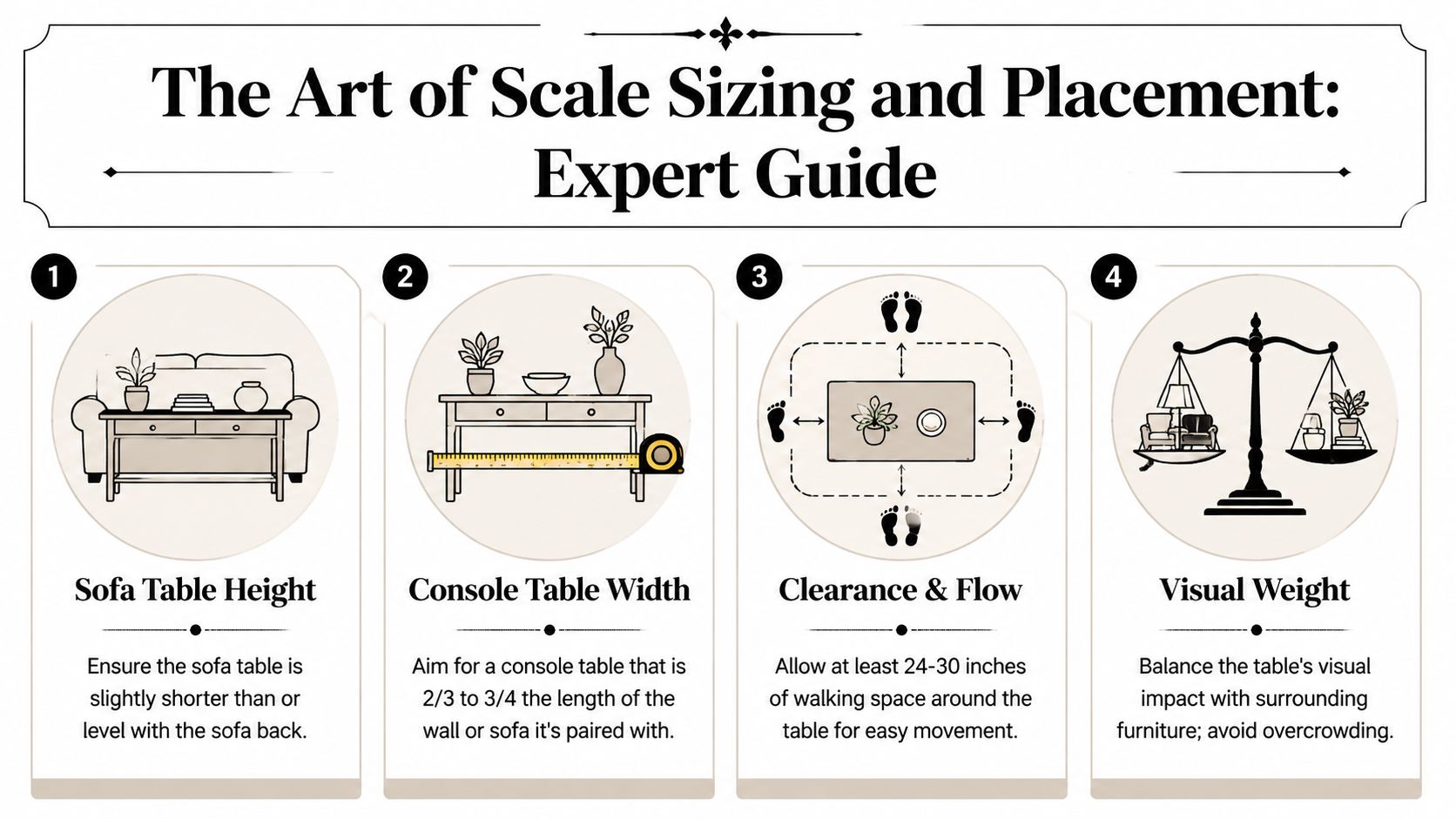
Scale is the quiet architecture of a room. A console or sofa table may look beautiful in a showroom and still fail at home if it is too shallow to be useful, too deep for the walkway, or too tall for the seating beside it. Styling cannot correct that. Proportion has to come first.
Length should relate to what it serves
Behind a sofa, the table and the upholstery are read as one composition. That is why proportion matters so much. As explained in this console table guide, a table that measures about two-thirds to three-quarters of the sofa length usually feels balanced, and a 90-inch sofa often pairs well with a console around 60 to 68 inches long.
The principle is simple. A table that is too short looks accidental. One that runs too long begins to crowd the seating group and pull attention away from the sofa itself.
Walls work in a similar way. On a long wall, a narrow console should hold visual weight without floating awkwardly in the middle like a postage stamp on a large envelope. If the wall is substantial, the table needs enough presence to anchor art, lighting, or a mirror above it.
Height and depth shape comfort
Height is about relationship. Behind a sofa, the tabletop should sit close to the sofa back height or slightly below it so the line feels calm and intentional. If it rises too high, it interrupts the furniture grouping. If it falls too low, it can look disconnected from the seating area.
Depth is about movement.
In Southern Ontario homes, that point matters more than many people expect. Downtown condos, townhomes, and older houses with narrower passages all ask furniture to do more with less space. A slim profile often solves the problem better than a larger piece with extra surface area you never truly use.
If you are planning from floorplans or showroom tags, this guide to measuring furniture for your home helps translate dimensions into real clearances, sightlines, and walking space.
A beautiful table that pinches circulation is still the wrong table.
Placement should answer a real household need
The best placement decisions begin with use, not decoration. In an entry, a console can create order the moment you come through the door. Behind a sofa, it can add lighting, a place for drinks, or concealed storage without requiring another bulky cabinet. Along a dining room wall, it can support serving pieces and help the room feel complete.
Heirloom thinking becomes practical in this context. A well-scaled table is not a filler piece you replace in two years. It is a flexible furnishing that can move from a condo entry to a family room, then later to a landing, study, or dining wall as your home changes.
For placement, three questions usually bring clarity:
What is the table anchoring?
A sofa, a wall, an entry sequence, or a transition between roomsHow do people move around it?
Passing through daily, carrying bags, entertaining guests, or sharing space with children and petsWhat job should it perform?
Holding lamps, catching keys, hiding chargers, supporting décor, or adding storage
Answer those thoughtfully, and sizing becomes much easier. That is how a console or sofa table stops being a decorative extra and starts working like a strategic layer in the room.
A Language of Materials From Timeless Wood to Modern Metal
Material isn't a decorative afterthought. It determines how a table ages, how it reflects light, how it relates to nearby furniture, and whether it feels temporary or lasting. If you're seeking heirloom quality, material selection deserves as much attention as the silhouette.
Why wood still carries such authority
Solid wood has a warmth that's difficult to imitate. It absorbs patina over time, softens a room's harder architectural lines, and carries a sense of permanence. In traditional and transitional interiors, wood often gives a console table its quiet gravitas.
That's one reason families still gravitate toward makers such as Stickley, where craftsmanship and joinery remain part of the appeal. A thoughtfully chosen wood console can sit beside antiques, newer upholstery, or artisanal lighting and still feel grounded.
For readers comparing species, finish character, and longevity, this guide to choosing the right hardwood gives a helpful framework.
Where metal and glass belong
Metal introduces definition. It can sharpen a room that already has softness through upholstery, drapery, and rugs. Dark metal frames feel structured and architectural. Brighter finishes can feel lighter and more contemporary.
Glass changes the visual weight of a table. It's useful when you want function without solidity, especially in a smaller room that can't absorb another heavy mass.
A few broad pairings tend to work well:
- Walnut or deep-toned wood suits rooms that favour heritage, library-like warmth, or refined luxury
- Oak and lighter woods bring ease to more casual, airy, or Scandinavian-leaning spaces
- Blackened metal works well with modern upholstery and cleaner architectural lines
- Mixed materials often bridge traditional craftsmanship and contemporary living most successfully
Choose for longevity, not novelty
Timeless craftsmanship rarely relies on trend finishes. It relies on balance, restraint, and honest material expression. A table you'll admire for years usually has one of two qualities. It is either beautifully simple, or it is richly made.
That's the difference between furniture that merely fills a spot and furniture that becomes part of a home's character.
Building a Complete Room Concept
A well-furnished room rarely comes together by adding one attractive piece at a time. It comes together when each piece explains the next. A console or sofa table often does that quiet, architectural work. It links seating to lighting, storage to circulation, and daily routines to the room's visual order.

Start with the room's anchor
In our family design practice, we often begin with the rug because it governs more than colour. It sets the room's footprint, the walking paths, and the emotional tone. A finely made rug works like a foundation course in masonry. Once it is set correctly, the pieces above it have logic.
That matters when selecting a console or sofa table. A richly patterned rug may call for a table with quieter lines. A restrained rug can support a table with more presence, texture, or detail. The goal is correspondence, not competition.
Let the table solve a modern problem
Southern Ontario homes often ask one room to do several jobs. A living area may need to welcome guests, hide cables, support a reading lamp, and soften the transition between dining and lounge zones. In a compact condo, that demand becomes even sharper. The right table helps the room work harder without looking crowded.
Used well, it can provide:
- A landing place for keys, mail, or a bag near an entry sequence
- A buffer behind a floating sofa so the room feels finished from the back as well as the front
- A discreet storage point for remotes, chargers, or small work tools
- A visual connector that repeats the wood tone, metal finish, or line of nearby furnishings
If you are arranging several functions within one sitting area, this guide to arranging furniture in a living room helps clarify spacing, balance, and traffic flow.
Use the table to complete the architecture of the room
Open-concept plans in Toronto, Hamilton, and Niagara often expose the back of a sofa to the rest of the home. That view needs as much care as the front. A sofa table gives the sofa a proper edge, much like trim gives a wall its finished outline.
This is also where a specific piece can act as a design connector rather than a standalone accent. For instance, the Critelli Woodcraft Tribeca Sofa Table (TR120) suits this role when a room needs a defined surface behind seating without adding visual heaviness. Its value in the composition is not only what it holds, but how it ties the seating group to the rest of the room.
Textiles complete that relationship. A lamp, a rug, and the right soft layer on the sofa can turn a functional arrangement into a room that feels lived in and settled. For added warmth and flexibility, these versatile throw blanket ideas show how a small textile choice can reinforce the whole concept.
The strongest rooms feel resolved from every angle. The table is often the piece that makes that resolution possible.
Curating the Surface Styling Ideas for Every Aesthetic
After the table is positioned correctly, styling provides its character. Many homeowners either finish the process prematurely or include an excessive amount of items. The surface should feel composed rather than crowded. It should reveal personality instead of visual noise.

Symmetrical elegance
In a traditional or well-appointed room, symmetry often brings the most ease. A pair of lamps, a central bowl, or balanced objects at either end creates steadiness. This approach suits wood consoles with classic lines and rooms furnished with established brands and timeless upholstery.
The mood is orderly, but it needn't be stiff. Books, framed photographs, or a small floral arrangement can keep the arrangement personal.
Collected and eclectic
A more layered interior benefits from asymmetry. You might place a lamp at one end, stack books near the centre, and lean artwork behind a smaller sculptural object. The key is variation in height and density.
This is often the right answer for homes that blend older pieces with modern ones. The table becomes a curated pause rather than a matched display.
Objects look better when each one has room to breathe. Edit first, then style.
Soft modern restraint
For a quieter contemporary look, use fewer pieces with stronger form. One ceramic vessel, a low tray, and a single branch or stem can be enough. Material contrast becomes the interest. Think matte wood against polished stone, or metal beside woven texture.
If you want to add softness nearby, versatile throw blanket ideas can help tie the console area back to the seating zone without making the room feel over-styled.
Designer's Insight
Our designers often begin with books to create height, then add one sculptural object and one organic element such as greenery or branches. That combination keeps a console table feeling layered, lived-in, and calm.
A final styling habit matters more than any formula. Remove one item before you declare the arrangement finished. Most surfaces improve with restraint.
The Critelli Legacy Bespoke Service from Showroom to Home
A couple walks through the showroom with a floor plan in hand. They know they need a table, but the key question is which one will make the room work better for years, not just fill an open wall today.
That is the difference thoughtful service makes.
Selecting a console or sofa table at this stage becomes a design exercise in relation. The table has to suit the architecture, respect circulation, sit comfortably with the rug and upholstery, and support the habits of the household. In a busy family room, that may mean rounded corners and durable finishes. In a formal sitting area, it may mean a narrower profile and a more architectural silhouette.
Why bespoke service still matters
A family furniture business with deep experience tends to look beyond the isolated piece. The discussion usually begins with proportion, then moves to materials, light, neighbouring furniture, and the mood the room should hold. A warm walnut console can steady a space with pale upholstery. A metal-framed sofa table can bring definition to a room that already has many soft forms.
Sometimes the right answer is not on the floor exactly as shown. A different finish, scale, or detailing choice may create a better result, especially when the goal is an heirloom-quality interior rather than a short-term fix. That is where bespoke guidance proves its value. It helps homeowners build a complete room concept, one decision at a time, with fewer costly corrections later.
Service also continues after the selection is made. Delivery, placement, and professional furniture assembly services for your home help the piece arrive as part of a finished plan, not as one more task on a weekend list.
The final measure of a good choice
The strongest interiors feel settled. A well-chosen console or sofa table does quiet work every day. It holds a lamp where light is needed, gives structure to an entry or seating area, and connects older pieces with newer ones so the room feels considered.
That lasting sense of rightness is the actual outcome of careful selection from showroom to home.