
Design TV Units: Elegant & Functional Solutions

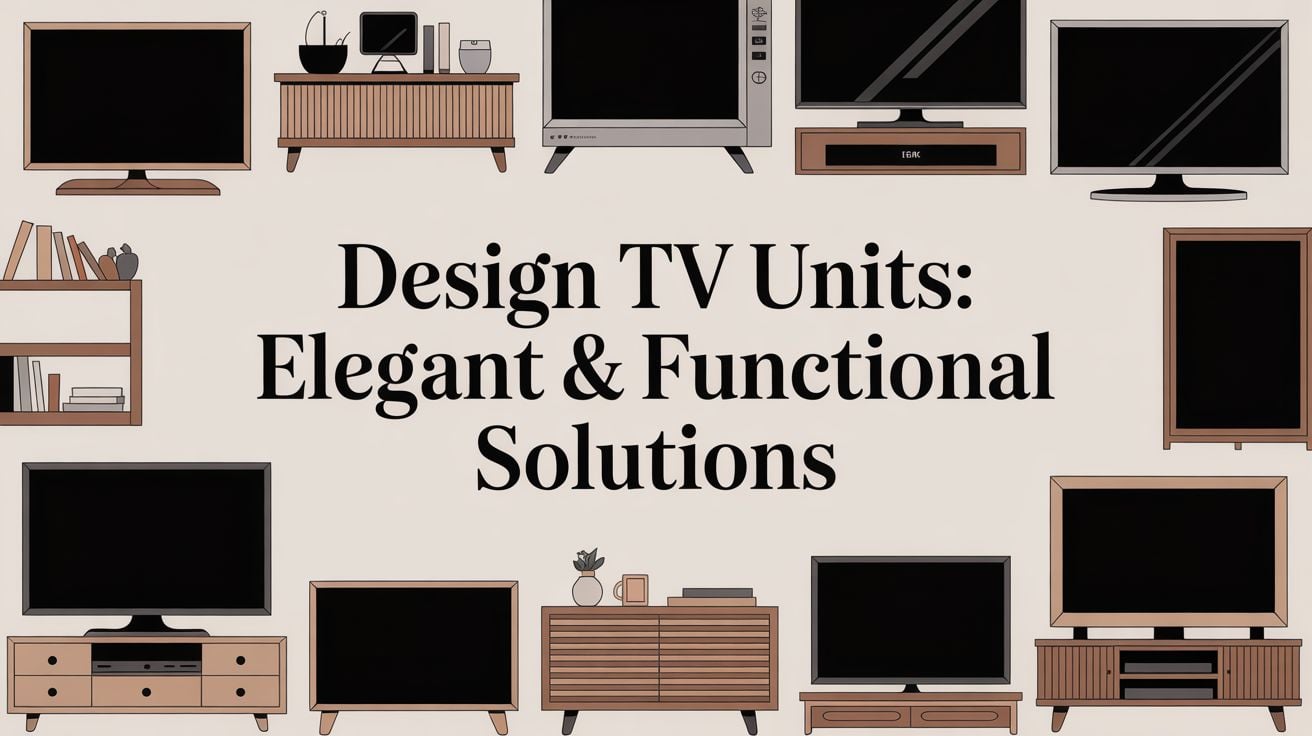
A television rarely creates the design problem on its own. The problem starts when a beautiful room has no plan for the screen, the speakers, the cable box, the gaming console, and the practical reality of daily living. Then the TV unit becomes an afterthought, and the room begins to feel organised around equipment instead of people.
Good design tv units do the opposite. They make technology feel intentional. They support comfortable viewing, preserve the architecture of the room, and sit naturally beside the pieces that matter most, including seating, lighting, and the rug that grounds the space.
In a family firm with roots going back to 1914, that lesson comes up often. The best media furniture isn’t selected as a standalone object. It’s considered as part of a complete room concept, shaped by proportion, circulation, materials, and the way a household lives.
Laying the Groundwork Your Room's Scale and Sightlines
A room can look settled at first glance, then feel wrong the moment the television goes in. The screen sits too high for comfortable viewing, the cabinet pushes into the walkway, or the whole seating plan turns toward technology instead of conversation. Those problems begin in the layout, not in the millwork shop.
In our work, the TV unit is planned with the room from the floor up. That means reading the architecture, the window placement, the path through the room, and the size and character of the rug that anchors the seating area. In many Southern Ontario homes, especially older ones, those decisions matter more than the cabinet style itself.
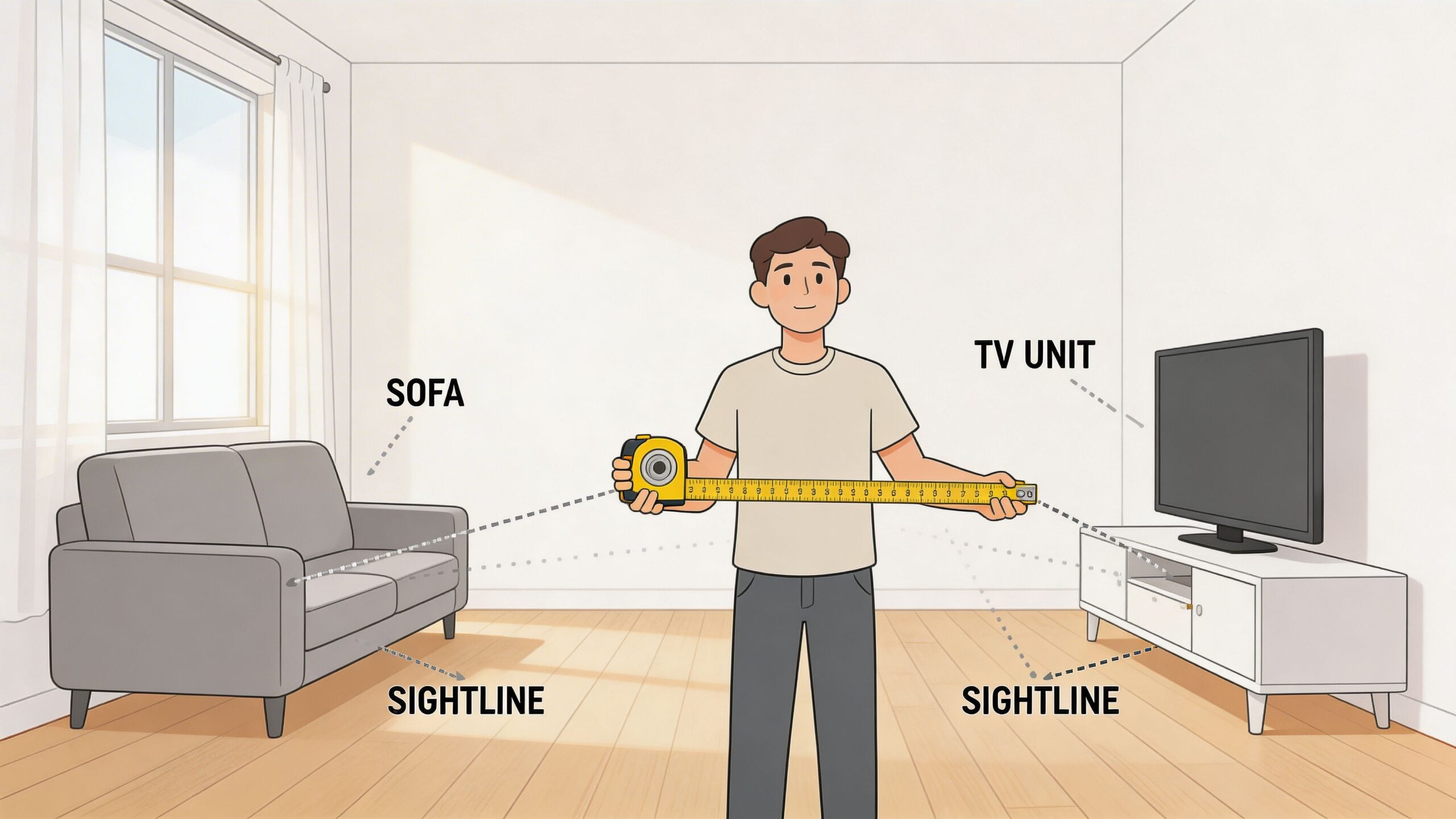
Measure the room before the furniture
A useful plan starts with four dimensions.
Wall width
This shows whether the TV unit should read as a strong horizontal element or stay visually quieter than the surrounding architecture.Seating distance
Screen size and sofa placement have to be resolved together. A scaled drawing helps you test viewing comfort before anything is ordered. If you're working through those relationships, this guide to calculate the best placement for your sofa and television is a practical starting point.Sightline height
The centre of the screen should sit comfortably within the natural line of sight from the main seat. Fireplaces often complicate this. A wall may look symmetrical with a television above the mantel, but the viewing angle can still feel tiring after half an hour.Traffic paths
Clearance around the unit matters every day. Cabinet depth, door swing, and the route between seating and adjoining rooms all affect whether the room feels calm or crowded.
A quick sketch is useful. A scaled plan is better, especially if the room also needs to accommodate a substantial coffee table, side seating, or an heirloom rug with a defined border that should remain visible.
Practical rule: If the room starts to revolve around the screen, revise the layout before you revise the furniture.
Work with the architecture you have
Older Southern Ontario houses rarely offer a perfect media wall. Bay windows, fireplaces, radiators, narrow chimney breasts, and generous trim can all limit placement. That is not a flaw. It means the TV unit has to respect the room rather than dominate it.
In a newer open-concept home, a long low cabinet often sits comfortably because the wall plane is broad and quiet. In a Victorian or Edwardian room, the better answer may be a shallower piece, a built-in fitted to an alcove, or a darker recess finish that lets the screen recede. The architectural character should still lead.
That same principle appears in well-resolved luxury home interiors. The best rooms account for proportion first, then layer in technology so it supports the experience of the space rather than interrupting it.
What tends to work in practice
Some patterns hold up across many projects.
- Low, horizontal forms usually keep the room visually settled and protect sightlines across the space.
- Floating units can help in smaller rooms where exposed floor area makes everything feel lighter.
- Shallow cabinetry is often the wiser choice in heritage homes, where circulation space is limited.
- Oversized screens can overpower delicate mouldings, narrow walls, or rooms with strong symmetry.
- Centred layouts are not always the right layouts. In some rooms, aligning the unit with seating and circulation produces a better result than forcing it onto the architectural centreline.
The strongest starting point is proportion. Once scale and sightlines are resolved, the TV unit reads as part of a composed room, with the rug, upholstery, lighting, and architecture all working in the same language.
Curating Your Style From Modern Minimalist to Timeless Craftsmanship
A TV unit should belong to the same visual family as the rest of the room. That doesn’t mean every piece must match. It means the forms, materials, and level of detail should speak the same language.
Television furniture has been adapting to this challenge for decades. By 1949, American consumers were purchasing 100,000 televisions per week, and early ornate cabinets gradually gave way to more integrated furnishings as the TV became central to domestic life (downstv.com). That shift still tells us something useful. The best pieces don’t disguise technology awkwardly, and they don’t celebrate it at the expense of the room. They absorb it.
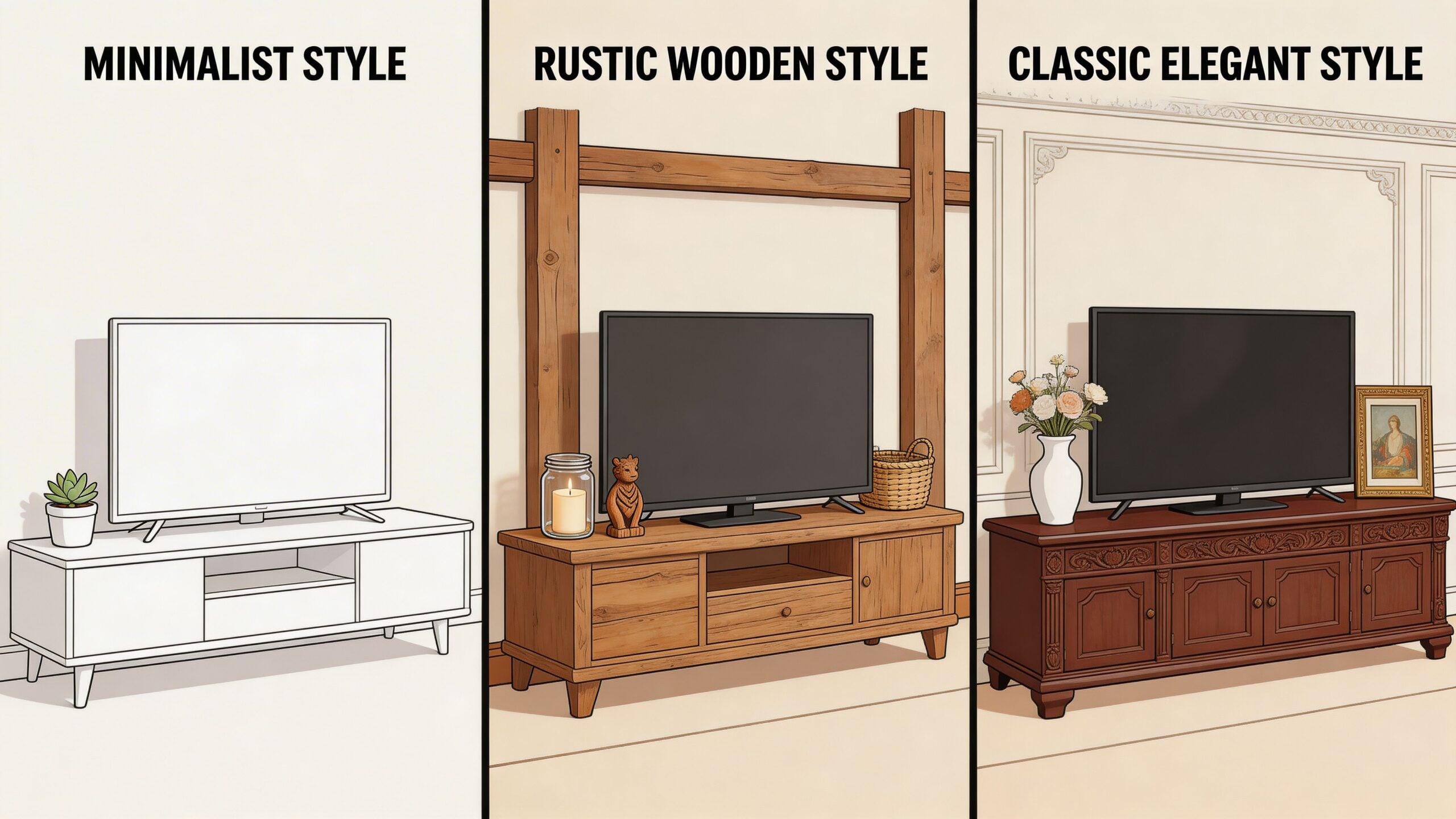
Three design directions that endure
| Style direction | What it looks like | Where it works best |
|---|---|---|
| Modern minimalist | Clean planes, restrained hardware, strong horizontal lines | Contemporary condos, newer builds, edited open-concept spaces |
| Transitional | Balanced proportions, warmer wood tones, subtle detailing | Mixed interiors with both classic and current elements |
| Timeless craftsmanship | Rich wood grain, artisanal joinery, furniture presence | Character homes and rooms built around heirloom quality |
Minimalist rooms ask for discipline. If the unit is sleek but every device is visible, the effect collapses. Transitional rooms allow more texture and softness. Traditional or craft-led interiors often benefit from wood with character, a cabinet profile that feels substantial, and detailing that can stand beside established pieces rather than disappear.
Let the room, not the trend, decide
The market has moved from furniture-like televisions to freestanding plastic sets and then to today’s thin screens. Along the way, the role of the cabinet changed as well. A TV unit no longer needs to pretend the screen isn’t there. It needs to frame modern living with more grace.
That’s where established craftsmanship still matters. Brands such as Stickley remain relevant because they understand proportion, timber, and permanence. A well-made piece can support modern hardware without looking temporary.
For homeowners studying broader examples of luxury home interiors, it’s worth noticing how the strongest rooms keep media furniture visually connected to architecture, upholstery, and lighting instead of treating it as isolated equipment.
Rooms age well when the media unit looks like it was chosen for the house, not for the screen alone.
Designer’s Insight
Our designers suggest creating visual harmony by matching the wood tone of your TV unit to other key pieces in the room, such as a coffee table or the legs of a Stressless recliner. Then, introduce contrast and warmth by selecting a hand-knotted rug from The Rug Market that picks up on secondary colours in the room's palette.
A century-old family firm learns this early. Style changes. Quality materials, disciplined proportion, and timeless craftsmanship remain persuasive much longer.
Planning for Perfect Functionality Storage and Technology Integration
A family settles into a beautifully furnished room. The rug is heirloom quality, the upholstery is right for the light, and the millwork suits the architecture of the house. Then the cabinet doors stay ajar because the modem is too deep, the soundbar blocks the screen, and a tangle of cords draws the eye before the fireplace does. Good media design fails or succeeds in these hidden decisions.
A TV unit should support the room as a whole. In many Southern Ontario homes, that means respecting older trim profiles, uneven plaster walls, generous baseboards, and the daily reality of modern equipment. The joinery has to serve the technology without letting the technology set the visual tone.
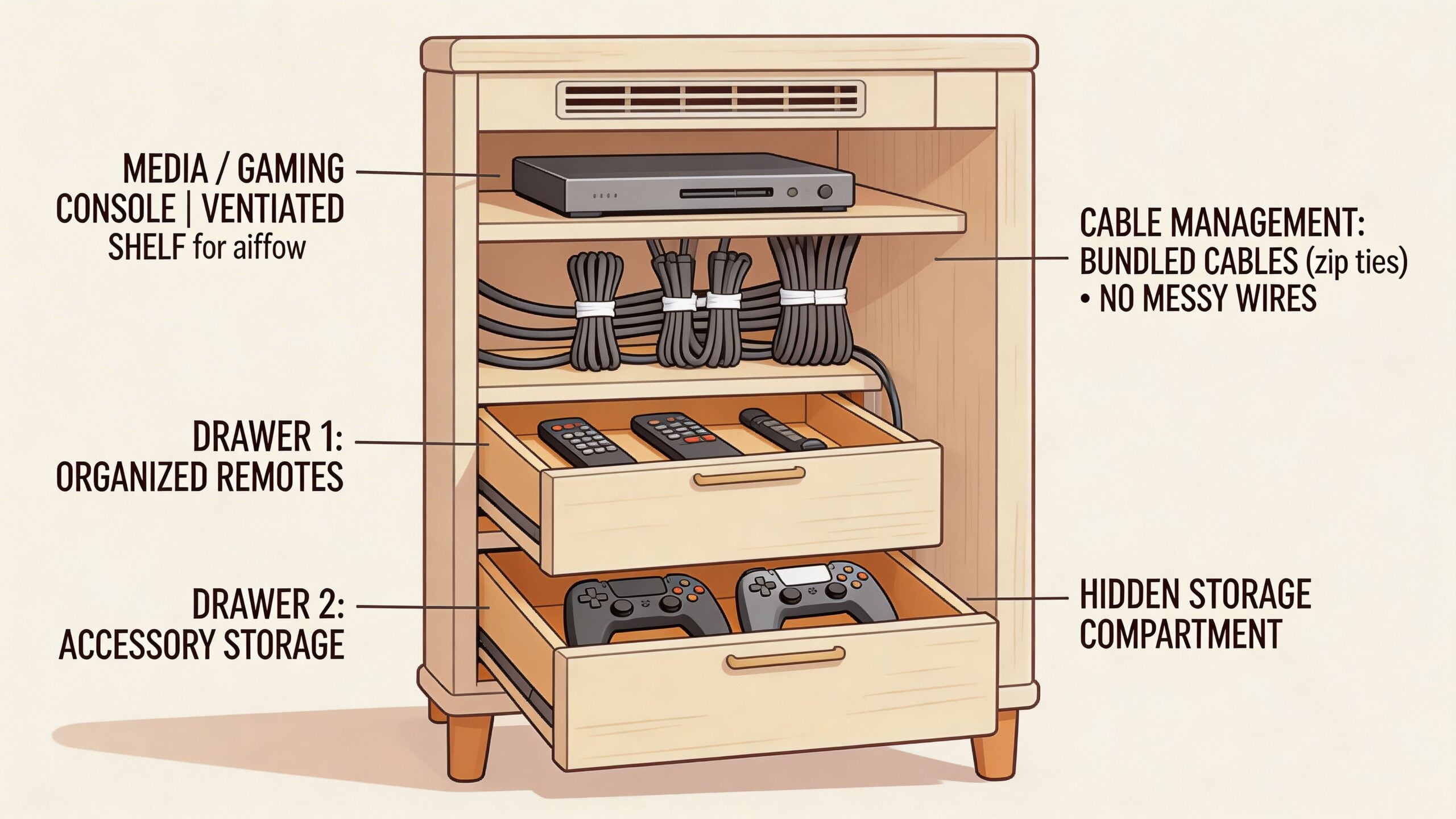
Start with the equipment list
The practical work begins before finishes are selected. Measure every component that needs a home, including the pieces clients often forget until installation day.
That usually means planning for:
- Screen support, whether the television sits on the cabinet or is wall-mounted above it
- Source equipment such as Apple TV, a cable box, or a media hub
- Audio components including a soundbar, amplifier, centre speaker, or subwoofer connection point
- Everyday storage for remotes, chargers, controllers, batteries, and manuals
Hidden AV integration is a regular request in our showroom work because clients want rooms that feel composed, not technical. Large televisions also require careful support planning. Manufacturers such as Sanus publish mount specifications for larger screens, including common patterns such as VESA 600 x 400, which should be confirmed before framing the wall or finalising cabinet depth and height (Sanus TV mount compatibility guide).
If you're comparing formats before committing, this guide on how to shop for TV stands covers the support, storage, and sizing questions that are often missed early.
Build the inside as carefully as the outside
The exterior may read as furniture, but the interior needs the logic of a well-planned workstation. Equipment runs hotter than many homeowners expect, and it rarely stays the same for long.
Open shelving works well for components that need airflow or direct remote access. Closed compartments give the room more visual quiet, which matters when the TV unit sits against handcrafted plaster, painted paneling, or a wall shared with art and antiques. The answer is usually a mix of both, with the most frequently accessed pieces in breathable zones and the visual clutter tucked away.
Several details consistently improve day-to-day use:
- Removable back panels make service calls and upgrades much easier
- Cable channels and grommets keep wiring from bunching behind components
- Adjustable shelves allow the unit to adapt as equipment changes
- Soft-close drawers and doors reduce noise in living rooms and open-plan spaces
Hide the wiring without trapping the heat
Cable management should disappear, but access still matters. A cabinet that looks immaculate on installation day becomes frustrating if every small change requires emptying the entire unit.
The best solutions usually include a concealed vertical route for power and data, a central access point for connections, and enough slack to move components safely during service. Ventilation needs equal attention. Perforated panels, recessed backs, and discreet shadow gaps help air circulate without turning the cabinet face into a sheet of visible grilles.
I have found that the most convincing rooms are the ones where this work is invisible. The cabinet appears calm because the technical mess was solved in the drawings.
Know the trade-offs
Every storage decision affects the room.
A floating cabinet lightens the wall and makes cleaning easier, which suits many contemporary renovations. It also reduces internal volume and can look insubstantial in a century home with weighty trim and substantial rugs. A fully enclosed unit feels more architectural and settled, but poor ventilation can shorten the life of the equipment inside. Wide drawer fronts create a cleaner facade, yet smaller internal divisions usually serve real households better.
The strongest design tv units respect those trade-offs. They hold the screen, support the hardware, and still belong to the larger room, with its architecture, textiles, and long-term character intact.
Achieving Harmony with Finishes Lighting and Your Room's Foundation
A media unit doesn’t feel resolved when the joinery is complete. It feels resolved when its finish, lighting, and surrounding materials settle into the room with confidence.
These issues cause many otherwise good rooms to lose coherence. The cabinet may be well proportioned, but the stain is too red for the flooring, the sheen is too sharp for the upholstery, or the screen wall ignores the rug that already sets the room’s colour language.
Choose finishes as part of a room palette
The finish of a TV unit should respond to at least three things in the room:
- The flooring, so the cabinet doesn’t fight the largest wood surface in view
- The upholstery, especially if leather or textured fabric introduces warmth
- The architectural light, because daylight changes how stain, lacquer, and metal read across the day
For many homes in Niagara and the surrounding market, natural light is generous. That can be beautiful, but it also means finish selection needs restraint. A glossy surface may look crisp in a sample and feel harsh once sunlight hits it for hours. Richer matte and low-sheen finishes often age more gracefully.
The rug should lead the conversation
This is the design step generic guides often miss. A rug isn’t an accessory tucked under the coffee table. It’s often the visual foundation of the room.
The trend of integrating TV units with artisanal rugs is growing, with 15% of Critelli's Rug Market collectors seeking this harmony. In Niagara's light-filled homes, coordinating finishes, like a Hancock & Moore leather accent, with a hand-knotted rug palette is a key personalization layer often overlooked by generic design guides (shelved.co.uk).
That doesn’t mean the cabinet should copy the rug. It means the two should share a relationship. If the rug carries softened blues and tobacco tones, the media unit can echo that with a smoked oak, a warm bronze pull, or a leather inset that speaks to those colours.
A room feels curated when the rug, the cabinet, and the upholstery seem to have been chosen in conversation with one another.
Use lighting to soften the screen wall
Integrated lighting can transform the entire mood of a media wall.
It works best when it’s subtle and layered:
- Shelf lighting draws attention to books or objects instead of the television alone.
- Low ambient light around the unit softens contrast in evening viewing.
- Targeted lighting can highlight texture in wood grain, stone, or decorative accessories.
For a deeper look at layered illumination in living spaces, put your living room in the best light offers practical guidance that applies particularly well to media walls.
Avoid the common finish mistakes
Several problems appear regularly:
| Misstep | Why it weakens the room |
|---|---|
| Matching everything exactly | The room becomes flat and showroom-like rather than collected |
| Using too many wood tones with no bridge | The eye reads conflict instead of depth |
| Choosing dramatic lighting for a calm room | The media unit begins to shout |
| Ignoring tactile materials | The cabinet feels disconnected from seating and soft furnishings |
The strongest rooms use contrast carefully. They might pair walnut with a pale wool rug, or a dark painted cabinet with a hand-knotted pattern that introduces movement and warmth. The result is less about display and more about composure.
Custom Bespoke vs Curated Modular Solutions
The right choice often becomes clear the moment you stand in the room. In a tall Victorian in Hamilton, the television wall may sit between uneven plaster returns and original trim that deserves respect. In a newer Oakville build, the architecture may be simpler, and the better investment may be a refined modular composition that leaves more room in the budget for the rug, lighting, and upholstery that complete the space.
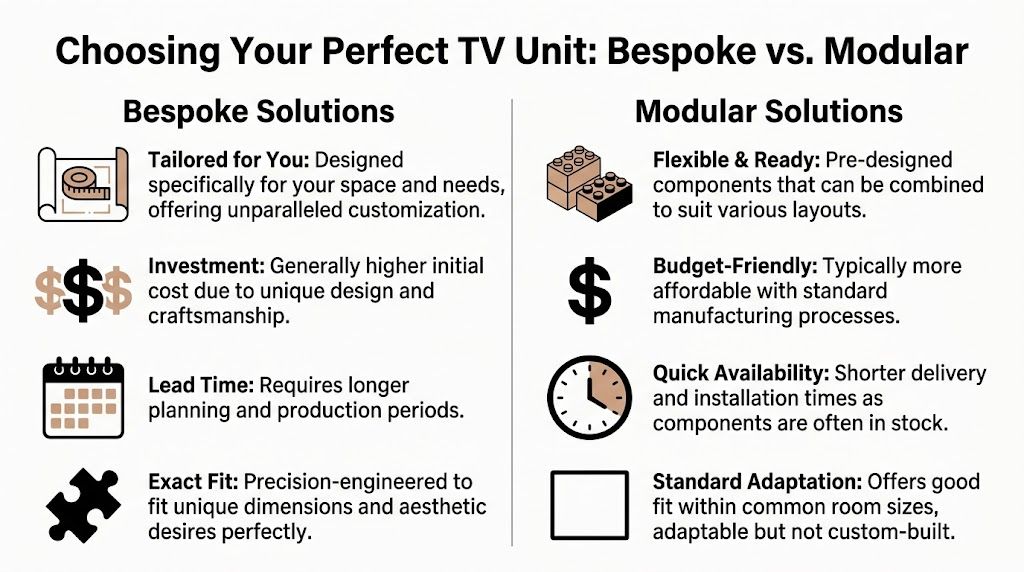
When bespoke is the right answer
Bespoke cabinetry suits rooms that ask for precision. I recommend it when a TV unit has to answer to original millwork, a sloped ceiling, a fireplace offset, shallow wall depth, or a full composition of closed storage, display shelving, and concealed equipment. In those cases, standard widths and fixed module heights usually leave awkward gaps or force visual compromises.
Custom work also gives tighter control over proportion. That matters in rooms with strong architectural character, especially many Southern Ontario homes where deep baseboards, historic casings, and varied ceiling heights can make an off-the-shelf piece feel temporary. Bespoke joinery lets the TV wall belong to the room rather than sit in front of it.
The practical gains are just as important. Ventilation, cable routing, speaker cloth panels, door swings, and finish matching are easier to resolve before fabrication than after installation.
When modular makes more sense
Curated modular systems work well in rooms with cleaner geometry and households that want flexibility. They are often the wiser route for condominiums, family rooms, secondary sitting areas, or projects where timing matters and the architecture does not require custom joinery at every edge.
A good modular scheme still needs a designer’s eye. The modules have to be composed with the same discipline as custom millwork, with attention to scale, negative space, and how the unit relates to the rest of the room. Done well, it can feel intentional and settled, not improvised. For adaptable configurations beyond a standard media console, a modular shelving system can provide that balance of order and flexibility.
A simple comparison
| Consideration | Bespoke | Modular |
|---|---|---|
| Fit | Built to the room, equipment, and architectural details | Best in rooms with standard dimensions |
| Lead time | Longer, with more design and fabrication coordination | Shorter, with faster installation |
| Flexibility after installation | More fixed once completed | Easier to revise or expand |
| Design control | Full control over proportion, materials, and function | Strong selection, within an existing system |
If the media wall is part of a larger renovation or new residence, it helps to look at it through the same lens as the architecture itself. These broader custom home building services examples show how cabinetry decisions are usually strongest when they are considered alongside trim profiles, flooring transitions, sightlines, and the overall character of the home.
The better route depends on the room, the equipment, and the life of the house. Bespoke offers precision and permanence. Curated modular offers flexibility and speed. Both can be beautiful when they are chosen as part of a complete room, with the rug, finishes, and architecture all working in concert.
From Showroom to Sanctuary with White-Glove Service
The final stage of a media unit project determines whether the experience feels complete. Even a beautifully designed piece can lose its impact if delivery is rough, assembly is rushed, or placement is guessed at in the moment.
White-glove service matters because TV units are rarely simple drop-in furniture. They often need careful handling, exact positioning, levelling, assembly, and coordination with surrounding pieces so the room reads as finished rather than newly unpacked.
In homes across Greater Niagara, Hamilton, and Toronto, the difference is obvious. Professional delivery teams inspect, assemble, place, and refine. They don’t leave a substantial furniture piece slightly off-centre, crowded against an outlet, or misaligned with the seating arrangement. They complete the room.
That same care should extend to practical details. Cable access should remain usable. Doors and drawers should open cleanly. The unit should sit exactly where the plan intended, with the television and the surrounding furnishings in visual balance.
For households that want help beyond delivery alone, furniture assembly services near me is a useful reference point for understanding what a properly finished installation should include.
A well-designed media unit should never feel like a technical concession. By the time the room is complete, it should feel calm, organised, and fully at home within the larger interior.
Experience heirloom quality and thoughtful design in person at Critelli Furniture. Visit the King Street Showroom, explore the Rug Market for your room’s foundation, or book your complimentary design consultation today.