
End tables round: Discover Luxury Round End Tables for Your

A room can be beautifully furnished and still feel unresolved.
That usually happens when the large pieces have been chosen well, but the smaller ones haven’t yet connected the composition. The sofa sits properly. The lamp gives off the right warmth. The rug grounds the seating area. Yet the room still asks for one last object that makes daily living easier and the arrangement feel complete.
In many Southern Ontario homes, that missing piece is a round end table. It softens the hard lines of a sectional, eases movement in tighter plans, and adds a note of timeless craftsmanship without demanding attention. For clients living in heritage homes in St. Catharines, townhomes in Hamilton, or condominiums connected to the Toronto market, that curved silhouette often solves both a practical and aesthetic problem at once.
The Finishing Touch Your Room is Missing
A nearly finished living room often reveals its weakness at the sofa corner.
You notice it when there’s nowhere graceful to set a book, a glass, or a lamp. You notice it again when the room feels slightly abrupt, as though every line stops too sharply. That’s where end tables round become more than an accessory. They become the element that joins the room together.
The appeal isn’t just visual. The global round tables market was valued at approximately USD 2.9 billion in 2023, with a projected 6.1% CAGR through 2033, a reflection of how strongly open-concept living continues to shape buying decisions, including in compact Southern Ontario homes (DataHorizzon Research). Clients are asking for pieces that preserve circulation without making a room feel sparse.
A round end table does that. It softens the architecture of a room filled with rectangular upholstery, square windows, and linear case goods. It also helps the eye travel more naturally through a seating group.
Since 1914, a heritage-minded approach to furnishing has always treated occasional tables as part of a complete room concept, not as afterthoughts. That’s why a well-chosen round table rarely looks “added in.” It looks resolved.
For homeowners exploring room composition beyond a single piece, it can also help to study how professionals layer diverse furnishings into a balanced interior. The lesson is the same whether the room is formal or relaxed. Variety in shape creates harmony.
A room usually doesn’t need more furniture. It needs the right furniture in the right shape.
If you’re still refining the seating area, it’s worth reviewing a broader framework for living room essentials before settling on the finishing pieces. The end table should answer the room that already exists, not compete with it.
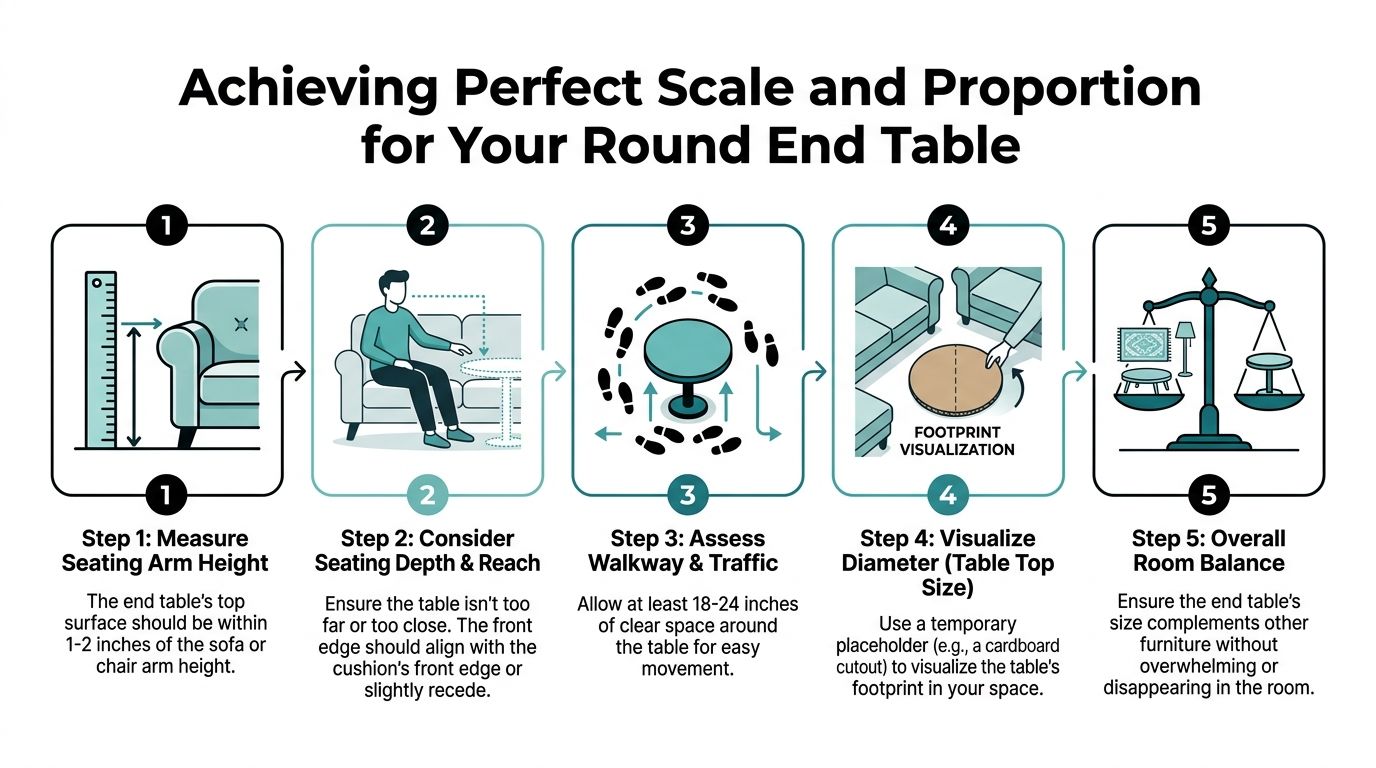
Achieving Perfect Scale and Proportion
Most mistakes with round end tables have nothing to do with style.
They happen because the scale is wrong. A beautiful piece that sits too low, too high, or too wide will always look accidental. Good proportion feels effortless, but it’s measured carefully.
Start with height
The first measurement is the sofa or chair arm. In Southern Ontario interior design methodology, the table top should sit within 1 to 2 inches of the sofa’s arm height, a match associated with 92% user satisfaction, and round shapes can reduce corner collision risks by 35% in narrow layouts common to heritage homes (Pop Maison guide).
That single rule does more work than people expect.
If the table is too low, reaching for a drink feels awkward and the silhouette looks dropped. If it’s too high, the piece begins to read as a plant stand rather than part of the seating arrangement.
Practical rule: Measure from the floor to the top of the sofa arm, then select a table that lands within that narrow range.
Check reach before diameter
A round table can look compact and still sit uncomfortably far away.
The front edge should align with the front of the seat cushion or recede slightly. If it sits too far back, people twist to use it. If it projects too far forward, it interrupts the natural line of movement through the room.
This matters especially beside recliners and deeper lounge seating. With Stressless seating, for example, comfort depends on preserving the chair’s movement while keeping essentials within easy reach.
A quick test helps:
- Sit in the chair you’ll use
- Reach naturally to the side
- Mark the spot on the floor where your hand lands comfortably
- Use that mark to judge placement before buying
For more exact planning, use a proper measuring method before anything is ordered. This guide on how to measure furniture is useful for checking dimensions against real room conditions.
Use floor space wisely
Round tables earn their place in compact rooms because they consume visual space differently from square pieces.
That doesn’t mean every round table is automatically right. Diameter still matters. In a tighter seating group, an oversized top makes the room feel crowded even if circulation technically remains open.
A simple placeholder is often the most reliable tool. Cut a circle from cardboard or use painter’s tape on the floor. Then live with it for a day or two. Walk past it. Sit down beside it. Notice whether it disappears into the arrangement or interrupts it.
Balance the room, not just the sofa
An end table should relate to the full composition.
If the coffee table is visually heavy, the end table may need an open base or slimmer profile. If the sofa has broad track arms, a delicate pedestal can feel too slight. If the rug carries a strong pattern, the table should either simplify the scene or intentionally echo that richness.
A useful shorthand is this:
| Room condition | Better round table direction |
|---|---|
| Deep, generous upholstery | Slightly weightier base |
| Narrow heritage walkway | Tighter diameter, open visual profile |
| Bold patterned rug | Calmer finish or simpler silhouette |
| Minimal modern seating | Cleaner form with restrained detailing |
Good proportion isn’t only about numbers. It’s also about visual weight, reach, and how the table behaves in the room every day.
Curating Materials and Matching Your Style
Material is where a round end table stops being functional furniture and starts becoming part of the room’s character.
This is also where generic advice fails Southern Ontario homeowners. A table that looks convincing in a studio photograph may perform poorly in a Niagara heritage home with seasonal humidity, uneven floors, or a basement-level family room.
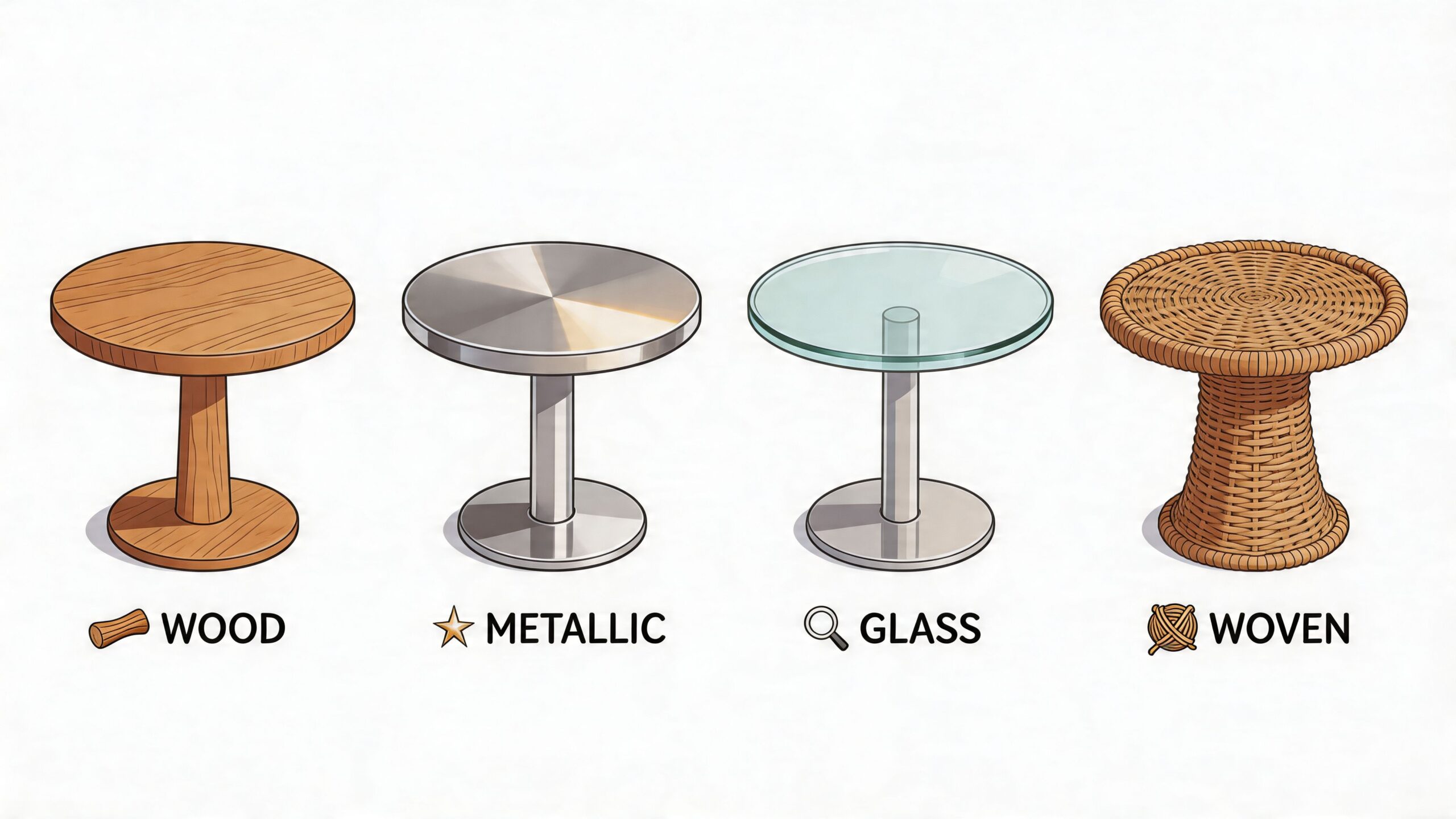
Solid wood for permanence
If you want heirloom quality, solid hardwood remains the benchmark.
That’s particularly relevant in this region. Sixty-eight percent of homes built pre-1980 in Southern Ontario have high moisture potential, and particleboard can warp 30% faster in typical 60% to 80% relative humidity, which is why solid hardwoods such as Canadian maple are the safer long-term choice (Tribesigns material guide).
Stickley is a strong reference point here because the appeal isn’t just appearance. It’s how the material ages, how the joinery holds, and how the finish develops depth rather than showing wear alone.
If the room already includes traditional millwork, antique frames, or older hardwood floors, a solid wood round table often feels native to the architecture.
For a closer look at how species differ in grain, durability, and long-term use, this primer on choosing the right hardwood for longevity and style is worth reviewing.
Metal and glass for visual lightness
Not every room wants the visual density of wood.
In smaller urban spaces, especially where the seating is substantial, a metal-framed or glass-topped round table can create breathing room. The eye passes through the piece more easily, which helps preserve openness.
That said, lighter-looking materials ask more from styling discipline. Glass shows clutter instantly. Metal can feel cold if the room doesn’t include softening elements such as wool, leather, linen, or wood elsewhere.
A useful way to decide is to think about what the room needs more of:
- Warmth and permanence often point to walnut, maple, or oak
- Airiness and edge often suggest metal and glass
- Texture and informality may lead to woven or mixed-material construction
Match the table to the architecture
In a red-brick Niagara home with original trim, I’d usually lean toward a wood finish with visible grain or a hand-finished surface with some depth.
In a sharper condominium interior, a simpler cylindrical form or a cleaner mixed-material piece may sit more comfortably. A round table should still support the room’s vocabulary. It shouldn’t feel imported from another design story.
Some rooms also need more stability than style sites acknowledge. Older floors aren’t always perfectly level. A top-heavy pedestal can become annoying very quickly if it rocks or tips easily. In those settings, a broader base or lower shelf often earns its place.
The most successful occasional tables don’t merely match a sofa. They respect the house they’re entering.
Designer’s Insight
Our designers often pair a rich wood round end table with a Stressless recliner when a room needs to bridge classic architecture and contemporary comfort. The curve of the table softens the chair’s engineered precision, while a hand-knotted wool rug underneath gives the entire corner a more collected feel.
That’s where the full room concept matters. The rug, upholstery, lighting, and table finish should work together. A round end table is small, but it can either sharpen the room’s identity or blur it.
As one factual example of a product type available in the market, Critelli Furniture offers the Roundabout End Table, a round-top design with a lower shelf and tapered legs, available with a glass top in multiple finishes. That kind of construction is useful when a room needs both softer geometry and an additional display layer.
Functionality Beyond Simple Form
A round end table should look composed when nothing is on it. It should also work hard when life is happening around it.
That distinction matters. Some tables are beautiful but impractical. Others are useful but visually flat. The right piece does both.
Decide what must live on the top
A lamp requires steadiness and enough diameter to avoid crowding the edge.
A reading chair may only need room for a cup, glasses, and one book. A family seating area may ask for more. Remote controls, a coaster, a candle, and whatever someone sets down in passing.
That’s why function should be named clearly before style is finalised. Not every end table needs storage, but every end table needs a job.
Storage changes the tone of the room
A drawer creates discretion. A lower shelf creates display.
Neither is automatically better. They support different ways of living.
Consider the trade-offs:
| Feature | Works well when | Less ideal when |
|---|---|---|
| Drawer | You want visual calm and fewer loose objects | The table is very small and the drawer makes it bulky |
| Lower shelf | You want to layer books or decorative objects | The room already feels crowded |
| Plain top with open base | You want a lighter, cleaner look | You need hidden storage nearby |
A lower shelf can be especially useful in a room anchored by “Art for your Floor.” If the rug carries subtle colour shifts, a stack of books or a small ceramic object on that shelf can gently echo them.
Safety is part of luxury
Elegant rooms still have to be lived in.
The category itself reflects that practical thinking. The side table market is projected to reach USD 19.03 billion by 2032, and in Canada round variants hold a 22% market share. One reason is safety. Their lack of sharp corners can reduce injury incidents by 25% in households with children (Fortune Business Insights).
That doesn’t reduce a round table to a family-room compromise. It confirms what many designers already know. A softer edge often improves a room without sacrificing refinement.
If you’re evaluating which pieces deserve priority in a seasonal refresh, this guide to must-have furniture pieces for a stylish home offers a useful broader lens.
Match function to behaviour, not aspiration
Buy for the way the room is used.
If the chair beside the fireplace is where you read every evening, prioritise reach and lamp placement. If the table sits between two conversational chairs, a broad enough top for shared use matters more than storage. If the room hosts grandchildren, a stable base and softened profile are essential.
A good round end table supports rituals. Morning coffee. Evening reading. A place for a lamp that turns a seating corner into a destination.
The Art of Placement and Styling Vignettes
Placement determines whether a round end table looks intentional or merely convenient.
The table may be beautifully made, but if it sits too far from the seating or carries unrelated objects, it won’t contribute to the room’s story. Styling is where function becomes atmosphere.
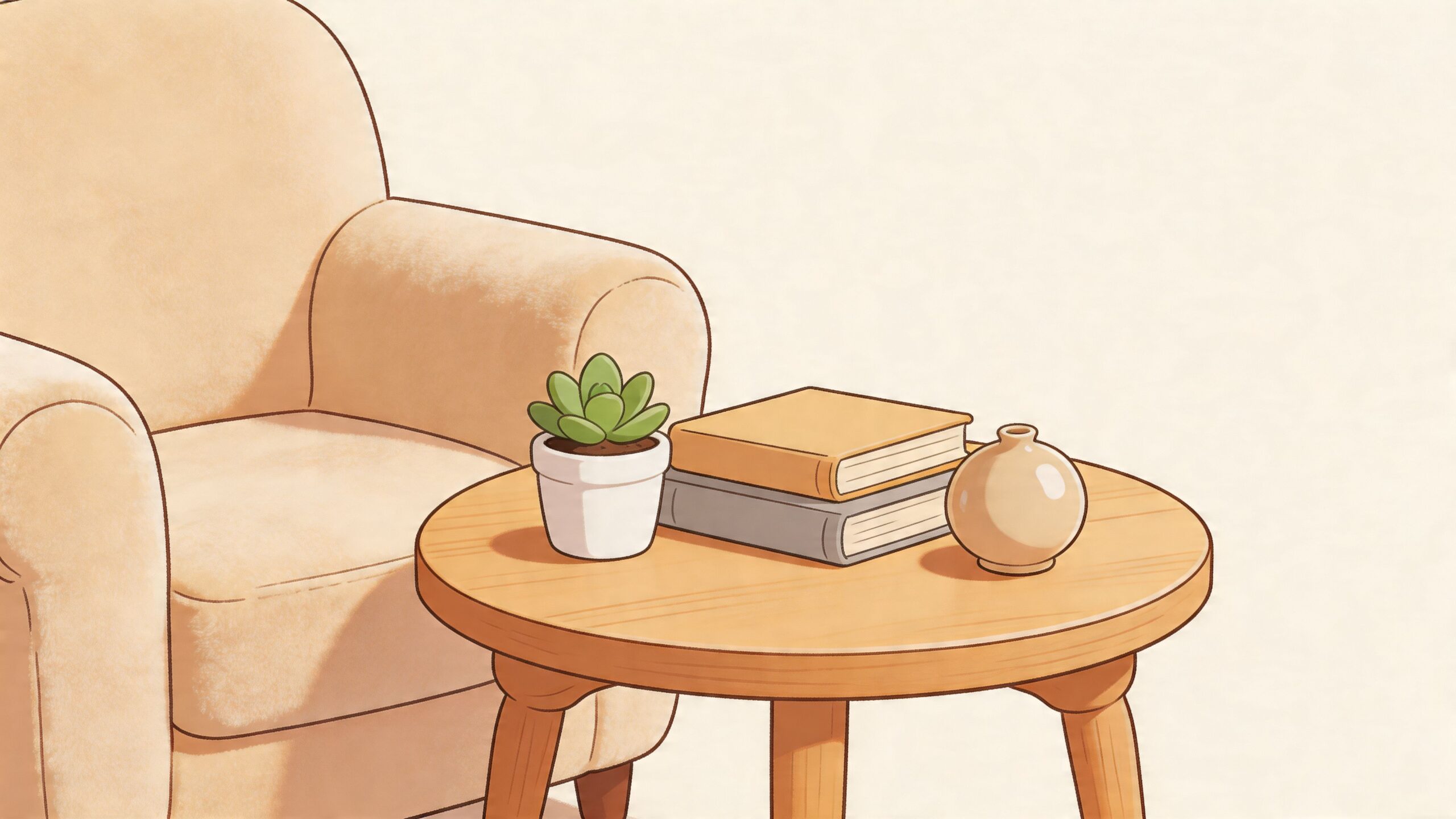
Build a vignette with contrast
A strong tabletop arrangement usually includes variation in height, shape, and texture.
That doesn’t require excess. In fact, the most convincing vignettes are often the most restrained.
Try a simple combination such as:
- A vertical element like a lamp or vase to establish height
- A living element such as a small plant or clipped branch to soften the surface
- A grounding object like a book or decorative box to give the grouping weight
This is less about a formula than rhythm. The objects should speak to one another, not line up like inventory.
A styled table should still leave room for real life. If there’s nowhere to set a glass, it’s overdone.
Let the rug lead
The most elegant rooms rarely style the end table in isolation.
They borrow from the floor upward. If the hand-knotted rug carries tobacco, rust, cream, or indigo, those notes can reappear in the tabletop objects, the lamp shade, or the finish of a small box. That approach creates continuity without making the room feel matched.
This is why the Rug Market philosophy matters so much. Art for your Floor isn’t a slogan. It’s a design principle. The rug often holds the room’s deepest colour intelligence.
The coffee table and end tables should answer it.
For readers who enjoy seeing how styled surfaces relate to the larger seating composition, this guide to the perfectly styled coffee table is a helpful companion.
Placement should respect movement
A vignette only works if the table is positioned properly to begin with.
The placement should allow easy use from the seat while keeping pathways clear. In open-plan homes, that means considering sightlines from adjacent dining and kitchen areas as well. A round table often helps because it reads less abruptly from multiple angles.
This is also why stylists and movers often coordinate more carefully than homeowners expect when preparing or resetting a room. Resources around property stylist transport show how much successful presentation depends on precise placement, protection, and sequencing, even before styling objects are added.
Edit harder than you think
Most styling mistakes come from adding too much.
One lamp, one book stack, one personal object is often enough. If the table has a beautiful top, show it. If the base is sculptural, don’t crowd the surface until the form disappears.
The round end table works best when it feels considered but not fussy. It should support the room’s character, then step back and let the full arrangement speak.
Bespoke Creations and White-Glove Service
Sometimes the right round end table isn’t the one you can take straight off the floor.
It’s the one adjusted to a particular chair height, made in a finish that speaks to existing millwork, or scaled to sit properly in an awkward corner of a heritage home. That’s where bespoke thinking becomes valuable.
The appetite for that kind of tailoring is growing. Ontario has seen a 22% rise in custom furniture inquiries, including requests to pair round end tables with Stressless recliners in high-traffic Toronto condos or to match finishes to artisanal hand-knotted rugs from specialty rug destinations (YouTube trend reference).
When custom makes sense
Customisation is usually worth considering in a few specific situations:
The chair is atypical in height or movement
A standard table may sit too high beside a recliner or too low beside a custom sofa.The room has architectural constraints
Older homes often present narrow passages, uneven floors, or trim details that make standard proportions feel slightly wrong.You’re matching an established interior
If the room already contains heirlooms, custom upholstery, or a hand-knotted rug with distinctive colouration, a bespoke finish often creates a cleaner result than settling for “close enough.”
Service matters after the selection
Luxury isn’t only about what you buy. It’s also about how it enters the home.
A well-made round end table can still disappoint if it arrives without planning, is placed hastily, or isn’t checked in the room where it will live. White-glove delivery matters because occasional tables are relationship pieces. Their success depends on exact placement next to upholstery, rugs, and lighting.
That continuity from showroom to home has always been part of a heritage approach to furnishing. A complete room concept isn’t finished at purchase. It’s finished when the piece is set correctly, the proportions make sense in context, and the room feels whole.
For clients in the Greater Niagara, Hamilton, and Toronto markets, that level of care is often what separates a transaction from a properly resolved interior.
If you’re refining a living room and want a round end table that suits the architecture, climate, and full design story of your home, explore Critelli Furniture. Experience the craftsmanship in person at our King Street Showroom, visit the Rug Market to find your room’s foundation, or book your complimentary design consultation today.