
How to Arrange Bedroom Furniture a Design-Forward Guide

Standing in a bedroom that should feel restful, yet somehow doesn't, is a familiar frustration. The bed fits, the dresser fits, and the nightstands technically fit, but the room still feels off. The path from the door is awkward, the windows seem to fight the layout, or the whole space feels more like storage than retreat.
That discomfort isn't only about square footage. It's about proportion, rhythm, and the quiet psychology of a room that supports sleep instead of interrupting it. Good arrangement solves practical problems, but it also changes how the room feels at the end of a long day.
Beyond Blueprints A Legacy of Creating Sanctuaries
A bedroom rarely fails because it lacks furniture. It fails because the pieces haven't been given a clear relationship to one another. A handsome bed can feel imposing in the wrong place. A beautiful dresser can make the room feel crowded if it interrupts the natural route from the door. Even an heirloom quality collection loses its presence when the layout is working against it.
That's why how to arrange bedroom furniture is never just a matter of pushing large pieces against the nearest wall. The room has to offer ease the moment someone enters it. It has to feel organised, settled, and subtly protective. In many Southern Ontario homes, especially those with older architecture, that takes more judgement than a generic floor plan can offer.
Critelli Furniture was founded in 1914 by Joseph Critelli and his son Thomas in Thorold, Ontario, beginning a family-run legacy that now spans five generations in the Niagara Region, as noted in this furniture industry archive. That heritage matters because bedroom planning benefits from long memory. Certain principles remain timeless, even as tastes become more design-forward and more bespoke.
Sanctuary first, furniture second
The strongest bedrooms begin with a simple shift in mindset. The goal isn't to display every piece that came in the set. The goal is to shape a sanctuary.
A well-arranged room should do three things at once:
- Support daily movement so nothing feels pinched or obstructed
- Create visual calm through proportion, alignment, and restraint
- Reflect the person living there through materials, colour, and personal layers
A bedroom should feel composed before it feels decorated.
That's why experienced designers start with function, then layer in timeless craftsmanship, artisanal texture, and the quieter details that make a room feel personal. The result is never accidental. It's curated.
The Unwavering Principles of Placement
The bed decides almost everything. Once it's placed correctly, the rest of the room usually begins to resolve. When it's placed poorly, every other piece has to compensate.
Start with the focal wall
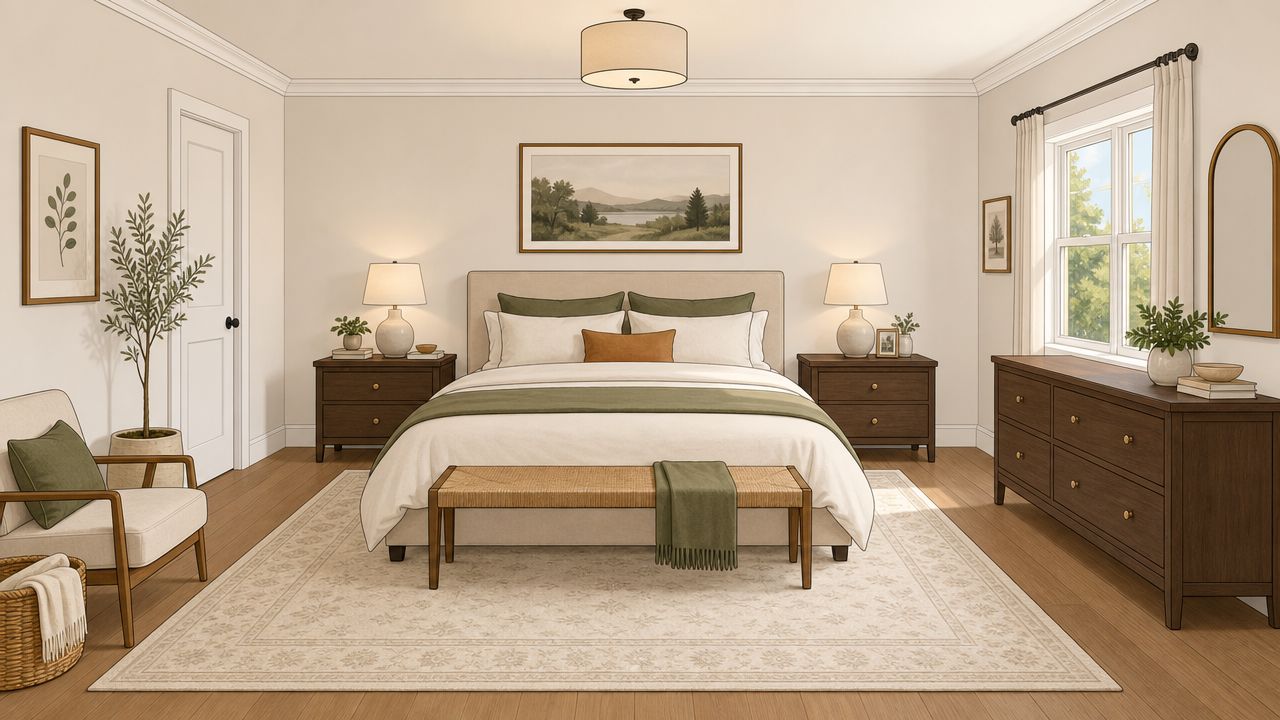
In most bedrooms, the bed belongs on the strongest uninterrupted wall. That wall often becomes the room's visual anchor because it can hold the headboard comfortably and support balanced placement on either side. A bed floating randomly from wall to wall tends to make even expensive furnishings feel unsettled.
The best focal wall isn't always the longest one. It's the wall that allows the room to breathe while preserving access to windows, wardrobes, and circulation. In heritage homes with unusual trim or offset openings, that may mean choosing the wall that offers the greatest sense of order rather than the most obvious symmetry.
Use the commanding position when the room allows it
A bedroom feels calmer when the sleeper can see the door without being directly in line with it. Designers often refer to this as the commanding position. It gives the bed a sense of shelter while keeping the entrance visible, which supports a stronger feeling of ease and security.
Southern Ontario space-planning guidance also requires practical clearance around that ideal placement. In local bedroom layouts, expert methodology calls for 24 to 30 inches (60 to 76 cm) of walking clearance around the bed and in front of dressers to prevent blocked flow, according to Southern Ontario bedroom planning guidance.
Practical rule: If drawers can't open comfortably or someone has to turn sideways to pass the bed, the layout isn't finished.
Protect the traffic path
A good bedroom plan is built around movement, not just furniture dimensions. The route from the doorway to the bed should feel immediate and natural. So should the path to the closet, the dresser, and any ensuite.
Three placement checks tend to reveal problems quickly:
Entry check
Stand at the door and note the first obstruction. If the eye lands on the side of a dresser or the corner of a bed frame, the room often feels tighter than it is.Drawer check
Open every drawer and cabinet mentally before placing the piece. Secondary furniture must work in use, not only in elevation.Bedside check
Each accessible side of the bed should feel intentional. If one side is generous and the other is cramped, the room usually feels visually lopsided as well.
What works and what doesn't
| Placement choice | What works | What often fails |
|---|---|---|
| Bed on a solid wall | Creates order and stability | Can fail if it blocks the room's best circulation |
| Bed facing the door indirectly | Supports the commanding position | Loses comfort if directly aligned with the doorway |
| Dresser on a secondary wall | Keeps storage useful but quiet | Overcrowds the room if placed in a primary pathway |
A strong layout doesn't ask the room to do tricks. It respects architecture, scale, and the body moving through space.
Arranging for Your Room's Unique Character
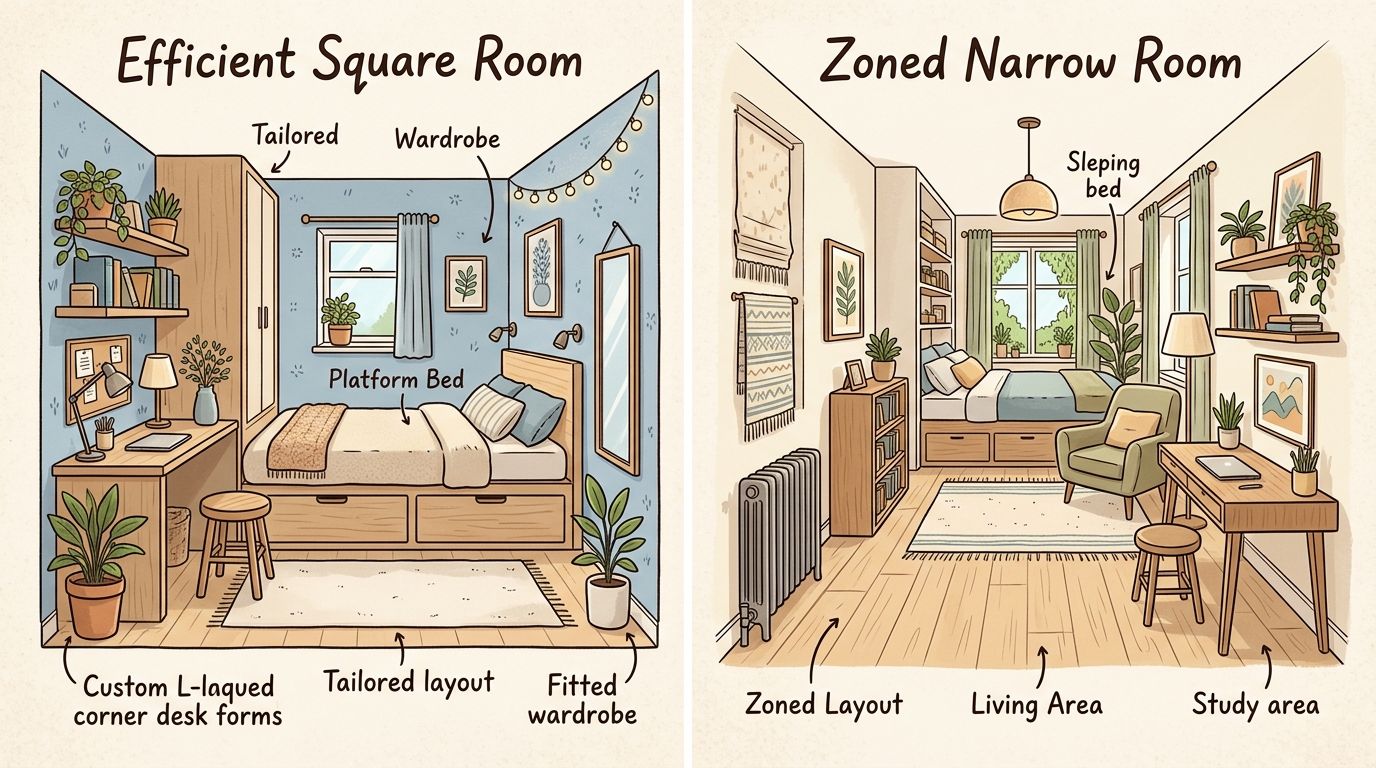
Not every bedroom wants the same solution. A compact room needs discipline. A large one needs structure. A difficult room needs strategy. Southern Ontario homes often add another layer, because narrow urban rooms and older heritage layouts don't follow textbook assumptions.
Small bedrooms need editing, not apology
A small bedroom usually looks best when the layout is restrained. That means choosing fewer pieces with more purpose. One well-scaled bed, proper bedside surfaces, and a storage piece that earns its footprint will create a more composed result than squeezing in every possible category of furniture.
In smaller rooms, these choices usually work well:
- Choose a visually lighter bed if the room already has heavy trim, dark flooring, or low natural light
- Use vertical storage instead of adding multiple low pieces across several walls
- Keep the centre open so the room reads as calm rather than compressed
What doesn't work is overfurnishing in the name of completeness. A bedroom doesn't need to look full to look finished.
Large bedrooms need zones
A generous bedroom can feel surprisingly empty if everything is pushed to the perimeter. Large rooms benefit from quiet zoning. A sleeping area can remain primary while a reading chair, bench, or dressing area creates a second layer of use.
A spacious bedroom should feel intimate, not underfurnished.
The key is to keep each zone visually tied to the main composition. A chair placed in an empty corner without lighting or a side table tends to feel abandoned. A reading spot anchored with a lamp and a considered textile feels intentional.
Long narrow rooms need a different orientation
Many urban homes deal with bedrooms that are more elongated than balanced. In those rooms, forcing the bed onto the long wall often exaggerates the tunnel effect.
For long, narrow bedroom layouts common in Canadian urban housing, including rooms around 9' x 14', functional layouts improve when the bed is turned so the headboard rests on a shorter end wall, according to guidance for long and narrow bedroom planning. That orientation widens the perceived depth of the room and helps create clearer traffic zones.
This comparison usually makes the decision easier:
| Room shape | Better choice | Usually less successful |
|---|---|---|
| Long and narrow | Bed on the short wall | Bed on the long wall with cramped side clearances |
| Nearly square | Centred bed on the strongest wall | Off-centre bed without a balancing reason |
| Oversized | Bed plus a defined secondary zone | Furniture scattered around the perimeter |
Another issue matters in narrow rooms. Tall furniture near windows can make the room feel noticeably smaller by interrupting light. Where possible, storage should go to solid walls, and slimmer vertical pieces often perform better than broad, heavy case goods.
Off-centre doors and windows need balance, not denial
Many heritage homes in St. Catharines, Hamilton, and across Niagara come with architectural quirks that don't cooperate with standard layout formulas. A door may sit awkwardly near one corner. A window may be offset just enough to make symmetrical placement impossible. Ignoring that asymmetry usually makes it more obvious.
In those rooms, designers often choose between two better options:
- Float a key piece slightly away from the wall to correct visual imbalance
- Use a larger secondary piece such as a dresser or upholstered bench to rebalance the room's weight
The right answer depends on what the architecture allows. Some rooms want formal symmetry. Others need thoughtful asymmetry to feel honest. The mistake is pretending every room has a perfect centre line when clearly it doesn't.
Placing Key Pieces with Scale and Proportion
Once the bed is placed, the secondary furniture has to support it rather than compete with it. The way these elements interact determines whether a bedroom feels beautifully curated or chaotic. A room can have fine materials and timeless craftsmanship, yet still feel wrong if every piece is the wrong visual weight.

Nightstands should relate to the bed
Nightstands are often chosen too late, as if they're accessories. They're not. They frame the bed, carry the bedside lighting, and establish whether the room reads as balanced.
A substantial upholstered or wood bed usually wants bedside pieces with enough presence to hold their own. A delicate table beside a commanding headboard can look accidental. On the other hand, broad nightstands in a modest bedroom can make the bed feel squeezed.
Designer's Insight
A strong bed often looks better when paired with visually lighter nightstands. That contrast keeps the room grounded without making the sleeping area feel heavy. In a design-forward room, a Stickley bed can carry remarkable presence when the surrounding case pieces step back slightly.
Dressers belong where they can work
The dresser should sit where it can be used comfortably and seen as part of the composition, not as an obstacle. Opposite the bed is often effective, but only if the room can support the drawer depth and standing space in front.
In tighter bedrooms, a tall chest may serve better than a wide low dresser. In broader rooms, a longer dresser can anchor a wall and offer a proper surface for lighting, art, or a mirror. Selection and placement go together. That's the heart of a complete room concept.
A useful way to judge proportion is to ask whether the room feels top-heavy, bottom-heavy, or evenly settled. If all the tallest pieces cluster on one side, the room tilts visually. If every piece is low and horizontal, the room may feel flat.
Accent seating should solve a real need
A chair, bench, or small ottoman can complete a bedroom beautifully, but only if it has a purpose. Seating works best when it supports reading, dressing, or the ritual of setting out clothing for the next day. It doesn't work when it becomes a decorative afterthought that collects clutter.
These placements tend to succeed:
- A chair near natural light with a lamp and table
- A bench at the foot of the bed when the room has enough length
- A compact stool or ottoman near a wardrobe or dressing area
For readers thinking beyond layout alone, mattress comfort also shapes how the room functions at night and in the morning. This guide to the best mattress for back pain is a useful companion when the arrangement is being planned as part of a broader sleep-focused update.
Grounding Your Design with Rugs and Lighting
Furniture arrangement gives the room structure. Rugs and lighting give it atmosphere. One works from the floor up. The other shapes the room from above and at eye level. Together, they turn a practical layout into something immersive and finished.
The rug is the room's foundation
A bedroom rug should do more than soften the floor. It should anchor the bed, unify surrounding furniture, and establish the room's palette. Critelli's Rug Market describes hand-knotted, artisanal rugs as “art for your floor,” with specialists guiding collectors through contemporary and traditional heirloom options that shape the room's colour and character, as noted in this profile on the Rug Market.
That philosophy is sound because the rug often resolves decisions the furniture alone cannot. It can introduce warmth beneath a precisely designed bedroom, soften strong wood tones, or connect a bespoke headboard to the surrounding textiles.
Three rug placement habits tend to produce a more polished result:
- Let the rug extend beyond the bed so the room feels anchored rather than perched
- Keep at least the front legs of adjacent pieces visually connected when possible
- Choose texture deliberately so the rug supports the architecture instead of fighting it
For homes with hardwood throughout the bedroom, practical placement matters as much as aesthetics. These expert tips for wood floor rugs offer useful guidance on protecting the floor while keeping the room visually balanced.
Lighting should come in layers
Many bedrooms still rely on a single overhead fixture. That creates brightness, but not comfort. A well-arranged bedroom needs light for waking, dressing, reading, and winding down. One source can't do all of that gracefully.
A layered plan usually includes:
| Lighting layer | Role in the room | Best use |
|---|---|---|
| Ambient | General illumination | Ceiling fixture or subtle overhead source |
| Task | Focused function | Bedside lamps, reading lamps, dressing light |
| Accent | Atmosphere and depth | Soft secondary light for evening calm |
Floor and ceiling should speak to each other
The most elegant bedrooms feel coherent from the rug upward. A hand-knotted rug with rich pattern can support simpler lighting. A quieter floor palette may allow for more sculptural lamps or artisanal sconces. The room doesn't need every element to make a statement.
Soft light over a grounded rug gives a bedroom its evening character.
That relationship is what makes a room feel curated instead of assembled. The rug stabilises the composition. The lighting controls the mood.
From Arranged to Artfully Curated
A good layout solves function. A finished bedroom goes further. It feels chosen. It reflects taste, habit, and a certain confidence about what belongs and what doesn't.
Symmetry brings order, asymmetry brings ease
Symmetry remains one of the most reliable ways to give a bedroom a timeless, composed presence. Matching nightstands, balanced lamps, and centred artwork create a restful visual rhythm. That approach suits formal architecture, classic millwork, and rooms where the bed deserves quiet emphasis.
Asymmetry can be just as successful when handled deliberately. One larger nightstand, an offset floor lamp, or a bench paired with a single chair can create a more relaxed, modern mood. The difference between elegant asymmetry and visual drift is intention.
Personal layers should feel edited
Art, books, throws, and objects with memory give the room character, but they should support the architecture rather than clutter it. The best bedrooms rarely display everything at once. They edit.
A few finishing touches often do the most work:
- One meaningful artwork grouping above a dresser or opposite the bed
- A considered textile layer that adds softness without excess bulk
- A tray, bowl, or small object collection that gives surfaces purpose
For homeowners updating existing furniture rather than replacing every piece, practical surface refreshes can help secondary items sit more comfortably within a new scheme. These Quote My Wall's vinyl wrap tips can be a useful reference when exploring cosmetic updates thoughtfully.
A complete room should arrive finished
Arrangement is only part of the experience. The transition from showroom to home matters too, especially when a bedroom includes substantial furniture, artisanal rugs, and carefully planned placement. Critelli's White-Glove Delivery serves the Greater Niagara, Hamilton, and Toronto markets, handling inspection, assembly, precise placement, and complete packaging removal for a smooth arrival, according to the company's delivery overview.
That level of care supports the complete room concept. Fine furniture shouldn't be dropped at the threshold. It should arrive positioned, composed, and ready to live with.
A curated bedroom isn't about perfection. It's about alignment. The architecture, the furnishings, the lighting, and the personal details should all feel as though they belong to the same story.
Experience heirloom quality, timeless craftsmanship, and a curated selection at Critelli Furniture. From luxury furniture Niagara clients seek for complete room concepts to hand-knotted rugs Ontario collectors admire, the collection reflects a design-forward approach shaped by generations of expertise. Experience the craftsmanship in person at our King Street Showroom. Visit the Rug Market to find your room's foundation. For bespoke guidance, interior design services St. Catharines homeowners value, and custom furniture Southern Ontario families can live with beautifully for years, book your complimentary design consultation today.