
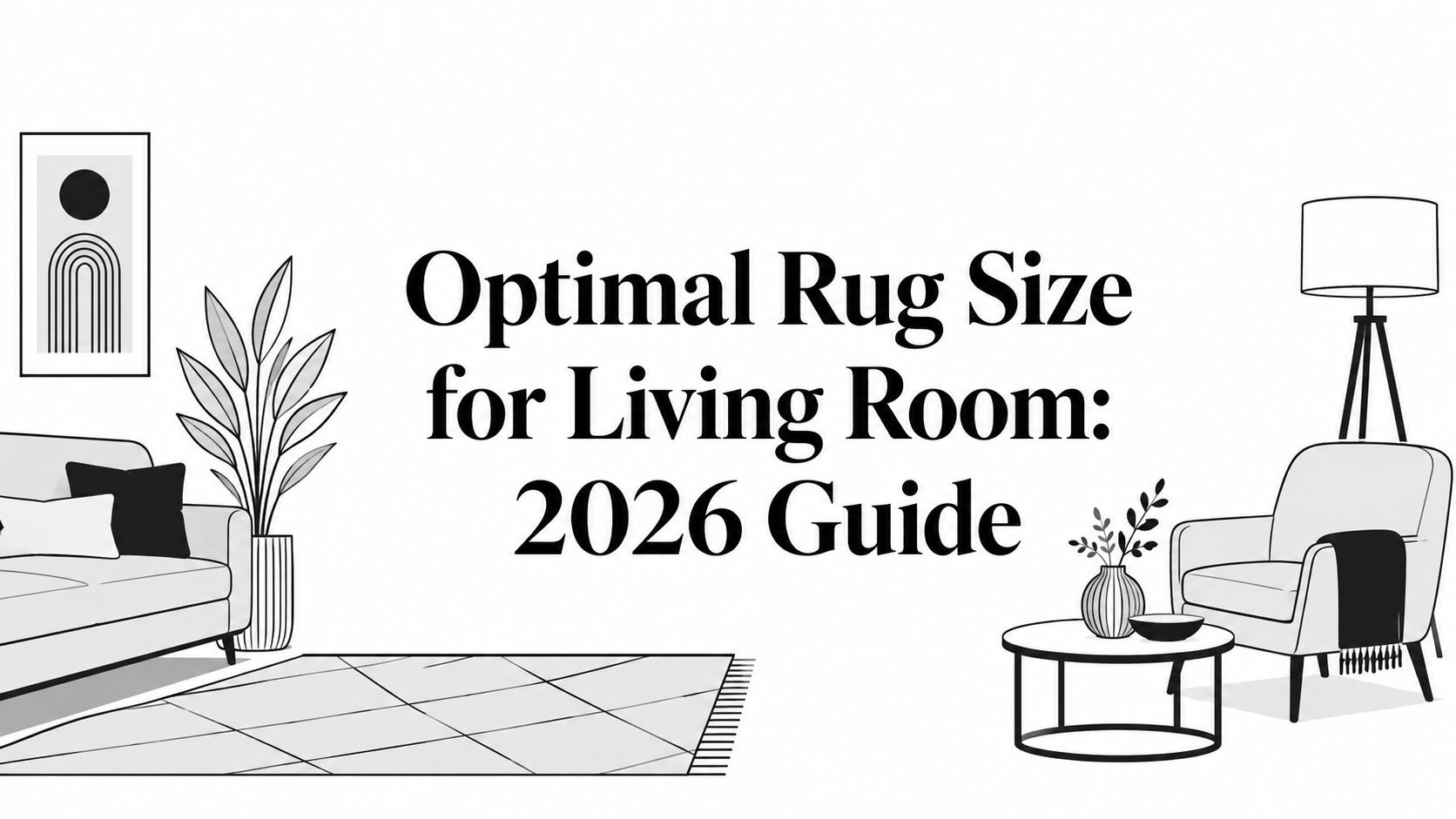
Optimal Rug Size for Living Room: 2026 Guide

A living room can hold all the right pieces and still feel unsettled. The sofa is handsome, the chairs are well scaled, the lighting is warm, and the palette is organised. Yet the room doesn't land. In many homes, the cause is simple. The rug is too small, too close to the walls, or disconnected from the seating it's meant to anchor.
That imbalance becomes more noticeable in premium interiors. Heirloom quality upholstery, custom furniture in Southern Ontario, and design-forward layouts ask more from a rug than mere surface coverage. The rug has to frame conversation, support circulation, and visually quiet the room so each piece feels intentional rather than scattered.
For many homeowners, the problem appears after the furniture has already arrived. A rug is chosen late, often from a list of standard sizes, and placed where it fits rather than where it belongs. The result is a room that looks furnished but not composed. The same issue appears in homes where the architecture is strong but the floor plane has been left unresolved. Even beautifully chosen seating can seem to float.
That's why many seasoned designers still treat the rug as the first real act of composition. It behaves much like artwork, except it works at the scale of the whole room. For readers also thinking about adjacent spaces, resources on unique wall decor for dining spaces can help clarify how visual weight should travel from one zone to the next in an open home.
The Soul of the Room An Introduction
Since 1914, a family-run design perspective has shaped how many Southern Ontario interiors are approached. The enduring view is that a rug isn't a finishing touch. It's Art for your Floor, and often the element that gives the room its centre of gravity.
A well-sized rug does more than sit beneath a coffee table. It tells the eye where the living room begins and ends. It gives upholstered pieces a shared purpose. It also softens the transition between architecture and furnishings, which matters in homes across the Greater Niagara, Hamilton, and Toronto markets where open-concept layouts demand visual order.
A room rarely feels complete when the floor plane has been treated as leftover space.
That principle matters even more when the furnishings themselves reflect timeless craftsmanship. A hand-finished wood frame, a beautifully crafted chair, or a bespoke sofa deserves a foundation that matches its presence. Without that foundation, the room can feel pieced together rather than curated.
In practical terms, choosing the right rug size for living room design means balancing mathematics with mood. The measurements matter. The proportions matter. The material matters. So does the feeling the room should carry when someone enters and takes a seat.
The Foundational Rules of Rug Placement
The rules that govern rug placement have lasted because they work. They aren't decorating folklore. They are spatial tools that help a room feel settled, legible, and comfortable to move through.
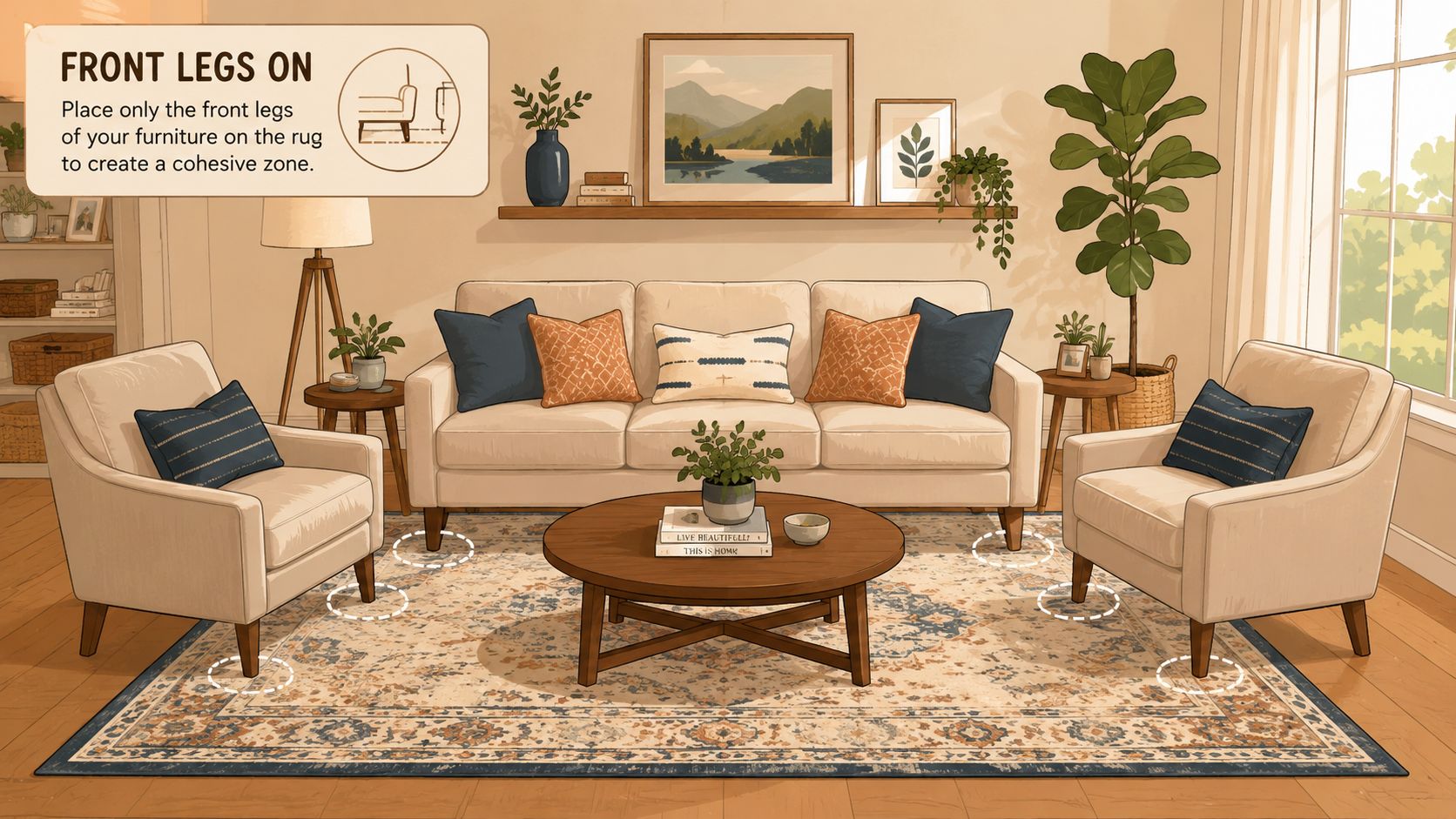
Front Legs On Is the Reliable Standard
For most living rooms, the most dependable arrangement is the one designers return to again and again. Historical design standards confirm that at least the front two legs of major furniture pieces should sit on the rug to define a space. A critical guideline is that the rug must be at least 6 inches wider than the sofa on both sides, with 8 inches being ideal. For walkways, professionals mandate 30 to 36 inches of clearance between large furniture pieces according to The Spruce's rug size guide.
This approach works because it creates connection without forcing every piece into a rigid footprint. The rug becomes the visual field beneath the conversation area, while the room still breathes around it.
For homeowners refining seating placement first, a furniture planning reference like living room arrangement guidance can help clarify the footprint before a rug is selected.
All Legs On Feels Expansive
The second approach places the full seating group on the rug. This is often the most luxurious look, especially in larger rooms where the rug needs to behave almost like an architectural plane beneath the furniture.
It works best when the room has enough depth and width to support it. In a constrained room, forcing all legs onto the rug can make everything bunch inward, and the seating begins to feel crowded rather than composed.
The Floating Rug Is Narrowly Useful
A floating rug sits under the coffee table but barely engages the main seating. It can serve a purpose in a compact room or when a statement rug is being layered for effect, but it has to be handled carefully.
Used carelessly, it's the arrangement that most often makes a room feel undersized. The eye reads the rug as the centre of the room, then notices that the furniture doesn't belong to it.
Practical rule: If the rug can't support the seating area in some meaningful way, it's usually not the right size for the room.
The Bare Floor Border Matters
The visible floor around the rug is not wasted space. It frames the composition. Too little border and the rug feels like nearly wall-to-wall carpeting. Too much and it shrinks the conversation area.
A good rug size for living room planning considers the floor that should remain seen, the seating that must feel anchored, and the circulation paths that must stay clear. That's where many expensive mistakes happen. The rug is judged in isolation rather than in relationship to furniture, walls, and movement.
Measuring Your Space for Timeless Proportions
A living room can look generous on paper and still feel wrong once the rug arrives. I have seen handsome sofas, heirloom tables, and well-made chairs lose their presence because the rug was measured to the walls instead of to the life of the room.
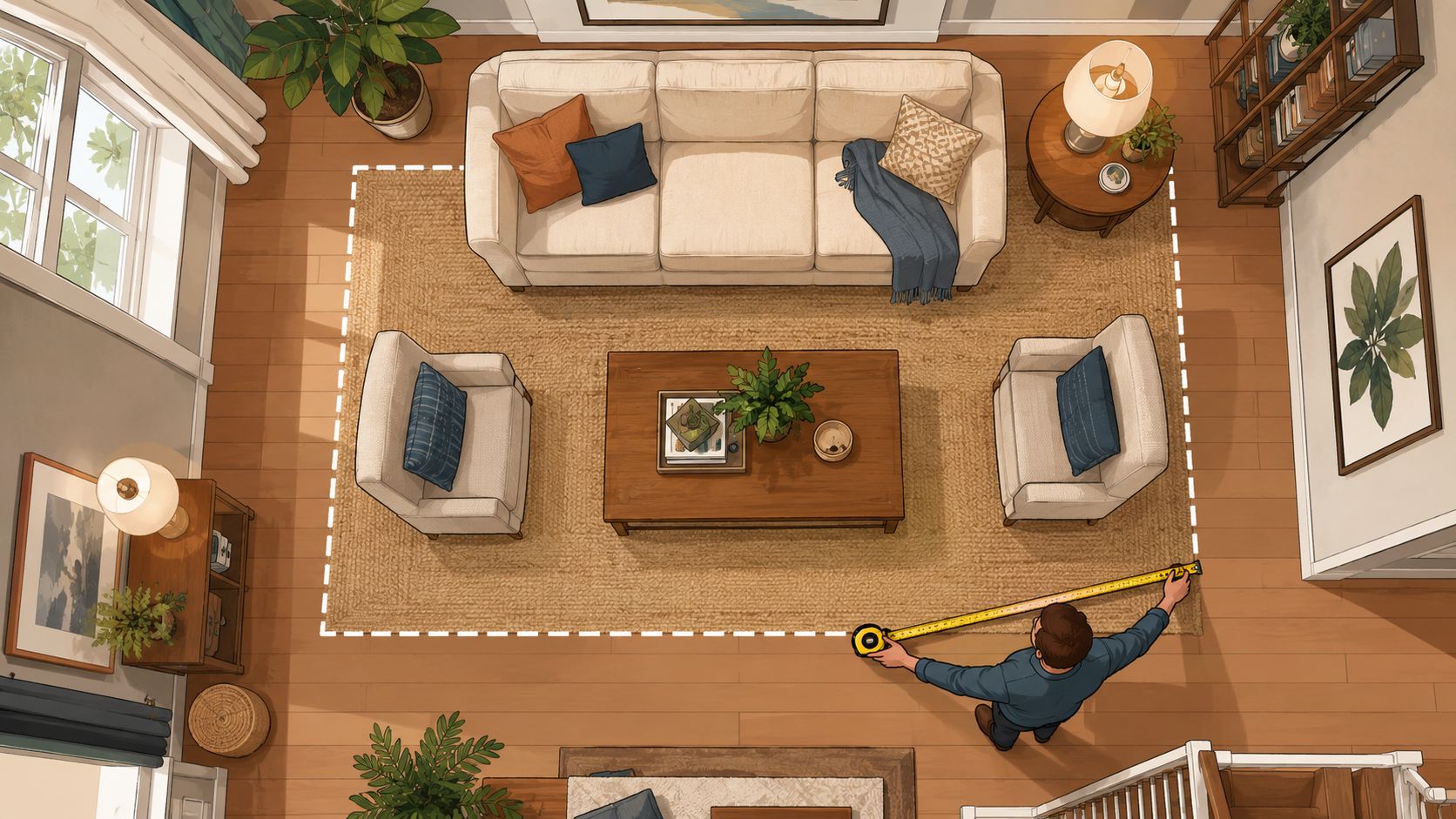
Measure the Seating Footprint First
Start with the furniture plan. Place the sofa, chairs, and coffee table where they are meant to live, then measure the full seating footprint those pieces create together. That is the area the rug must support.
This approach matters in Southern Ontario homes, where room proportions vary sharply between older city houses, newer suburban builds, and compact condominiums. Two living rooms can share similar wall dimensions and still require different rug sizes because the furniture scale, traffic paths, and sightlines are doing different work. A rug should be chosen as a foundational piece of art within that composition, not as a generic rectangle that happens to fit the floor.
Leave a visible floor border around the rug so the room has a clear frame. The exact amount depends on the architecture and the furniture depth, but the border should look intentional, not accidental.
Use Tape Before Ordering
Painter's tape is still one of the best tools in the room. Mark the proposed rug outline directly on the floor and live with it for a day or two. Walk the path from the entry. Sit down. Pull a chair out slightly. You will learn more from that taped outline than from a product page.
A taped plan exposes three common mistakes:
- Pinched circulation: pathways around the coffee table or between seating pieces start to feel cramped.
- Weak furniture support: the rug misses the legs that should anchor the arrangement.
- Poor centring: the rug is aligned to the room shell rather than to the conversation area.
For homeowners who want to sketch a room before taping it out, Virtual Tour Easy's guide for floor plans offers a useful starting point for thinking through room geometry.
A careful measuring checklist also helps when the room includes custom upholstery or several large pieces. This furniture measuring reference is a practical way to confirm dimensions before anything is ordered.
Read the Rug in Relation to the Architecture
Good proportion is never about the rug alone. It is about the relationship between the rug, the furniture, and the architecture around them.
That is especially true in open-concept homes, where the living room is visible from the kitchen, dining area, or front hall. In those spaces, the rug needs enough presence to hold the seating group together, yet it also needs to respect the room's broader lines. If it runs too small, the furniture looks disconnected. If it runs too large, the room loses definition and the rug stops feeling curated.
The best results come from measuring with the whole room in mind. That is how a rug begins to act less like an accessory and more like the ground plane for everything you place above it.
Matching Rug Size to Common Living Room Layouts
A rug should answer the room's actual layout, not a generic chart. The same dimensions can feel perfect in one plan and entirely wrong in another.
The Classic Sofa and Two Chairs
This is the arrangement many people recognise first. A sofa faces one or two chairs, with a coffee table at the centre. In this layout, the rug's job is to gather the pieces into a conversation area without making them feel locked together.
The usual failure is choosing a rug that only supports the coffee table. A better solution lets the sofa and chairs engage the rug, usually through front-leg placement. The eye then reads one composed zone rather than several separate objects.
The Large Sectional
Sectionals complicate rug size for living room decisions because they create a broad footprint that can fool the eye. A sectional may seem to dominate the room, yet still require a larger rug than expected to prevent the arrangement from looking top-heavy.
The rug should extend far enough to support the sectional's open edge and any accompanying chairs or ottomans. If the rug stops too close to the sectional, the seating appears compressed and the room loses ease. For homeowners planning around this type of upholstery, sectional layout considerations can help frame how the rug should relate to the full seating composition.
Open-Concept Plans
Open layouts need rugs to define zones. In these homes, the living area isn't boxed in by four walls, so the rug often acts as the strongest boundary.
That's why larger sizes tend to succeed. The rug has to hold the seating arrangement firmly enough that the living zone feels deliberate, not like furniture drifting inside a larger shell.
Designer's Insight
In an open-concept room, the rug should relate to the seating group first and the architecture second. When those priorities are reversed, the layout often looks centred in the room but disconnected in use.
L-Shaped and Irregular Rooms
Generic advice falls short. Surveys show 34% of Ontario homeowners live in homes with non-standard, L-shaped or open-concept room shapes, yet fewer than 5% of online rug guides address proportionality for these complex spaces according to Bloomsburg Carpet's living room rug guide.
In these rooms, the rug shouldn't chase every corner of the architecture. It should respond to the furniture zone. That usually means establishing a strong rectangle beneath the main living area, even when the room itself turns, widens, or merges into another space.
A useful way to judge common layouts is this:
| Layout | What usually works | What usually fails |
|---|---|---|
| Sofa and two chairs | Rug supports all front legs and coffee table | Rug sits only under the table |
| Large sectional | Rug extends beyond the sectional's active edges | Rug ends too close to the sofa line |
| Open-concept room | Rug defines the living zone clearly | Rug feels centred in the room, not under the seating |
| L-shaped room | Rug follows the seating group | Rug tries to mirror every angle of the architecture |
The best result is almost always the one that makes the seating look intentional first.
Beyond Size Shape and Material Considerations
Size establishes order, but shape and material create character. Once the footprint is correct, the rug begins to act as a visual and tactile counterpoint to the furniture around it.
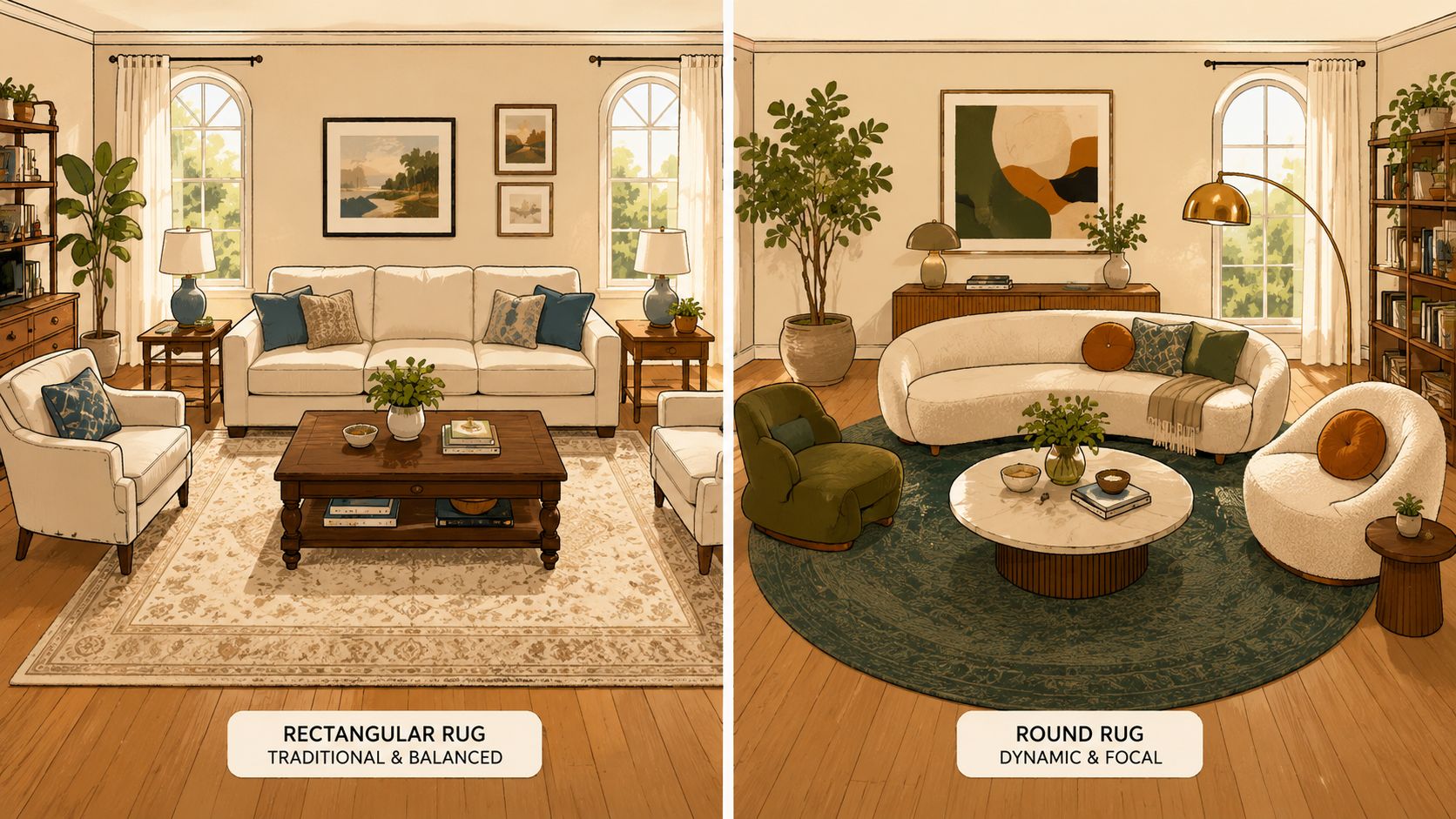
Shape Changes the Room's Temperament
A rectangular rug brings structure and architectural clarity. It suits most living rooms because it aligns naturally with sofas, consoles, and room edges. A round rug does something else. It softens a plan, eases hard lines, and can be especially persuasive beneath a curved seating arrangement or in a room with a strong angular feature.
The shape should either reinforce the architecture or deliberately relieve it. Both can work. The wrong move is choosing an unusual shape to be different when the room calls for steadiness.
Material Signals Quality Immediately
Material is where a rug moves from functional to artisanal. Among North American high-end furniture buyers, artisan techniques such as hand-knotted weaving are highly sought for their rarity and heritage value, directly aligning with the 'heirloom quality' and 'timeless craftsmanship' expected in luxury rug selections according to Zigpoll's high-end furniture buyer trends analysis.
That preference makes sense in a well-curated interior. A hand-knotted wool rug has gravity. It carries variation, depth, and the quiet irregularity that gives a room soul. A flatter or simpler weave can be equally effective, but it creates a different mood. One feels layered and collected. The other feels crisp and restrained.
For readers considering material, scale, and placement together, this guide to the best area rugs in Canada offers a useful reference point.
A rug should do what framed artwork does on a wall. It should set tone, establish colour relationships, and make the surrounding pieces feel more intentional.
That's why it helps to think of the floor and walls as part of the same composition. For anyone refining that relationship, ideas on how to decorate your living room with art can help clarify how pattern, colour, and visual emphasis should be distributed through the room.
A room with Stickley case goods, a sculptural chair, or a refined leather silhouette benefits from a rug that doesn't merely match. It should complete the atmosphere.
Experience Your Rooms Foundation at Critelli
The right rug does two jobs at once. It solves proportion, and it deepens character. It anchors the seating, supports circulation, and gives the room the composed feeling that separates a decorated space from a finished one.
That level of discernment matters even more as premium interiors continue to command attention. In Canada's home furniture market, the premium segment is projected to grow at a compound annual growth rate of 11.05% through 2031, reflecting sustained interest in high-end, design-led furnishings in Southern Ontario according to Mordor Intelligence's Canada home furniture market report.
For homeowners who want that foundation chosen with care, a century-old perspective still carries weight. Since 1914, a family-run approach has linked craftsmanship, proportion, and complete-room thinking in a way that suits discerning homes across Greater Niagara, Hamilton, and Toronto. The transition from showroom to home matters as much as the selection itself, which is why the Rug Market in Hamilton remains such a valuable starting point for those looking for hand-knotted rugs in Ontario, luxury furniture Niagara, and interior design services St. Catharines clients can trust.
Visit Critelli Furniture to explore a curated selection shaped by timeless craftsmanship and design-forward thinking. Visit the Rug Market to find your room's foundation. Experience the craftsmanship in person at our King Street Showroom. Book your complimentary design consultation today. With white-glove service extending across Southern Ontario, the path from selection to placement feels every bit as considered as the room itself.