CRITELLI'S SUMMER SALE | UP TO 70% OFF



Best Modular Sectional Sofa Canada Options 2026


A Southern Ontario homeowner often reaches the same point in the search. The old sofa no longer suits the room, the family has changed how it lives, and every online listing claims to be flexible, comfortable, and beautifully made. Yet the practical questions remain stubbornly real. Will it fit a condo lift in Toronto. Will it sit properly in a century home near Niagara-on-the-Lake. Will the fabric stand up to winter boots, dry indoor heat, and everyday use without looking tired in a few seasons.
That's where a modular sectional becomes more than a trend piece. For many Canadian homes, it's the rare category that can answer both aesthetic and architectural needs. It can soften an open-plan great room, define a smaller urban living area, or adapt when a family moves, renovates, or wants the room to work harder.
Good guidance matters here. A sofa of this scale isn't an impulse purchase. It's part comfort, part floor plan, part material science, and part logistics. Households looking for heirloom quality want more than a fashionable silhouette. They want confidence that the piece will live well, arrive well, and continue to feel right years from now.
Table of Contents
- An Introduction to Curated Living
- The Art of Modular Configuration
- Planning Your Layout for Canadian Homes
- A Foundation of Quality Materials and Craftsmanship
- Investing in Sustainable and Timeless Design
- The Seamless Journey from Showroom to Home
- Styling Your Sectional and Completing the Room
An Introduction to Curated Living
The search for a modular sectional sofa in Canada usually begins with an image and ends with a list of difficult trade-offs. One household wants a generous lounge piece for film nights, but the room also needs clear walking paths. Another wants a cleaner, design-forward profile, but still needs enough depth for real comfort. The sofa has to be beautiful, yet it also has to survive the ordinary rhythm of Canadian family life.
That tension is why modular seating has become so compelling. It offers a way to think beyond a fixed silhouette. Instead of forcing the room to accept one rigid form, the owner can shape the arrangement around architecture, habits, and future changes. That matters in Southern Ontario, where homes vary dramatically. A downtown condo, a post-war family home, and a heritage property all ask different things of the same piece of furniture.
A careful buyer also wants reassurance that style won't come at the expense of sound judgement. Heritage businesses tend to understand that distinction best. There's a difference between selling a sofa and curating a room that will remain useful and elegant over time. That point becomes clearer when the selection is viewed through a legacy of family stewardship, design literacy, and long-standing service, as reflected in the story behind Critelli's heritage and family-run roots.
A sectional isn't just seating. In a well-composed room, it becomes the architectural centre of daily life.
The strongest modular choices tend to feel calm rather than clever. They don't announce their flexibility for its own sake. They make the room more liveable. They frame conversation, support posture, welcome guests, and adapt when the home itself changes. For busy professionals furnishing homes across the Greater Niagara, Hamilton, and Toronto markets, that balance is often the true luxury.
The Art of Modular Configuration
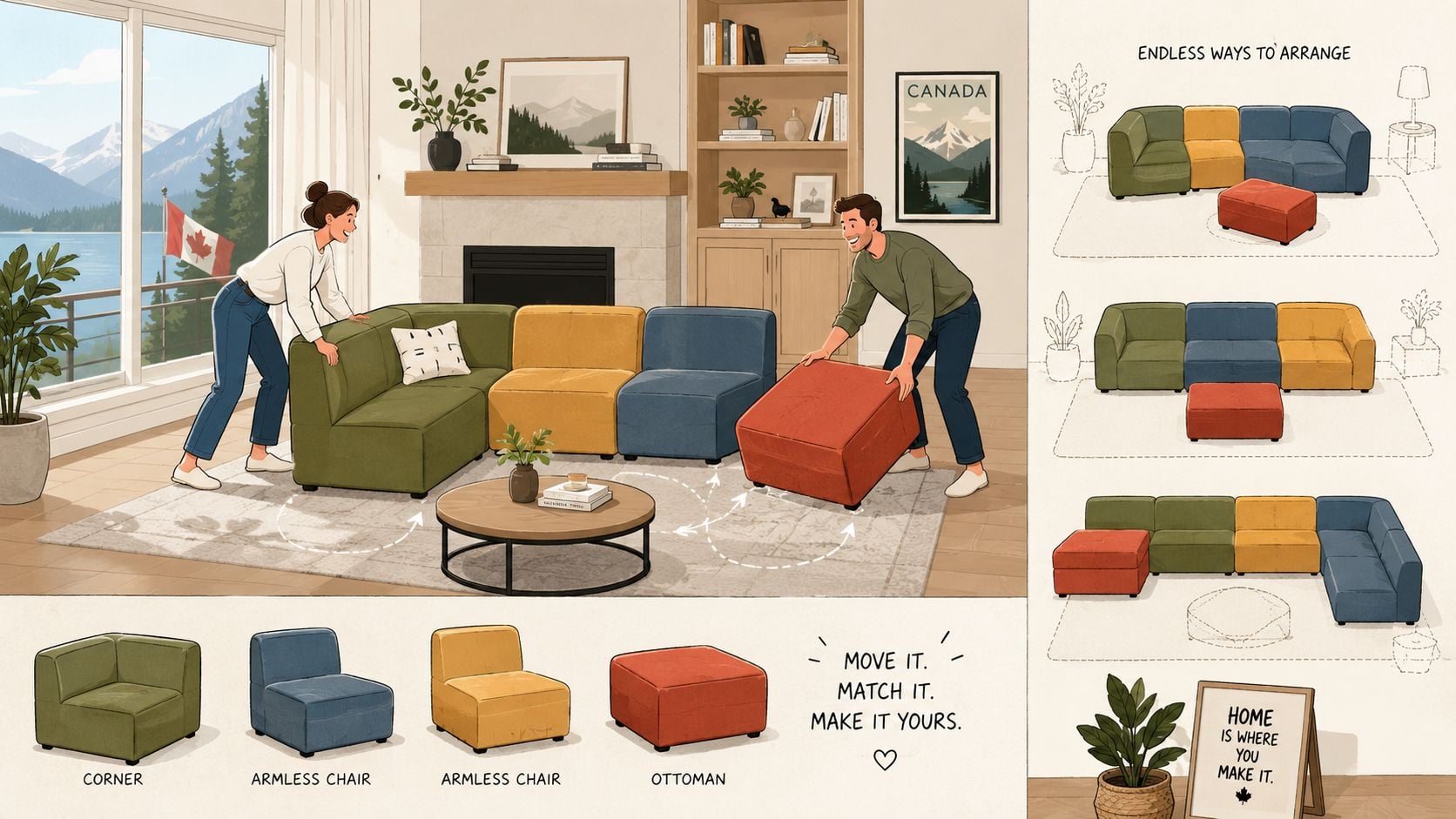
A modular sectional works best when it's understood as a set of building blocks, not a single oversized object. Each piece has a role, and the beauty lies in how those roles combine. That's what gives the category its bespoke appeal.
Thinking in individual pieces
The essential shift is simple. Instead of shopping for one predetermined left-facing or right-facing sectional, the buyer chooses a collection of units that can be assembled into a layout that suits the room.
Custom order options for bespoke seating make the process easier to visualise because each module can be treated as part of a complete room concept, rather than a standalone purchase.
A practical way to read a modular sectional is this:
- Corner units create the turn. They anchor an L-shape or U-shape and often define the room's conversational centre.
- Armless chairs extend the run without adding visual bulk. They're useful when the room needs seating length but can't spare the heavier look of repeated arms.
- Chaises or ottoman sections introduce lounge space. They're ideal when one side of the composition should feel softer and less formal.
- Standalone ottomans offer the most freedom. They can act as a footrest, extra perch, or bridge between seating zones.
What each module actually does
Many Canadian-ready designs are built around fully reconfigurable pieces, which is what gives the category its strength in changing homes. One useful benchmark comes from a model sized at 103" L x 59.5" W x 33" H with a 22.5" seat depth, dimensions that show how a modular layout can balance footprint and ergonomic comfort for typical Canadian rooms, as outlined in this modular sectional specification.
That seat depth matters. A sofa can look inviting online and still feel awkward in daily use if the depth pushes everyone into a slouch or, at the other extreme, keeps the sitter perched too upright. The right modular arrangement isn't only about shape. It's about how the body meets the seat.
A quick reading tool helps:
| Module | Best use | Common mistake |
|---|---|---|
| Corner piece | Anchoring social layouts | Using one in a room that needs open circulation |
| Armless seat | Extending length cleanly | Forgetting to check whether the run becomes too long for side tables |
| Chaise unit | Everyday lounging | Blocking a major walkway |
| Ottoman | Flexible utility | Choosing one so large it acts like clutter |
Practical rule: The best modular sectional sofa Canada shoppers choose is usually the one with the fewest unnecessary pieces, not the one with the most options.
Modularity should serve the room. If the arrangement becomes complicated to justify itself, it's no longer functioning as design. It's functioning as inventory.
Planning Your Layout for Canadian Homes
Many buyers assume that once the sofa fits on paper, the problem is solved. It isn't. A successful layout depends on what happens around the furniture, not just under it.
Room size is only the first measurement
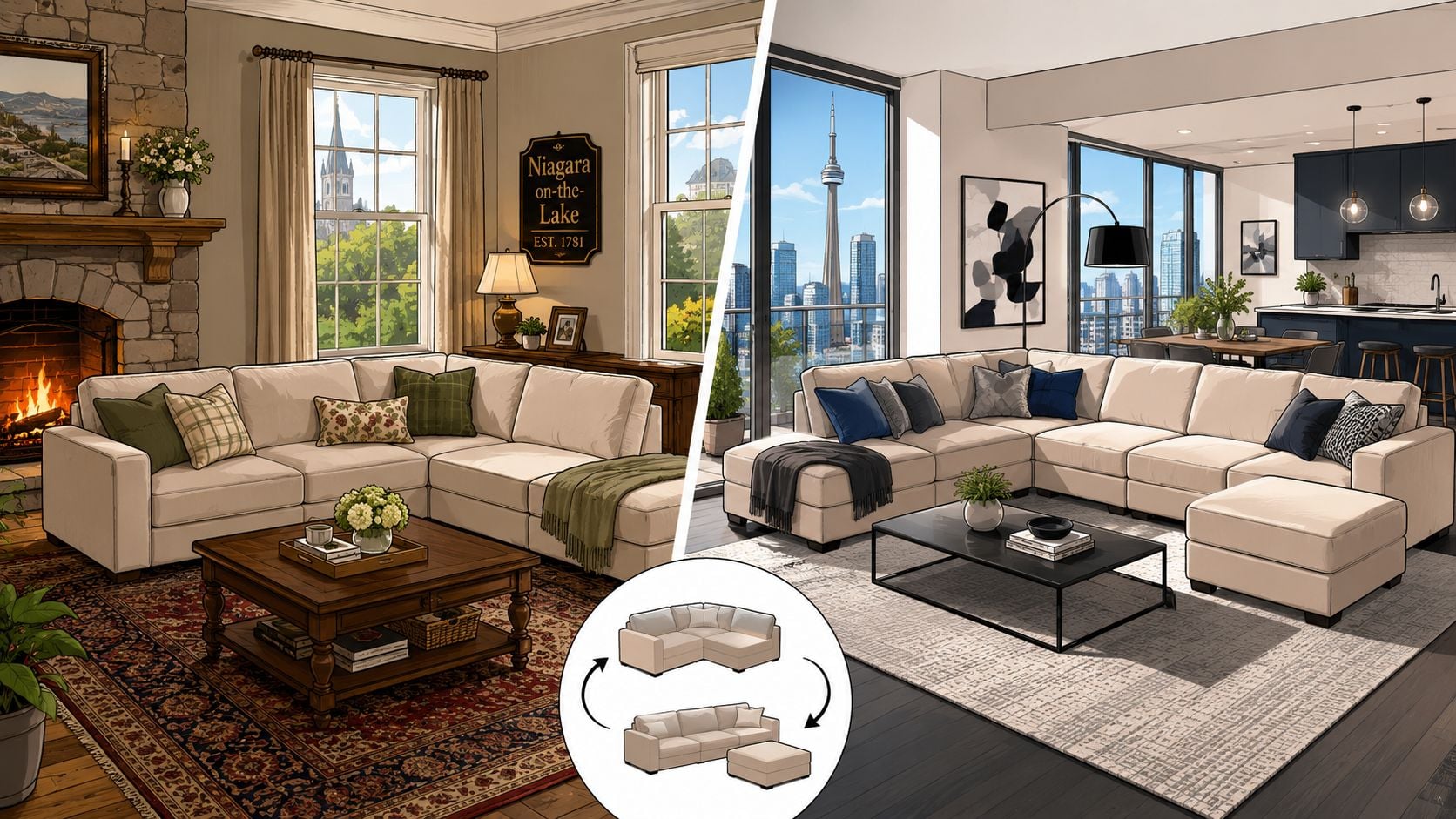
A sectional should support movement through the room, not interrupt it. In Canadian homes, that means accounting for entries, radiator locations, fireplace hearths, low windows, balcony doors, and the route from kitchen to seating area. A lovely plan can fail quickly if someone has to sidestep a chaise every time they cross the room.
A sound layout review usually includes:
- Primary circulation paths so the sectional doesn't pinch the route between doorways.
- Sightlines to windows, art, or a focal wall, especially in open-plan spaces.
- Support pieces such as lamps, side tables, and a rug proportioned to the seating group.
- Daily habits including where people read, watch television, host guests, or stretch out and relax.
Designers often borrow principles from gallery planning because both disciplines depend on balance, spacing, and the way people move visually through a composition. For readers interested in that broader idea, this guide to mastering artwork displays offers a useful parallel in how placement affects the overall experience of a room.
Why delivery physics changes the decision
This is the point most online advice skips. Delivery physics can eliminate an otherwise perfect choice.
In dense urban settings, especially condos and narrow-entry homes, modularity only helps if the pieces can move through the building. Research on delivery constraints in Canadian homes notes that 42% of modular sofa buyers in Toronto and Vancouver report their sofas cannot be fully disassembled for re-entry after a move. That fact changes the conversation immediately.
If a sectional can't make the journey into the room, its elegance is irrelevant.
A smart planning process checks more than the room footprint. It also checks the full route:
Building entry
The first turn from exterior door to corridor often causes more trouble than the living room itself.Lift dimensions and stair geometry
A piece may fit one route and fail on the other.Interior turns
Hallway corners and door swings matter more than buyers expect.Future moves
A reconfigurable sofa should remain re-enterable, not just re-arrangeable.
For households still clarifying their preferred living room style before finalising size and shape, a thoughtful planning exercise such as a living room style quiz can help connect aesthetic direction to practical layout choices.
The best outcomes usually come from restraint. A slightly smaller, cleaner configuration that enters the home gracefully and supports a room's flow will outperform a larger arrangement that dominates the plan or complicates every future move.
A Foundation of Quality Materials and Craftsmanship
A handsome sectional can still be poorly built. Real heirloom quality shows up in the unseen structure first, then in the upholstery, then in how the whole piece ages under ordinary use.

What sits beneath the upholstery
Frame construction determines whether a sectional feels composed after years of use or begins to loosen, creak, and sag. Buyers looking for custom furniture Southern Ontario homes can depend on should pay close attention to the frame before being distracted by the cover.
One important benchmark appears in premium units built from solid hardwood and reinforced with steel components. These can support up to 500 lbs per segment, a specification linked to long-term stability in this engineering benchmark for modular couch construction.
That number matters because modular seating carries stress differently from a conventional sofa. Each segment must remain stable on its own while also connecting securely to neighbouring pieces. If the internal build is weak, the join points begin to reveal it.
A buyer should look for these signs of stronger construction:
- Solid hardwood framing for dependable structural integrity.
- Reinforced connection points so modules don't drift or separate during use.
- Balanced seat support that feels supportive without turning rigid.
- Consistent tailoring across seams, corners, and cushion edges.
Fabric choices that suit Canadian living
The cover fabric is not just a style decision. In Canada, it needs to perform through winter wear, indoor humidity shifts, and the friction of daily living. High-performance, stain-resistant textiles tend to make the most sense for households that want the room to remain polished without constant anxiety.
A practical fabric review should consider:
| Material quality | Why it matters in daily use |
|---|---|
| Stain resistance | Helps preserve appearance in active family rooms |
| Tight, even weave | Supports durability and cleaner tailoring |
| Colour depth | Keeps the piece looking refined under changing light |
| Hand feel | Determines whether the sofa reads formal, relaxed, or inviting |
There's also the tactile question of mood. Some rooms want a quiet woven neutral. Others benefit from an artisanal leather accent elsewhere in the composition, especially when paired with more textural flooring or case goods. That's where design-forward curation becomes important. A sectional doesn't need every detail to shout. It needs the materials to converse.
For shoppers interested in Canadian-made values and construction standards, made-in-Canada furniture considerations offer a useful lens for evaluating workmanship and material integrity.
Good upholstery should do two things at once. It should invite touch and reduce worry.
That balance is what separates a merely attractive sofa from one that belongs in a well-lived home.
Investing in Sustainable and Timeless Design
The price of a premium sectional only makes sense when the buyer understands what the investment is buying. It isn't just extra seating. It's longevity, comfort, material integrity, and the ability to live with the piece gracefully over time.
Value lives in what lasts
Cheap furniture often asks for hidden payments later. It can lose shape, wear unevenly, or force replacement far sooner than expected. A better sectional tends to deliver value more reliably. It remains comfortable, the proportions stay relevant, and the room doesn't need to be redesigned around its failures.
That's especially true with modular forms. Because the configuration can evolve, the owner isn't locked into one rigid arrangement. If the home changes, the seating can often be edited, expanded, or rebalanced without abandoning the original investment. That flexibility is part of its lasting worth.
A timeless piece usually shares a few traits:
- Calm proportions that won't feel dated after one fast-moving trend cycle.
- Bespoke options in fabric, finish, and scale that help the sectional feel rooted in the home.
- Construction discipline that protects the shape and sit over the long term.
- Design restraint so the sofa can adapt to changing art, rugs, and lighting.
The certification questions worth asking
Sustainability has also become more specific. Buyers aren't only asking whether a sofa looks natural or is described as eco-conscious. They're asking what, exactly, is in the fabric and whether the piece aligns with Canadian standards.
A 2025 Canadian Green Building Council survey summary found that 59% of Southern Ontario homeowners prioritize furniture with certified low-VOC fabrics, yet many guides don't address the limited disclosure around CAN/ULC-S109 compliance for imported sofas. For a health-conscious household, that omission isn't minor.
Materials should earn trust before they enter the home.
For buyers considering a modular sectional sofa Canada retailers present as premium, a few questions are worth asking directly:
- What's disclosed about low-VOC content
- Whether fire-safety compliance is clearly identified
- How the upholstery performs in a tightly sealed modern home
- Whether the materials feel timeless enough to justify their footprint
Timeless craftsmanship and sustainable thinking often belong together. When a piece is well made, carefully specified, and intended to remain in service for many years, it avoids the disposable cycle that weakens both design quality and environmental responsibility.
The Seamless Journey from Showroom to Home
A sectional doesn't stop being a design decision once it's ordered. The last stage often determines whether the experience feels refined or exhausting.

Why service matters after the sale
Households investing in luxury furniture Niagara clients often seek aren't just paying for the object. They're paying for competence at every touchpoint. That includes scheduling, inspection, assembly, placement, and the quiet professionalism that protects both the furniture and the home.
That expectation has deep roots in heritage firms. The history of Critelli Furniture notes that the company was founded in 1914 by Thomas Critelli and has remained family-run for over a century, with a downtown St. Catharines presence since the 1950s. That kind of legacy matters because long-standing service cultures tend to understand that a sofa of this calibre should arrive with the same care that shaped the selection process.
When buyers compare service quality, the right question isn't “Do they deliver?” It's “What happens between the truck and the final placement?”
What white-glove should actually include
White-glove service should feel smooth, not theatrical. It should reduce friction at every stage and leave the room ready to enjoy.
A proper white-glove process usually includes:
- Pre-delivery coordination so access details, timing, and room readiness are confirmed in advance.
- Careful in-home handling that respects flooring, walls, and architectural details.
- Assembly and positioning based on the intended room layout, not guesswork at the doorway.
- Packaging removal so the home is left orderly and usable.
For households interested in what that level of care looks like in practice, white-glove delivery details are worth reviewing before purchase.
There's also a larger truth here. Good delivery teams understand furniture the way good removal specialists understand homes. They know awkward turns, fragile surfaces, and timing can undo an otherwise excellent plan. While this article is focused on Canadian interiors, the operational discipline seen in specialists such as Armadale Removalists offers a helpful reminder that successful transport depends on planning, route awareness, and handling skill.
The final impression of a furniture purchase is often formed in the first ten minutes after it enters the home.
For buyers across the Greater Niagara, Hamilton, and Toronto markets, the most luxurious outcome is often the least dramatic one. The sectional arrives, is placed with precision, the room comes together, and daily life begins without disruption.
Styling Your Sectional and Completing the Room
Once the sectional is in place, the room still needs composition. Styling isn't decoration applied after the fact. It's the work that turns a seating arrangement into a coherent interior.
Start with the room, not the accessory bin
The sectional should establish the room's tone. A structured profile with quiet upholstery may call for a more sculptural lamp, a warmer wood table, or art that introduces movement. A softer, lounge-driven silhouette often benefits from cleaner surrounding pieces so the room doesn't become visually heavy.
A useful styling sequence is simple:
- Anchor the seating zone with a rug large enough to support the arrangement.
- Introduce contrast through pillows, throws, and side materials rather than through clutter.
- Balance height with lighting and artwork so the eye moves comfortably around the room.
- Edit firmly until the composition feels intentional rather than full.
For readers gathering visual ideas for wall treatments and layered living spaces, this collection of inspiration for living room spaces can help clarify how art and upholstery work together.
Art for your Floor and the final layer
No room is complete until the floor has been considered. In strong interiors, rugs aren't background. They're Art for your Floor. They set the palette, soften acoustics, and visually connect the sectional to the rest of the room. That's why hand-knotted rugs Ontario homeowners choose so often become the true foundation of the scheme.
A complete room concept often works best when these elements are in dialogue:
| Element | Design role |
|---|---|
| Sectional | Anchors comfort and scale |
| Rug | Establishes colour, texture, and spatial unity |
| Accent chair | Introduces shape contrast |
| Lighting | Adds height and atmosphere |
| Art and objects | Personalise without overcrowding |
Designer's Insight
Pair a bold Hancock & Moore leather accent with a neutral hand-knotted wool rug to balance the room's energy, then let the sectional sit as the calm centre of the composition.
That approach keeps the room feeling curated rather than over-styled. It also supports longevity. Pillows can change with the season. Throws can shift the mood. Art can evolve. The foundational pieces should remain steady, design-forward, and confident.
For anyone refining a living room with interior design services St. Catharines homeowners value, the most satisfying results come from treating the sectional as one part of a larger composition, not the whole story.
Experience the craftsmanship in person at Critelli Furniture. Visit the King Street Showroom to explore a curated selection of heirloom quality furnishings, visit the Rug Market to find your room's foundation, or book your complimentary design consultation today for a bespoke, complete room concept delivered with white-glove care.