
Rug Placement Bedroom: Ultimate Guide 2026


A beautiful bedroom rug often arrives with more uncertainty than expected. The colour is right, the texture is lovely, and the room should feel finished. Yet once the rug is unrolled, the question becomes obvious. Should it sit fully under the bed, stop at the nightstands, or frame the waking path on each side?
That moment matters more than is often understood. Rug placement in a bedroom isn't a final styling flourish. It shapes balance, comfort, circulation, and the way every other piece in the room is perceived. In a home where floors carry as much visual weight as furnishings, many designers also look to broader hardwood flooring design inspiration before settling on a rug plan, because the floor and the textile should always speak the same language.
A heritage approach helps here. Critelli Furniture was founded in 1914 in Thorold, Ontario, and has remained family-run for over 110 years, a legacy that has earned trust across Southern Ontario through long-view design rather than short-lived trends, as noted in this brand history reference. That philosophy is especially useful in the bedroom, where the rug should feel considered, grounded, and enduring. A design-forward piece such as the Sutri Area Rug does more than decorate a room. It can become the first decision that clarifies everything else.
Table of Contents
- The Soul of the Room Begins Underfoot
- Foundational Rules for Flawless Rug Placement
- Choosing Your Ideal Bedroom Layout
- Selecting an Heirloom Quality Rug
- Ensuring Lasting Beauty and Stability
- Realizing Your Complete Room Concept
The Soul of the Room Begins Underfoot
A bedroom rarely feels settled until something soft and intentional anchors the bed. Without that grounding element, even fine furniture can seem to float. The room may be furnished, but it doesn't yet feel composed.
That is why seasoned designers often treat the rug as Art for your Floor. It isn't a background accessory. It sets the mood of the space, establishes the colour conversation, and gives the sleep zone a clear visual centre. In a design-forward bedroom, the rug often does the quietest but most important work.
A rug gives the room its point of view
A well-appointed bed, a pair of nightstands, and a beautiful chest can still feel disconnected if each piece reads as separate. Once the right rug is placed beneath them, the room starts to behave as one composition. That is the difference between decorating and building a complete room concept.
A well-placed rug doesn't just soften the floor. It tells the bed where it belongs.
Heritage is of great importance. A family business that has worked with generations of Southern Ontario homes tends to see rugs not as trend pieces, but as foundational design decisions. The most successful bedrooms often begin from the floor up, with the rug establishing the visual rhythm that the furniture follows.
What works in real bedrooms
In compact city rooms, the right placement can make a modest footprint feel more gracious. In larger homes, the rug keeps the bed from feeling adrift within too much open flooring. In both cases, the principle is the same.
- Warmth with purpose means the first step out of bed lands on something considered, not accidental.
- Visual order helps the bed read as a destination, not just the largest object in the room.
- Timeless craftsmanship matters because a bedroom rug is handled daily, seen constantly, and expected to age with grace.
For homeowners searching for Luxury furniture Niagara, Interior design services St. Catharines, or Hand-knotted rugs Ontario, this approach has enduring value. The rug isn't the final layer. It's the beginning.
Foundational Rules for Flawless Rug Placement
Good bedroom rug placement begins with proportion. In practice, that means sizing the rug to the bed first, then checking how it behaves with the rest of the room. In many Southern Ontario homes, that second step matters more than people expect. Older houses often have tighter clearances, deeper baseboards, radiator locations, or door swings that punish a beautiful plan drawn without real measurements.
Start with the bed, not the empty floor
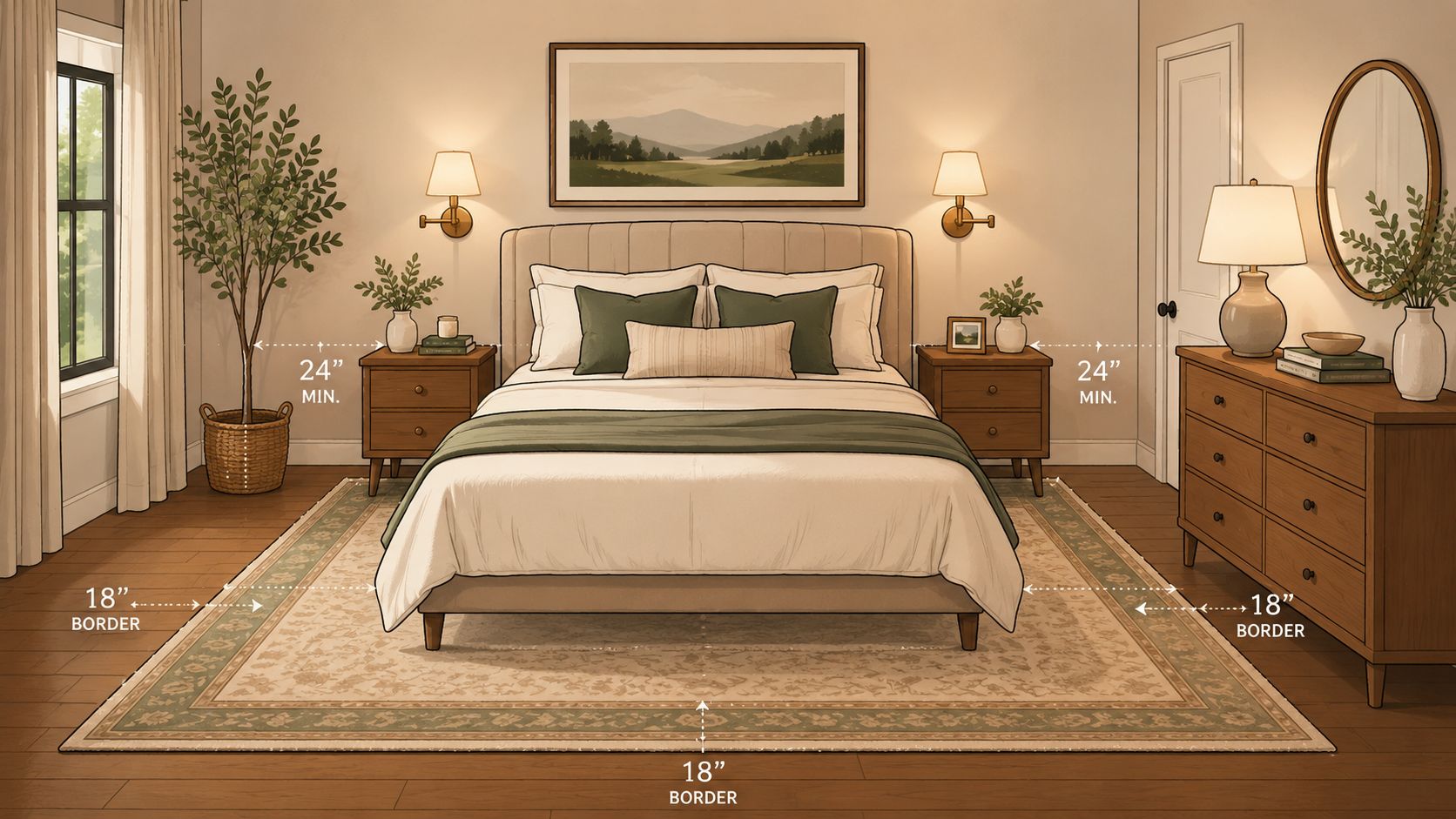
For a standard queen bed, an 8×10-foot area rug is usually the clearest starting point. Place it perpendicular to the bed and tuck it under the lower two-thirds so roughly 18 to 24 inches extends beyond the sides and foot, as outlined in this bedroom rug placement guide.
That range gives the room proper footing, visually and physically. The bed feels settled, the morning step lands on wool rather than cold floor, and the composition holds together without forcing every piece of furniture onto the rug. I also prefer this arrangement because it usually leaves the nightstands on the hard surface, which keeps them stable and avoids the slight wobble that can happen when only part of the case sits on pile.
A rug that only peeks out at the corners almost always reads underscaled.
Rug and Bed Size Pairing Guide
| Bed Size | Minimum Rug Size | Ideal Rug Size |
|---|---|---|
| Queen | 5×8-foot | 8×10-foot |
| King | 9×12-foot | 9×12-foot or larger |
A 5×8-foot rug can still serve a queen bed, especially in a narrower room where every inch counts. The trade-off is visible. You get softness at the sides and foot, but not the generous border that gives a bedroom that considered, complete feel.
For a king bed, a 9×12-foot rug usually restores the right scale. Anything smaller tends to make the bed feel heavier and the room feel meaner than it is.
If you are still defining the overall look, a quick bedroom style quiz for your room concept can help clarify whether your layout should feel formal, relaxed, architectural, or layered.
The spacing that protects function
Effective placement must also account for use. Dressers need to open properly. Closet doors need swing room. Bedroom benches need enough rug beyond them to look intentional instead of crowded.
A few rules keep the plan practical:
- Keep clearance around storage: Leave about 24 inches between the rug and nearby case goods so drawers and doors can move freely.
- Use visible floor as a frame: In larger bedrooms, a rug placed under the bed and nightstands should still leave exposed flooring around the perimeter. That border helps the room feel calm rather than wall-to-wall heavy.
- Avoid the teetering edge effect: Aim for 24 to 30 inches of rug beyond the sides and foot of the bed when the room allows, as described in this area rug placement article.
These rules are simple, but they create the difference between a rug that merely fills space and one that completes the room. In a well-composed bedroom, the rug supports movement, quiets the scale of the bed, and gives every surrounding piece a more deliberate place.
Choosing Your Ideal Bedroom Layout
A bedroom can have the right rug size and still feel unsettled once the furniture is in place. Layout is what decides whether the room reads as gracious, airy, polished, or slightly cramped. In Southern Ontario homes, that decision matters even more, because room proportions vary so widely from older houses with modest footprints to newer builds with broad primary suites.
The full-anchor layout
This is the most formal arrangement, and often the most satisfying when the architecture can support it. The rug sits under the entire bed zone and gives the room a clear centre of gravity. In bedrooms with generous spacing, that extra coverage helps the bed, nightstands, and bench feel intentionally composed.
It is also the layout that asks the most from the room. In a narrower space, a fully anchored rug can make circulation feel tighter than it should, especially near closet openings or along one side of the bed. I usually reserve this approach for rooms that already have a sense of breadth.
The partial-placement layout
For many homes, this is the best balance of comfort and restraint. The rug begins under the lower portion of the bed, leaving the nightstands on the exposed floor. You still get softness underfoot where it counts, but the perimeter of the room stays visually lighter.
This approach suits many Southern Ontario bedrooms, particularly in older homes where dimensions are sound but not expansive. It also works well when the room includes substantial wood furniture, because a little more visible flooring keeps the composition from feeling dense.
A smaller rug under a bench or ottoman at the foot of the bed can also help finish the arrangement, provided it looks deliberate rather than incidental.
The runner approach
Runners are often the quiet solution that makes a compact room work. They bring comfort to each side of the bed, preserve more of the floor, and keep the room from feeling overfurnished.
I recommend this layout often in condominiums, guest rooms, and secondary bedrooms where every inch of visible space helps. It can also be the right answer when a bed is set off-centre because of windows, radiators, or angled walls, which is not uncommon in older regional homes.
If you are still shaping the room's overall direction, the bedroom style quiz for your room concept can help clarify whether the layout should feel symmetrical, relaxed, architectural, or softly layered.
Designer's Insight
Smaller bedrooms often benefit from a slightly lighter touch. A rug that supports the bed without swallowing the floor can make the room feel more open, especially when the walkway beside the bed is limited.
Good layout depends on how the room is used. Some bedrooms benefit from partial nightstand coverage. Others look sharper with the rug pulled farther back so the case goods sit fully on wood. The goal is to balance warmth, proportion, and daily movement.
Round rugs deserve consideration as well. Placed under one corner of the bed, they soften a strict rectangular room and can be especially effective when the bed sits against a wall or when the room needs a little asymmetry to feel complete.
Selecting an Heirloom Quality Rug
Placement solves only one half of the bedroom. The other half is the rug itself. A poorly chosen rug in the correct position still weakens the room. An artisanal rug with depth, texture, and integrity can enrich even a restrained scheme.
Why material changes the room
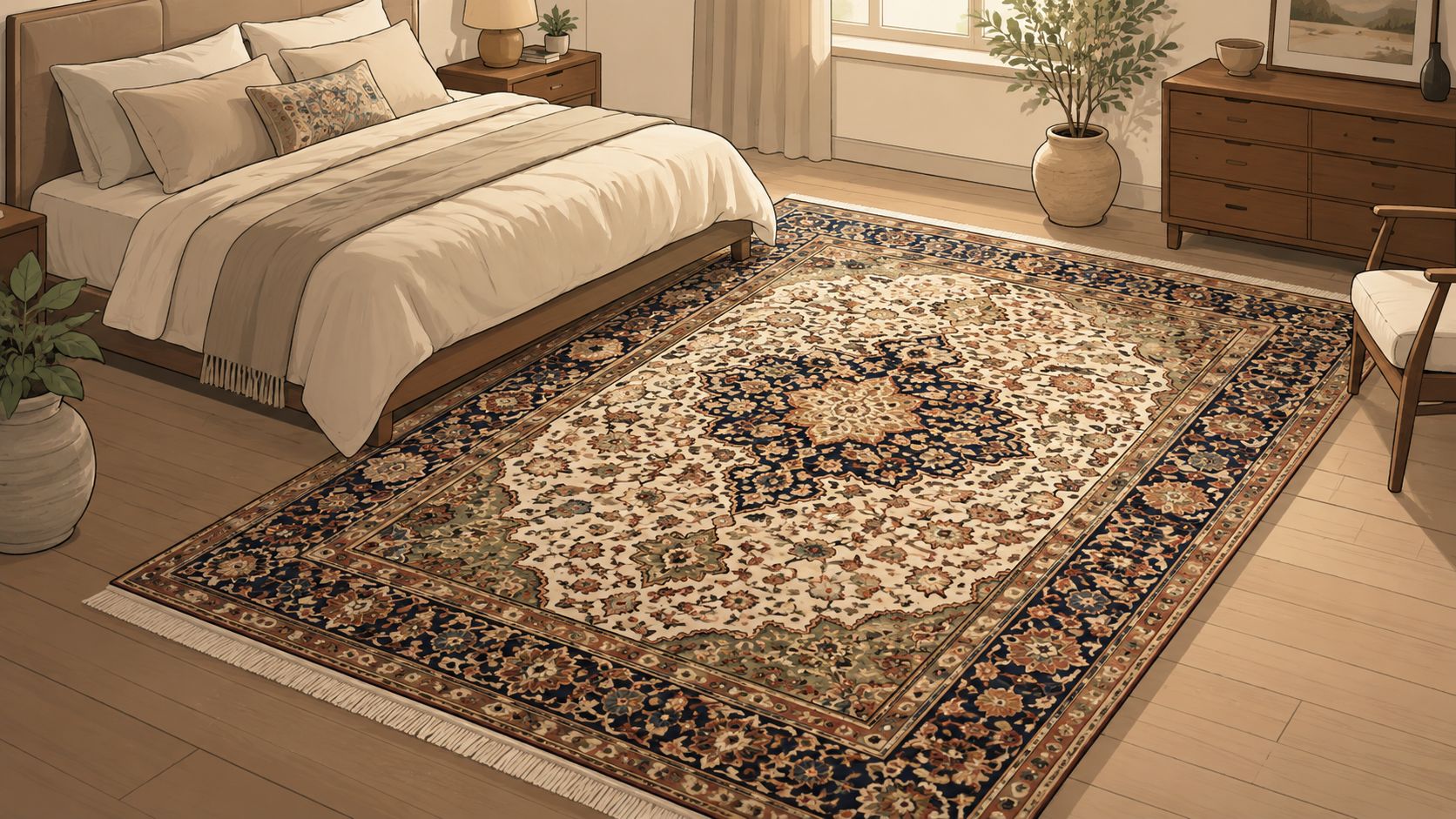
The finest bedroom rugs are not merely a rectangle on the floor. They contribute atmosphere. Hand-knotted wool offers a depth of texture and a visual softness that machine-made pieces rarely match. Natural fibres can also introduce a quieter, more relaxed mood, depending on the room's architecture and furnishings.
That is why many design studios begin with the rug when shaping a bedroom palette. Critelli's Rug Market presents hand-knotted, artisanal rugs as "art for your floor," positioned as the foundational element for a room's colour palette and character, with a focus on heirloom-quality pieces from global sources, as described in this Rug Market profile. For anyone exploring a more curated selection, the Rug Market reflects that philosophy directly.
A rug should lead the palette
A bedroom becomes more convincing when the rug leads and the furniture supports. That doesn't mean every finish must match. It means the room should share a common temperament.
Consider how an artisanal rug might direct the rest of the scheme:
- A muted hand-knotted wool rug can steady richly grained case goods and upholstered pieces with sculptural lines.
- A pattern with age and variation often softens rooms that feel too crisp or too newly assembled.
- A quieter neutral field allows standout pieces from brands such as Stickley, Stressless, or Magniflex to hold their shape without visual competition.
A bedroom rug should feel collected, not merely coordinated.
Custom furniture Southern Ontario and a bespoke rug strategy often meet. The strongest interiors don't look purchased all at once. They look edited over time, with timeless craftsmanship carrying the room rather than novelty.
Ensuring Lasting Beauty and Stability
A bedroom rug can be perfectly chosen and perfectly placed, then slowly lose its polish if the practical details are ignored. Corners curl. Edges drift. The centre creeps out of position each time the bed is made. None of that is minor. It changes both safety and appearance.
The practical layer most bedrooms miss
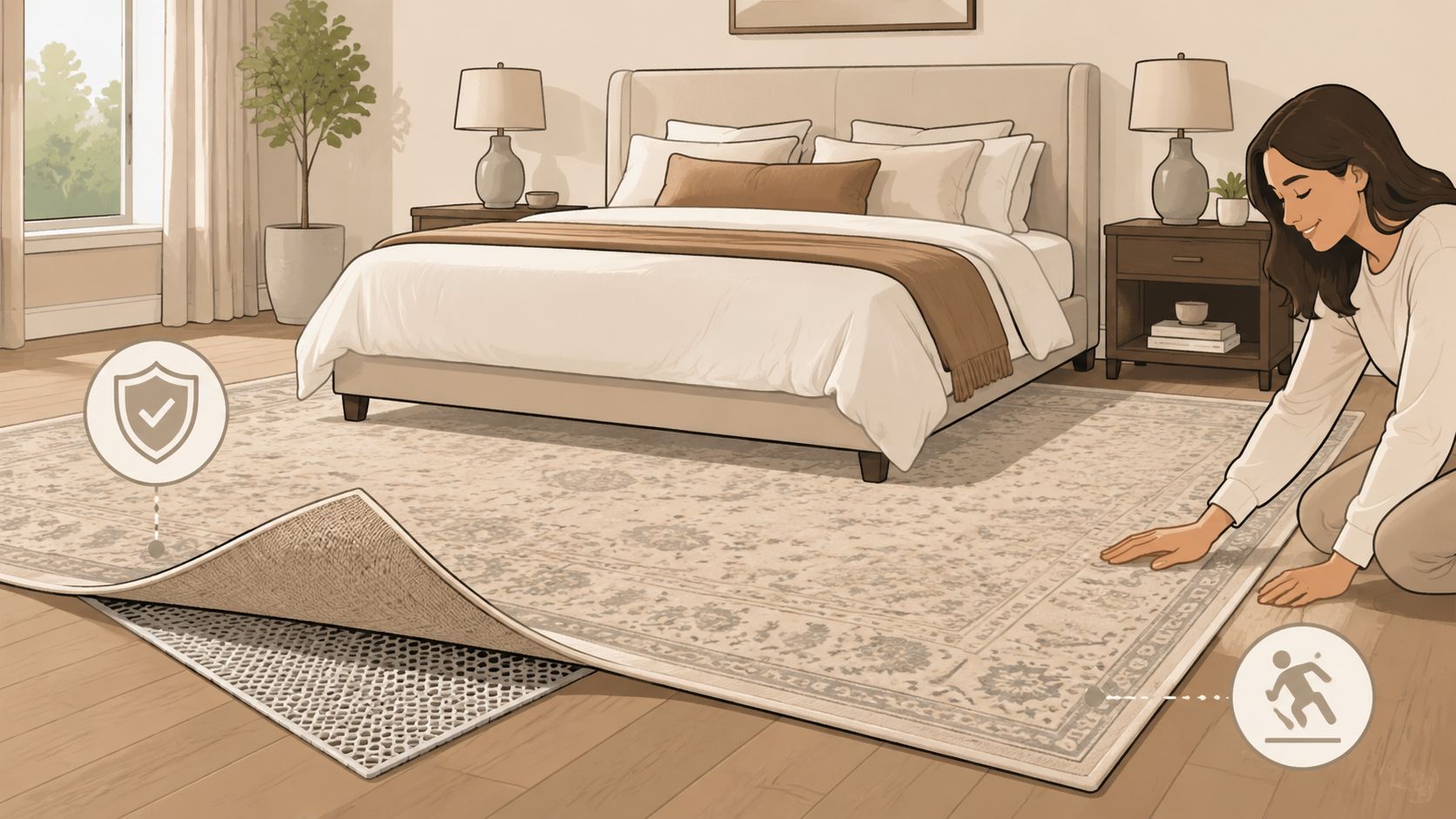
A rug pad is not optional in a finished bedroom. It keeps the rug where it was meant to stay and protects the calm geometry of the room. On smooth flooring, skipping the pad is a common cause of instability.
According to this rug placement and pad guide, 70% of reported bunching and slippage incidents in bedrooms on smooth floors are linked to skipping non-slip rug pads. The same source stresses using a pad suited to the specific surface, whether that is carpet or a smooth floor.
Placement is only finished when it stays finished
A stable bedroom rug depends on a few disciplined choices:
- Match the pad to the floor type: A smooth floor and a carpeted surface need different levels of grip.
- Keep the rug flat before final furniture placement: If the rug is even slightly skewed, the bed will lock that error in place.
- Watch low-pile edges carefully: They can look beautifully finished, but they still need proper support underneath.
For owners of delicate or hand-finished pieces, maintenance matters just as much as installation. Guidance on protecting your valuable oriental rug investment can be useful when building a long-term care routine for bedroom textiles that see daily use.
There is also a service advantage in having placement handled with care from the outset. Critelli's White-Glove Delivery service extends across the Greater Niagara, Hamilton, and Toronto markets and includes assembly, precise in-home placement, and packaging removal so rooms are left showroom-ready, as described in this delivery service overview. Homeowners who want that final layer of precision can review the details of White-Glove delivery.
Realizing Your Complete Room Concept
A well-designed bedroom doesn't come together because one piece is beautiful. It comes together because every element agrees on proportion, tone, and purpose. The rug anchors the bed. The bed gives scale to the room. The surrounding furniture supports both comfort and order.
From floor plan to finished sanctuary
This is the heart of a complete room concept. The rug placement bedroom decision isn't separate from the furniture plan. It is the furniture plan, at least in its earliest and most important form. Once the rug size, layout, and material are resolved, the rest of the room becomes easier to refine with confidence.
That approach is especially helpful in Southern Ontario homes, where room sizes vary widely from gracious houses in Niagara to compact urban spaces closer to Toronto. A hand-knotted rug, a carefully scaled bed, and a few well-proportioned pieces can make either setting feel deliberate rather than improvised.
For clients seeking Interior design services St. Catharines or a more design-forward path to furnishing, professional guidance can turn isolated purchases into a coherent retreat. Critelli also operates two St. Catharines showrooms, one on King Street and one on St. Paul Street, reinforcing the idea that furnishings are best approached as part of a room-wide vision rather than as standalone purchases, as noted in this showroom listing. Design support is available through interior design services, which helps translate those principles into a personalized home.
The final step should feel effortless. White-glove service across the Greater Niagara, Hamilton, and Toronto markets helps ensure that what was envisioned in the showroom arrives in the home with the same sense of order and finish.
Experience a more refined approach to bedroom design with Critelli Furniture. Visit the Rug Market to find your room's foundation. Experience the craftsmanship in person at our King Street Showroom. Book your complimentary design consultation today.