
Dining Room Set 7 Piece: Sizing, Style and Budget Guide

A shopper measures the dining area, orders a seven-piece set, then discovers the bench sits too low for the table and the chairs block the route to the kitchen. The advertised piece count looked right, but the room and the furniture weren't checked as a working arrangement. A better purchase starts with three tests: what the set actually includes, whether its occupied footprint fits, and whether its materials and construction can be maintained.
For a dining room set 7 piece, the useful question isn't how many people it claims to seat. It's whether the table, chairs, clearances and access work together in your home.
What a Seven-Piece Dining Set Includes
A seven-piece dining set is commonly one table and six matching chairs. The number counts furniture pieces, not seats, so a bench changes the seating calculation without changing the total piece count.
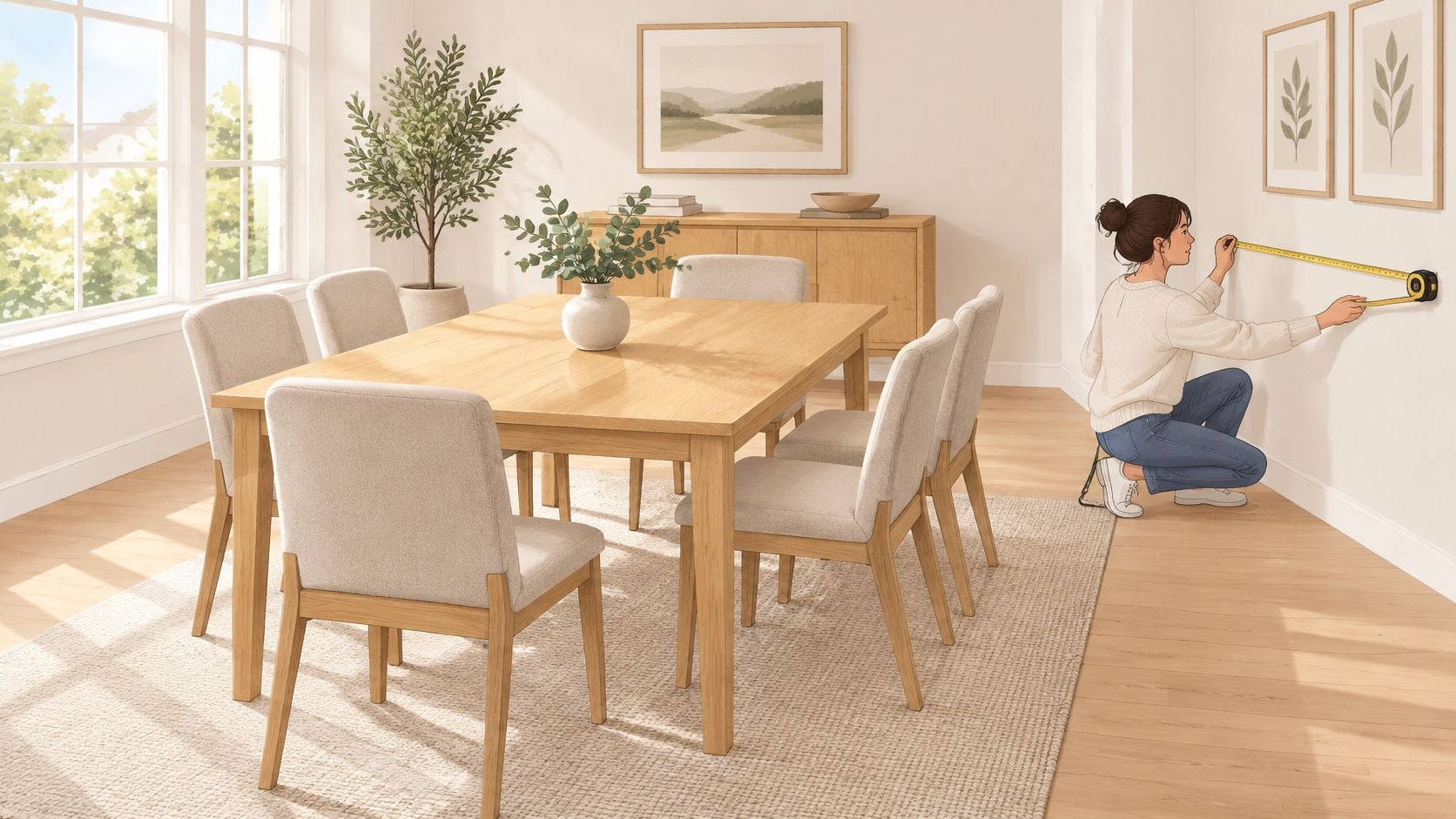
For example, a set with a table, one bench and five chairs has seven pieces. If the bench seats two, it has seven seats. A table with two armchairs and four side chairs also has seven pieces and six seats. Extension leaves lengthen the table when opened, but they're components of the table, not additional furniture pieces.
| Seven-piece configurations compared | Pieces | Seats | Best fit |
|---|---|---|---|
| Table with six matching chairs | 7 | 6 | Formal dining and households that host often |
| Table, one bench and five chairs | 7 | 7 (bench seats two or more) | Casual rooms and families with children |
| Table, two armchairs and four side chairs | 7 | 6 | Mixed seating and a more relaxed, lounge-style room |
Before comparing quotes, confirm the piece count and seat count in writing. Ask whether the chairs are included, whether an extension leaf is part of the listed set and whether every chair's seat height works with the table. A bench may look relaxed in a showroom, but it won't be a comfortable match if its height leaves diners sitting too low or pushes knees against the table apron.
For a closer look at chair pairings, browse dining chairs in a set of six and check the seat and frame details against the table you're considering. Dining furniture has long been a distinct part of Canada's furniture trade: the federal government's 1926 furniture industry report valued Canadian dining-room furniture production at approximately $4.85 million that year. In St. Catharines, Critelli Furniture was founded in 1914 and remains run by fourth- and fifth-generation family owners, making it a local source with a long history in home furnishings.
Matching Table Size and Clearance to Your Room
A table's dimensions don't tell you whether six people can use it comfortably. Measure the usable footprint, including chairs pulled out, walking routes and any nearby sideboard, door or fixed obstruction. A room can accommodate a tabletop on paper and still feel cramped once everyone sits down.
The chart uses planning estimates, not product guarantees. For a rectangular table, allow about 0.5 m beyond each long side for chair pull-out. Behind a chair facing a traffic route, plan for about 0.9 m of walkway. A sideboard or hutch along one wall needs about 0.6 m of additional depth, so include it in the drawing rather than treating it as an afterthought.
| Table size and room size for six chairs | Minimum clear room (approx.) | Comfortable clear room (approx.) |
|---|---|---|
| 60 in (152 cm) rectangle | About 3.2 m across | About 3.7 m across |
| 72 in (183 cm) rectangle | About 3.5 m across | About 3.7 m across |
| 72 in (183 cm) round | About 3.7 m across | About 4.2 m across |
These estimates use the chair envelope and walkway rules above. Check them against your actual floor plan, including chair width and the table base. A round table can make movement around the edge feel more fluid, but its curved perimeter doesn't remove the need for chair pull-out space.
Ontario residential guidance identifies 7.0 m² as the minimum floor area for a standalone dining room and 2.3 m as a minimum room dimension. It also stresses that chairs need room to pull out without striking doors, hutches or sideboards, as described in the Ontario residential guidance. Those are minimums for a room, not a promise that every seven-piece set will feel comfortable there. In open-plan homes across Southern Ontario, a smaller table in the right orientation often serves the household better than a larger one centred in the dining area.
For another kind of compact dining setup, features to consider for campsite dining offers a useful reminder that furniture needs to suit how people move through a space, not just how it looks when unused.
Make a full-size floor plan
Use painter's tape, a tape measure and the chair dimensions supplied by the seller. Then test the arrangement in order:
- Measure the clear room. Subtract radiators, built-ins and other fixed projections. Mark door swings and note which openings people use to reach the kitchen or living room.
- Mark the tabletop. Tape out the table's full size, including its extended length if you expect to use the leaves. For a round table, mark the full diameter.
- Add chair envelopes and walkways. Extend the outline to account for chairs pulled out. Include a sideboard or hutch if it'll stay in the room.
- Test the main route. With all six chairs occupied, check the path from the kitchen or hallway. A person should be able to pass without asking diners to shift chairs.
- Try a wall-side chair. Pull one chair close to a wall and confirm the others can still be occupied and used.
Designer's rule: A set fits when people can sit down, pull back from the table and keep the main walking route open at the same time.
Check chair access, not just the tabletop
Toronto accessibility guidance recommends loose-seat heights of approximately 405–460 mm and stable furniture that won't shift or tip when someone uses it for support, according to the Toronto accessibility design guidelines. Try chairs with the actual table when possible. A seat can appear suitable on its own yet leave too little knee room when a deep apron or awkwardly placed legs reduce the space beneath the table.
Check whether armrests can slide beneath the tabletop if that matters to your household. At least one position should ideally offer unobstructed knee and toe room, especially for someone using a mobility aid. A pedestal or trestle base may look elegant, but check where its supports land before assigning the most accessible seat.
Pass: All six seats can be occupied, chairs can pull out, and the main route stays clear. Fail: A doorway is blocked, one chair can't be used, or diners must move furniture to let someone pass. If the test fails, change the table size or orientation before ordering. For a round option, compare the actual base and overall proportions with round dining table dimensions.
Materials, Finishes and Repairability
An heirloom-quality dining set should be judged by what can be maintained and repaired, not just by the look of its finish on delivery day. Joinery, finish and hardware determine how practical that work will be. Solid joints can often be tightened or re-glued, repairable finishes can be renewed, and replaceable glides and fittings help keep everyday wear from becoming a reason to discard a piece.
| Dining set materials compared on repairability | Refinishing | Repairs and replacement parts | End-of-life options |
|---|---|---|---|
| Solid hardwood (oak, walnut, cherry) | Many times, by sanding and refinishing | Strong; joints can be re-glued and parts replaced | Donation, resale or reuse |
| Veneer over hardwood or plywood | Limited; sanding can cut through the veneer | Moderate; surface repairs are possible with skilled work | Donation or resale if structurally sound |
| Engineered board (MDF or particleboard) | Poor; swells with moisture and holds finish weakly | Limited; parts are often unavailable | Usually landfill unless specialist recycling exists |
| Metal (steel, iron, aluminum) | Good; can be powder-coated or repainted | Good; bases and fittings are often replaceable | High recyclability |
| Upholstery (leather or fabric) | Not applicable | Good; chairs can be reupholstered and cushions replaced | Donation or textile recycling, depending on condition |
| Mixed-material construction | Depends on the dominant material | Hardest to repair if glued together | Difficult to separate for recycling |
Solid hardwood and metal are generally among the more repairable choices, while glued mixed-material construction can be difficult to take apart. Veneer can be durable when well made, but its thin surface limits aggressive sanding. That difference matters if the set gets scratched or if a finish needs attention later.
Price alone doesn't prove that a set is repairable. Ask what's beneath the visible surface, how the frame is joined and whether replacement parts can be ordered. For more context on material choices and construction, review solid wood furniture.
A dining chair with an upholstered seat may be worth keeping even when the fabric no longer suits the room. Reupholstery and cushion replacement can extend its useful life; for white leather, use care products suited to the specific material and follow the maker's cleaning guidance. This practical guide to cleaning white leather dining seats can help clarify the extra care a pale surface may call for.
Matching Traditional, Contemporary and Transitional Style
Start with the room's architecture, light and existing furniture, not a catalogue image. A set should feel at home beside the floor, trim and lighting, while still giving the dining area its own character. Traditional, contemporary and transitional styles each offer a different balance of shape, ornament and softness.
| Style families and what each set looks like | Defining silhouette | Typical woods and finishes | Chair and upholstery cues | Rug direction |
|---|---|---|---|---|
| Traditional | Turned or carved legs, pedestal or column bases | Rich cherry, walnut or mahogany with deep stains | Wood or tufted upholstery with classic backs | Wool or silk rug with medallion or border pattern |
| Contemporary | Slim profiles, clean lines, open or sculptural bases | Light oak, ash or lacquered finishes; metal accents | Minimal shells, leather or simple fabric seats | Solid-tone or abstract hand-knotted wool |
| Transitional | Traditional proportions with simpler, streamlined detailing | Mid-tone oak or walnut with matte finishes | Upholstered seats with clean backs; mixed metal or wood | Neutral hand-knotted wool with subtle texture |
Traditional sets suit rooms that welcome richer woods and shaped details. Contemporary designs work well where clean lines and lighter visual weight support a modern interior. Transitional furniture draws on familiar proportions while simplifying the ornament, which makes it a practical choice when a home combines older architectural details with newer finishes. This guide to transitional interior design offers a closer look at that balance.
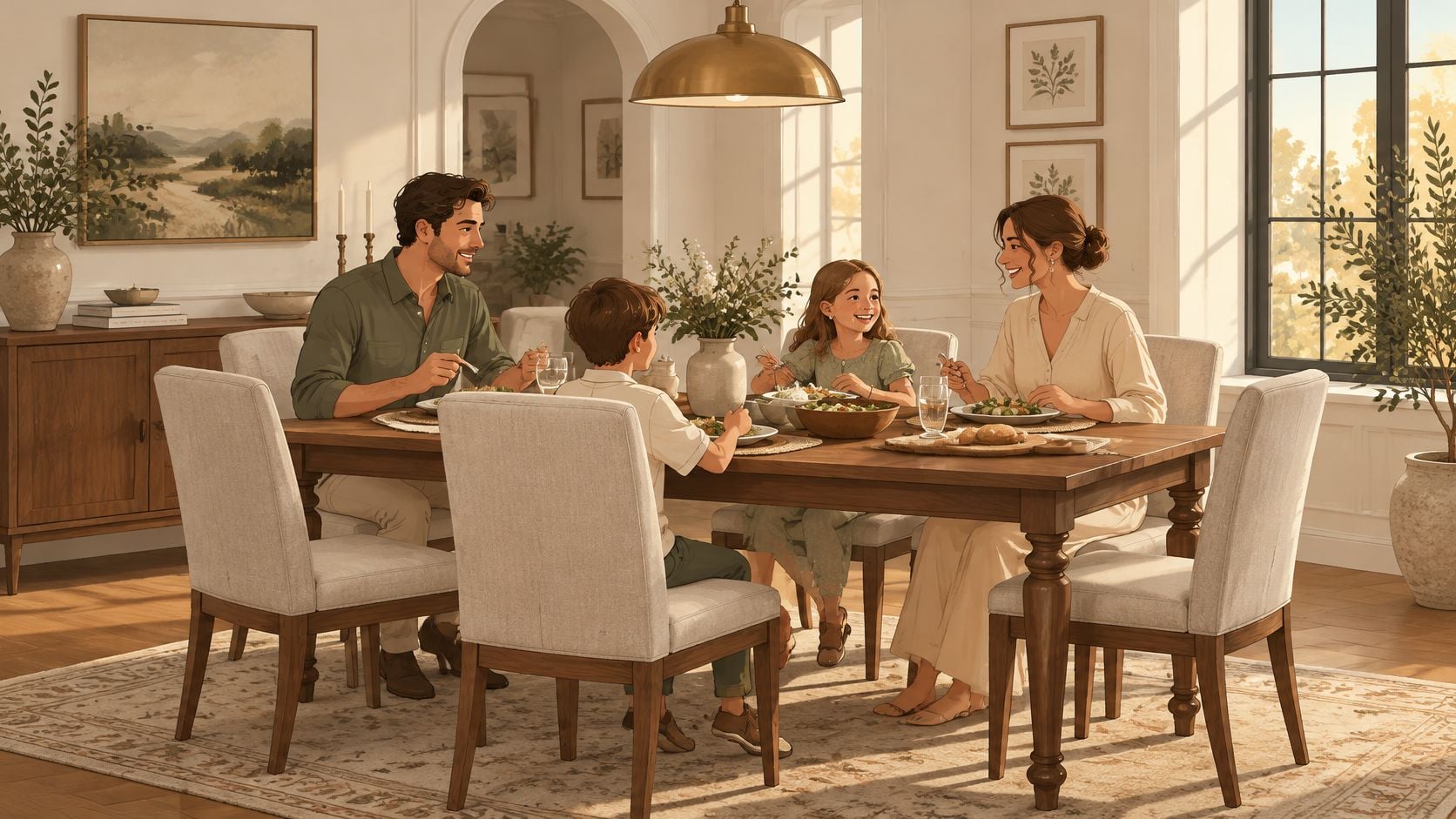
Treat the rug as art for your floor and as the visual foundation beneath the table and chairs. The Greater Niagara Chamber of Commerce's account of the Rug Market notes that Critelli introduced it in 2014, with hand-knotted silk and wool rugs sourced from around the world. A rug helps establish the room's palette, but it must also leave chairs stable and usable when pulled back. Choose its scale and pattern with the table footprint in mind, not as a finishing detail selected after every other decision.
Designer's Insight: A bold Hancock & Moore leather chair can bring depth to a room; a neutral hand-knotted wool rug balances that energy without competing with the upholstery.
A complete-room concept makes the choices easier to judge together. Book a complimentary design consultation to coordinate the style family, table, seating and rug as one design-forward arrangement.
Budget Tiers and What Each Tier Buys
Two seven-piece sets can look much alike in a showroom, yet differ sharply in what happens after daily use begins. One may have sturdy frames and serviceable joints; the other may rely on limited-repair materials and basic hardware. The sensible comparison is not just the purchase price. It's what the construction allows you to maintain, repair or replace.
Entry-level sets often use veneer or engineered board, with simpler hardware and fewer practical repair options. They can make sense when the budget is firm or the room's needs are temporary, but inspect edges and joints closely, and ask whether a damaged component can be replaced.
Mid-range sets may combine solid and veneered wood, sturdier joinery and standard finishes. This tier can offer a useful balance: a sound table and chair frames, with decorative details kept straightforward. Check which pieces are solid wood rather than assuming the whole set shares the same construction.
Premium sets generally place more emphasis on solid hardwood, strong joinery and durable finishes. They may allow more choice in wood, upholstery or finish, though custom selections can add cost and waiting time. Custom heirloom sets go further with bespoke choices shaped around the room and the household, usually requiring the most planning.
Spend on the table and chair frames first. A finish or fabric can often be changed more readily than an unstable joint or a frame that can't be repaired.
A chair with a sound frame may be reupholstered instead of replaced, so ask about that option before dismissing a set because its fabric isn't ideal. Request a written quote in Canadian dollars, with the table, chairs, leaf, finish and delivery clearly identified. If financing is part of the decision, review the available furniture financing in Canada before settling on a budget tier.
Confirm Your Seven-Piece Set Before You Order
A well-chosen set should be clear on paper before it arrives at your home. Ask the seller for these details in writing:
- Piece and seat count: Confirm every included item and the number of people the arrangement seats.
- Materials and joinery: Identify the wood or other materials used in the table and chair frames, and ask how their joints are constructed.
- Finish and replacement parts: Confirm the finish type, care requirements and whether glides, fittings or other parts can be replaced.
- Warranty and upholstery terms: Check what the warranty covers and whether the chairs can be reupholstered.
Choose the style family and anchor rug before comparing finishes, then set a budget tier before requesting a quote. That sequence helps keep the table and seating coherent with the room instead of leaving the rug and palette to solve after the furniture has arrived.
A complimentary design consultation can help coordinate the table, chairs and rug with the room's dimensions and natural light. Custom options allow finish and fabric choices, while white-glove delivery can include inspection, assembly, precise placement and packaging removal. Critelli Furniture serves the Greater Niagara, Hamilton and Toronto markets, with a family history in St. Catharines dating to 1914.
Book your complimentary design consultation today. Experience the craftsmanship in person at our King Street Showroom. Visit the Rug Market to find your room's foundation.
For a dining room set that fits the way your household lives, Critelli Furniture offers a curated selection, design consultations, custom options and white-glove delivery. Visit Critelli Furniture to discuss a seven-piece arrangement that suits your room, style and plans for the years ahead.