

Nesting Tables Canada: Find Your Perfect Set

A well-appointed room often asks more of a table than we admit. On a quiet morning, it holds coffee and a book. By evening, it serves guests, supports conversation, and gives a compact living area the flexibility it didn't seem to have. That's where nesting tables earn their place.
In Southern Ontario homes, that need shows up in different ways. A Toronto condo asks for restraint and versatility. A Niagara-on-the-Lake sitting room may need pieces that can expand gracefully for company without upsetting the architecture of the space. In both settings, the right nesting tables don't feel temporary or purely practical. They feel considered.
The Enduring Allure of Nesting Tables
For clients searching nesting tables canada, the appeal is rarely just about adding another surface. It's about solving a room properly. A nesting set can sit discreetly beside a stylish sofa most days, then open outward when family gathers. That kind of flexibility has always mattered, but it's become more relevant as homes are asked to do more.
Since 1914, heritage firms in Southern Ontario have seen certain furniture categories return again and again because they answer a lasting need. Nesting tables belong in that group. They're design-forward, yes, but their real virtue is that they adapt without announcing themselves.

Why they remain relevant in Canadian homes
The category isn't a passing fad. The global nesting tables market was valued at USD 1.7 billion in 2023 and is projected to reach USD 2.9 billion by 2033, with North America holding the largest share and growth particularly pronounced in Canada because of rising disposable incomes and a shift toward multifunctional furniture for compact urban homes, according to DataHorizzon Research on the nesting tables market.
That broad shift matches what many homeowners already feel in daily life. They want fewer pieces doing more work. They also want those pieces to feel settled and architectural, not improvised.
The difference between useful and beautiful
The strongest nesting table arrangements do two things at once:
- They preserve visual calm by reducing bulk when the room doesn't need extra surfaces.
- They create flexibility for entertaining, reading corners, and hybrid living spaces.
- They support a layered scheme rather than acting as a stopgap purchase.
Good nesting tables should disappear into the room's rhythm when closed, then become indispensable when opened.
That last point matters. A beautifully finished set can also shape the mood of the room. If you're refining a quieter palette, artwork and furniture should speak to one another. For readers exploring black, white, and tonal interiors, this guide to incorporating monochrome styles into your space offers a useful perspective on building depth without clutter.
A Primer on Nesting Table Styles and Materials
Style should come first only if construction keeps pace. Too many tables photograph well and disappoint in the room. The scale feels thin, the finish looks flat, or the smaller table never quite tucks away cleanly. With nesting tables, the mechanics are part of the beauty.
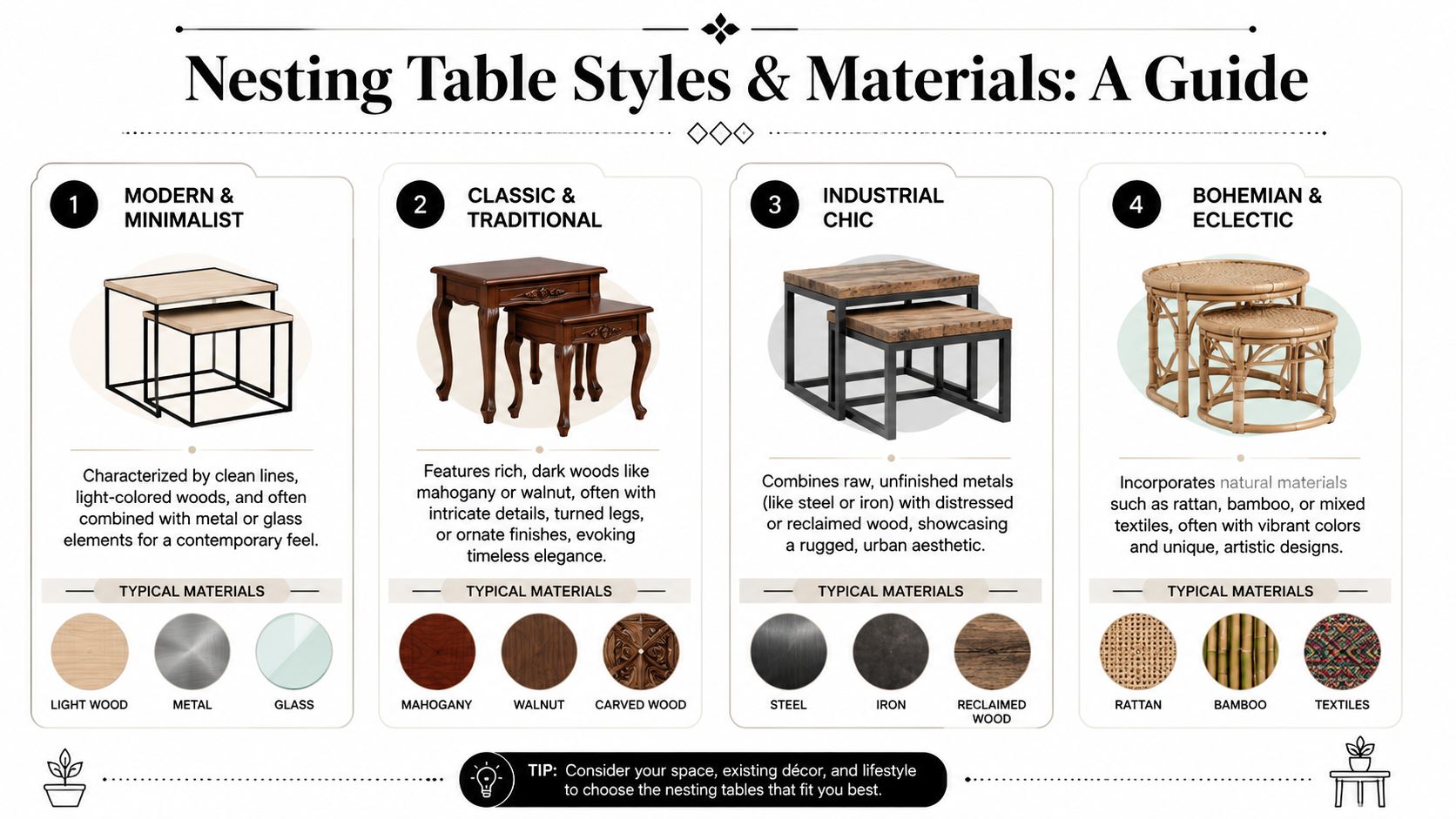
Four style directions that work
| Style | What it brings to a room | Best suited to |
|---|---|---|
| Modern and minimalist | Clean lines, lighter visual weight, crisp geometry | Condos, contemporary townhomes, rooms with restrained palettes |
| Classic and traditional | Warmth, depth, and a sense of permanence | Heritage homes, formal living rooms, layered interiors |
| Industrial chic | Contrast, edge, and texture | Loft-inspired spaces, mixed-material rooms |
| Bohemian and eclectic | Soft informality and artistic character | Casual seating areas, collected interiors |
A modern set in oak and metal works well when the room already carries enough texture through upholstery, drapery, and rugs. A traditional room often benefits from richer wood tones and subtle shaping in the legs or apron. Industrial styles need care. Too much exposed metal can make the room feel hard if there isn't enough softness elsewhere.
Materials that justify the investment
Solid wood remains the benchmark for heirloom quality because it ages with dignity. Good walnut or oak gains character. Veneer can also perform beautifully when used appropriately over a stable substrate, but it has to be well executed.
Glass and metal create a lighter visual footprint. That's useful when a room already has substantial seating or dark case goods. Stone tops can be elegant, though they require more thoughtful care and a room composition strong enough to support their presence.
One practical reference point is the joinery. Precision-mitered hardwood frames with concealed steel reinforcement can reduce a nesting set's footprint by up to 65% when stacked, making this type of modular construction especially useful for busy Southern Ontario living areas, as shown in Castlery's Hugg nesting square coffee table details.
Practical rule: If the smaller table drags, catches, or sits awkwardly under the larger one, the set isn't well resolved no matter how attractive the finish appears.
What to inspect before you choose
When reviewing options, I'd look closely at these details:
- Edges and profiles. Crisp, intentional edges signal discipline in the design. Overly bulky tops often make a set feel heavy.
- Joinery and alignment. The nested tables should sit close without rubbing or appearing off-square.
- Finish quality. A refined finish should have depth, not plastic shine.
- Use case. Ask whether the set is serving as a coffee table alternative, a side-table solution, or an occasional pair that moves through the room.
For clients comparing compact occasional pieces and wood finishes, this collection of wood end tables is a practical starting point for understanding how material and proportion change the feel of a room.
Mastering Scale and Placement in Your Home
Scale mistakes are what make nesting tables feel accidental. In a showroom, many sets seem universally useful. In a home, proportion decides everything. A set that's too petite gets lost beside a deep sofa. One that's too broad blocks circulation and defeats the very flexibility that made nesting tables appealing in the first place.
That concern is particularly current in urban settings. Google Trends data for Canada showed a 28% spike in searches for “nesting tables small apartment Toronto,” and CMHC reported that 62% of GTA condos are under 800 sq ft, which explains why correctly sized multifunctional furniture has become a pressing issue for Southern Ontario homeowners, as referenced in this Canadian nesting table trend overview.

Where nesting tables work best
A nesting set can solve several layouts elegantly:
- Beside a sofa arm when you need one usable surface every day and a second only when entertaining.
- In front of a loveseat or apartment-scale sofa where a full coffee table would crowd the walkway.
- Between two chairs in a conversational grouping, with the smaller table pulled out only when needed.
- At the edge of a sectional where a single large table would make the room feel static.
In a compact Toronto condo, I'd favour visually lighter forms and disciplined spacing around the seating group. In a larger Niagara or Hamilton home, nesting tables often work as supporting players in a layered composition, especially when the room includes more than one conversation zone.
A room should read as one composition
The strongest placements come from treating the tables as part of a complete room concept, not a stray accessory. Their top shape should relate to the sofa lines, the rug border, and the leg style of nearby upholstery. If every element speaks a different language, the room feels restless.
A few placement principles hold up consistently:
- Keep the set within easy reach of seating. If a guest has to lean too far, the table is decorative, not functional.
- Respect the rug boundaries. A nesting set should either sit confidently on the rug or intentionally off it. Half-measures often look unresolved.
- Leave clear circulation. If opening the smaller table blocks movement, the set is too large or poorly located.
Designer's Insight
Our designers suggest pairing a tailored nesting table set with Stressless seating when you want flexibility without visual weight. Add a neutral hand-knotted wool rug beneath the arrangement and the room holds its centre even as the tables move through daily use.
For homeowners refining furniture flow before purchasing, this guide on how to arrange furniture in a living room offers a useful framework for spacing, sightlines, and balance.
Choosing Heirloom Quality A Guide
There's a clear difference between a table that fills a gap and one that belongs to your home for years. Heirloom quality isn't a marketing phrase when the materials, finish, and joinery support it. You can feel it in the weight of the table, see it in the way light moves across the surface, and notice it later when the piece still looks composed after regular use.

Construction details worth paying for
Premium nesting tables often show their quality in restrained ways. Tempered glass tops in the 8 to 10 mm range, FSC-certified wood frames, and UV-resistant finishes that can extend lifespan by 25% compared with standard laminates in humid climates like Hamilton or Niagara are all meaningful specifications noted in West Elm Canada's Arnet nesting side table details.
That matters in Southern Ontario because finishes have to tolerate seasonal shifts. Pieces that look polished in a climate-controlled showroom may respond poorly once they meet real humidity changes, active households, and daily handling.
What usually doesn't hold up
Mass-market alternatives often miss in the same places:
- Thin tops and lightweight frames that shift when touched
- Flat synthetic finishes that show wear without gaining character
- Poorly resolved proportions that look acceptable online but awkward in person
A well-made nesting set doesn't need ornament to feel special. It needs integrity. That's what allows it to move between modern and traditional rooms without feeling dated a few seasons later.
The room always reveals whether a table was chosen for price alone or for permanence.
Why the rug matters just as much
No occasional table should be chosen in isolation. In a resolved room, the nesting tables answer the rug, and the rug anchors the conversation area. This is why the Rug Market matters so much in a living room plan. Art for your Floor isn't a decorative afterthought. It's often the foundation that tells you whether the table should bring contrast, softness, shine, or quiet texture.
A rich leather chair from Hancock & Moore can take a more restrained nesting table if the rug already carries movement and pattern. A quieter rug may invite a table with stronger grain, glass, or a sculpted profile.
For clients interested in furnishings with a heritage sensibility and enduring materials, Heritage Lifestyle home furnishings offers a useful reference point for the kind of craftsmanship that supports long-term interiors.
Sourcing Your Nesting Tables in Canada
Sourcing nesting tables canada well means sorting through a crowded market with very uneven information. Many listings show dimensions and a few styled images, but they stop there. For a discerning buyer, that's not enough. You need to know what the frame is made of, how the finish will age, whether the wood is responsibly sourced, and whether the set was designed for real use or only for visual appeal.
The Canadian sourcing question
Sustainable and locally informed purchasing has become far more important in Southern Ontario. A 2025 Furniture Market Report indicates that 68% of Southern Ontario homeowners prioritize FSC-certified wood furnishings, yet many online retailers still fail to explain local sourcing or eco-certifications, creating a real opening for informed curation, as noted in this Canadian market snapshot on nesting table demand.
That gap is where buyers often get stuck. They may be willing to invest in better furniture, but the product information doesn't help them distinguish between artisanal work, responsibly sourced material, and generic imports with polished photography.
Three sourcing paths and their trade-offs
| Sourcing path | Strength | Limitation |
|---|---|---|
| Large online marketplaces | Broad variety and quick comparison | Limited material transparency, inconsistent finish quality |
| Canadian makers and workshops | Strong craftsmanship, local relevance, bespoke potential | Longer lead times, narrower selection |
| Curated showrooms | Design guidance, finish support, room-level coordination | Requires a more deliberate buying process |
For many homes, the most sensible route isn't purely local or purely imported. It's curated. Some rooms call for Canadian-made wood pieces. Others benefit from an international design language or a specific finish not easily found through local production alone.
One practical reference for buyers weighing domestic options is this overview of made in Canada furniture, which helps clarify where Canadian craftsmanship fits within a broader furnishing plan.
What to ask before you commit
Ask direct questions. Is the wood certified? Is the finish low-odour and durable? Does the seller explain how the tables are meant to function in a complete room, or only list dimensions and a price?
A good source will help you choose a table that belongs with your architecture, upholstery, and flooring. A weak source leaves you to solve all of that yourself.
The White-Glove Experience From Showroom to Sanctuary
Furniture selection doesn't end at purchase. With nesting tables, the final impression depends on delivery, assembly, placement, and the small adjustments that make a room feel finished. Many otherwise good purchases often encounter problems at this point. A table arrives with packaging damage, hardware is loosely assembled, or the pieces land in the room without regard for the rug, seating clearance, or traffic flow.
Why service changes the outcome
White-glove service matters because nesting tables are movable by nature. If they aren't level, properly aligned, and placed with intention, they'll never feel integrated into the room. Professional setup protects the finish, avoids unnecessary strain on joinery, and ensures the set begins its life in the right position.
Critelli Furniture offers furniture assembly services near you as part of that transition from showroom selection to in-home placement. For clients in St. Catharines, the Greater Niagara region, Hamilton, and Toronto, that kind of support removes the usual friction from a design-led purchase.
Care that preserves timeless craftsmanship
The right maintenance is straightforward, but it should match the material:
- For solid wood. Dust with a soft cloth and avoid leaving moisture in place. Use protective pads under decorative objects.
- For glass tops. Clean with a non-abrasive cloth and avoid dragging ceramics or metal accessories across the surface.
- For stone or marble-look finishes. Use coasters consistently and address spills promptly.
A well-placed table feels inevitable. A poorly delivered one always feels recently purchased.
White-glove delivery also supports the larger room concept. When the team places the tables in relation to the seating and rug from the start, the room settles immediately. You're not left reworking the layout after the fact.
Your Next Step in Timeless Design
A thoughtful nesting table set does more than save space. It gives a room grace under changing conditions. It can make a compact living area feel less constrained, help a formal room become more hospitable, and support the layered, collected interiors that many Southern Ontario homeowners want without sacrificing function.
That's why the best results come from looking beyond the table itself. Material, silhouette, finish, and proportion matter. So do the rug beneath it, the seating around it, and the service that carries it into the home. The room should feel composed when the tables are nested and equally resolved when they're in use.
A discerning choice is always contextual
For some homes, the right answer is a warm wood set with classic lines and quiet authority. For others, it's a lighter profile in glass and metal that keeps the architecture feeling open. Neither is universally correct. The proper choice is the one that fits the home's scale, the household's habits, and the atmosphere you want to create.
That's where a heritage perspective still matters. A family-run firm with deep roots in Southern Ontario understands that good furniture isn't chosen in isolation. It's curated as part of a complete room concept, one that respects the home and the life unfolding inside it.
What to do next
If you're refining a living room, sitting room, or condominium layout, take the next step with intention:
- Experience the craftsmanship in person at our King Street Showroom.
- Book your complimentary design consultation today.
- Visit the Rug Market to find your room's foundation.
The right nesting tables won't just fill an empty spot. They'll help the entire room function with more elegance.
Discover a more considered approach to fine furnishings with Critelli Furniture. Experience the craftsmanship in person at our King Street Showroom, book your complimentary design consultation today, or visit the Rug Market to find your room's foundation.