
What is Transitional Style Interior Design

You’re probably here because your taste doesn’t fit neatly into one box.
You may love the warmth of a carved wood sideboard that reminds you of your grandparents’ home, but you also want a room that feels lighter, calmer, and easier to live in today. Or perhaps you’re drawn to modern spaces, yet every all-white, ultra-minimal room feels a bit too severe for real life. That tension is exactly where many homeowners begin asking, what is transitional style interior design, really?
After generations of helping families furnish homes across Southern Ontario, I can tell you this style isn’t a vague middle ground. It’s a considered way of creating rooms that feel settled, elegant, and flexible enough to evolve with you. For many busy homeowners, that’s part of the appeal. Transitional design removes the pressure of having to commit to one strict visual identity, which is one reason its psychological comfort resonates so strongly, as noted in this discussion of transitional style’s broad appeal.
It’s also why long-established family firms have remained trusted guides in this category for so long. A heritage-led approach tends to favour rooms with longevity, not novelty, and that perspective is closely aligned with a century of family-run design tradition.
The Enduring Appeal of Transitional Design
Transitional design appeals to people who want their home to feel finished, but not fixed in time.
That distinction matters. Traditional interiors can feel gracious and layered, but sometimes too formal. Purely modern rooms can feel crisp and efficient, but occasionally short on warmth. Transitional design takes the best qualities from both and edits out the excess. The result is a home that feels composed rather than themed.
For many homeowners, the attraction is emotional as much as visual. Life already asks you to make too many decisions. A room doesn’t need to add more stress by forcing you to choose between “old” and “new” at every turn. Transitional spaces feel reassuring because they allow both. Your grandmother’s console can live beside a cleaner-lined sofa. A contemporary lamp can sit happily on a classic side table.
Transitional design often feels calm because nothing in the room is trying too hard to win the argument.
That’s why I often describe it as a style of quiet confidence. It doesn’t shout. It doesn’t chase the latest finish or insist that every piece belongs to the same era. Instead, it rewards restraint, good proportions, and thoughtful editing.
In Southern Ontario, that sensibility makes particular sense. Many homes carry architectural history, family pieces, or renovation decisions made across several decades. Transitional design gives those layers a common language. It lets a house feel current without erasing its character.
Why it stays relevant
Some styles rise quickly because they’re dramatic. Transitional design endures because it’s livable.
It supports heirloom quality furnishings, but it also makes room for modern comfort. It values timeless craftsmanship, yet it isn’t museum-like. If you’ve ever wanted a room to feel polished, welcoming, and less vulnerable to trend fatigue, you’re already thinking like a transitional designer.
Understanding the Philosophy of Balance and Serenity
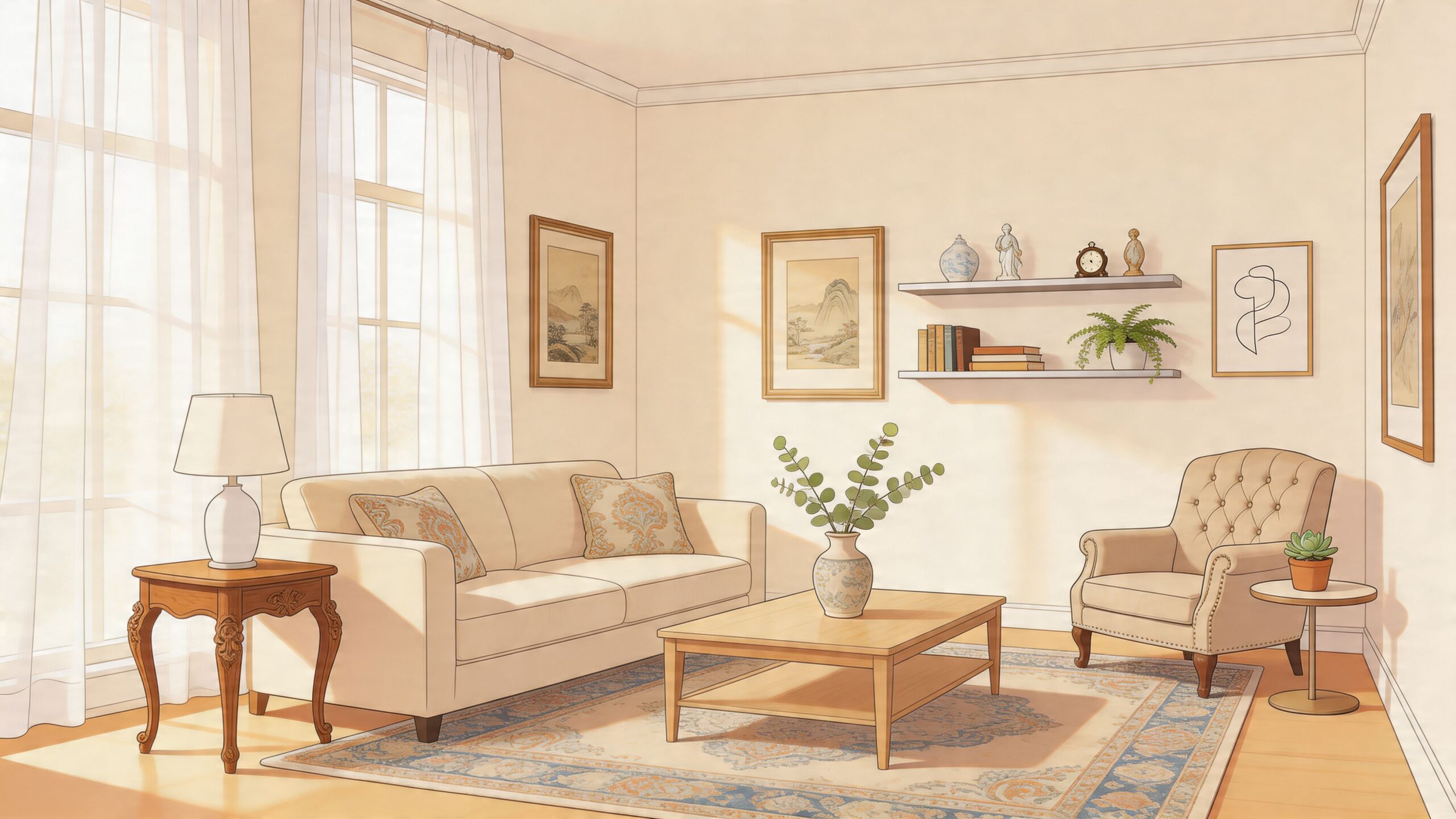
Transitional design is often described as a blend of traditional and modern style. That definition is true, but it’s incomplete. The core philosophy is balance.
Consider a beautifully fitted jacket. It may reference something classic, but the fit feels current. It isn’t costume-like, and it isn’t trying to look futuristic. It looks exactly right. That’s how a successful transitional room behaves.
It’s not half traditional and half modern
Many people misunderstand that transitional doesn’t mean placing one antique beside one contemporary piece and calling it done. The room still needs a point of view.
A better way to think about it is this:
- Traditional contributes depth through shape, history, and familiarity.
- Modern contributes ease through cleaner lines, simpler finishes, and visual breathing room.
- Transitional design curates both so the room feels settled instead of busy.
That sense of editing is what gives transitional interiors their serenity. There’s enough detail to keep the room interesting, but not so much that your eye feels tired.
Serenity comes from visual discipline
A strong transitional room usually has a calm backdrop. Colours are often soft and restrained. Forms are elegant, but not over-ornamented. Accessories are chosen, not accumulated.
If modernism can sometimes feel austere, and traditional design can sometimes feel overly dressed, transitional design lands in a more comfortable middle. It creates a home that supports everyday life while still feeling refined.
You can see that same idea reflected in broader conversations about mixing styles while maintaining balance. The room works because contrast is controlled.
Practical rule: If every piece is demanding attention, the room will feel noisy. Transitional design asks a few pieces to lead and lets the rest support them.
Why the style feels timeless
Timelessness isn’t accidental. It comes from selecting elements with staying power.
That usually means:
- Classic silhouettes that won’t date quickly
- Design-forward materials used with restraint
- A cohesive palette that allows art, textiles, and furniture to relate to one another
- Comfortable function so the room isn’t precious
This is one reason transitional design works so well for people who want an elegant home without feeling like they need to redecorate every few years. It’s a style built around lasting decisions.
The Hallmark Elements of Transitional Interiors
Transitional rooms are easy to recognise once you know what to look for. The clues aren’t loud. They’re usually found in proportion, materials, and restraint.
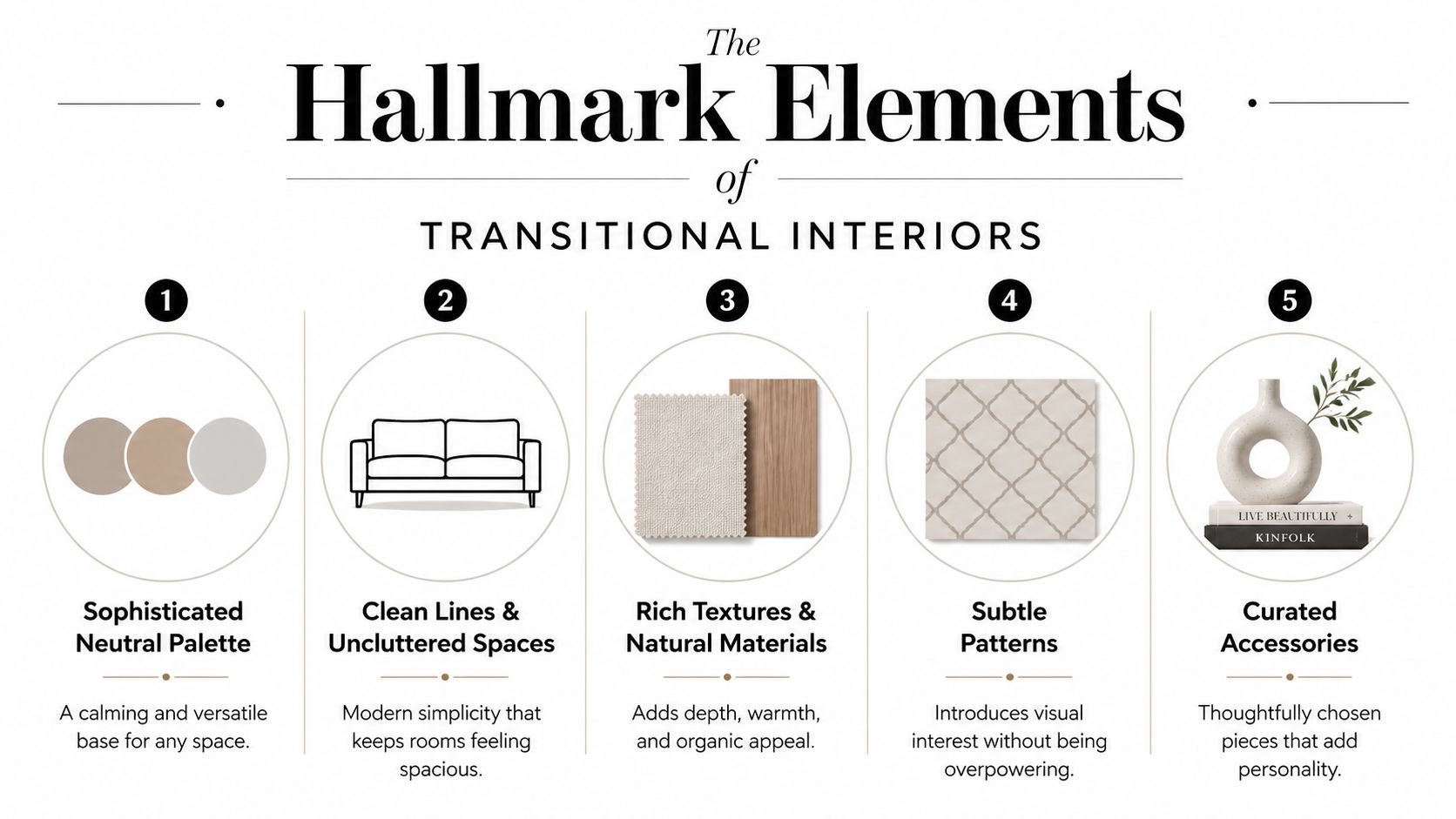
A sophisticated neutral palette
Most transitional interiors begin with a neutral foundation. That doesn’t mean bland. It means the palette is doing subtle work.
Taupe, sand, stone, warm grey, ivory, mushroom, and softened charcoal all fit comfortably here. These colours let materials take the lead. In Southern Ontario, they’re especially useful because they reflect available natural light more gently during long, overcast stretches of the year. The strongest transitional schemes often use neutrals with enough depth to feel architectural, not flat.
Colour, when introduced, usually appears with restraint. A muted blue chair, a deep olive accent, or warm cognac leather can all work beautifully. The room stays grounded because the larger palette remains calm.
Furniture with clean lines and familiar shapes
Furniture in a transitional space tends to sit between two extremes. It isn’t heavily carved and formal, but it also isn’t stark or highly experimental.
You might see:
- a sofa with clean lines, a classic profile, and simpler arms
- an upholstered bed with graceful lines but minimal ornament
- a substantial wood dining table paired with lighter, more refined chairs
- a sleek recliner from Stressless placed near a traditional bookcase
Many homeowners realise transitional style is more approachable than they expected. The room doesn’t need to reject comfort or sentiment. It needs to refine them.
For readers comparing this with a sharper aesthetic, this overview of the elements of a modern home helps clarify where transitional interiors deliberately soften the modern edge.
Texture does the heavy lifting
Transitional rooms are rarely pattern-heavy. They rely more on texture layering to create warmth and visual depth.
In Southern Ontario, this approach also makes practical sense. Guidance drawn from transitional texture layering notes a minimum 5-texture stack per focal zone, and the same source describes combinations such as hardwood floors, stone, linen or velvet upholstery, glass or metal hardware, and a dense wool rug. That layered approach is also linked to a 92% preference in Critelli’s Rug Market data for neutral, texture-rich transitional settings.
A room might combine:
- smooth painted millwork
- matte metal
- hand-finished wood
- nubby upholstery
- polished glass
- hand-knotted wool
The result feels richer than a room relying on colour alone.
Designer’s Insight: Start with one tactile anchor. Our designers often like a bold Hancock & Moore leather paired with a neutral hand-knotted wool rug to balance the room’s energy. The leather gives structure. The rug softens and grounds it.
That rug matters more than many homeowners realise. In transitional design, rugs aren’t an afterthought. They’re often the element that joins old and new, crisp and soft, structured and relaxed. I often describe hand-knotted rugs as Art for your Floor because they establish the room’s foundation while adding artisanal character.
If you want another perspective on arranging these layers in a real space, this guide on how to style your living room offers useful visual thinking around cohesion and placement.
Accessories are curated, not crowded
A transitional room usually contains fewer accessories than a traditional one. Each object should feel chosen.
That might mean a sculptural ceramic lamp, one framed abstract work, a stack of books, and a vase with branches. It doesn’t mean every shelf must be full. Empty space is part of the composition.
In this style, sophistication often shows. The room trusts quality over quantity.
Style Spectrum comparison
| Element | Traditional | Modern | Transitional |
|---|---|---|---|
| Colour palette | Richer, often more layered | Often restrained and crisp | Soft neutrals with selective contrast |
| Furniture lines | Ornate, shaped, formal | Clean, spare, linear | Tailored, refined, balanced |
| Materials | Wood, pattern, decorative finishes | Glass, metal, smooth surfaces | Wood, metal, fabric, stone in measured layers |
| Accessories | Collected, often abundant | Minimal, edited | Curated and intentional |
| Overall feeling | Formal, classic | Sleek, disciplined | Calm, welcoming, polished |
How to Mix Traditional and Modern Pieces
The question isn’t whether you can mix styles. You can. The question is how to make them look as though they belong together.
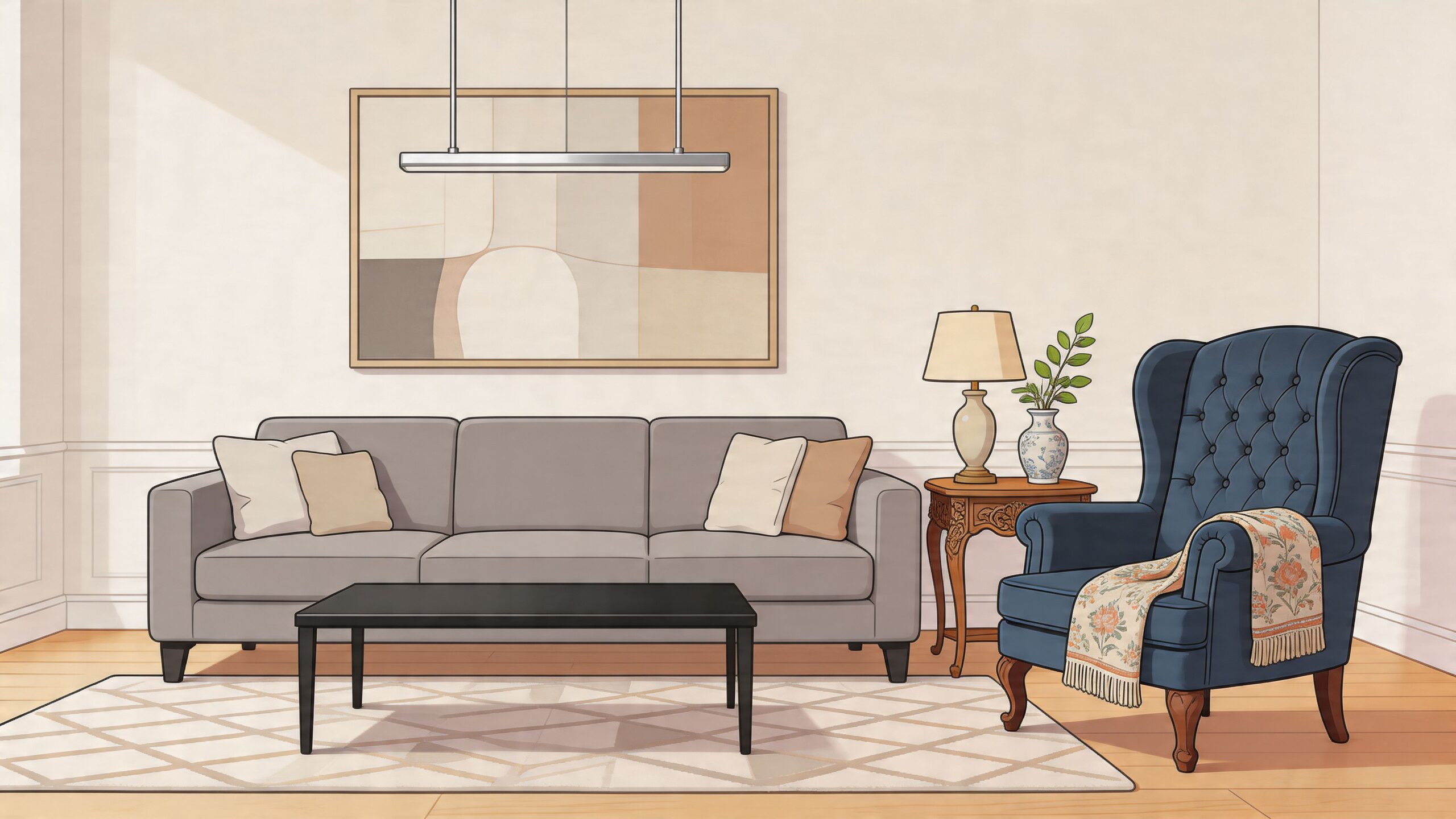
A useful guideline comes from fresh transitional design recommendations, which suggest a 40/60 to 25/75 ratio of traditional to modern elements. The same source notes that this balance produced 85% client satisfaction in Critelli design consultations when antiques were paired with contemporary pieces. In plain terms, that means one style should usually lead while the other supports.
Start with an anchor piece
Choose the item that has the strongest voice in the room.
That anchor might be:
- a Stickley Mission-style bookcase
- a traditional pedestal dining table
- a classic tufted sofa
- a modern Stressless recliner
- a substantial antique chest
Once you know the anchor, the rest becomes easier. If the anchor is traditional, bring in modern support pieces with cleaner profiles. If the anchor is modern, add warmth through wood, softer textiles, or a more familiar silhouette nearby.
Pair by tension, not by sameness
Good transitional rooms are built on controlled contrast.
Try combinations like these:
- a tufted sofa with a glass-topped coffee table
- a traditional console beneath abstract art
- a classic dining table with simple upholstered host chairs
- a modern bed softened by a bench in natural wood
What matters is relationship. Curves can soften straight lines. Smooth metal can lighten heavy wood. Upholstery can quiet a more structured piece.
A room feels layered when the pieces are different. It feels harmonious when their scale, tone, and finish still speak to one another.
Avoid the exact split
Many homeowners assume the safest route is a perfect fifty-fifty mix. In practice, that often creates a room that feels undecided.
Instead, let one language dominate. A room with traditional architecture may benefit from more modern furnishings. A newer condo may need a few classic forms to avoid feeling impersonal. Transitional style works best when the blend is intentional, not mathematically even.
Use era-spanning accents with care
Some pieces are especially helpful in transitional rooms because they bridge stylistic language naturally. Mid-century forms can do that well, especially when they’re used sparingly. If you’re curious which silhouettes adapt most easily, this look at iconic mid-century pieces is a useful reference.
For a broader comparison of old-world and current aesthetics, this discussion of contemporary vs traditional design styles can help sharpen your eye.
A simple decision framework
When you’re unsure whether two pieces belong together, ask four questions:
Do they share a similar visual weight
A delicate chair beside an overly massive table will often feel mismatched.Is there one repeated note
Perhaps both pieces have warm wood tones, softened corners, or matte finishes.Does one piece soften the other
This is often where the magic happens.Would the room still make sense if one item were removed
If not, the mix may be relying on novelty rather than cohesion.
That’s the difference between a room that feels bespoke and one that looks mixed.
Transitional Design Inspiration for Every Room
The easiest way to understand transitional style is to walk through a home and watch how it changes from room to room. The principles stay consistent, but the expression shifts with function.
The living room
This is often where transitional design feels most natural. The room benefits from a mix of comfort, conversation, and visual poise.
A strong living room might centre on a clean-lined sofa in a soft neutral. Across from it, two more characterful chairs could introduce shape or a richer material. A wood coffee table with a quieter profile can ground the seating plan, while a hand-knotted rug provides pattern in a restrained, refined way.
The mistake to avoid is making everything equally soft and equally beige. A successful transitional living room usually needs one or two sharper notes. That might be a metal-framed side table, a more modern chandelier, or a large abstract canvas above a traditional mantel.
The dining room
Dining rooms respond beautifully to transitional thinking because they often contain one naturally traditional element: the table.
A substantial wood dining table has presence. To modernise the composition, pair it with upholstered armless chairs, simpler lighting, and less ornate storage pieces. A credenza with clean lines can keep the room feeling current even when the table itself is more classic.
What makes the room memorable is the conversation between forms. A rounded tabletop might sit under a linear pendant. A more architectural mirror can offset softer dining upholstery. The room feels gracious, but not ceremonial.
In a transitional dining room, comfort matters as much as formality. People should want to stay at the table.
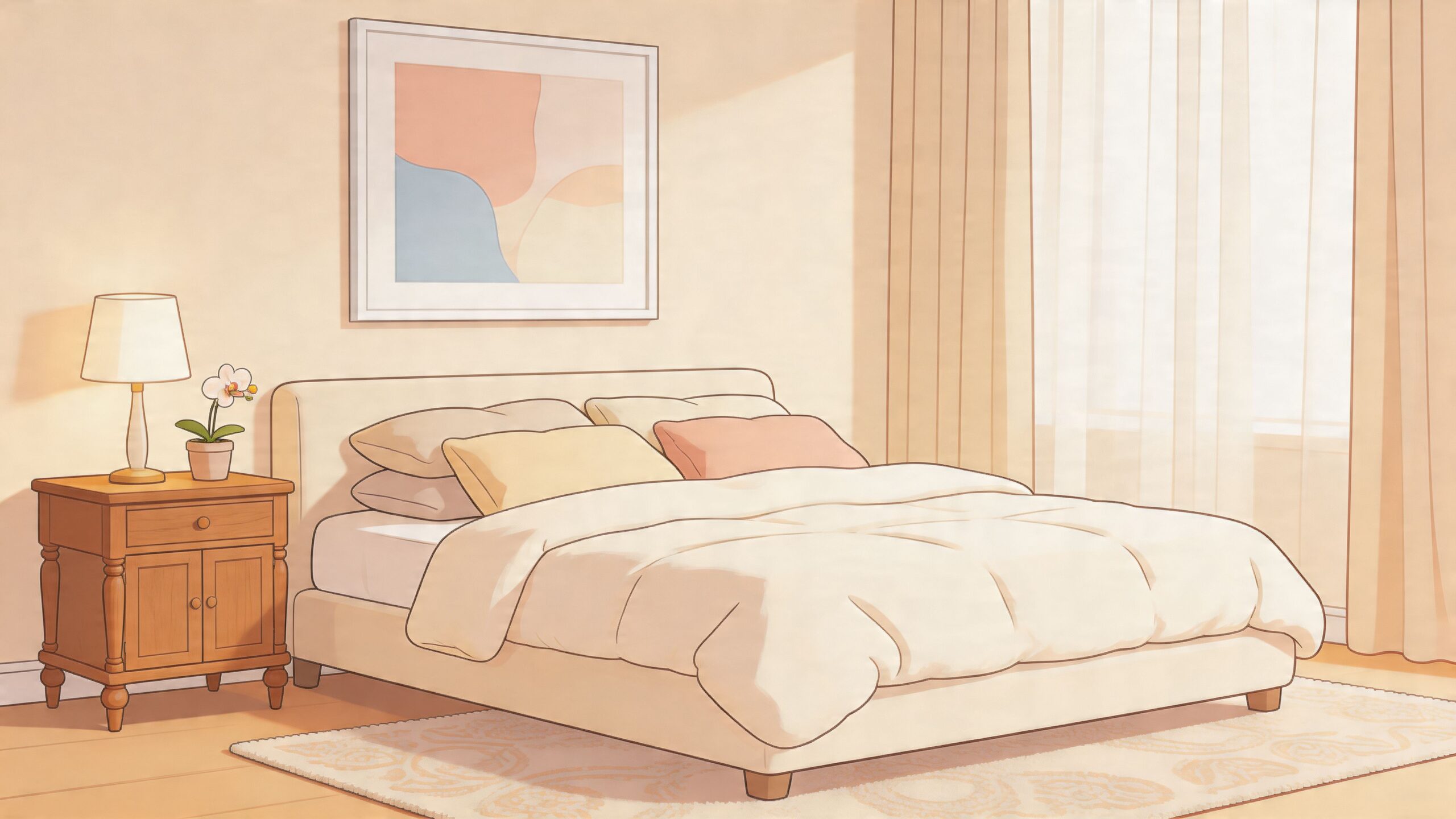
The bedroom
Bedrooms are often where homeowners most appreciate transitional serenity. The style is naturally suited to spaces that should feel restorative.
An upholstered headboard in linen or velvet can create softness without fuss. Bedside tables in wood add warmth and permanence. Lamps with simple silhouettes keep the room from drifting too traditional. Layered bedding in tonal neutrals adds depth without noise.
This is also an ideal room for restraint. Fewer decorative objects usually lead to a calmer atmosphere. One bench, one rug, one beautiful chest, and thoughtful lighting can do more than a room crowded with small accents.
Why room planning matters
Many people can identify pieces they like. Fewer know how to make those pieces work together throughout an entire house. That’s where a complete room concept becomes valuable.
Professional designers often approach transitional interiors through:
- space planning so furniture placement feels balanced
- material coordination so woods, metals, and textiles relate
- bespoke customisation for upholstery, finish, and scale
- architectural response so the furnishings suit the house itself
That level of planning is especially important in homes across Niagara, Hamilton, and the Greater Toronto market, where architecture can vary dramatically from heritage houses to new builds and condominiums. A design studio approach helps the home feel coherent from room to room, rather than assembled one isolated purchase at a time.
Common Transitional Design Mistakes to Avoid
Transitional design looks effortless when it’s done well. It isn’t effortless.
The style depends on judgement, and a few small mistakes can make a room feel muddled rather than refined.
Treating neutral as enough
A common error is creating a room that’s technically neutral but visually flat.
When every surface sits in the same tone and texture, the room loses depth. Transitional design needs contrast, but not necessarily through bright colour. It can come from wool against leather, stone against wood, matte metal against soft upholstery, or smooth lacquer against woven fibre.
If the room feels dull, the answer usually isn’t “add more colour.” It’s often “add more material character.”
Splitting the room into two camps
Another mistake is assigning some pieces to “traditional” and others to “modern” so explicitly that the room feels divided.
You’ll notice this when one half of the room looks formal and the other half looks like a different house altogether. Transitional style should feel blended, not negotiated.
Ignoring scale in smaller homes
This is an especially important issue in Southern Ontario condominiums and compact homes. A challenge identified in this discussion of transitional design scalability is that layered lighting, texture, and blended eras can need more breathing room than people expect. That same source suggests a “micro-transitional” approach for smaller footprints, with emphasis on signature pieces, mirrors, and metallic accents.
In practice, that means:
- Choose one standout piece instead of several competing ones
- Use mirrors strategically to extend light and perceived depth
- Select furniture with visible legs so the room feels lighter
- Let one rug define the zone rather than over-layering small accents
Over-accessorising to make the room feel finished
This one is very common. Homeowners worry the room looks incomplete, so they keep adding objects.
Transitional spaces usually improve through subtraction. If the architecture, furniture, lighting, and rug are strong, the accessories only need to support them. A curated room always feels more refined than a crowded one.
If you’re styling shelves or tabletops and nothing feels resolved, remove one-third of the objects first. Then reassess.
Begin Your Design Journey with Critelli
A well-designed transitional home doesn’t ask you to choose between elegance and ease. It gives you both.
That’s why the style continues to speak to homeowners who want a polished interior that still feels personal. It accommodates heirloom quality pieces, modern comfort, artisanal finishes, and the realities of how people live now. It’s design-forward without becoming fashion-driven.
For clients who want guidance beyond inspiration photos, working with experienced professionals makes an enormous difference. Many homeowners benefit from seeing how custom interior design experts approach planning, flow, and material selection at a whole-home level. The same principle applies when you want your own rooms to feel cohesive rather than pieced together over time.
A design studio brings that discipline into the process. Through professional interior design services, homeowners can move from individual preferences to a complete room concept, with support for space planning, bespoke selections, and in-home coordination. That’s often what turns a room from “nice pieces” into a fully resolved interior.
For a family-run firm established in 1914, that service is part of a larger tradition. The value isn’t just in the furnishings themselves. It’s in the curation, the confidence of an experienced eye, and the smooth path from selection to installation. White-glove delivery matters because a refined home should arrive that way too.
If transitional style has been difficult to define, that’s partly because its success is subtle. It doesn’t rely on obvious formulas. It relies on balance, thoughtful contrast, and timeless craftsmanship. When those elements come together, the home feels calm, beautiful, and ready to live in for years.
If you’re ready to shape a home that feels both current and enduring, Critelli Furniture offers a rare combination of family-run heritage, curated selection, and white-glove service. Experience the craftsmanship in person at our King Street Showroom. Visit the Rug Market to find your room's foundation. Or book your complimentary design consultation today to begin a bespoke transitional interior designed for your life in Niagara, Hamilton, or the Greater Toronto area.