
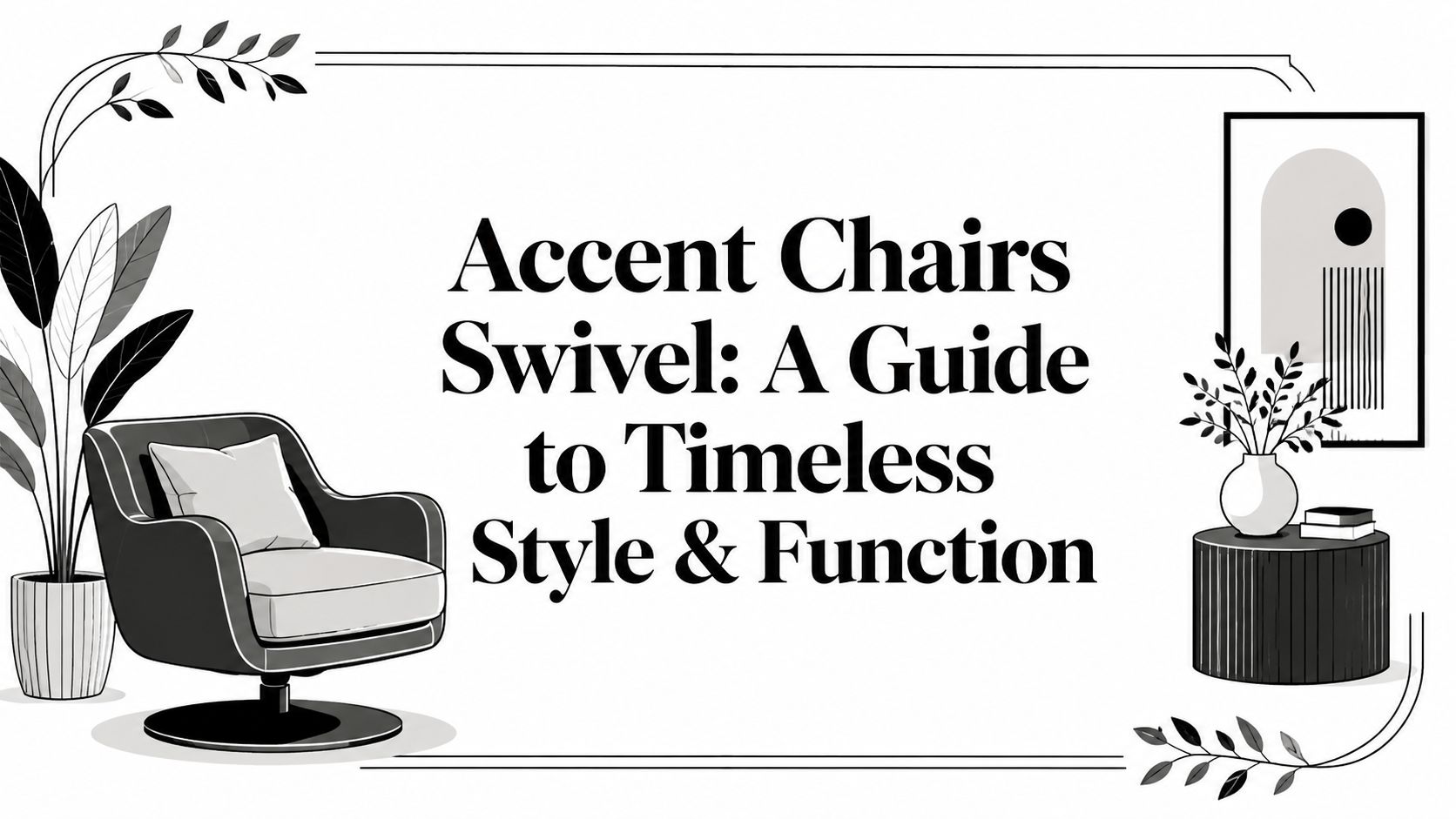
Accent Chairs Swivel: A Guide to Timeless Style & Function

A living room can be beautifully furnished and still feel oddly rigid. The sectional is generous, the coffee table is scaled correctly, the lighting is warm, yet conversation stalls because one person faces the fireplace, another faces the television, and someone at the end seat has to twist awkwardly just to stay engaged. That friction is common in open-concept homes across Southern Ontario, especially where one room has to serve several purposes at once.
That's where accent chairs swivel from being a stylistic choice into a practical design move. A well-made swivel chair softens the fixed geometry of a sectional, improves circulation, and gives a room more social intelligence. It lets a seat respond to the way people live. Morning coffee by the window. Evening conversation toward the sofa. A quick turn toward the kitchen when guests arrive.
That flexibility helps explain why swivel accent chairs have seen a 35% increase in market preference across Southern Ontario's premium furniture segment between 2020 and 2025 in design schemes that prioritize fluid spatial flow, according to regional market analysis referenced here. For a family-run firm with roots dating back to 1914, that shift feels less like a passing trend and more like a return to furniture that solves a room gracefully.
A refined chair should do more than fill a corner. It should support the architecture, respect the traffic pattern, and add lasting comfort. In homes from St. Catharines to Hamilton and the Greater Toronto market, that usually means looking past inspiration images and focusing on fit, movement, materials, and craftsmanship.
Table of Contents
- An Introduction to Dynamic Living
- The Enduring Appeal of Swivel Chairs
- Curating Your Style Form and Material
- Finding the Perfect Fit Placement and Proportion
- Beyond the Surface Heirloom Quality and Longevity
- Creating a Cohesive Vision Styling Your Swivel Chair
- The Critelli White-Glove Experience
An Introduction to Dynamic Living
The most successful rooms aren't static. They guide movement without feeling busy, and they let people connect without rearranging furniture every time company arrives. Swivel seating does that. It introduces motion into a room that might otherwise be dominated by a large sectional, a fireplace wall, or an open sightline to the kitchen.
In Southern Ontario homes, this matters because many living spaces now have to perform several roles at once. One area might host family gatherings, evening television, casual reading, and occasional work calls. Fixed seating can make those transitions feel clumsy. A swivel chair gives the room a degree of responsiveness that's hard to achieve with a traditional accent chair alone.
The problem a swivel chair actually solves
A sectional often anchors the room correctly, but it also establishes a dominant direction. That's useful for structure, though not always for interaction. A swivel chair can offset that rigidity by creating a seat that participates in more than one focal point.
Practical rule: A chair earns its place when it improves both conversation and circulation.
This is one reason swivel seating keeps appearing in design-forward living rooms. It doesn't demand attention through ornament. It improves the room through use. In homes that favour open-concept planning, that distinction matters.
A heritage approach to a modern room
For a multi-generational design firm founded in 1914, the appeal of swivel chairs isn't novelty. It's utility paired with timeless form. The strongest pieces still follow old principles. Good scale. Quiet craftsmanship. Materials that age with dignity. Placement that supports the whole room rather than calling attention to one object.
That point is often missed in trend-driven shopping. A swivel chair shouldn't be chosen because it swivels. It should be chosen because the room needs a more fluid seat, a lighter profile near a sectional, or a flexible perch that can face more than one zone beautifully.
When selected with care, accent chairs swivel in a way that feels gracious rather than gimmicky. That's the difference between a piece that merely moves and one that belongs.
The Enduring Appeal of Swivel Chairs

Swivel chairs have become central to many contemporary living rooms because they answer two needs at once. They support a cleaner visual language, and they make the room easier to use. That combination is hard to ignore in homes that blur the lines between lounging, entertaining, and working.
Their rise also reflects how people occupy their homes now. Industry records show that 68% of homeowners in Southern Ontario who purchased swivel chairs in 2023 chose them for “Zoom call” readiness and “modern or organic” aesthetic alignment, alongside a 22% increase in demand for swivel chairs in home office configurations, according to this category reference. The chair is no longer confined to a formal sitting area. It now belongs in rooms that shift function through the day.
Movement suits the way people live now
Open-concept planning sounds effortless, but it can be difficult to furnish well. Large rooms often need lighter pieces that connect zones without visually crowding them. A swivel chair helps because it can face a conversation grouping, pivot toward a view, or turn toward adjoining activity without changing its footprint.
That's especially useful in layouts where a sectional already occupies substantial floor area. A fixed chair may feel planted in one direction. A swivel chair gives the occupant choice.
A few rooms that benefit most include:
- Family rooms with sectionals: the chair can engage with the sofa or rotate toward another focal point.
- Reading corners near windows: the seat can follow natural light through the day.
- Dual-purpose spaces: a chair can serve leisure time and video calls without looking office-like.
Why the silhouette matters
Not every accent chair is suited to modern circulation. Tall backs, heavy wings, and bulky arms can interrupt sightlines, particularly in open layouts. Many swivel designs avoid that problem through softer curves, lower profiles, and cleaner bases.
A swivel chair often works best when it looks calm at rest and capable in use.
That's why the category has staying power. It offers flexibility without the visual commotion of furniture that tries too hard to signal function. A rounded barrel form can soften the angular lines of a sectional. An armless swivel can disappear lightly into a compact condo plan. A chair-and-a-half can balance a large seating group without reading as another sofa.
For homeowners seeking luxury furniture Niagara, custom furniture Southern Ontario, or refined seating that supports a complete room concept, swivel chairs remain compelling because they combine grace with utility. They don't just fill a gap. They improve how the room behaves.
Curating Your Style Form and Material
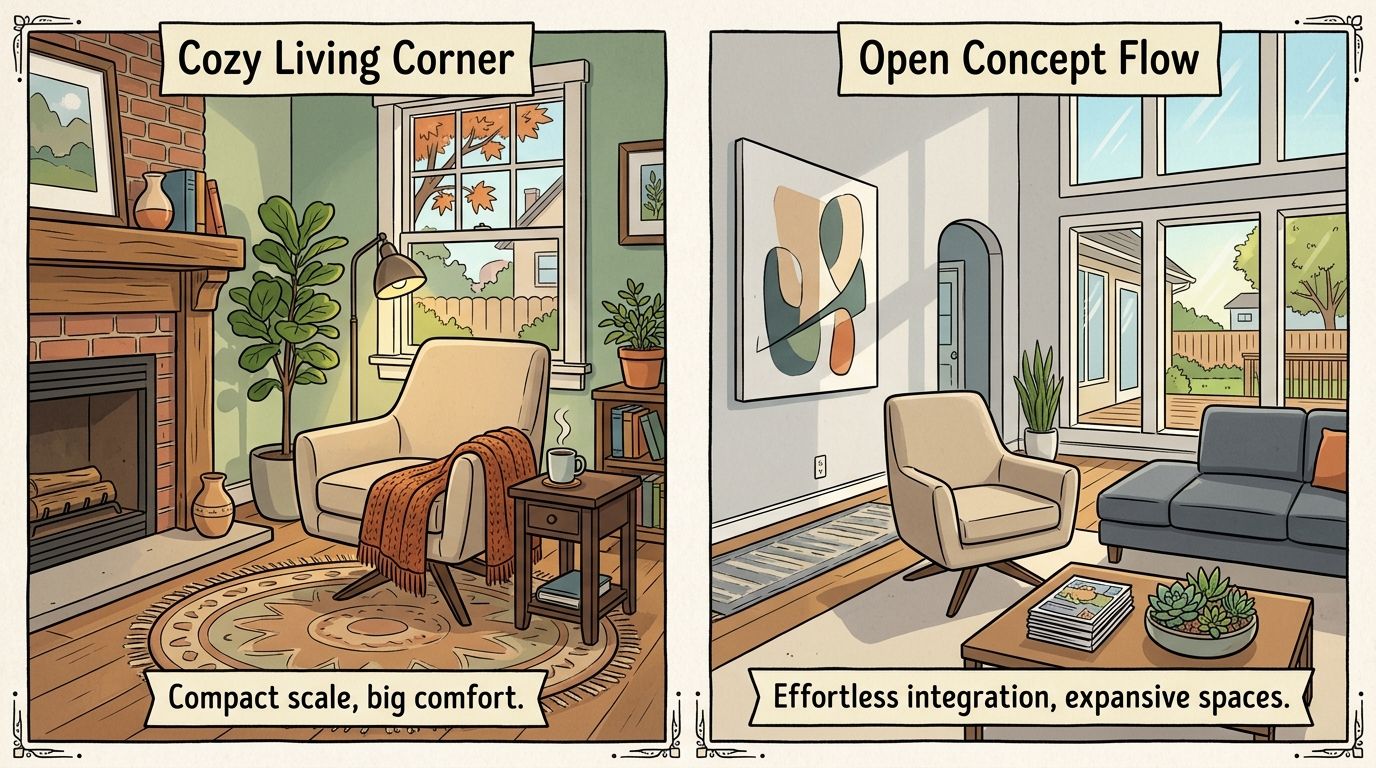
A swivel chair earns its place when the form suits the architecture and the material suits daily life. In Southern Ontario homes, that usually means balancing two realities at once. The chair has to look settled within the room, and it has to stand up to regular use in spaces that often serve family time, entertaining, and quiet reading all in the same week.
I advise clients to choose the shape first, then the fabric. If the silhouette is wrong, no upholstery will rescue it.
Start with silhouette
Form sets the mood of the chair and its visual weight in the room. A rounded barrel shape feels composed and inviting. A club-style frame carries more tradition and presence. An armless profile keeps the room lighter, which can matter in open-concept plans where every piece is visible from several angles.
Each option solves a different design problem.
- Barrel forms soften the long, horizontal lines of large sofas and sectionals.
- Structured club silhouettes add substance when the seating group feels too low or visually spread out.
- Armless or open-profile designs suit tighter footprints and rooms where preserving sightlines matters.
The better question is not which shape is most popular. It is what the chair needs to do in the composition. Some chairs are meant to quiet a busy corner. Others need enough presence to hold their own beside a substantial sectional.
Choose material for the way the room is actually used
Material choice has less to do with trend and more to do with service life. In family rooms, I often recommend performance upholstery because it handles day-to-day wear with less worry. In a formal sitting room, a refined woven fabric or leather can bring more structure and polish. In homes that feel a little flat, a textured fabric such as bouclé or a tactile weave can add depth without adding another pattern.
The smartest selections usually come from honest use patterns, not showroom optimism.
| Room condition | Material direction | Why it works |
|---|---|---|
| Busy family room | Performance upholstery | Easier upkeep and a cleaner appearance over time |
| Formal lounge | Refined woven or leather | Sharper, more tailored character |
| Texture-led interior | Bouclé or tactile weave | Adds softness and visual depth |
| Mixed-material room | Smooth upholstery with wood or metal accents | Keeps the palette controlled |
A good swivel chair should still look graceful after years of turning toward a fireplace, a television, or a conversation area. That is why I pay close attention to how the fabric behaves on a curved back and seat. Some materials drape beautifully but show wear sooner. Others wear well but can feel stiff if the tailoring is not handled properly.
Designer's Insight: A swivel chair with visible texture often works best beside a sofa in a quieter fabric. The contrast gives the room depth and keeps the seating group from feeling flat.
An experienced design studio proves its worth. At Critelli Furniture, clients are guided through shape, scale, finish, and upholstery choices as part of the full room, not as isolated swatches on a table. For a closer look at practical fabric choices, this guide to upholstery materials and how they perform in real homes is a useful starting point.
Finding the Perfect Fit Placement and Proportion
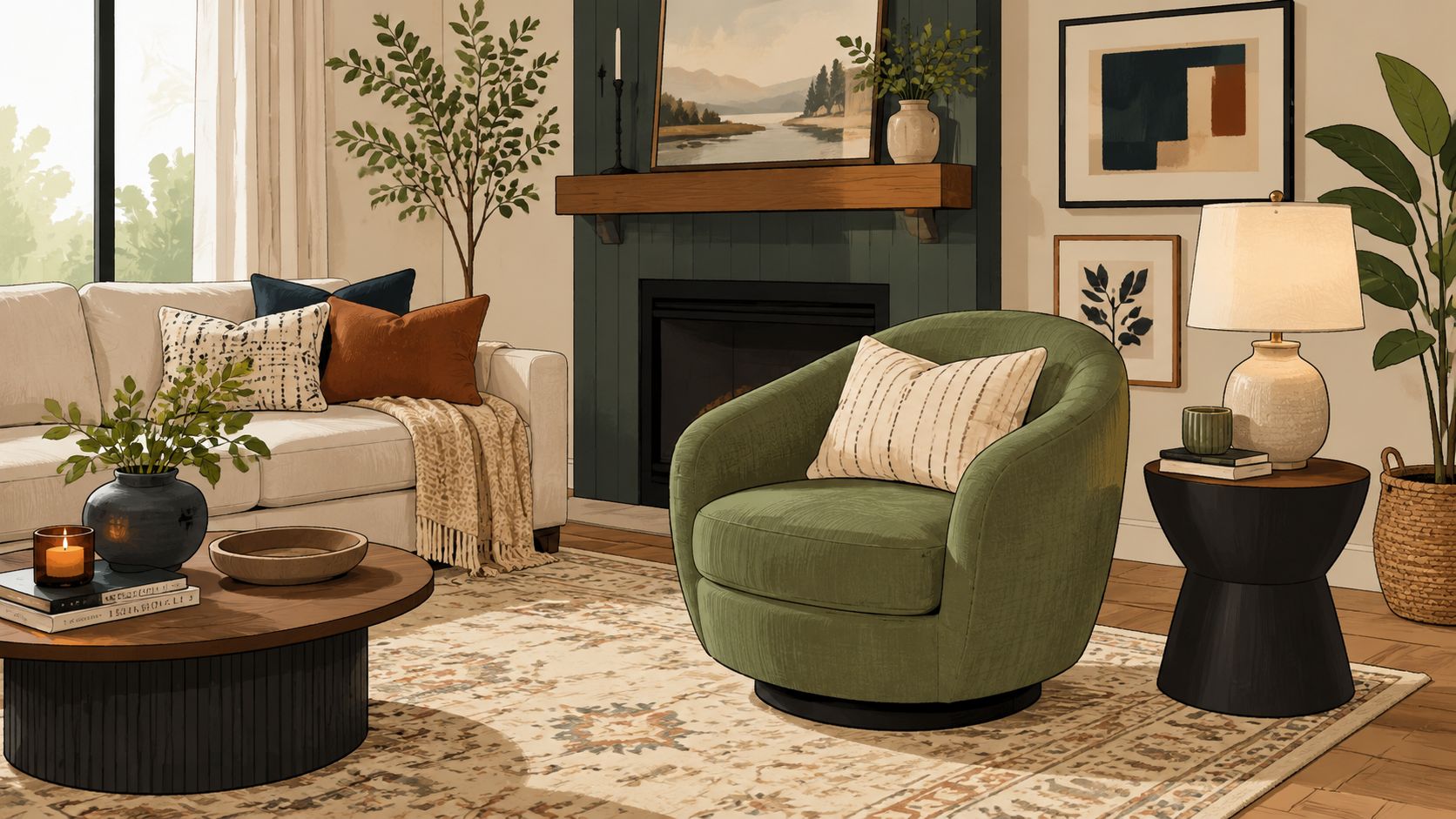
A beautiful chair placed poorly will make the whole room feel wrong. Many homeowners struggle with accent chairs swivel near sectionals. The issue usually isn't the chair itself. It's the relationship between the chair, the walkway, the chaise, and the conversation zone.
The most useful rule is simple. A designer guideline is to keep seat heights within 4 inches of each other and to use swivel chairs in open layouts because they preserve flow while adding flexibility, as noted in this Canadian-facing design video reference. That one measurement helps protect visual harmony and sitting comfort across the room.
Measure the relationship, not just the chair
Many shoppers measure the empty corner and stop there. That's not enough. A swivel chair needs room not only to sit, but to turn without clipping a coffee table, brushing a floor lamp, or crowding the sectional chaise.
A practical checklist includes:
- Seat height alignment so the chair doesn't feel noticeably too low or too upright beside the sofa.
- Turning clearance around the chair's widest point, including arms and back curve.
- Sightline control so the chair doesn't interrupt the room when viewed from adjoining spaces.
- Walkway protection so circulation still feels effortless when the chair is occupied.
If a swivel chair has to be held still so the room functions, it's the wrong size or in the wrong place.
That's especially relevant in urban homes near Toronto, where square footage often asks one piece to solve both comfort and space efficiency.
What works in compact rooms and large rooms
Compact living rooms usually favour chairs with less visual bulk. Armless silhouettes, rounded backs, and exposed bases tend to keep the room lighter. Large family rooms can absorb a deeper or more embracing swivel chair, particularly if the sectional has a long, low line that needs counterbalance.
A few common pairings tend to work well:
- With a chaise sectional: place the swivel opposite the chaise end, not tight against it.
- In an open-concept room: angle the chair so it can address both the seating group and the adjacent zone.
- By a fireplace: allow enough distance for swivel movement without drifting too far from the conversation area.
For homeowners refining layout before they shop, this guide on how to arrange furniture in a living room offers a helpful starting framework.
Scale isn't decorative. It's functional. The chair should support the room's architecture, not argue with it.
Beyond the Surface Heirloom Quality and Longevity
The most expensive mistake in swivel seating is choosing with the eye alone. Upholstery colour, silhouette, and trend appeal get attention first, but long-term value lives underneath. In premium seating, the swivel mechanism is not a secondary detail. It is the core of the chair's daily performance.
That matters because premium furniture buyers often scrutinize purchase longevity, and a major concern is how well the swivel mechanism holds up over time, a practical issue highlighted in this consumer-facing category discussion. A chair can look elegant on day one and still disappoint if the turn becomes noisy, unstable, or resistant.
What to inspect before selecting
A quality swivel chair should rotate smoothly and return to rest with composure. It should feel grounded, not loose. The base should support movement without wobble, and the frame should hold its shape under repeated use.
The unseen details worth asking about include:
- Frame construction: kiln-dried hardwood and reinforced joinery tend to support longer service life.
- Seat support: resilient suspension and well-balanced cushioning help the chair age more gracefully.
- Mechanism stability: movement should feel controlled, not overly light or mechanically abrupt.
- Upholstery suitability: heavier materials should still rotate cleanly without making the chair feel laboured.
When fixed seating may be the better answer
Swivel chairs are versatile, but they aren't automatically the right answer everywhere. In a formal sitting room, a fixed accent chair may produce a more composed arrangement. In a very tight room, eliminating the swivel function can simplify placement and reduce mechanical complexity.
That trade-off deserves attention because premium design isn't about adding features. It's about selecting the right feature for the room.
A chair becomes heirloom quality when its construction supports years of ordinary use without demanding constant forgiveness.
Material care also affects longevity. Leather, in particular, benefits from consistent maintenance and thoughtful placement away from harsh sun or drying heat. For anyone considering leather upholstery, this care guide for maintaining leather furniture properly is worth reviewing before a final selection.
Timeless craftsmanship is rarely loud. It shows up in quiet stability, graceful wear, and comfort that lasts.
Creating a Cohesive Vision Styling Your Swivel Chair
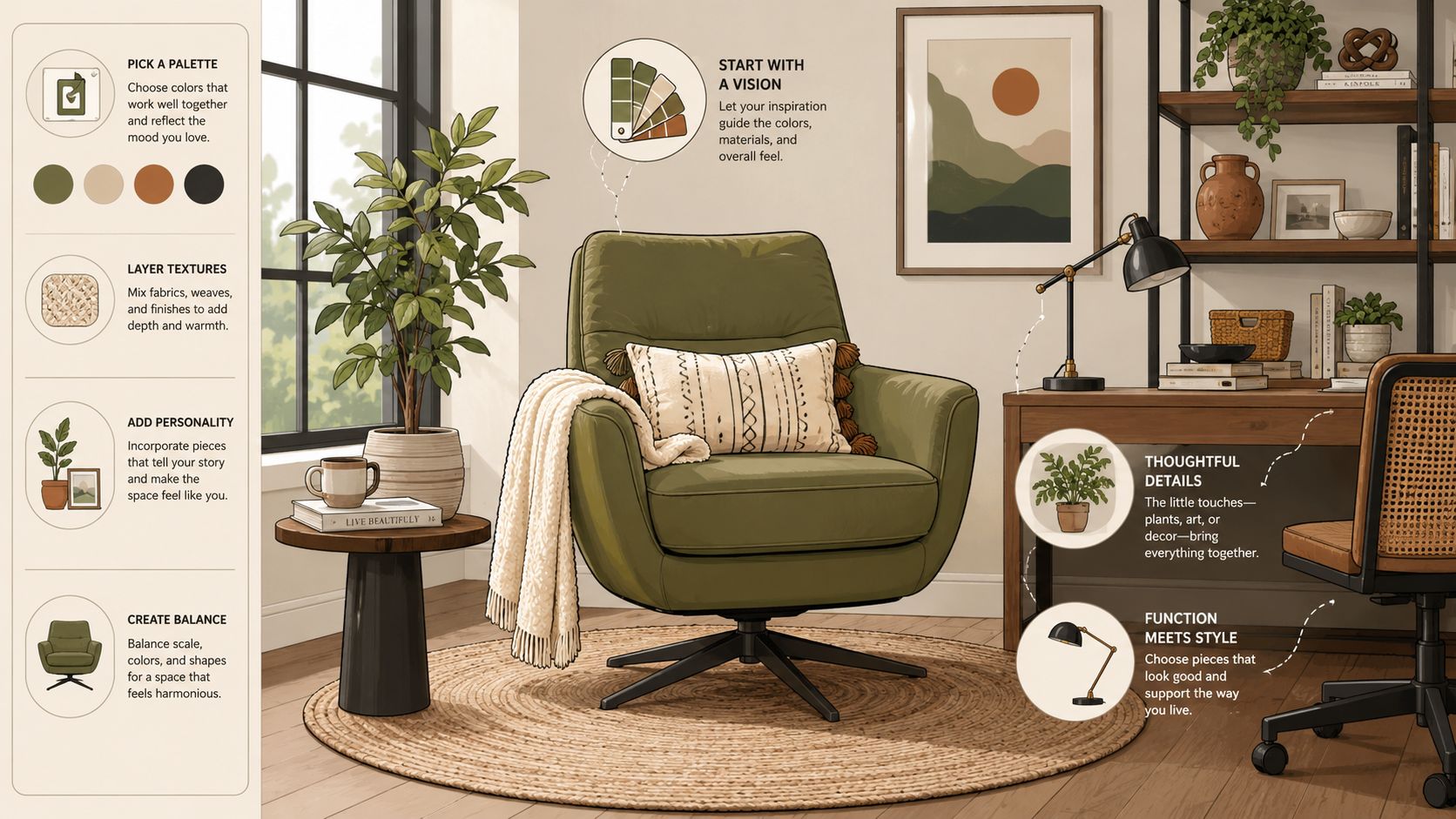
A swivel chair should never feel like a leftover seat placed wherever there was space. It needs to participate in the room's full composition. That means colour, texture, lighting, and surrounding objects should all reinforce its purpose.
Build from the floor up
The strongest rooms often begin with the rug. In a thoughtful interior, the rug does more than soften acoustics or define a seating group. It establishes palette, rhythm, and mood. That's why many designers regard the Rug Market as a place to find Art for your Floor, especially when building a complete room concept around a sectional and accent seating.
A hand-knotted rug can give a swivel chair context. The chair's upholstery might echo one quiet tone from the rug rather than matching the sofa directly. That creates a layered look that feels collected.
For homeowners refining ambience as well as layout, this piece on how to make your home cozy offers useful ideas on warmth, texture, and atmosphere that pair naturally with furniture planning.
Finish the vignette with restraint
A swivel chair vignette works best when each neighbouring piece has a purpose. Add too much, and the chair loses the freedom that makes it valuable.
A concise styling formula often works well:
- A compact side surface: a C-table or small round table keeps essentials close without adding bulk.
- Focused lighting: a floor lamp or articulated reading light gives the chair a defined role.
- One soft layer: a cushion or throw can add comfort, but too many textiles make the chair feel overworked.
- Breathing room: leave enough negative space around the chair so its movement still feels elegant.
Designer's Insight: A small-footprint table beside a swivel chair is often more useful than a larger end table. It keeps the composition lighter and respects the chair's range of motion.
For more inspiration on integrating occasional seating into a broader room scheme, this article on ways to use an accent chair thoughtfully can help connect function and styling.
When done well, accent chairs swivel without feeling transient or trendy. They become part of a layered, intentional room that feels settled from every angle.
The Critelli White-Glove Experience
A swivel chair often proves itself in the last ten minutes of a project. It arrives, the rug is already down, the sectional has set the traffic path, and suddenly an inch too close to the cocktail table or a slight turn in the wrong direction changes how the whole seating area works.
That final placement matters in real homes across Southern Ontario, especially in open-concept plans where one chair may need to address both a conversation area and a view toward the kitchen or fireplace. In rooms anchored by large sectionals, a swivel chair only earns its place when the clearance is right and the movement feels natural from day one.
Why delivery shapes the final result
Swivel chairs ask for more precision than many occasional pieces. The base needs to sit level. The chair needs enough room to rotate without clipping a side table or crowding a walkway. The angle also has to feel considered in relation to the sofa, rug, and sightlines across the room.
A thoughtful white-glove process handles those details in the home, not just at the truck. Inspection, careful placement, assembly where needed, and removal of packaging all help the room feel finished instead of interrupted by delivery debris and guesswork.
Homeowners who continue refining the room after furniture delivery often add finishing layers such as greenery. For tasteful guidance that complements a polished interior, this article on how to decorate with houseplants is a useful resource.
A complete room deserves a complete service
Our family has worked with furniture long enough to know that a well-made chair is only part of the value. The other part is protecting the mechanism, the upholstery, and the design intent from showroom to living room. That is particularly true with heirloom-quality swivel chairs, where the long-term return comes from proper handling and placement as much as from the frame and fabric.
A family-run firm with a heritage dating to 1914 understands that furniture selection is tied to a larger room plan. Rugs, lighting, upholstery, and scale all affect whether the chair feels collected over time or added as an afterthought. Clients considering what that process includes can review the details of white-glove delivery and in-home placement.
Book your complimentary design consultation today.
Experience the craftsmanship in person at our King Street Showroom.
For homeowners seeking bespoke seating, timeless craftsmanship, and a complete room concept grounded in thoughtful design, Critelli Furniture offers a warm, heritage-led approach to furnishing. Visit the Rug Market to find your room's foundation, or begin with a design consultation to curate accent seating that fits your home beautifully.