
Find the Best Custom Furniture Makers in Ontario


A great many homeowners arrive at the custom furniture search in the same state. They've bought the stylish sofa that looked perfect under showroom lights, only to watch it flatten, wobble, or date itself far too quickly. They've filled rooms with pieces that fit well enough, but never quite belong.
That's usually the moment taste sharpens. The brief changes from “find something nice” to “find something worth keeping.” In Southern Ontario, that search can feel oddly narrow. There's no shortage of rustic farmhouse offerings, Mennonite-inspired silhouettes, and reclaimed-wood statements. But for clients who want a more refined, design-forward interior, the options can seem less obvious.
The best custom furniture makers don't merely build to size. They interpret architecture, daily habits, proportion, and material character. They create pieces with presence, restraint, and the kind of timeless craftsmanship that still feels right years later. That is the difference between furniture that fills a room and furniture that defines it.
Heirloom quality begins with standards, not trends. It also benefits from working with firms that understand legacy. Southern Ontario has examples of that tradition in long-established, family-run businesses, including a St. Catharines institution founded in 1914 that has served Ontario for over 110 years with a heritage-led approach to furniture and interiors, as noted in this history of Critelli Furniture's family legacy. For clients exploring Canadian-made furniture and craftsmanship, that continuity matters.
Table of Contents
- An Introduction to Heirloom Quality Furniture
- Discerning Quality The Hallmarks of True Craftsmanship
- The Commissioning Process A Step-by-Step Bespoke Journey
- Deciding Between Custom and Curated High-End Furniture
- Sourcing Your Bespoke Piece in Southern Ontario
- Essential Questions to Ask Your Furniture Maker
- Investing in a Timeless Legacy
An Introduction to Heirloom Quality Furniture
The phrase heirloom quality gets used too casually. A handsome finish or a higher ticket price doesn't make a piece worthy of that description. Heirloom quality means the furniture improves with use, holds its structure, and carries enough design integrity to outlast passing fashion.
That's why bespoke furniture should never be treated as a simple retail transaction. It's a design decision with a long horizon. The right dining table becomes the backdrop to family rituals. The right sideboard settles a room architecturally. The right bed anchors how a home feels at the most private level.
Furniture with permanence, not just personality
Mass retail tends to solve for speed, sameness, and immediate visual appeal. Bespoke work solves for permanence. It considers wood movement, human comfort, sightlines, storage behaviour, and how a piece will sit with flooring, millwork, and light at different times of day.
Good custom furniture doesn't ask for attention every time someone enters the room. It makes the room feel resolved.
For clients commissioning their first important piece, that distinction matters. They don't need more options. They need better judgement. They need someone to say plainly that a well-made custom piece costs more because it's built with better material logic, better proportions, and better restraint.
Why heritage still matters
Southern Ontario has long supported family-run furniture traditions, and that culture remains useful to the buyer. Businesses that survive for generations generally do so by understanding service, repairability, and the value of trust. That heritage mindset tends to align well with buyers who want bespoke, artisanal furnishings rather than disposable décor.
The strongest interiors also resist the urge to treat furniture as isolated objects. A room should read as a curated selection, not a row of unrelated purchases. That's why the best projects are developed as a complete room concept, where scale, upholstery, wood tone, lighting, and rugs all speak the same language.
Discerning Quality The Hallmarks of True Craftsmanship
A buyer can't choose among the best custom furniture makers until that buyer knows how to judge the work. Quality is visible, but only if someone knows where to look.
The first clues are structural. Open a drawer. Lift a chair. Look underneath a table, not just across the top. Run a hand along the inside edge of a case piece. Fine furniture doesn't hide its standards in the parts no one photographs.
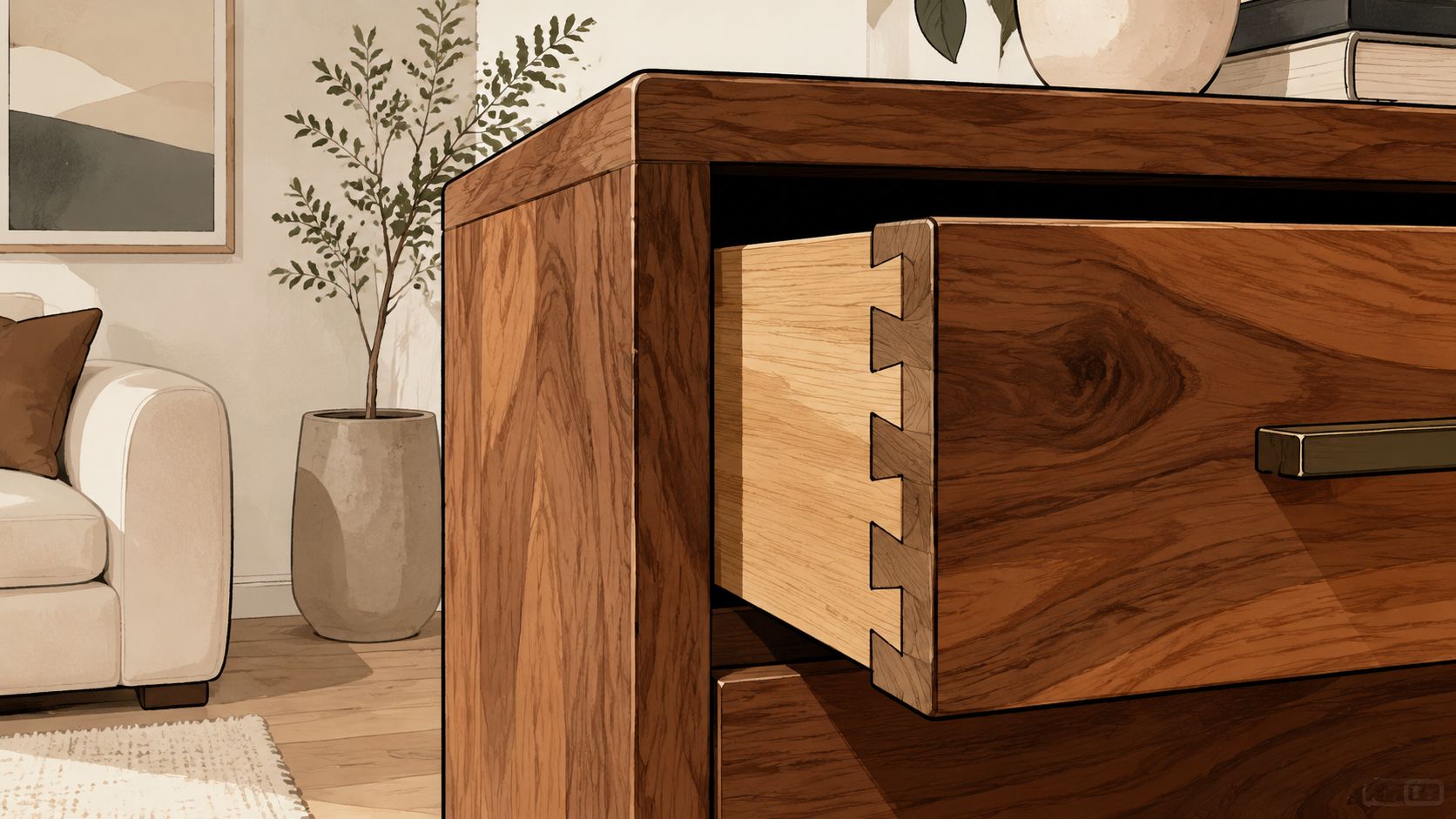
For readers comparing timber choices, this guide to choosing hardwood furniture for longevity and style is a useful starting point.
What solid wood should do over time
The strongest custom makers in Southern Ontario build with sustainably sourced native hardwoods such as walnut and oak, and they stabilise those materials to a 12 to 16% moisture content equilibrium. According to Grain & Burl's material standards, that process keeps dimensional change to less than 0.5 mm over a decade, which helps prevent warping and protects long-term structural integrity in homes.
That point is technical, but it has a practical outcome. Furniture made this way behaves predictably through seasonal heating cycles and changing indoor conditions. It doesn't fight the house.
A discerning client should pay attention to:
- Wood species selection. Walnut, oak, and cherry age beautifully and hold visual depth.
- Board orientation. Stable cuts matter, especially on broad surfaces such as dining tables and cabinet doors.
- Joinery honesty. Strong work reveals care at stress points rather than hiding weak construction under finish.
Practical rule: If a maker speaks fluently about wood movement, moisture balance, and joinery, that maker is usually thinking like a craftsperson rather than a marketer.
Why upholstery construction matters
Upholstery deserves the same scrutiny as case goods. The difference between a seat that holds its shape and one that fails early is usually inside the frame, not in the fabric card.
In Southern Ontario, custom upholstered furniture makers often use a 12-layer system that includes natural latex, high-density foam, premium fabrics or leather, stainless steel staples, and reinforced edges. On Houzz's Waterloo custom furniture listings, that construction is described as delivering a 40% increase in compressive fatigue resistance and 25,000+ cycle durability compared with standard units, verified by ASTM D3574 testing.
That's the sort of detail buyers should want. Not fluff. Construction.
A well-upholstered sofa or chair should offer:
- A seat that recovers properly after daily use.
- Edge definition that doesn't collapse visually.
- Back support that feels intentional, not overstuffed.
- A silhouette that still looks composed from across the room.
The best pieces combine comfort and discipline. If a sofa is soft but shapeless, it isn't luxury furniture. It's just expensive disappointment.
The Commissioning Process A Step-by-Step Bespoke Journey
The custom process intimidates first-time clients because they assume they must arrive with a fully formed idea. They don't. What they need is clarity about how they live, what the room lacks, and what must be solved.
A proper bespoke journey is collaborative. It should feel organised, not mysterious.
Start with the room, not the object
The first conversation should focus on architecture, circulation, scale, and use. A dining table isn't just a dining table. It's clearance around chairs, finish tolerance for daily life, and how the top relates to flooring, window lines, and nearby cabinetry. A custom sofa isn't merely upholstery. It's seat depth, arm profile, conversation distance, and whether the room needs calm or contrast.
That's where a true design studio earns its keep. It treats furniture as part of a complete room concept, not an isolated purchase. In well-run projects, the custom piece often begins with something already established in the room, especially a rug.

That approach is grounded in a useful principle. In coverage of a St. Catharines design destination, Critelli's Rug Market is described as “art for your floor,” with specialists helping homeowners build the room's colour palette and character from that foundation in this Furniture Today feature on the Rug Market. Clients exploring how to begin a custom furniture order benefit from thinking this way from the outset.
Designer's Insight
A bold leather frame often looks more sophisticated when it sits over a neutral hand-knotted wool rug. The rug absorbs visual intensity and gives the furniture room to speak.
Approve the details before the build begins
After the design direction is established, the strongest makers move into refinement. During this phase, dimensions are finalised, wood or upholstery materials are chosen, finish samples are reviewed, and any special details are confirmed.
A disciplined approval stage should include:
- Exact dimensions so the piece fits the room and moves through the home properly.
- Material selections that respond to real life, not fantasy use.
- Finish decisions based on light, adjacent surfaces, and maintenance tolerance.
- Drawings or visual references that remove ambiguity before fabrication begins.
Clients shouldn't rush this phase. The bespoke process rewards decisiveness, but it punishes vagueness.
A premium experience also carries through to installation. The best firms don't abandon the project at the curb. They coordinate a smooth handoff from showroom to home with white-glove care, so the final placement feels as considered as the design itself. That final moment matters because even exceptional furniture can look wrong if it's poorly positioned in the room.
Deciding Between Custom and Curated High-End Furniture
Fully bespoke furniture isn't always the smartest answer. Sometimes the right decision is a custom commission. Sometimes it's a beautifully resolved piece from a curated luxury collection that already does the job brilliantly.
Busy households benefit from honesty here. The goal isn't to make every room custom. The goal is to spend custom money where custom thinking changes the result.
When bespoke is the right answer
Custom makes sense when the room has unusual constraints, when proportions must be exact, or when a client wants a piece that doesn't exist in the market at the required scale or finish. It's also the right route when a homeowner is designing around architecture rather than around inventory.
Upholstery is a good example. In Southern Ontario, high-quality custom upholstery can involve advanced internal construction and premium material choices that dramatically improve durability, as noted earlier. That makes bespoke especially attractive for seating used every day.
When a curated piece is the better decision
A curated high-end piece often wins when the silhouette is already excellent, the dimensions work, and the client values a faster path with less decision fatigue. This is common with refined lounge seating, bedroom furniture, or dining chairs from established premium collections.
Lighting also affects this decision more than many clients expect. A room can feel bespoke when the furniture is curated but the environment around it is thoughtfully composed. For readers aligning furnishings with fixtures, these Golden Lighting style tips offer a useful way to think about cohesion without overcomplicating the scheme.
| Consideration | Bespoke Custom Furniture | Curated High-End Furniture |
|---|---|---|
| Timeline | Longer, because drawings, approvals, and fabrication are part of the process | Shorter, especially when the piece is already specified |
| Personalization | Highest level of control over scale, material, and finish | Selective customization, often through finish or upholstery options |
| Investment | Best reserved for pieces where precision or uniqueness matters | Strong value when the design is already resolved beautifully |
| Ideal use case | Difficult rooms, statement pieces, architectural integration | Clients who want design certainty with less back-and-forth |
The most sophisticated homes usually combine both. Bespoke where the room demands it. Curated where excellence already exists.
Many first-time buyers often err by assuming “custom” automatically means “better.” It doesn't. Better means right for the room, right for the use, and right for the level of permanence the client wants.
Sourcing Your Bespoke Piece in Southern Ontario
Southern Ontario offers genuine depth in furniture culture, but it also has a clear stylistic imbalance. Buyers searching in the Greater Niagara, Hamilton, and Toronto markets often discover that a large share of the conversation still centres on rustic, farmhouse, or heritage-country aesthetics.
That's a problem for clients with cleaner architectural homes, transitional interiors, or a more polished urban sensibility.
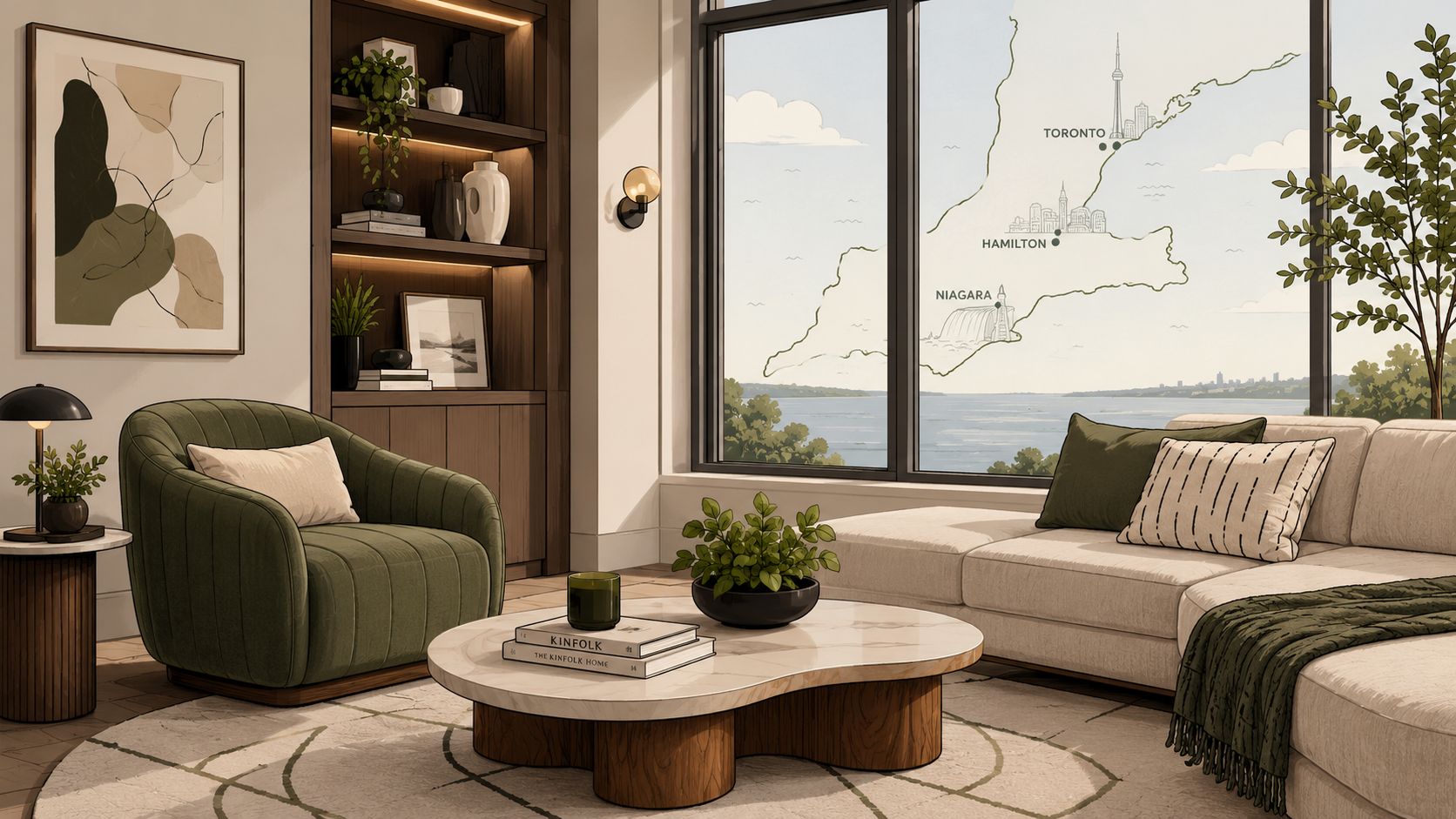
For readers looking for a locally grounded starting point, this St. Catharines furniture destination sits in a strategic position for clients coming from across the Niagara corridor and beyond.
The rustic versus refined gap is real
This is not a matter of taste alone. It's visible in the market. A Houzz survey of 1,200 Ontario homeowners found that 68% prefer contemporary or transitional custom styles, yet the market remains heavily saturated with rustic makers, leaving significant underserved demand for design-led, non-rustic custom furniture in the GTA and Niagara regions, according to Houzz's Toronto-area custom furniture data.
That statistic confirms what many design-forward clients already feel. They're not struggling to find woodworkers. They're struggling to find aesthetic alignment.
A refined custom piece in Southern Ontario should offer some combination of the following:
- Architectural restraint rather than decorative heaviness.
- Transitional fluency that bridges classic and modern interiors.
- Material richness without performative rusticity.
- A complete-room sensibility instead of a one-piece showroom trick.
Buyers in Niagara and Toronto don't need another oversized farmhouse table. Many need furniture that can sit comfortably beside tailored upholstery, contemporary art, and hand-knotted rugs.
What to expect financially
Custom furniture requires a realistic budget. According to Houzz data for London, Ontario, the average cost for custom furniture ranges from $1,210 to $4,521, reflecting the premium nature of bespoke work in Southern Ontario and the higher cost of skilled craftsmanship over mass-produced alternatives, as outlined in these London custom furniture cost profiles on Houzz.
That range is useful, but it should be treated as a starting point, not a promise. Material choice, scale, upholstery complexity, and delivery conditions all influence the final figure.
Clients planning a broader renovation often benefit from coordinating furniture early with other trades. For example, outdoor living upgrades can shift sightlines and room priorities inside the home, so practical planning resources such as this guide on hiring Guelph deck builders can be surprisingly relevant during the larger design process.
Essential Questions to Ask Your Furniture Maker
A polished showroom and a reassuring tone aren't enough. Clients should ask direct questions, and they should expect direct answers. That's how expensive mistakes are avoided.
The strongest makers welcome scrutiny because quality stands up well under specific questioning.
Questions that reveal real quality
These are the questions worth asking before any deposit is paid:
- Where do the primary materials come from? Ask about wood species, sourcing, and whether the maker can explain why those materials suit the application.
- How is the piece constructed at stress points? Table bases, drawer boxes, corners, and seat decks reveal far more than the finish does.
- What will the finish be like in daily life? A beautiful sample means little if the surface can't handle ordinary use.
- Who is building it? Clients don't need a romantic story. They need confidence that skilled hands and disciplined processes are involved.
- What happens if something arrives imperfect? The answer should be calm, clear, and procedural.
A serious custom project also deserves questions about longevity rather than novelty.
Ask what the piece will look like in ten years, not just what it looks like on delivery day.
Delivery is part of the commission
Premium furniture requires premium handling. White-glove delivery should be treated as a mandatory standard, especially for larger or more delicate pieces.
That means more than transport. It should include careful inspection, in-home placement, assembly when needed, and removal of packaging so the room is left composed rather than chaotic. For design-forward homes, final placement is part of the aesthetic outcome. A console shifted two inches too far forward or a rug left unanchored can change the entire read of the room.
Clients looking for Luxury furniture Niagara, Interior design services St. Catharines, Custom furniture Southern Ontario, or Hand-knotted rugs Ontario should judge the service model as closely as the object itself. Fine furniture deserves a finish line equal to its fabrication.
Investing in a Timeless Legacy
The best custom furniture makers don't sell novelty. They help households make decisions that age well. That is a different discipline entirely.
A bespoke piece should hold its structure, suit its architecture, and continue to feel relevant after trends move on. When it's done properly, it becomes part of the family's visual language. It stops feeling “new” and starts feeling necessary.
That long view is why heritage still matters. Critelli Furniture was founded in 1914 and remains a fifth-generation family-owned business that has served Ontario for over 110 years, a record that reflects the enduring value of craftsmanship, trust, and continuity in the home, as noted in this look at why furniture purchases are high-consideration decisions.
Timeless craftsmanship isn't nostalgic. It's disciplined. It asks more at the beginning so the piece can ask less of the homeowner later.
For those ready to move beyond generic retail and commission something with lasting character, Critelli Furniture offers a rare combination of heritage, design-forward guidance, and a curated selection suited to refined homes across Niagara, Hamilton, and Toronto. Experience the craftsmanship in person at our King Street Showroom. Book your complimentary design consultation today. Visit the Rug Market to find your room's foundation.