
Discover Your Ideal l shaped sofa small


You’re likely balancing two competing instincts right now. You want the comfort of a sectional, the kind of sofa that invites conversation and long evenings, but your room doesn’t have the scale for a sprawling piece that swallows every sightline.
That’s exactly where a l shaped sofa small earns its place. In a compact condo, a townhome sitting room, or a narrower heritage living space, the right sectional doesn’t feel like a compromise. It feels composed, deliberate, and far more elegant than forcing several mismatched seats into one room.
The Enduring Appeal of the Compact Sectional
A client in Southern Ontario often wants the same three things from a living room. Proper comfort, clear circulation, and a room that feels considered rather than crowded. A compact sectional answers all three when it is chosen as part of the full scheme, not as a last-minute seating fix.
That distinction matters.
A small L-shaped sofa does more than add seats. It establishes the room’s centre, holds a conversation area together, and often removes the need for an extra chair that would break up the plan. In tighter condos, townhomes, and older homes with narrower rooms, that economy of form can make the space feel calmer and better resolved.
We see this often across St. Catharines, Niagara, and surrounding communities. Homes may differ in age and architecture, but the design brief is familiar. Clients want generous seating without losing light, legibility, or the character of the room itself. The compact sectional suits that brief because it can be customized to the architecture around it, whether the setting is a newer open-plan suite or a heritage home with defined walls, trim, and specific sightlines.
Critelli has been helping families make these decisions since 1914, and one lesson has held up. Small rooms reward discipline. Every arm height, cushion depth, and corner turn affects how the room reads as a whole.
Why the shape works so well
The L-shape brings order to a room in a way separate pieces often do not. It defines where conversation happens, and in open-plan spaces it can gently separate the living area from dining or kitchen zones without adding a screen or cabinet.
Corners are part of that appeal. In many rooms, a corner becomes dead ground that collects a lamp table or nothing at all. A well-scaled sectional turns that area into active seating and gives the layout a stronger architectural anchor.
A small sectional should make a room feel organised, not occupied.
It also supports a more bespoke approach to the room. Once the main seating form is resolved, it becomes much easier to develop the rest of the concept, from rug size and cocktail table shape to lighting, storage, and traffic patterns. For clients comparing options, our guide to arranging furniture in a living room is a useful starting point alongside in-home measuring.
For homeowners who want to test ideas before moving furniture, digital tools can help. Resources such as AI solutions for small properties can help visualise how a sectional might sit within a compact footprint before you commit to a configuration.
What it does better than a full-size sectional
The advantage isn't only that it takes up less room. It can give you the comfort and presence of a sectional while keeping the room breathable. That balance matters in Southern Ontario homes, where living spaces often need to serve several purposes across the day.
A full-size sectional can dominate a modest room and flatten everything around it. A compact L-shaped sofa, properly specified, leaves space for side tables that are functional, lighting that feels intentional, and circulation that does not force people to turn sideways to pass. It also preserves the architecture. In a heritage setting, that may mean allowing trim, windows, or a fireplace wall to remain visible. In a newer condo, it may mean giving an open room enough structure to feel mature and settled.
The enduring appeal comes from that combination of comfort, order, and restraint. It is furniture with a clear job to do, and when it is chosen well, it improves the entire room rather than only filling it.
Laying the Groundwork for Your Living Space
A well-furnished room usually starts with a tape measure on the floor and a clear picture of how the household lives. In Southern Ontario homes, that often means one room must handle conversation, television, weekend guests, and the daily route from entry to kitchen without feeling overfilled. A small L-shaped sofa works best when it is planned as part of that whole composition, not chosen in isolation.
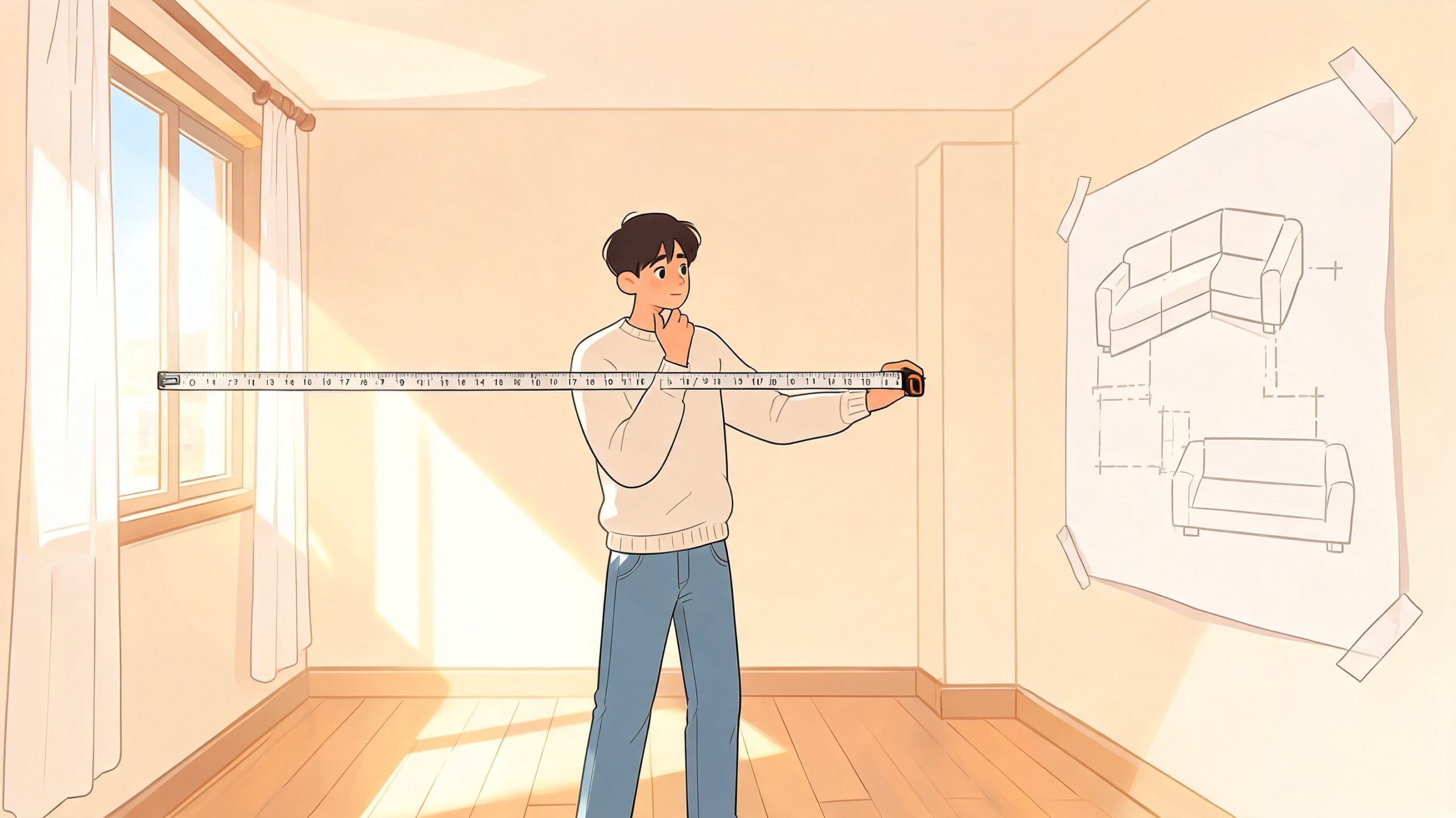
Start with the room itself. Measure wall lengths, ceiling height, window placement, door swings, floor registers, radiators, and any trim or sill details that could interfere with the back of the sofa or the line of the chaise. Then identify the path people use without thinking. From my side of the work, that is often the point where a promising layout succeeds or fails.
Clear circulation matters more than a sofa that technically fits. If the corner of the sectional interrupts the natural route across the room, the space will feel clumsy every day. In a bespoke scheme, comfort includes how you move around the furniture, how light reaches the seating area, and whether the architecture still has room to breathe.
Measure the room as a seating plan
Clients often begin by measuring a single wall. That is rarely enough. The usable footprint includes the sofa, the coffee table, the side table that needs to hold a lamp, the rug border, and the space required to sit down and stand up comfortably.
A better planning method is straightforward:
- Measure the full footprint of the sofa, including the chaise and the depth of the arms.
- Allow for companion pieces such as side tables, an ottoman, or a floor lamp beside the sectional.
- Test the main sightline from the primary seat to the fireplace or television. If media is part of the room, this guide for your home theater TV helps establish a sensible relationship between screen size and seating distance.
- Check daily movement from the doorway to the most-used parts of the room.
One rule holds up in practice. If you need to turn sideways to pass the sofa, the piece is too ambitious for the room.
Painter's tape remains one of the best planning tools available. Mark the exact outline on the floor, then live with it for a day or two. Walk through with a laundry basket. Open drawers nearby. Sit where an accent chair might go. Those small tests reveal whether the sectional supports the room or merely occupies it.
The most successful rooms also consider what sits beyond the sofa. A compact L-shaped piece may solve seating, but the room still needs proper balance from lighting, storage, art, and occasional tables. That is why I advise clients to review the layout as a complete plan. This article on how to arrange furniture in a living room for better flow and balance is a useful companion during that stage.
A small sectional earns its place when it gives the room structure, preserves easy movement, and leaves space for the rest of the story you want the room to tell.
Choosing Your Sofa's Configuration and Scale
A compact sectional succeeds or fails on two decisions. The first is orientation. The second is scale. Get both right, and the sofa feels as though it was built into the room from the beginning.
Start with how the room is used. In many Southern Ontario homes, the living area is doing several jobs at once. It may need to hold a conversation area, preserve a route to the balcony or dining space, and still feel composed enough for everyday family life. A small L-shaped sofa should reinforce that wider plan, not solve seating at the expense of the rest of the room.
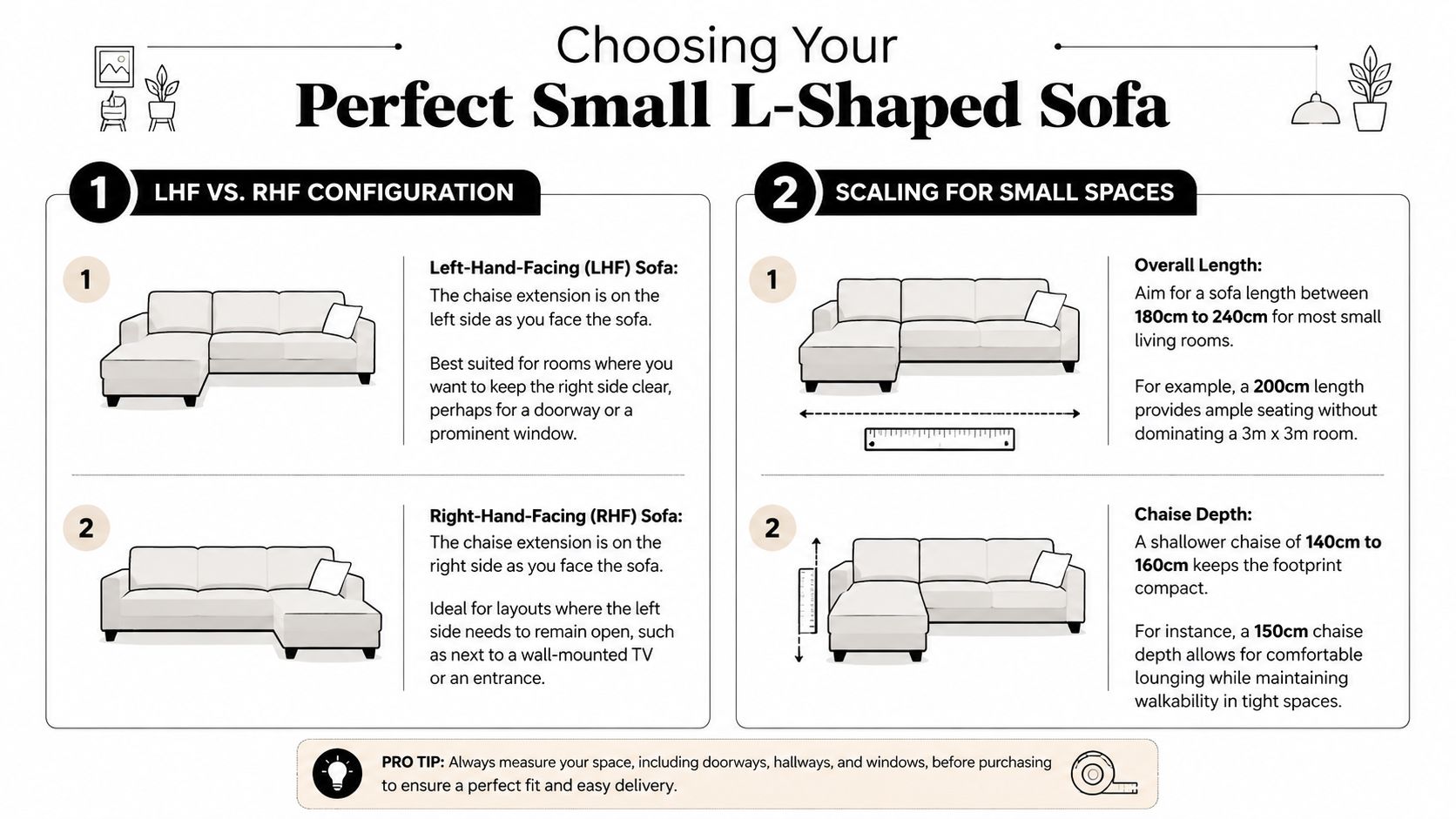
The first practical choice is Left-Hand-Facing (LHF) or Right-Hand-Facing (RHF). Identify it while standing in front of the sofa. If the chaise sits on your left, it is LHF. If it sits on your right, it is RHF.
LHF and RHF in real rooms
Orientation should follow circulation and sightlines.
An LHF sectional often works well when the room needs to stay more open on the right side, perhaps for a doorway, access to a window, or a cleaner path toward an adjoining kitchen or dining area. An RHF sectional suits the opposite condition. It keeps the left side clearer and can help the seating group settle naturally around a focal wall.
Here is a practical comparison:
| Configuration | Often works well when | Common mistake |
|---|---|---|
| LHF | The room opens to the right, or the left corner needs visual weight | Letting the chaise project into a daily walkway |
| RHF | The room opens to the left, or the right side is the better anchoring corner | Pushing the chaise too close to a window or radiator |
I advise clients to judge the chaise by what it protects. It should preserve the easiest route through the room, keep the main view comfortable, and support the room's best feature, whether that is a fireplace, a bank of windows, or the cleanest wall for art and media.
Scale for Southern Ontario layouts
Scale needs the same level of discipline. In condos, townhomes, and older houses with narrower front rooms, the wrong depth is often more troublesome than the wrong width. A sofa can technically fit and still make the room feel compressed.
That trade-off shows up often in homes across Hamilton, Burlington, Oakville, and the GTA. A deep chaise may offer generous lounging, but it also shortens the usable space around a coffee table, limits chair placement, and can make the room read as sofa first, architecture second. In a carefully composed room, that is usually the wrong hierarchy.
Instead of chasing a standard measurement, judge the piece by proportion. The long side should anchor the seating area without forcing every other item to the perimeter. The chaise should read as an invitation to sit, not as an obstacle that stops the eye halfway across the room. If the sectional faces media, the viewing distance also needs to remain comfortable. This guide for your home theater TV is useful for checking that relationship before you commit.
Modular pieces and what they solve
Apartment-scaled and modular sectionals are often the most sensible choice for smaller rooms. They solve more than one problem at once. Delivery is easier in tight stair halls and condo lifts. Future reconfiguration is possible if you move. The proportions are usually more disciplined than oversized sectionals adapted poorly to compact homes.
For clients building out a full room concept, I often recommend reviewing what to know before buying a sectional before finalizing the layout. It helps clarify seat depth, arm width, corner construction, and the practical differences between fixed and modular formats.
Keep the longest line of the sectional aimed toward the room's strongest feature. That single decision brings order to the entire scheme and helps the sofa feel like part of a bespoke plan for the home, rather than a large object that happened to fit.
Selecting Materials and Colours to Enlarge Your Space
A small room reacts strongly to material. The same silhouette can feel airy in one upholstery and heavy in another. That’s why fabric and colour aren’t finishing touches. They’re space-planning tools.

Lighter tones usually keep the eye moving. Soft stone, warm oat, muted taupe, pale greys, and restrained leather shades tend to reflect more light and allow the room’s architecture to remain visible. Dark upholstery can be handsome, particularly in a den or moodier heritage interior, but it asks more of the room. It needs sufficient light, breathing room, and supporting pieces that prevent the seating area from feeling dense.
Materials that help a room feel larger
A few details consistently help:
- Raised legs let you see more floor, which creates a sense of openness.
- Slimmer arms reduce visual mass without sacrificing comfort.
- Subtle texture gives depth to a neutral sofa so it doesn’t appear flat or clinical.
- Tighter upholstery often looks cleaner in compact rooms than heavily overstuffed cushions.
Leather deserves its own category. A refined leather sectional can look remarkably sleek in a small room, especially when the lines are crisp and the colour is restrained. Hancock & Moore is often a strong fit for homeowners who want that heirloom quality presence without fussiness. Fabric, on the other hand, tends to soften a room and can be the better answer for family living, relaxed lounging, or spaces where acoustics need a little visual warmth.
Designer’s Insight
Our designers suggest selecting a sofa fabric with a subtle texture or a two-tone weave. It adds visual interest without overwhelming a small space, and it pairs beautifully with the rich patterns found in our curated collection of hand-knotted rugs.
Why local customisation matters
There’s also a practical case for Canadian-made upholstery. Amid supply chain shifts, demand has grown for customizable, Canadian-made small L-shaped sofas, with faster lead times of 8-12 weeks locally versus 20+ for imports, according to this market overview on small L-shaped sectionals. For Southern Ontario homes, that local approach can also mean materials chosen with regional climate conditions in mind.
This is one reason some clients prefer a bespoke route rather than buying strictly from floor samples. Critelli Furniture is one option for custom upholstery and room coordination, particularly when a client wants the sofa considered alongside rug scale, lighting, and surrounding case pieces rather than chosen on its own.
The rug sets the room’s language
A sectional never lives alone. The rug underneath it determines how grounded, expansive, and finished the room feels. In our design work, the rug is often the first real act of composition. It isn’t an accessory. It is Art for your Floor.
A hand-knotted rug can carry nuance that allows a compact room to feel layered without becoming busy. If you’re considering a cooler leather or fabric palette, a reference such as this look at a grey leather sofa can help clarify how upholstery tone and floor foundation work together.
Styling and Multi-Functional Solutions
Once the sofa is in place, restraint matters. A small sectional looks elegant when the surrounding pieces support it subtly. It looks crowded when every adjacent surface competes for attention.

One of the most successful arrangements is also one of the simplest. A compact L-shaped sofa, a round or softly shaped coffee table, one floor lamp, and a single well-scaled side table. That combination keeps corners open and makes the seating area feel intentional rather than overfilled.
What tends to work
In smaller rooms, accessories should add texture and ease, not volume.
- Pillows with variation work better than a matched set. An odd-numbered grouping often looks more natural.
- A throw with drape softens the sectional and adds a lived-in quality without clutter.
- Nested tables are often more useful than one bulky rectangular coffee table.
- A C-table can slide over the chaise or seat cushion when you need a place for a laptop or a tea tray.
Multi-functional details worth considering
The strongest small-room pieces often do more than one job. A chaise with concealed storage can hold throws and seasonal cushions. A refined sleeper mechanism can make a sitting room pull double duty for guests. These details matter most in condos, secondary lounges, and homes where one room has to perform more than one role.
A useful companion to a sectional is often an ottoman. It can serve as a footrest, extra seating, or a movable surface with a tray on top. For options and proportion ideas, a guide to ottomans in Canada can help you judge what belongs beside a compact sectional and what will crowd it.
The room should still feel easy to enter when every seat is occupied.
What usually doesn’t work
A few choices consistently make a small sectional feel heavier than it is:
- Oversized square coffee tables that leave little knee room.
- Too many small accent pieces around the perimeter.
- High-contrast busy pillows that chop up the silhouette.
- Large side chairs added out of habit rather than need.
The most inviting rooms edit themselves. They don’t prove how much furniture can fit. They show how comfortably a space can live.
Your Bespoke Sofa Journey with Critelli
Choosing a small sectional becomes much easier when you treat it as a sequence of decisions rather than one dramatic purchase. The right piece is usually the one that satisfies several quiet requirements at once. It fits the room, supports circulation, suits the architecture, and still feels generous.
A practical checklist helps:
- Room first. Measure the true footprint, not just the wall.
- Orientation next. Choose LHF or RHF based on traffic flow and sightlines.
- Scale with discipline. The sectional should anchor the room without darkening it.
- Material with purpose. Select upholstery that suits both the room’s light and your daily life.
- Support pieces carefully. Rug, table, lighting, and accents should complete the composition.
For clients who want a more personalized path, custom couches in Toronto and the surrounding market can offer a useful starting point for understanding the bespoke process. This is often the smartest route when the room has unusual proportions, heritage detailing, or a very specific performance requirement.
What matters most is that the sofa belongs to the home. It should feel considered from every angle, including the first step into the room and the last view before the lights go out. That’s where a design studio perspective changes the result. The sectional becomes part of a whole room concept, with the rug as foundation, the upholstery as texture, and the final placement handled with the same care as the selection itself.
White-glove delivery also matters more than many people expect. In a compact room, placement isn’t incidental. A few inches can change everything, and professional installation protects both the piece and the space around it.
For over a century, Critelli Furniture has helped Southern Ontario homeowners furnish with confidence and permanence. If you’re weighing a l shaped sofa small for a condo, townhome, or heritage house in the Greater Niagara, Hamilton, or Toronto markets, Experience the craftsmanship in person at our King Street Showroom. For a complete room concept designed for your home, Book your complimentary design consultation today. If the room still needs its visual anchor, Visit the Rug Market to find your room's foundation.