
Swivel Lounge Chair: A Buyer’s & Design Guide

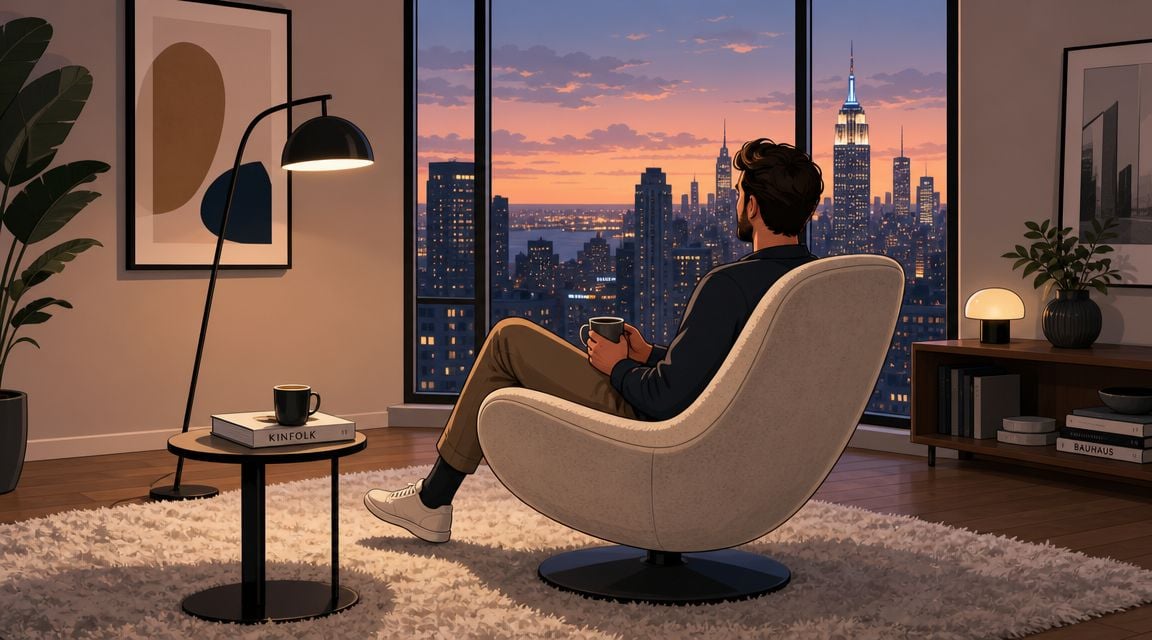
A swivel lounge chair often enters the conversation after a room is already “done.” The sofa is in place. The rug is down. The lighting is lovely. Yet something still feels stiff. One seat faces the fireplace, another faces the television, and no one quite knows where to sit when conversation begins.
That's usually the moment a client starts looking for a chair that can do more than fill a corner. They want a seat for reading, for morning coffee, for turning toward guests without dragging furniture across the floor. In many Southern Ontario homes, especially where rooms need to work hard and look composed, the swivel lounge chair answers that need with unusual grace.
The Art of Flexible Seating
A well-appointed room can still feel formal in the wrong way. You may have a handsome sofa, a pair of occasional tables, and a beautifully scaled lamp, but if every seat is fixed in one direction, the room can become more static than inviting.
That's where a swivel lounge chair changes the experience of the room, not just its appearance. A chair that turns lets one person face the conversation, then pivot toward the window, the fire, or the garden view without breaking the visual order of the space. It solves a problem discreetly.
When a room looks right but lives poorly
Consider a familiar Southern Ontario setting. A family room opens toward the kitchen on one side and a bank of windows on the other. The homeowners want seating that feels polished enough for guests, but relaxed enough for daily use. A fixed accent chair gives shape and symmetry, yet it asks the sitter to commit to one focal point. That's often the source of the room's quiet frustration.
A swivel lounge chair introduces movement without visual clutter. It allows a parent to join a conversation, then turn toward children playing nearby. It lets one seat support both entertaining and retreat. If you're exploring living room lounge chairs, this is the distinction worth paying attention to. The chair isn't merely decorative. It's a behavioural tool.
Why timeless homes benefit from adaptable pieces
Since 1914, Critelli has served Southern Ontario as a family-run destination for refined interiors, and that long view tends to sharpen one's judgement. Trend-driven furniture usually asks to be noticed first and lived with second. A well-chosen swivel lounge chair does the opposite.
Practical rule: The best lounge seating doesn't announce its cleverness. It simply makes the room easier to use.
That matters in homes across Greater Niagara, Hamilton, and the Toronto market, where one room often needs to support multiple rhythms in a single day. Morning light, evening entertaining, quiet reading, and weekend family life all ask something different of the same seating plan.
A design-forward swivel chair works because it respects that reality. It gives a room more than softness or silhouette. It gives the room a little intelligence.
Defining the Modern Swivel Lounge Chair
Many people still reduce the swivel lounge chair to one feature. It turns. That's true, but it misses the point. In a serious interior, a swivel chair isn't a novelty seat. It's a strategic alternative to two familiar compromises: the beautiful chair that doesn't adapt, and the very comfortable chair that overtakes the room.
More than a spinning accent chair
A static accent chair often performs one job well. It completes the arrangement. It may even sharpen the architecture of the room. But once someone sits down, its usefulness can narrow quickly. If the chair faces the sofa, the sitter may need to twist awkwardly to enjoy the view out the window. If it faces the fireplace, conversation can feel sideways.
A swivel lounge chair resolves that tension. It preserves the composed look of an accent chair while allowing the body to respond naturally to the room. That flexibility is especially valuable in design-led homes where seating must honour several focal points at once.
The quieter alternative to a bulky recliner
At the other end of the spectrum sits the recliner. It can be marvellously comfortable, but it often demands visual and physical space in return. Many retail pages focus on style language or 360-degree rotation, yet they rarely explain how seating mechanics affect long-term use in a busy household, a gap noted in the product context for buyers comparing swivel chairs with recliners at Blu Dot's Close Encounter Swivel Lounge Chair page.
That buyer question is an intelligent one. If you want daily comfort, easy conversation angles, and a cleaner profile than a large recliner, the swivel lounge chair often makes more sense. It won't suit every person or every room, but it frequently provides the best balance between performance and restraint.
For clients who prefer leather, browsing swivel leather chair options can make that comparison clearer. Upholstery, scale, and base design all affect whether the chair reads as structured, cocooning, architectural, or casual.
What defines the category
The modern swivel lounge chair usually combines four qualities:
- Relaxed posture support with a seat and back designed for lingering, not merely perching
- A concealed or integrated swivel base that allows the chair to pivot without disturbing the room's layout
- A refined footprint that feels substantial without becoming cumbersome
- Design versatility that can sit comfortably in contemporary, mid-century, transitional, or more classic interiors
A good swivel chair lets the sitter move while the room stays composed.
That last point matters. In fine interiors, movement should come from the person using the furniture, not from the furniture visually fidgeting in the room.
When it's the right choice
A swivel lounge chair is particularly compelling when a room includes more than one anchor. Think fireplace and television. Sofa grouping and garden doors. Reading corner and open-concept family space.
It also suits clients who want a chair that earns its place daily. Not every beautiful object needs to work hard, but seating does. If you'll use the chair for conversation, reading, and quiet retreat, the swivel version often offers better long-term value than a fixed occasional chair chosen only for shape.
A Curated Guide to Styles and Mechanisms
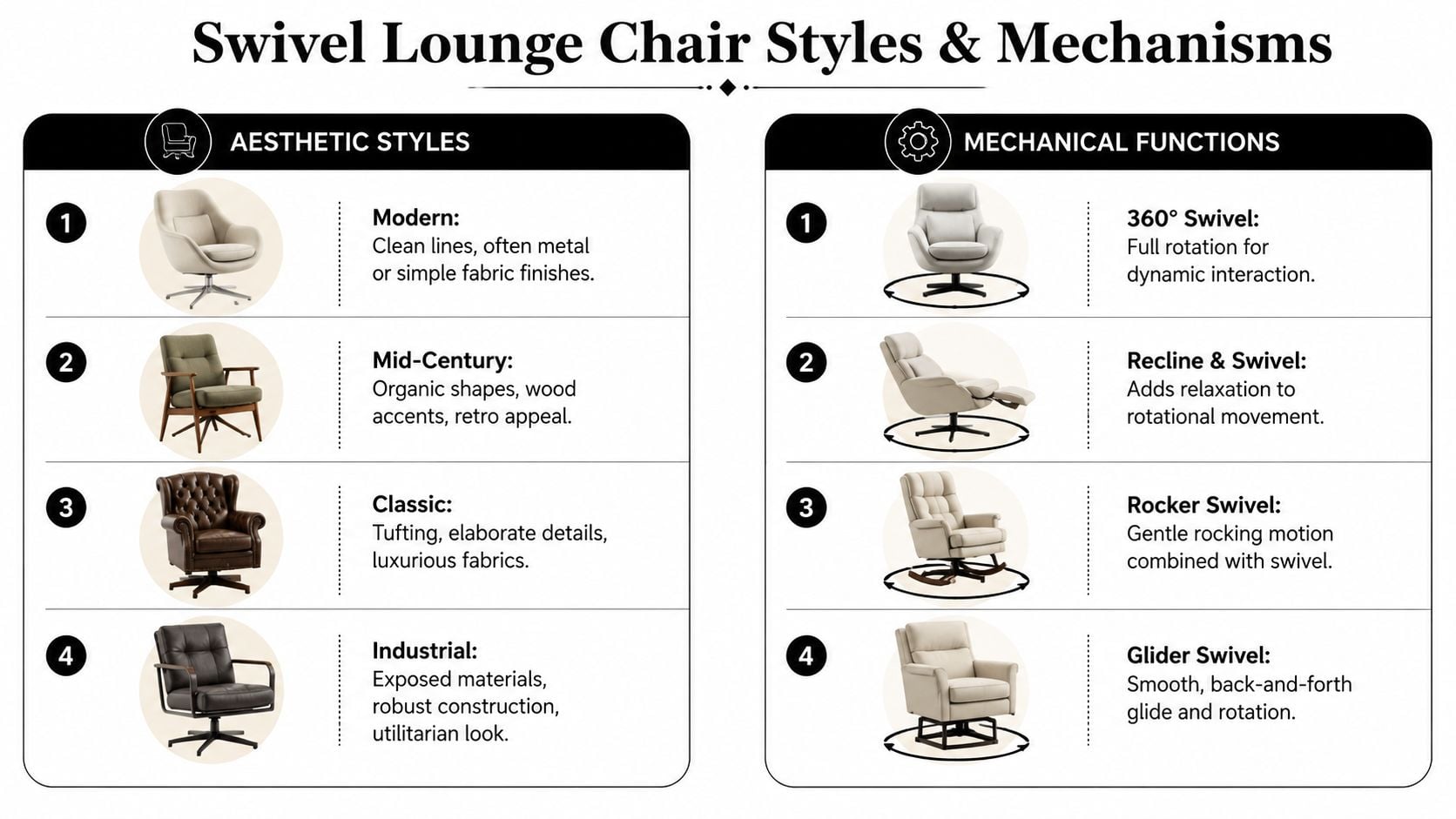
The phrase “swivel lounge chair” covers a wide range of looks and functions. That's why selection begins with two separate questions. First, what visual language belongs in your home? Second, what sort of motion will support the way you live?
Choosing the visual language
Some clients are drawn to the clean precision of modern upholstery. Others want a chair with a little more softness and familiarity. The right answer usually comes from the architecture first, then the lifestyle.
Here's a useful way to think about the main families:
| Style direction | What it tends to look like | Where it tends to work best |
|---|---|---|
| Modern | Crisp lines, edited profiles, restrained detailing | Urban homes, renovated interiors, minimal palettes |
| Mid-century | Organic form, wood accents, sculptural ease | Homes with vintage references, glass, walnut, warm neutrals |
| Transitional | Balanced shape, softer tailoring, broad versatility | Traditional homes being refreshed, mixed collections |
| Plush contemporary | Rounded silhouettes, deeper comfort, cocooning scale | Family rooms, reading corners, relaxed luxury settings |
The most historically significant reference point in this category is the Eames Lounge Chair, introduced in 1956 and still produced today, with molded plywood and leather construction that helped redefine postwar lounge seating, as noted in the Eames Lounge Chair history entry. That legacy matters because it shows what enduring design looks like. Not fashionable. Enduring.
Understanding the mechanism
Many buyers assume all swivel chairs function the same way. They don't. The feel of the movement changes the entire experience of the piece.
- Full swivel offers free rotation and suits rooms where the chair may regularly turn between focal points.
- Memory-return swivel recentres the chair after use, which keeps a formal arrangement looking organised.
- Swivel-glider combines turning with a gentler back-and-forth motion, often favoured in softer family settings.
- Swivel-recline combinations can suit comfort-led spaces, though the mechanism should be chosen with extra care to avoid adding bulk or visual heaviness.
Matching style to architecture
A sleek chair can look misplaced in a character home if the rest of the room hasn't been edited to support it. The reverse is equally true. A heavily detailed chair can feel over-dressed in a clean-lined condo.
Designer's Insight
Our designers often pair a sculptural swivel silhouette with a quieter room foundation so the chair feels intentional, not isolated. A bold leather or textured boucle can sit beautifully against a neutral hand-knotted wool rug and simpler case goods.
For those exploring local options, Critelli Furniture offers a product called the Castiel Swivel Chair. It's one example of how this category appears in showroom assortments, where the same general function can be interpreted through different silhouettes and finishes.
The small decision that affects daily satisfaction
Clients usually spend most of their time choosing the fabric or leather. That's understandable, but the mechanism deserves equal attention. A chair can look exactly right and still feel wrong if the rotation is too loose, too abrupt, or at odds with the room's function.
That's why the strongest choices tend to come from a curated process. Start with architecture. Then choose silhouette. Then test how the chair moves. In that order, a swivel lounge chair becomes far easier to choose well.
Selecting Heirloom Materials and Finishes
A swivel lounge chair earns its longevity through material discipline. The shape may draw you in first, but the upholstery, stitching, base construction, and finish quality determine whether the chair still feels handsome after years of daily use.
Upholstery that suits the household
Leather remains one of the most compelling choices for heirloom quality seating. It develops character, responds beautifully to light, and often gives a chair a defined presence that fabric can't quite replicate. In the right room, a fine leather swivel chair can feel both architectural and inviting.
Fabric, however, shouldn't be treated as the lesser option. In many homes, it's the more intelligent one. For households with children or pets, easy-clean performance fabrics or synthetic leathers are a practical choice, according to guidance gathered in the Eureka Ergonomic swivel lounge chair guide. Practical doesn't mean plain. Today's performance textiles can still look richly woven, soft, and design-forward.
A useful question to ask is not “Which material is more luxurious?” but “Which material will still look composed in my daily life?”
The base is part of the comfort
Many buyers focus entirely on what they can see above the seat cushion. The base deserves equal scrutiny. A swivel chair with a poorly resolved base can feel light in the wrong way. It may wobble, shift, or move with a nervous quality that undermines the sense of craftsmanship.
That's why base weight matters. The same Eureka Ergonomic guide notes a 58.87 lb product weight for the Vari Lounge Chair and connects heavier base architecture with a more stable feel during rotation. In practice, that stability contributes to what people often describe as “luxury,” even if they don't immediately know why.
The feeling of quality in a swivel chair often reveals itself when you sit down, turn, and stop. Smooth control feels expensive. Wobble does not.
What to inspect before you commit
When clients are choosing custom furniture in Southern Ontario, I encourage them to inspect details in layers rather than all at once.
- Seams and stitching should look intentional and even, especially where curves meet arms and back.
- Cushioning should support without collapsing the silhouette.
- Base finish should complement surrounding metals or woods in the room.
- Upholstery hand matters. Touch it. A chair is a tactile object.
The same principle applies elsewhere in the room. If you're coordinating wall colour with upholstery and wood tones, this practical guide to paint finishes and durability is a useful reference for understanding how surface sheen affects maintenance and appearance around high-touch furniture.
Materials should belong to the whole room
A swivel lounge chair rarely succeeds as an isolated luxury object. It has to converse with the rug, the drapery, the case pieces, and the light in the room. Warm leather may need a cooler surrounding palette to feel balanced. A boucle chair may benefit from cleaner-lined tables so the room doesn't become overly soft.
That's where timeless craftsmanship reveals itself. It isn't only in the chair's construction. It's in how gracefully the chair joins the larger interior.
Ergonomics and Sizing for Perfect Placement
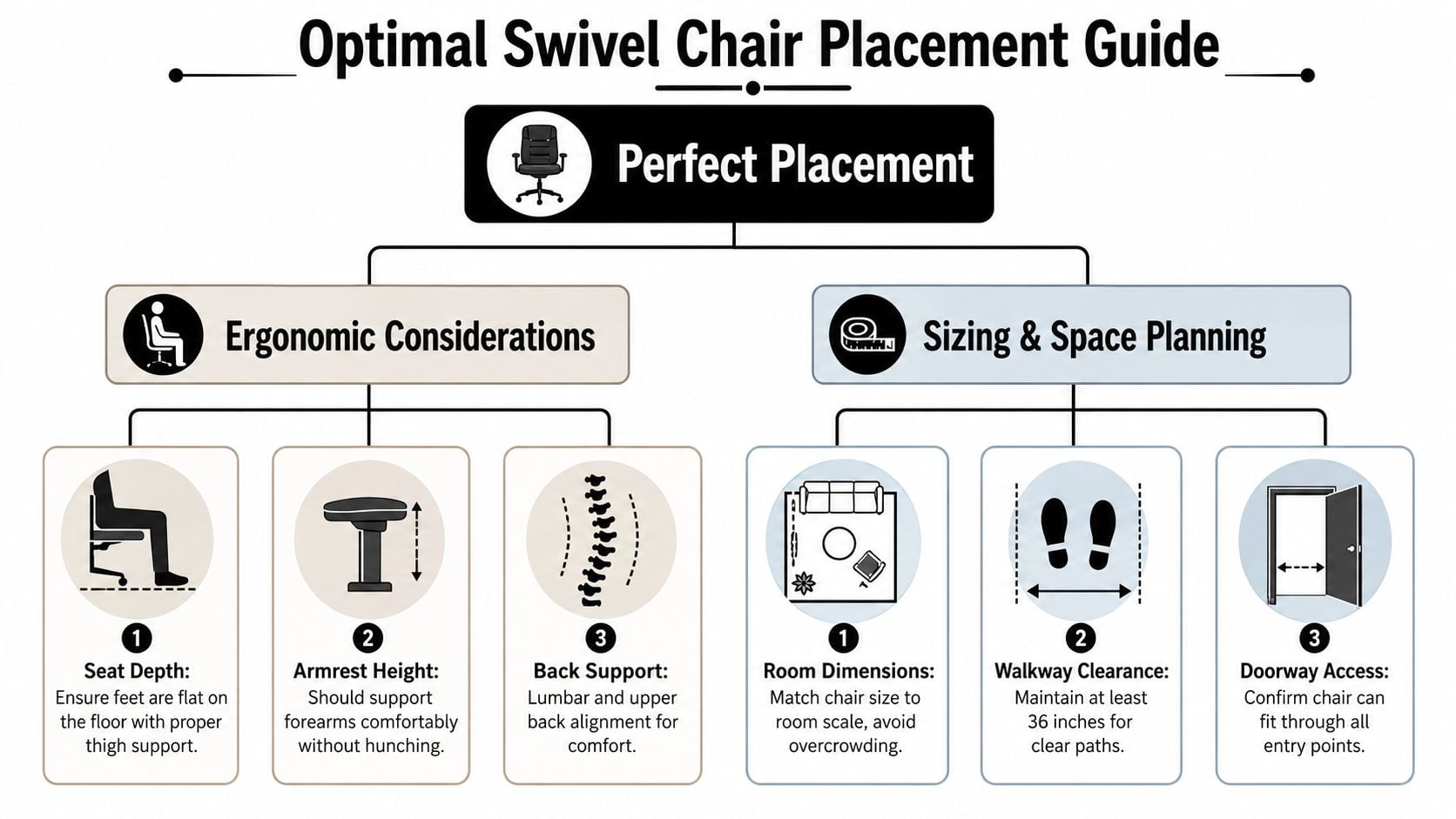
A swivel lounge chair can be beautifully made and still fail in the room if it's poorly sized. Such sizing errors often lead to regrettable purchases. Buyers measure the width of the chair, compare it to an open corner, and assume they're done. But a swivel chair needs more than footprint. It needs room to move.
Start with the body, not the catalogue photo
Comfort begins with proportion. If the seat is too deep, some sitters won't feel properly supported unless they add a pillow. If the arms are too high, shoulders rise and the chair becomes tiring. If the back is too low for the person using it most, the chair may look elegant but feel incomplete.
The goal isn't to find a universally perfect chair. It's to find one that suits the intended user and purpose. A reading chair may call for firmer support and a more upright sit. A conversation chair can often be slightly more relaxed.
If ergonomic performance is part of your comparison, it can be helpful to look at seating examples from makers known for human-centred design, such as the Embody Chair by Herman Miller, even if your final choice is a lounge piece rather than a task chair. The exercise sharpens your eye for posture, support, and body fit.
Use real dimensions and a rotation envelope
Published dimensions are your first checkpoint. The Article Leigh 33" Swivel Lounge Chair is listed at 28"H x 33"W x 35"D, with a 19" seat height and 22" seat depth, according to the Article product listing for the Leigh 33" Swivel Lounge Chair. Those numbers tell you the chair's static size, but they don't fully describe how it behaves once someone sits down and turns.
That's why the planning concept of a rotation envelope matters. The chair's motion requires more room than its still footprint suggests. Eureka Ergonomic recommends keeping an unobstructed “30° arc” on each side to preserve smooth rotation and reduce collision risk, as cited in the verified planning guidance provided for this article.
Room-planning note
Measure for the chair, then measure for the movement. Those are two different exercises.
A simple way to test placement
Before ordering, mark the chair's footprint on the floor with painter's tape. Then stand in for the chair's turning path. Open nearby doors. Walk past the proposed location. Check whether a side table, ottoman, or sectional corner will interfere once the chair rotates.
Use this quick checklist:
- Check the sweep so the chair can turn without striking adjacent furniture
- Check the sightline from the chair to the room's key focal points
- Check the exit path so the chair doesn't block natural circulation
- Check the scale from across the room, not only from above on paper
This practical discipline matters in every market, but especially in homes where space is carefully allocated and each seat has to justify itself.
Styling in a Complete Room Concept
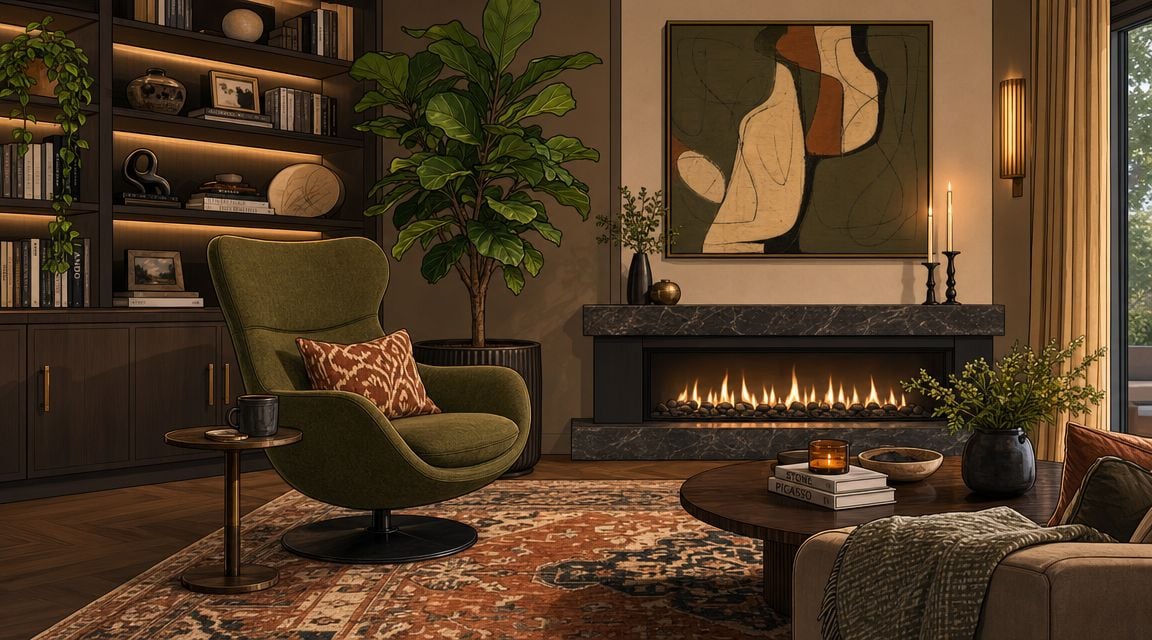
A swivel lounge chair reaches its full value when it becomes part of a complete room concept. On its own, it's a well-made seat. In relation to the sofa, rug, lighting, tables, and architecture, it becomes an organising element.
Position it for both beauty and usefulness
The most successful placement usually gives the chair two jobs. It should contribute to the room's composition when no one is using it, and it should become more useful when someone sits down.
In a living room, that may mean angling the chair near the end of a sofa so it can turn toward conversation or toward the fireplace. In a bedroom sitting area, it may face outward toward a window but still pivot back toward the bed or side table. In open-concept spaces, the swivel chair can soften the boundary between zones without introducing another rigid visual line.
That flexibility matters because Southern Ontario homes vary widely. Some clients have spacious single-detached homes. Others are furnishing tighter condos where every inch of circulation matters. A verified Ontario housing note used for this brief states that about 43% of occupied private dwellings in Ontario were single-detached houses, while a meaningful share of households also live in more compact multi-unit settings. In other words, generic placement advice often misses the realities of actual rooms.
Let the rug do the anchoring
A swivel chair can look adrift if the floor beneath it hasn't been considered. The rug thus becomes indispensable. At Critelli, the Rug Market's philosophy of Art for your Floor is exactly right. The rug isn't an accessory at the end. It's often the element that gives the seating plan its legitimacy.
A hand-knotted rug can define the conversation area, temper the motion of the chair visually, and connect upholstery colours that might otherwise feel unrelated. If you're exploring furniture layout more broadly, this guide on how to arrange furniture in a living room is a useful companion to the planning process.
Use surrounding elements with restraint
A swivel lounge chair already introduces movement. The surrounding pieces should support that quality rather than compete with it.
Consider these pairings:
With a sofa
Choose a chair silhouette that contrasts gently. If the sofa is linear, a slightly curved swivel chair often adds welcome softness.With a side table
Keep the table close enough for function, but not so close that turning feels constrained.With lighting
A floor lamp behind or beside the chair can turn it into a proper reading zone.With greenery
Plants can soften the architectural edges around a lounge setting. For clients who want help balancing upholstery, natural texture, and foliage, this guide to create a vibrant home with plants offers practical decorating ideas.
A room feels resolved when every piece knows its role. The rug grounds. The sofa anchors. The swivel chair mediates between stillness and movement.
Why design services matter here
This is exactly the kind of decision-making the Interior Design Studio can support. A single chair may seem like a small purchase, but in a finished room it affects traffic flow, balance, viewing angles, colour distribution, and comfort. That's why experienced designers don't treat it as a standalone object.
In homes across St. Catharines, Greater Niagara, Hamilton, and Toronto, the strongest results usually come from seeing the swivel lounge chair in context. Not as a corner filler. As part of a room with intent.
The Critelli Experience from Showroom to Home
A luxury swivel lounge chair should arrive in your home with the same care that went into choosing it. That's part of the value. The selection process is more satisfying when it includes measured guidance, material expertise, and a clear plan for how the piece will live in the room.
Seeing craftsmanship in person
Some furniture categories can be evaluated reasonably well online. Swivel lounge chairs aren't one of them. The sit, the resistance of the turn, the scale of the back, and the hand of the upholstery all matter too much.
In a showroom setting, those differences become obvious. One chair may feel graceful but too shallow. Another may have the right posture support but too much visual bulk. Bespoke customisation also becomes more meaningful in person, where leathers, fabrics, and finishes can be compared under proper light and against your broader room concept.
Service that protects the investment
Once a piece is selected, the final stages matter just as much as the first ones. A swivel chair needs to be inspected, transported carefully, and placed correctly. If it arrives poorly handled or is set in the wrong position, the quality of the purchase is immediately diminished.
That's why white-glove service matters. It creates continuity between selection and installation. For clients who need help with set-up and in-home placement, furniture assembly services are part of making sure a chair functions as intended from the day it arrives.
The value of a heritage approach
Critelli's history as a family-run Southern Ontario business since 1914 informs this part of the experience as much as the showroom itself. A heritage brand tends to think beyond the transaction. It considers whether the chair suits the architecture, whether the finish belongs with the rest of the room, and whether the delivery process preserves the sense of occasion that should accompany a significant piece.
For clients in Niagara, Hamilton, and the Toronto market, that continuity matters. Good furniture should feel settled the moment it arrives. Not dropped off. Settled.
A swivel lounge chair is a modestly scaled piece with an outsized effect on daily life. Chosen well, it adds movement without chaos, comfort without heaviness, and sophistication without stiffness. That's why it remains one of the most intelligent additions to a thoughtfully curated room.
Experience the craftsmanship in person at Critelli Furniture. If you're considering a swivel lounge chair as part of a full living room refresh, book your complimentary design consultation today and explore a curated selection shaped by timeless craftsmanship, bespoke options, and white-glove care from showroom to home. Visit the Rug Market to find your room's foundation.