
Postmodern Furniture Design: A Curator’s Guide for 2026

A lacquered cabinet in tomato red, lemon yellow, and ink black can stop a room cold. Not because it matches anything, but because it changes the conversation, turning a quiet seating area into a place with wit, memory, and confidence.
An Introduction to Postmodernism's Bold Spirit
Many people recognise postmodern furniture design before they can define it. It's the bookcase that looks almost too expressive to be practical. It's the side table with a shape that feels half sculpture, half joke. It's the chair that seems to wink at the seriousness of the room around it.
That reaction is part of the point.
Postmodernism arrived as a refusal of rigid design manners. Where earlier modern interiors often prized restraint, uniformity, and a kind of moral clarity in form, postmodern rooms welcomed contradiction. Colour returned. Ornament returned. Historical references returned, though not in a solemn way. They came back with humour, exaggeration, and a touch of theatre.
A helpful way to understand it is to compare a postmodern room with a strictly minimalist one. In a minimalist room, the ideal object often disappears into order. In a postmodern room, the object speaks. A cabinet may borrow the silhouette of a classical column, then render it in laminate. A lamp may feel cartoonish from one angle and elegantly architectural from another. The room still functions, of course, but it also tells a richer story.
That's one reason the style still feels alive in Southern Ontario homes. Many clients don't want spaces that look interchangeable. They want rooms with point of view, but they also want them to feel polished and liveable. Postmodern furniture design offers that middle ground. It can be daring without becoming chaotic, especially when used as part of a full room concept rather than as a novelty.
For readers sorting out where this style sits beside more familiar approaches, this guide to contemporary and traditional design styles helps clarify the broader design family tree.
Postmodernism didn't reject beauty. It rejected the idea that beauty had to be obedient.
Since 1914, heritage design institutions in Southern Ontario have watched tastes swing from formal to sparse to eclectic. Postmodernism matters because it wasn't a passing decorative whim. It changed how people understood furniture itself, from useful object to expressive cultural piece.
The Playful Rebellion of Postmodern Origins
Postmodern furniture design began with a mood many designers recognised. The room was orderly, disciplined, beautifully resolved, and a little too restrained. By the late twentieth century, some architects and furniture makers, especially in Italy, felt that modernism had narrowed into a rulebook. Furniture still worked well, but it had less room for wit, memory, ornament, or contradiction.
So they changed the tone.
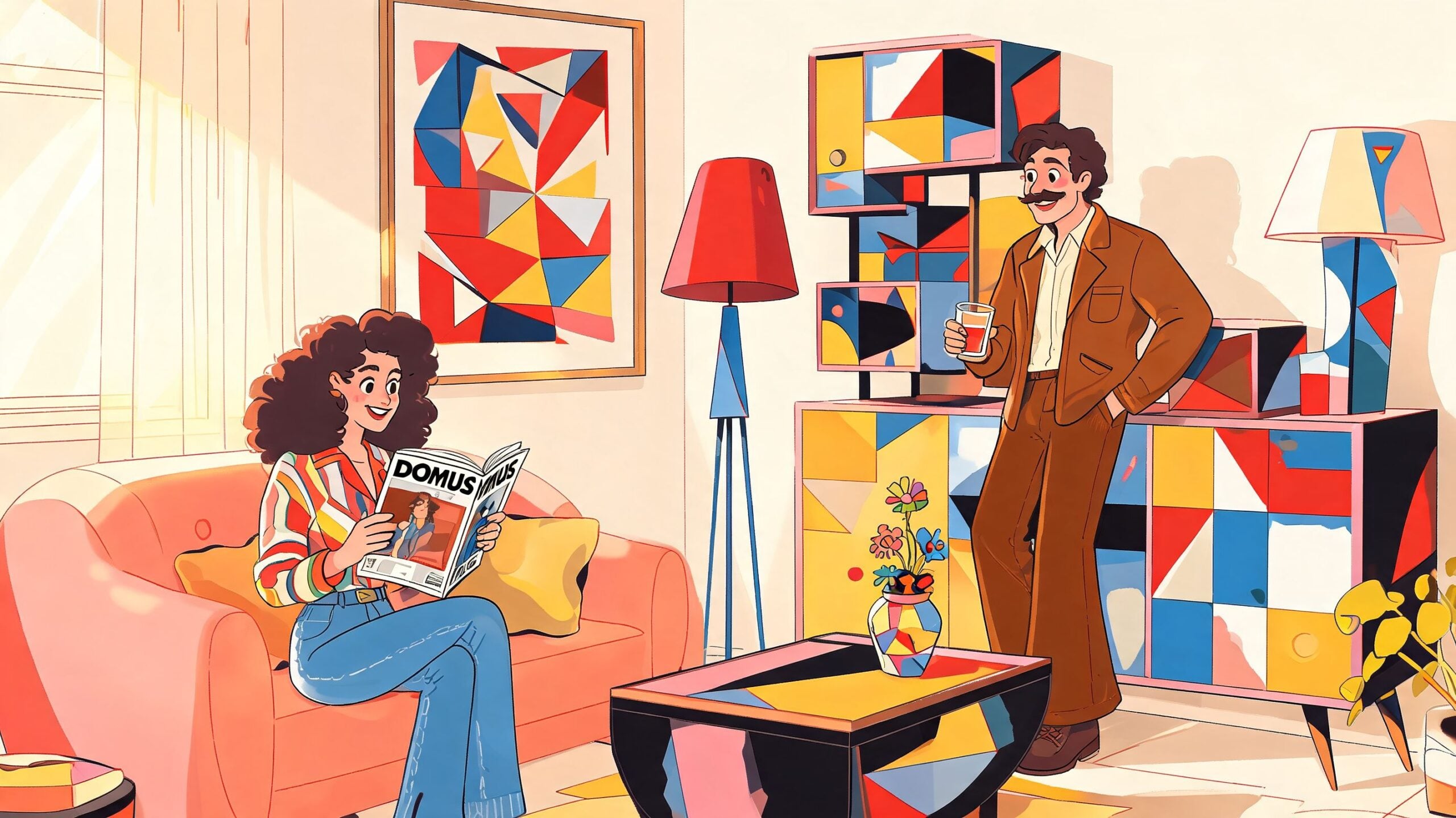
Around Ettore Sottsass and the Memphis group, furniture took on a new visual language. Cabinets used stacked geometry and unexpected colour pairings. Tables mixed crisp lines with shapes that felt almost hand-drawn. Lamps could read as sculpture first and utility second, like punctuation marks placed carefully around a room. The point was not disorder. The point was freedom from a single idea of good taste.
How the style reached Canada
In Canada, these ideas arrived through exhibitions, design media, import channels, and adventurous retailers that saw promise in a more expressive approach to interiors. Toronto became an early meeting point for that conversation, and from there the style spread through Southern Ontario showrooms and homes.
That local history matters because it changes how we read the movement. Postmodern furniture was not only admired from afar as an Italian experiment. It was selected for real dining rooms, living rooms, and entrance halls across the Niagara, Hamilton, and Toronto corridor. A curved laminate console or a boldly coloured side chair had to do more than make a statement. It had to live comfortably with family routines, older architecture, and the practical expectations of Canadian households.
For a heritage retailer such as Critelli Furniture, that kind of adaptation is familiar territory. A century-old design institution does not survive by treating style as theatre alone. It survives by recognising which ideas can be translated into lasting, livable rooms. That is one reason postmodernism still feels relevant here. In Southern Ontario, the style has long been filtered through a curatorial lens, balanced with craftsmanship, comfort, and proportion rather than treated as a novelty.
Why the movement still resonates
One helpful comparison sits beside mid-century design. Mid-century furniture often centres organic forms and functional design. Postmodern pieces keep function, then add quotation marks around form. A chair may nod to classicism, pop culture, and industrial production in the same silhouette. It works much like a well-layered room in an older Ontario home, where original millwork, contemporary art, and a new sofa can coexist without flattening one another.
That is why many collectors and homeowners are drawn to both styles. Mid-century offers clarity. Postmodernism offers personality with a point of view.
For readers comparing those design languages in more detail, this guide to modern and mid-century furniture in Canada gives helpful context for the conventions postmodern designers chose to disrupt.
Understanding the Philosophy Behind the Form
A postmodern cabinet can seem random at first glance. It usually isn't. The movement has a philosophy, but it helps to translate it into everyday language.
The easiest place to begin is this. Modernism often treated furniture as a problem to solve. Postmodernism treated furniture as a conversation to continue. The object still needed to work, but it could also be funny, symbolic, decorative, or even slightly provocative.
Irony in furniture
In design, irony doesn't mean mockery for its own sake. It means using familiar forms in unfamiliar ways. A chest might echo classical architecture, then appear in a candy-coloured laminate. A side chair might look formal in outline but playful in scale.
That contrast creates a double reading. You recognise the historical reference, yet you also see that the designer is reinterpreting it rather than preserving it.
Practical rule: If a piece makes you ask, “Is this serious or playful?” it may be operating in a postmodern spirit.
Eclecticism without chaos
People often confuse postmodernism with visual disorder. Good postmodern furniture design isn't careless. It's curated.
Think of it as a collage. A collage can combine unrelated materials, colours, and references, but a strong one still has composition. In interiors, that means a room can hold terrazzo, lacquer, brass, velvet, and graphic pattern, yet still feel resolved if scale, proportion, and placement are handled well.
This is also where readers sometimes blur postmodern style with transitional rooms. They're not the same. Transitional spaces usually aim to smooth differences between classic and contemporary elements. Postmodern rooms let those differences remain visible, sometimes even delightful. This explanation of transitional style in interior design helps distinguish the two.
Form that carries meaning
The phrase “form follows function” doesn't disappear here. It stops ruling the room.
A postmodern table may still hold a lamp perfectly well, but it might also introduce asymmetry, exaggerated geometry, or a bold finish that invites attention. Decoration is no longer treated as suspect. It becomes part of the object's meaning.
Three ideas often sit together in strong postmodern work:
- Historical pastiche blends references from earlier eras instead of staying loyal to one.
- Expressive colour turns furniture into a focal point, not just a background element.
- Deliberate asymmetry creates tension, movement, and personality.
Once you understand those principles, the style becomes far less mysterious. What looks wild at first often reveals itself as carefully composed, intellectually alert, and surprisingly beautiful.
Signature Materials and Motifs of Postmodern Design
A well-chosen postmodern piece often introduces itself through surface before you notice its silhouette. You see the gloss of lacquer, the fleck of terrazzo, the flash of brass, and only then begin to read the shape. In a Southern Ontario home, that order matters. Our rooms often balance heritage architecture, practical family use, and long winters that ask more of colour and texture.

Materials that carry the look
Postmodern designers favored materials that could hold crisp colour, sharp edges, or dramatic contrast without losing a sense of luxury. Some feel industrial. Others feel richly decorative. The pleasure comes from their combination.
| Material | What it contributes |
|---|---|
| Laminate | Clean colour, slick surfaces, and a polished, intentionally manufactured finish |
| Terrazzo | Speckled movement and visual depth, almost like pattern built into stone |
| Brass and polished metal | Light, reflection, and a touch of glamour |
| Velvet | Soft pile that tempers angular forms |
| Painted wood and lacquer | Dense colour and a sculptural, almost gallery-like presence |
Colour is often the first point of hesitation for readers. “Clashing” can sound careless. In strong postmodern furniture, colour behaves more like a conductor than a commotion. A bright coral door can sharpen a deep teal frame. A stripe of black can steady a pale lilac surface. The composition feels intentional because each note has a job.
That is one reason these materials still work so well outside a showroom. A lacquered cabinet in a Toronto condo, a terrazzo-topped table in Oakville, or a velvet occasional chair in a classic Burlington living room can all feel current if the rest of the room gives the piece enough breathing space.
Motifs that make a piece feel postmodern
Materials set the tone, but motifs tell you what language the piece is speaking.
Look for these recurring traits:
- Asymmetry that gives one side more visual weight
- Geometric play through arcs, circles, triangles, grids, and squiggles
- Decorative detail used for delight, not only utility
- Historical references borrowed from Art Deco, classicism, or older ornamental traditions
- Unexpected pairings such as glossy with tactile, rigid with soft, or flat planes with rounded forms
A postmodern object often feels layered in time, as though it remembers the past while refusing to behave politely in the present.
How to keep the room grounded
Good curation matters in this context. A room filled with strong shapes and assertive finishes needs a calm framework around it. Otherwise, every piece asks for attention at once.
Rugs often do that quiet work better than people expect. A hand-knotted rug can gather colour, soften geometry, and give a sculptural chair or cabinet a setting that feels settled rather than scattered. In well-furnished homes, the rug acts almost like punctuation. It helps the statement piece read clearly.
Upholstery deserves the same care. Postmodern seating can have bold profiles, but it lasts in a room because the materials age well and are maintained properly. If you are mixing expressive forms with classic finishes, this guide on caring for leather furniture properly is a useful reference.
The aim is a room that feels collected, not crowded. One confident credenza, one memorable lamp, one rug with presence. Often, that is all postmodern design needs to feel alive in a contemporary home.
Iconic Designers and Pieces That Defined the Movement
Some movements are understood best through theory. Postmodern furniture design is understood best through objects.
The names most often associated with the movement became influential because they made furniture impossible to ignore. They designed pieces that looked argumentative, witty, and oddly elegant all at once.
Ettore Sottsass and the bookcase that changed the room
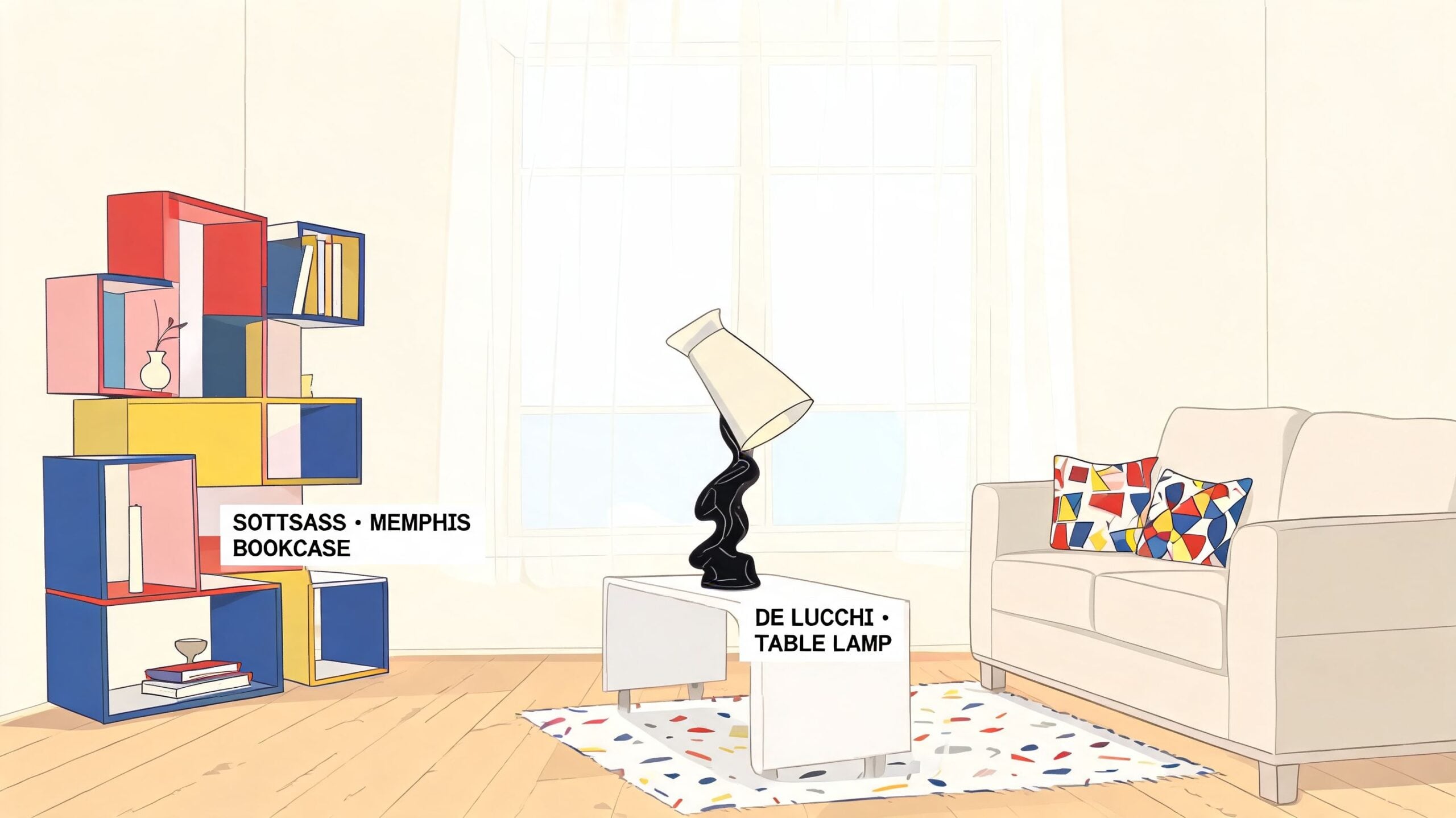
Ettore Sottsass remains the essential figure for many collectors. His work showed that a storage piece didn't have to hide in the background. The famous Carlton bookcase is the clearest example. It behaves partly like shelving and partly like a freestanding artwork, with stacked diagonals, saturated colour blocks, and a silhouette that feels architectural without becoming solemn.
Carlton's importance isn't only visual. It gave permission. After it, designers could treat furniture as symbolic and expressive, not merely efficient.
Michele De Lucchi and the energy of line
Michele De Lucchi brought a different kind of force to the movement. His lighting and furniture often carry a sense of motion, as though line itself were doing the talking. In postmodern interiors, lamps matter enormously because they can introduce humour without demanding as much floor space as a large case piece.
A good postmodern lamp often works like jewellery in a room. It catches the eye, creates rhythm, and helps a scheme feel intentional rather than flat.
Martine Bedin and the charm of the unexpected
Martine Bedin's work often reveals the movement's tenderness. There's wit, yes, but also warmth. Her designs remind us that postmodernism wasn't only intellectual play. It was also about emotional response. Delight matters. Surprise matters.
That's why many of these pieces have become heirloom quality collector's items. They hold their cultural value because they don't vanish into taste cycles as easily as safer furniture does. A well-chosen postmodern piece can still feel radical decades later.
What makes these pieces endure
Their longevity comes from more than rarity. They endure because they solve a continuing design problem. How do you make a room feel cultivated without making it feel predictable?
These designers answered that with furniture that behaves almost like art. Not art in the sense of fragility, but art in the sense of intention. The best examples still offer utility. They refuse anonymity.
For a refined home, that refusal can be the difference between a room that is nicely furnished and one that is remembered.
Styling Postmodern Furniture in a Contemporary Home
A well-lived Southern Ontario home rarely succeeds by following a period script. It succeeds when each piece feels chosen, placed, and understood. Postmodern furniture belongs beautifully in that kind of interior. In a Toronto condo, it can sharpen a quiet room. In a Hamilton character home, it can add tension against traditional millwork. In a Niagara residence with generous light, it can introduce colour and wit without disturbing the sense of calm.
The goal is curation, not recreation. A contemporary home does not need to mimic the 1980s to enjoy postmodern design. It needs a few pieces with personality, and the confidence to let them speak clearly.
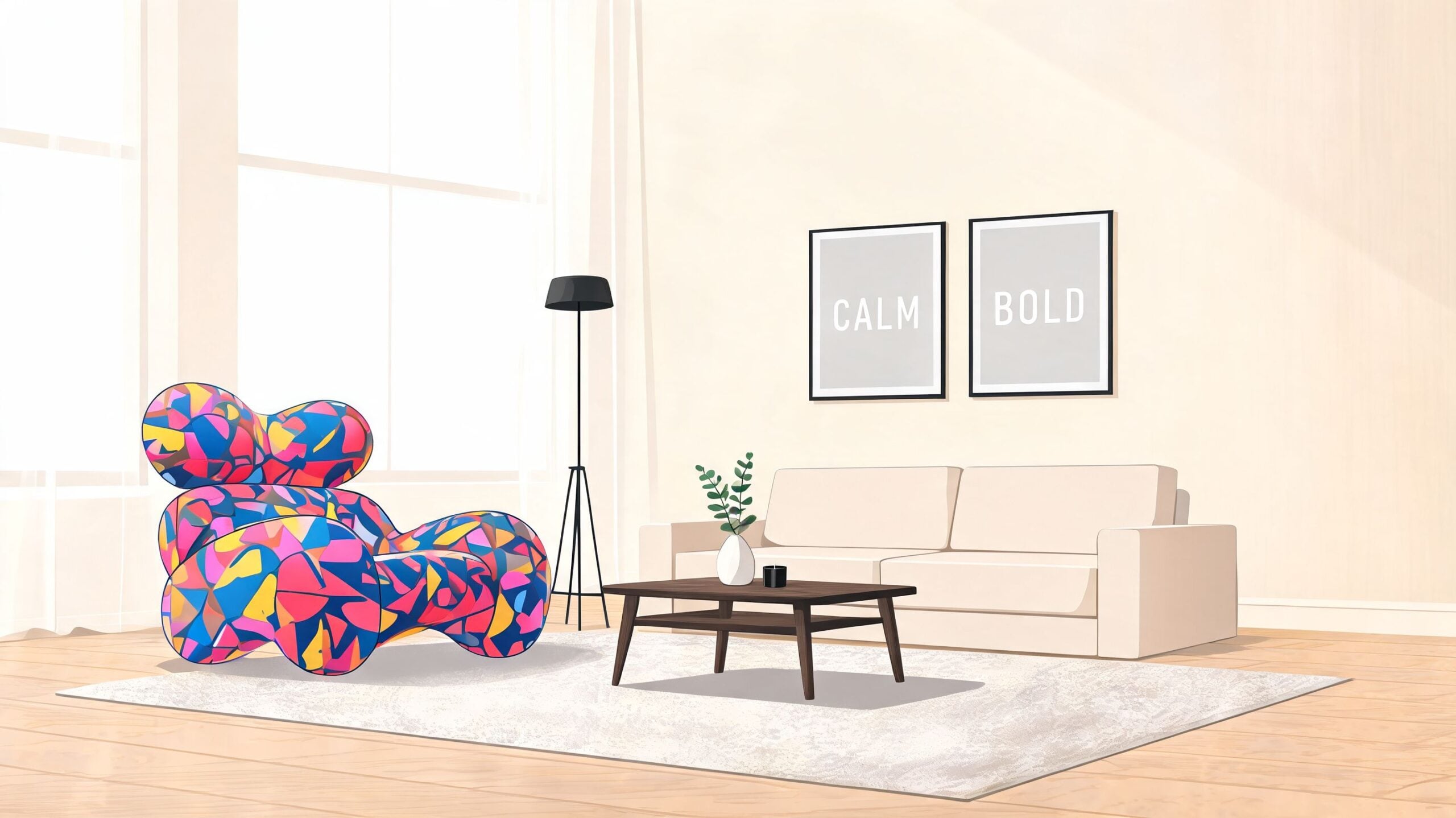
Start with one expressive anchor
Every memorable room has a centre of gravity.
Often, that is a single postmodern piece with enough character to set the tone for everything around it. A lacquered credenza in a saturated colour, a sculptural lounge chair, or a dining table with an unexpected pedestal can do that work. The piece acts like a host at a gathering. It establishes the mood, then invites the quieter furnishings to fall into place.
This approach also suits the way many Southern Ontario homes are lived in. Condos benefit from a focused statement rather than visual clutter. Older homes benefit from contrast. Larger open-concept spaces benefit from a distinct form that helps define a zone.
Keep the surrounding furnishings disciplined. A refined sofa, a restrained coffee table, and lighting with a clear silhouette will give the statement piece room to breathe.
Build the room as a composition
Postmodern rooms tend to fall flat when the furniture is chosen one item at a time, with no larger picture in mind. The stronger approach is to build the room the way a curator hangs an exhibition. Each object should have a relationship to the next, whether through colour, scale, material, or shape.
Start with the floor. A hand-knotted rug often does more than add softness. It steadies the room, much like a frame steadies a painting. Once that foundation is in place, bring in seating that feels composed rather than busy. Then add one sculptural storage piece and a lamp or table with a playful note.
Designer's Insight
Our designers suggest pairing a vibrant postmodern credenza with the organic texture of a neutral hand-knotted wool rug to create a dialogue between playful art and timeless craftsmanship.
For readers refining furniture placement before investing in new pieces, this guide on how to arrange furniture in a living room offers a strong planning framework.
Pair bold forms with trusted craftsmanship
Postmodern furniture looks especially convincing when it is surrounded by pieces that bring comfort, material integrity, and proportion. That is why it sits so well beside established luxury brands. The contrast is part of the beauty.
A playful accent chair can sharpen the intentional calm of Stickley. A sculptural table can add energy beside the ergonomic ease of Stressless. A geometric cabinet can look richer when balanced by the artisanal depth of Hancock & Moore. In each case, the room feels collected rather than themed.
For trade professionals and homeowners exploring bespoke options, The Knotty Lumber Co. professional resources offer useful perspective on the design value of custom-made furniture. That route can be especially helpful when a room needs postmodern character adapted to the scale, architecture, and daily life of a specific Southern Ontario home.
The most successful interiors use postmodern furniture the way a seasoned collector would. With restraint, with pleasure, and with a clear sense of what the room needs. That is what makes the style feel alive now, not archived.
A Curator's Guide to Sourcing Authentic Pieces
A client once arrived with a phone full of saved images. Some were true postmodern pieces. Some were clever copies. A few were loud furniture in bright colours. Her question was the right one. How do you tell the difference, and how do you buy something bold that will still feel right at home five years from now?
That is the fundamental sourcing challenge. Postmodern furniture is available, but good examples require a trained eye. In Southern Ontario, that matters even more because homes here ask for flexibility. A condominium in downtown Toronto, a renovated Niagara farmhouse, and a traditional St. Catharines home all need different proportions, materials, and scale.
The market gap is often described through rising interest in eclectic interiors and limited retail supply, including a reported 22% year-over-year rise in eclectic design inquiries in Southern Ontario, 8% of luxury furniture sales featuring postmodern pieces, and 65% of St. Catharines-area design-focused clients requesting custom mixes, as referenced in this discussion of the postmodern market gap. The exact numbers matter less than the pattern. Interest has grown faster than thoughtful sourcing support.
What to look for in an authentic piece
Authenticity begins with intention.
A strong postmodern piece has the same clarity you see in a well-composed room. Every curve, angle, colour break, and material choice feels deliberate. Even the playful pieces have discipline underneath them.
When assessing a piece, look for:
- A purposeful silhouette with a clear point of view, rather than novelty for its own sake
- Well-chosen materials such as lacquer, laminate, stone, metal, glass, or upholstery used with care
- Balanced proportions that hold up from every side, not just in a front-facing photo
- Finish quality that gives colour depth and definition instead of making it look flat or plastic
- Construction details such as stable joinery, crisp edges, and weight where weight should be
Copies usually reveal themselves quickly. The colour may be right, but the scale feels clumsy. The shape may be dramatic, but the craftsmanship falls short. An authentic piece has conviction. It does not need to shout.
Vintage, reissued, or bespoke
Each sourcing path serves a different kind of home.
Vintage pieces carry the atmosphere of their era and can bring real collector interest. Reissues offer established forms with current production standards, which can be reassuring for buyers who want the look without the uncertainty of age. Bespoke pieces often suit Southern Ontario homes especially well because they allow for practical adjustments in width, height, finish, or upholstery.
That custom route is often the difference between a piece that merely resembles a gallery object and one that is at home in a living room, library, or bedroom. A sculptural console may need a softer finish to sit comfortably with millwork in a heritage home. A dramatic chair may need a slightly reduced footprint for condo living. Good sourcing respects architecture as much as style.
White-glove delivery matters with sculptural furniture because placement, angle, and scale affect the final design result.
Buy for longevity
The best question is not whether a piece feels daring today. It is whether the design has enough clarity and craftsmanship to remain persuasive over time.
A worthwhile postmodern piece works like art in a room. It changes the conversation around it. A restrained sofa can look sharper beside it. A traditional rug can feel more current. A quiet corner suddenly has structure and personality.
This is why many homeowners prefer a curated, expert-led buying process over endless scrolling and guesswork. With a heritage design institution such as Critelli, postmodern furniture stops feeling like a rare collector's puzzle and starts feeling usable, adaptable, and beautifully resolved for contemporary Southern Ontario living.
If you're ready to explore postmodern furniture design with the confidence of expert guidance, Critelli Furniture offers the kind of heritage, design-forward support that makes bold interiors feel beautifully resolved. As a family-run Southern Ontario destination founded in 1914, Critelli pairs curated selection with complete room thinking, from interior design services in St. Catharines to the Rug Market's hand-knotted foundations and efficient white-glove delivery across Niagara, Hamilton, and Toronto. Experience the craftsmanship in person at our King Street Showroom. Visit the Rug Market to find your room's foundation. Or book your complimentary design consultation today.