
Expert Guide: Kids Bedroom Furniture & Safety

A child's room rarely changes all at once. One day the nursery still works, and the next, the crib feels too small, the storage is overflowing, and the room no longer suits the child who lives there. That moment can feel practical and emotional at the same time. You're not only replacing furniture. You're shaping the backdrop for sleep, reading, play, study, and the rituals that make a home feel settled.
The strongest kids bedroom furniture choices aren't the ones that chase a theme for a season. They're the pieces that support daily life gracefully, hold up to real use, and still look right as a child grows. In a well-composed room, the bed, storage, rug, lighting, and layout work together as one complete room concept.
That perspective has guided family furniture firms for generations. Since 1914, a family-run approach to furnishing Southern Ontario homes has always come back to the same principle: buy less often, buy more thoughtfully, and choose timeless craftsmanship where it matters most.
Creating a Room That Nurtures and Inspires
At some point, every parent stands in the doorway of a child's room and sees two timelines at once. There is the child who needs comfort tonight, and the older one who will soon need better storage, a place to read, and furniture that still feels right in the house. The room works best when it is planned for both.
A well-made child's bedroom supports daily rhythms. Good sleep, easier mornings, calmer tidy-up routines, and enough open floor for play all come from the same decisions about scale, layout, and furniture quality. Rooms planned only for the present often become expensive in the long run, because pieces are replaced before the child has outgrown them.
The strongest schemes begin with use, not theme. I always look first at how the room behaves. A narrow room with one usable wall needs different answers than a square room shared by siblings. A child who reads on the floor needs space beside the bed. One who collects books, building sets, or keepsakes needs storage that is easy to reach and easy to reset.
Three priorities usually shape the room well:
- Rest supported by a calm layout, proper blackout treatments, and a bed placement that feels secure.
- Order created by storage the child can use without constant adult intervention.
- Longevity built into the larger pieces, so the room can mature without starting over.
That last point matters more than many families expect. The decorative layer can change often and affordably. Bedding, art, lampshades, cushions, and paint can shift with age and interests. The investment belongs in the furniture that carries the room for years, such as a well-proportioned bed with integrated storage, like these twin drawer beds for growing bedrooms.
Transitions matter too. Parents often spend a great deal of energy deciding what to buy, when the better first question is when the room itself needs to change. Guidance on when to move a toddler to bed can help clarify timing, but the design principle is straightforward. Choose pieces that make each stage feel settled rather than improvised.
A child notices that feeling before they can name it. The room feels calm. Their things have a place. The furniture fits the scale of the space and still belongs to the home as a whole.
That is where real value sits. A child's bedroom should carry imagination and personality, but it should also respect the architecture of the home and the years ahead. When those two goals are met together, the room feels gracious from the beginning and remains useful long after the latest phase has passed.
The Foundation A Bed Built for Growing Dreams
A child may outgrow a favourite colour in a season. They should not outgrow the bed in a year.
The bed sets the room's proportions, daily rhythm, and much of its cost. Get this decision right and the rest of the scheme has a clear logic. Get it wrong and even a generous room can feel awkward, crowded, or short-lived.
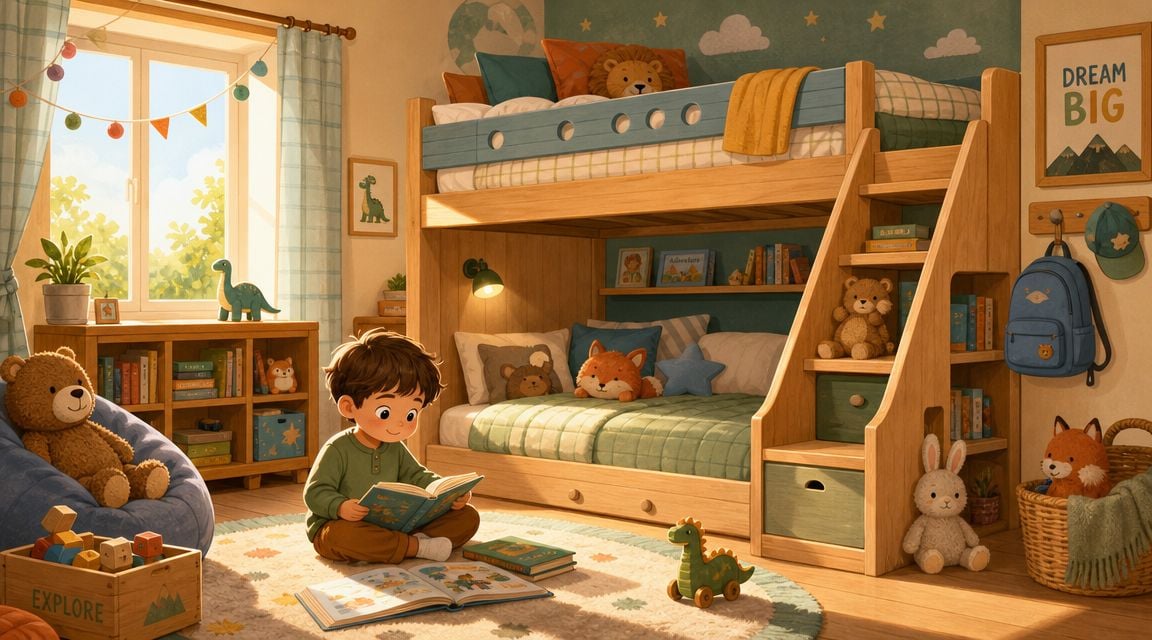
This is the piece I advise clients to treat as a long-term purchase. A well-made bed should carry a child from one stage to the next while still sitting comfortably within the design language of the home. That is very different from buying a stopgap frame with an obvious expiry date.
Choose the size with the room in mind
Parents often ask whether to buy for the child in front of them or the older child they can already foresee. The answer starts with the room itself, not the catalogue.
A twin usually gives the best balance in a compact bedroom. It keeps more floor area free for circulation and leaves the room flexible as needs change. A twin XL adds welcome length for a fast-growing child without introducing the visual bulk of a wider frame. A full can be comfortable, especially for readers, cuddlers, or sleepovers, but it asks more of the room and often limits what else can fit gracefully.
In many homes across Niagara, Hamilton, and Toronto, discipline pays off. A properly scaled bed with breathing room around it nearly always feels better than a larger bed pressed too tightly between walls and casegoods.
Match the style to the years ahead
Some silhouettes mature well. Others date themselves almost immediately.
The safest choices are simple, well-proportioned forms. Panel beds, spindle beds, understated upholstered frames, and restrained sleigh profiles usually move from early childhood into the teenage years without apology. Heavily themed beds rarely do. They can delight a six-year-old, then force a full redesign much sooner than expected.
Shared rooms and raised sleeping options need more scrutiny. Bunks and lofts can be sensible where square footage is tight, but access, guardrails, ceiling height, and the child's age all matter. Practicality comes first.
Families deciding on timing may find this guide on when to move a toddler to bed helpful. The design side of that decision is straightforward. Once the move happens, the new bed should feel settled and intentional, not like a temporary fix.
Designer's Insight
Choose a bed with the same discipline you would use in a guest room. Good scale, honest materials, and a quiet silhouette will still feel right years later.
Don't separate the frame from the mattress decision
A beautiful frame cannot rescue poor sleep. Mattress support, airflow, height, and ease of getting in and out all affect how the bed performs every night.
That practical view matters with storage beds as well. Underbed drawers earn their keep when they are easy to open, properly built, and solving a real shortage of enclosed storage. If they are compensating for a room with no plan, they usually become overflow space for clutter. In smaller bedrooms, twin drawer beds with built-in storage can make excellent sense because they combine the sleeping zone and part of the storage requirement in one footprint.
A child's bed should support more than sleep. It should support growth, independence, and a room that still feels considered several years from now.
Designing for Play Smart Storage and Layouts
A child's room should never feel as though every inch has been filled only because it could be. The best layouts leave room to move. In compact homes, that isn't a luxury. It's the difference between a room that functions and one that frustrates.
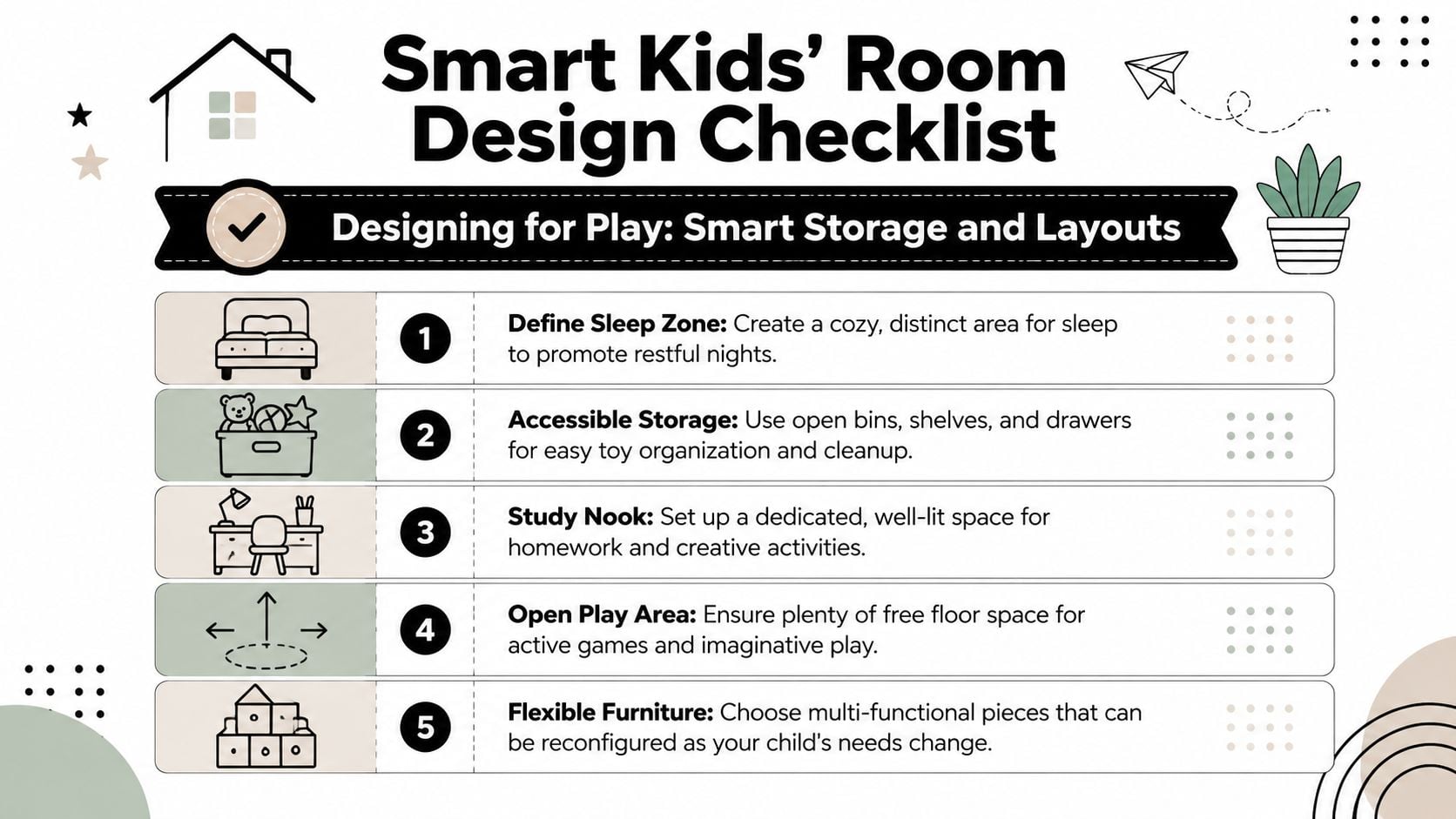
A practical benchmark is to keep the bed's footprint to no more than 30% to 40% of the room's total floor area, which helps preserve space for play, dressing, and safe movement according to Wayfair's kids bedroom furniture size guide.
Give each zone a job
Even a small bedroom works better when it's clearly zoned. That doesn't require partitions or elaborate built-ins. It means the child can understand the room at a glance.
A useful arrangement often includes:
- Sleep along the calmest wall where the bed doesn't compete with the door swing or block natural light awkwardly.
- Storage nearest the point of clutter so books stay near reading spots, and toys stay near open floor space.
- A desk or activity surface by the best light if the room is used for drawing, homework, or crafts.
This kind of planning is where a design studio earns its keep. Space planning isn't just about what fits. It's about what fits well. That's the difference between buying furniture and shaping a complete room concept.
Use storage that a child can actually manage
Beautiful storage that a child can't reach or understand won't stay organised. Low drawers, open bins, bookcases with sensible shelf spacing, and a dresser that suits the room are usually better than complicated systems. In smaller rooms, one modular piece often does more than several mismatched accents.
For families trying to solve toy overflow without swallowing the room, these ideas on toy storage solutions for small spaces are a useful companion to more permanent furniture planning.
One practical option for flexible organisation is a modular shelving system, particularly when a room needs to change from toys and picture books to school materials and display objects over time.
The room should help the child tidy up with as little friction as possible. If every item needs a complicated sequence to put away, the system will fail.
Watch the small spacing decisions
Good layouts are built on details. Nightstands should sit close enough to be useful, but not so tight that they pinch movement. Dressers need full drawer clearance. Doors, closet access, and walking paths have to stay easy.
What doesn't work is the common instinct to line every wall with furniture. That can make a room feel furnished, but it doesn't make it livable. Leaving an intentional patch of open floor often improves the room more than adding one more piece.
If you want a room that feels organised without feeling crowded, Book your complimentary design consultation today.
Heirloom Quality Materials and Finishes That Last
Children use furniture thoroughly. They climb, pull, lean, drag, spill, bump, and test every edge. That's why material selection isn't a decorative question. It's a performance question.
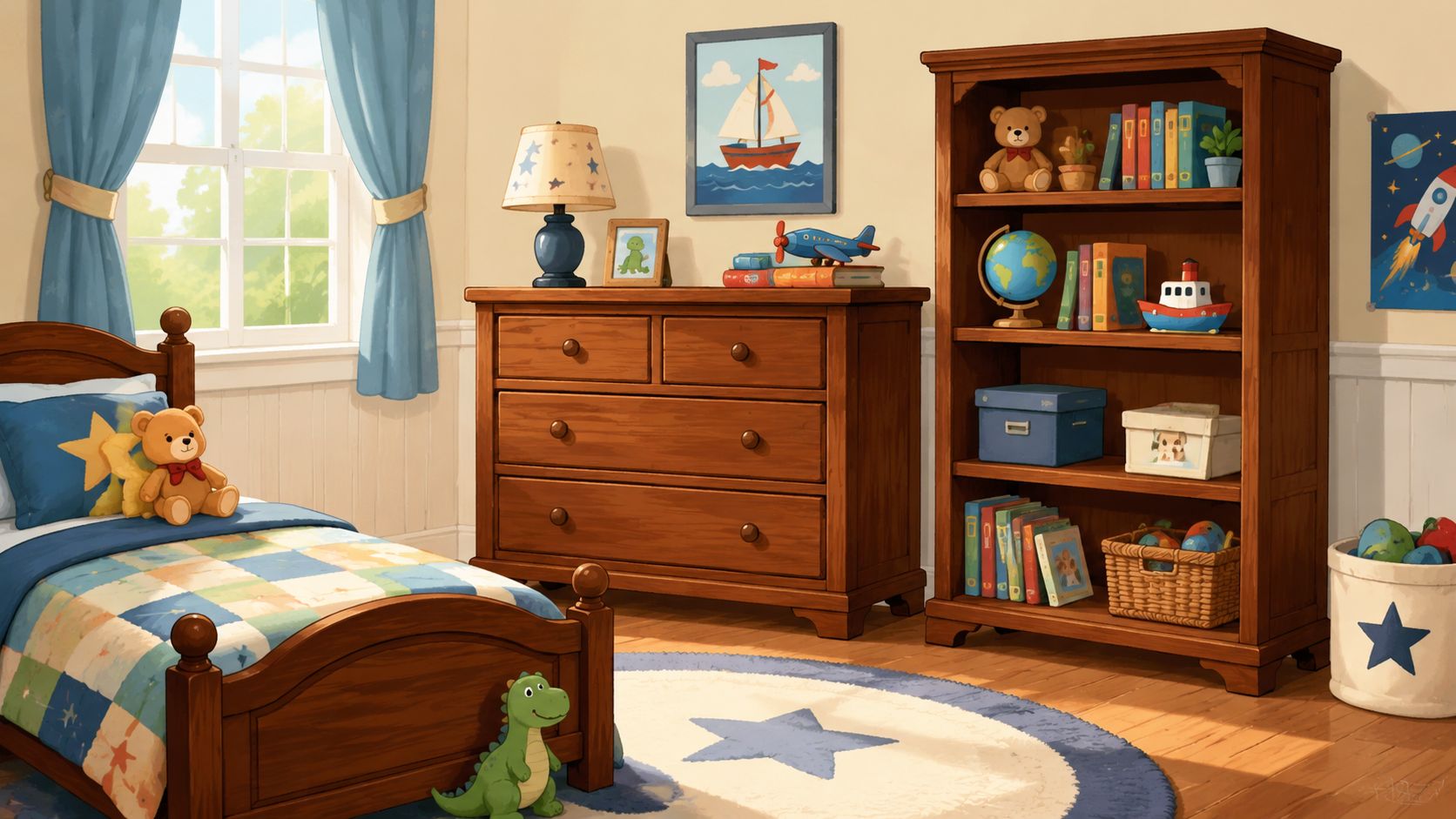
The core technical standard for premium kids' furniture combines anchoring tall pieces to a wall, designing with a low centre of gravity for stability, and using durable, repairable materials like solid wood with rounded corners and smooth edges to reduce injury risk, as outlined in this kids bedroom furniture guide.
Why solid wood still matters
If you want heirloom quality, solid wood remains the clearest benchmark. It ages with dignity, can often be repaired, and tends to look better after years of use than materials that rely heavily on a thin surface finish. Scratches and dents are part of family life. With solid wood, many of them can be addressed rather than merely tolerated.
That doesn't mean every engineered material should be dismissed. MDF and similar constructions can perform adequately when protected by a high-quality laminate or veneer. But they depend far more on finish integrity. Once that surface is compromised, the piece often loses both beauty and resilience.
Finishes and forms that support real life
Parents are right to ask about safer finishes, smooth edges, and stability. In a child's room, these details are not optional.
Look for:
- Rounded corners that soften impact points in active rooms.
- Smooth, well-finished hardware that won't catch clothing or scrape small hands.
- Lower, wider casegoods because broad proportions usually provide better stability than tall, narrow ones.
- Repairable surfaces so the piece can be refreshed rather than discarded.
For a broader look at practical upholstery and finish decisions in active households, this guide on kid-friendly and pet-friendly furniture offers useful considerations that apply well beyond the family room.
Buy construction first and appearance second. Good furniture can be refinished, reupholstered, and restyled. Poor construction rarely redeems itself.
The families who are happiest with their purchases usually aren't the ones who found the most novelty for the least money. They're the ones who chose materials that could absorb childhood and still come out looking composed.
Styling A Room That Evolves With Your Child
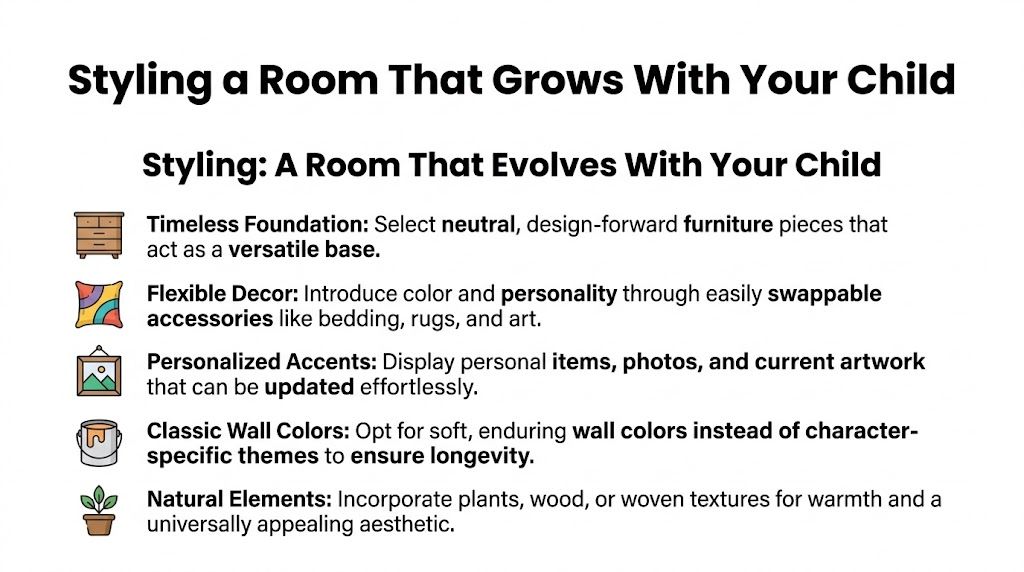
A room doesn't need to be plain in order to last. It needs a stable foundation. The art lies in knowing which elements should stay timeless and which ones should remain flexible.
Current style direction for 2025 is moving away from novelty themes and toward longevity, with an emphasis on calming, nature-inspired palettes such as sage green and dusty blue, natural textiles, and multifunctional furniture that adapts as a child grows, according to this overview of kids' bedroom trends for 2025.
Build the room on a quiet base
The furniture should carry the architecture of the room, not the temporary personality of a single age. Wood tones, painted finishes in restrained hues, and classic silhouettes leave room for bedding, art, and accessories to shift over time.
Walls also matter. A gentle, enduring colour tends to outlast a highly specific motif. Children's tastes change quickly. Replacing linens and art is simple. Replacing a roomful of themed furniture isn't.
Let the rug do more of the design work
Many rooms achieve a polished look. Rather than forcing all the colour into the furniture, ground the room with a rug and let it establish the palette. In that sense, Art for your Floor isn't just a lovely phrase. It's a strong design principle.
A hand-knotted or richly textured rug can soften acoustics, define the play area, and connect the room to the rest of the home. It also gives you more freedom with bedding, accent pillows, and wall art. A well-chosen rug makes the room feel finished even when the accessories evolve.
If you're building the scheme from the ground up, bedroom pendant lights can also help shift the room from overtly childlike to refined, especially as the space matures.
Designer's Insight
Pair a simple bed and dresser with layered textiles. A wool rug, linen-look drapery, woven baskets, and cotton bedding create warmth without locking the room into one age or theme.
Change the accents, not the architecture
The easiest elements to refresh are often the most expressive. Rotate framed artwork, switch the duvet, add a new reading lamp, or update cushions and throws as interests change.
A good formula looks like this:
| Element | Keep timeless | Refresh easily |
|---|---|---|
| Furniture | Bed, dresser, shelving | Bedside accessories |
| Colour | Soft wall tones, wood finishes | Bedding, art, cushions |
| Texture | Rug, woven storage, drapery | Seasonal layers, decorative objects |
For families who want a room with personality and longevity, this balance matters. Visit the Rug Market to find your room's foundation.
The Bespoke Journey From Vision to White-Glove Delivery
Luxury in a child's bedroom isn't about excess. It's about resolution. The proportions feel right, the finishes make sense in the home, and nothing arrives as a compromise. That level of ease usually comes from a guided process, not a rushed series of purchases.
Why professional planning changes the result
When a room includes a bed, dresser, nightstand, rug, lighting, window treatments, and perhaps a desk, every choice affects the next one. A designer sees those relationships early. That's especially useful in children's rooms, where scale errors and storage mistakes become obvious very quickly.
An in-home consultation can clarify details that showroom shopping alone may miss:
- Natural light and how it changes the feel of paint, textiles, and wood tones
- Architecture such as sloped ceilings, radiator placement, or narrow wall sections
- Daily use including shared bedrooms, reading habits, and toy storage patterns
That's why interior design services in St. Catharines are valuable for more than visual polish. They reduce expensive missteps and help turn individual pieces into a unified room.
The final stage should feel effortless
The importance of delivery is often underestimated. Children's furniture often arrives with multiple components, tight room clearances, and assembly that has to be done correctly for both appearance and safety. A white-glove process removes that burden from the family.
With a professional furniture assembly service, the transition from showroom to home is smoother. Pieces are placed properly, assembly is handled with care, and the room begins life as intended rather than as a weekend project stretched across the hallway.
For clients across the Greater Niagara, Hamilton, and Toronto markets, that continuity matters. The experience should feel considered from first selection to final placement. It's one of the clearest differences between acquiring furniture and commissioning a room.
A bespoke process also leaves room for customisation. Fabrics, finishes, hardware, and rug pairings can be selected to complement the rest of the house, so the child's room feels connected rather than isolated. That kind of coherence is what gives a home its quiet confidence.
Investing in Your Child's Room Key Questions Answered
A child's room is one of the few spaces in the house that has to work hard every day while changing year by year. Good furniture makes those changes easier. Poorly chosen furniture gets replaced in stages, and the room never quite settles.
Parents tend to ask the right questions once they move past colour and theme. Is better-made furniture worth paying for at the start, and what matters for safety after installation? Both deserve a clear answer.
Is it wiser to buy a full matching set now?
Usually, no.
A better approach is to buy the pieces with the longest useful life first. In practice, that often means a well-made bed, a properly sized dresser, and one storage piece that can serve through several ages. Those are the items that take the most wear and shape the room visually for the longest time. Lamps, textiles, wall colour, and smaller decorative pieces can change as your child grows.
That is how a room starts to feel lasting rather than temporary.
Should kids bedroom furniture match exactly?
Exact matching can make a room feel flat. Coordinated furniture tends to age better.
The strongest rooms use related materials, balanced proportions, and a consistent colour palette without making every piece identical. A painted bedside table can sit comfortably beside a timber bed if the scale is right and the finish belongs with the rest of the house. That collected quality is often what gives a child's room charm.
What safety measure gets overlooked most often?
Anchoring tall dressers and bookcases.
Families often focus on finishes, rounded corners, and soft furnishings, all of which matter, but tip-over prevention deserves equal attention. Tall casegoods should be fixed properly to the wall, and that should be handled as part of installation. It should not be left for later, once life gets busy and the packaging is gone.
Is long-life furniture worth it if tastes change?
Yes, provided the main pieces are quiet in style.
Children's preferences change quickly. Furniture should not have to. Beds, wardrobes, and dressers with simple lines and honest materials can carry a room from early childhood into the teenage years. Personality is better introduced through bedding, artwork, rugs, and paint, because those layers are far easier to refresh.
This is the value of buying well. You are not purchasing a short-lived look. You are building a room with a strong foundation that can keep pace with your child and still belong to the home as a whole.
What should I bring to a design consultation?
Bring accurate room measurements, a few photographs, and notes on how the room is used now.
It also helps to mention what is not working. An awkward corner, a drawer that blocks a walkway, a child who reads in bed every night, or siblings sharing storage all change the recommendation. The most successful plans come from real habits, not an idealised version of family life.
A child's room should feel beautiful on day one and sensible years later. If you're ready to create a design-forward space with timeless craftsmanship, bespoke guidance, and a smooth finish, experience the craftsmanship in person at our King Street Showroom.