
Round Coffee Tables Glass: The 2026 Buyer’s Guide


You know the room. The sofa is in place, the rug is decent, but the centre still feels unresolved. That is usually the moment a round glass coffee table earns its keep, not as filler, but as the piece that opens the room, softens the circulation, and gives the seating area a proper centre.
In Southern Ontario homes, especially in compact condos and busy family rooms, round coffee tables glass works because it solves two problems at once. It keeps the room visually light, and it removes the hard corners that can make a tight layout feel awkward. For anyone comparing Luxury furniture Niagara, Interior design services St. Catharines, or broader Custom furniture Southern Ontario options, this is one of those purchases where the right shape and the right material matter just as much as style.
Why Round Glass Coffee Tables Transform Living Spaces
A client once had a living room that felt crowded even though it wasn't packed with furniture. The issue was the coffee table, a dark, boxy rectangle that blocked the sightline from the doorway to the windows. Replacing it with a round glass table changed the room immediately, because the floor became visible again and the seating area felt easier to walk around.
That's the appeal here. The transparency of glass gives the room breathing space, while the circular form keeps the composition soft and fluid. In homes where every square foot has to work, that combination is more than a style choice, it's a practical design move.
The broader coffee-table market reflects that appeal. One report estimates the global coffee table market at US$15.2 billion in 2025, with glass coffee tables at about 26.4% of that value and round coffee tables at about 22.6%, while also noting growth of 5.1% CAGR for the glass segment and 5.4% CAGR for the round segment market report. Those numbers matter in the Canadian context because the design logic lines up with what works in urban homes and condos, where light reflection and visual openness are especially valuable.
Why the shape feels so different in a room
A round top does not fight the sofa, the rug, or the traffic path. It sits comfortably in the middle of a conversation zone and lets the room read as arranged, not crowded. That's why it works so well in layered interiors as well as minimal ones.
A glass top also plays well with both calm palettes and richer finishes. It can disappear just enough to let a hand-knotted rug become the visual anchor, which is exactly the kind of relationship a well-composed room needs.
Practical rule: if a room already has strong lines, heavy upholstery, or a patterned rug, a round glass table usually calms the composition instead of adding more visual weight.
For a deeper look at how texture shapes the way a room feels, see texture in interior design.
Understanding Tempered Glass Construction and Safety Standards
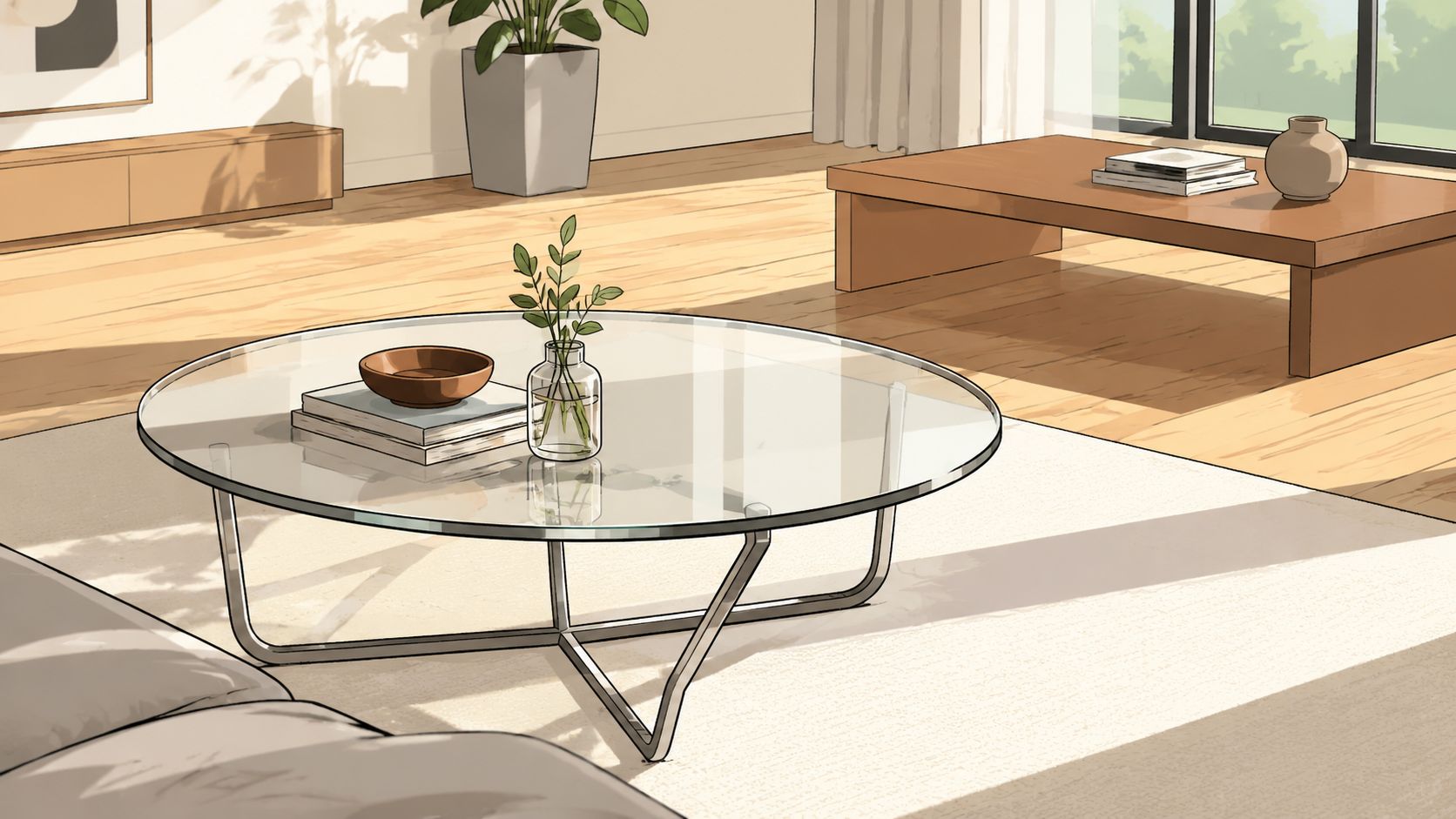
The first question is about construction quality, not style. For a coffee table that will live in a family room, tempered glass is the right starting point. For round table tops, 10 mm (3/8 in) tempered glass is the practical sweet spot, and thicker 13 mm (1/2 in) and 19 mm (3/4 in) options are generally used for larger, higher-load pieces such as dining, lobby, or conference tables round glass table tops.
That thickness range affects both the feel and the performance. Thicker glass brings more bending stiffness and a more substantial look, and moving from 6 mm to 10–13 mm improves resistance to flex and edge vulnerability. For residential use, that difference separates a table that reads as decorative from one that feels properly engineered.
How to read the specs without guessing
Canadian buyers should look for tempered glass, polished edges, and clear compliance with recognised safety standards. Product specifications commonly reference tempered construction and published thickness ranges from 5–19 mm, while industry guidance places tempered coffee-table glass typically around 10–19 mm to balance durability, weight, and cost tempered glass table top guide.
That is the cleanest way to separate a table that looks refined from one that is built for daily use. If the spec sheet is vague, treat that as a warning. If the edges are unfinished, pass.
A good buyer also checks the language around the base and the top together. The safest route is to use how to read furniture product descriptions and buy with confidence so you can spot whether a listing is giving you real construction details or just polished marketing copy.
| Glass Thickness Guide for Round Coffee Tables | |||
|---|---|---|---|
| Thickness | Best Use Case | Load Capacity | Ideal For |
| 1/4 inch, 6 mm | Decorative or light-duty use | Light | Accent pieces, occasional use |
| 3/8 inch, 10 mm | Medium-load residential use | Moderate | Coffee tables, daily family living |
| 1/2 inch, 13 mm | Daily-use tables | Higher | Heavier residential use, more substantial bases |
| 3/4 inch, 19 mm | Large round dining or conference tables | Very high | Oversized or commercial-scale applications |
Designer's Insight: in a family room, judge the thickness with the base, not in isolation. A strong top on a shaky base still feels wrong, and a pretty table that wobbles is never luxury. For Southern Ontario homes with active family traffic, that steadiness matters as much as the glass itself.
Measuring Your Space for the Perfect Fit
The easiest mistake is buying a table that looks right in a showroom and feels wrong at home. A round glass table should sit in the room like it belongs there, which means the diameter has to suit both the seating group and the circulation around it. If it crowds the sofa, the room shrinks. If it's too small, the arrangement feels unfinished.
Start with the sofa length, then look at the open zone between seating pieces. For a standard living room, a round table should feel proportionate to the front edge of the sofa and leave enough room to move without sidestepping. That's especially important in condos and townhomes where the coffee table often sits on a main traffic route.
A simple measuring sequence
- Measure the sofa front edge. The table should feel visually balanced against that span, not lost beneath it.
- Mark the walking lane. Keep the surrounding path clear so people are not brushing past the table every time they cross the room.
- Check the rug border. The table should sit inside the seating zone, not floating out on the edge of the arrangement.
- Test reach from the seat. People should be able to place a drink or book down without leaning awkwardly.
For sofa-and-table proportion, a useful rule of thumb is that the coffee table should be at least half the length of the sofa, and generally no more than roughly two-thirds. Seat height matters too, and a coffee table close to the sofa seat level usually feels more comfortable in daily use coffee table rules. That same source also notes that round tables are a strong choice in small spaces and in nook-like layouts.
If the seating is intimate, a smaller diameter keeps the room easy to move through. If the room is open and the conversation area is generous, a larger round shape can hold the composition better. For broader sizing guidance, refer to coffee table size guide.
A table that clears the traffic path by a comfortable margin will always read more expensive than one that forces people to squeeze past it.
For many homes, 36-inch tops suit coffee-table use, while 24-inch tops work better as side tables or accent corners and 42-inch or 48-inch tops belong in larger arrangements round glass table top guide. Those sizes are a practical starting point, not a rule carved in stone.
Pairing Your Table with Sofas, Rugs, and Lighting
A round glass table does its best work inside a full room concept. The table may be the centrepiece, but the room's tone comes from the sofa, the rug, and the light falling across both. Without those supporting pieces, glass can feel cold. With them, it feels deliberate and curated.
The rug should do the heavy lifting. In a proper room composition, the rug is the foundation, the surface that settles the room and gives the seating group its shape. That's why a hand-knotted rug belongs in the conversation from the beginning, not as an afterthought. For clients comparing Hand-knotted rugs Ontario selections, the right rug frames the coffee table and makes the glass look more refined, not more fragile.
What works with what
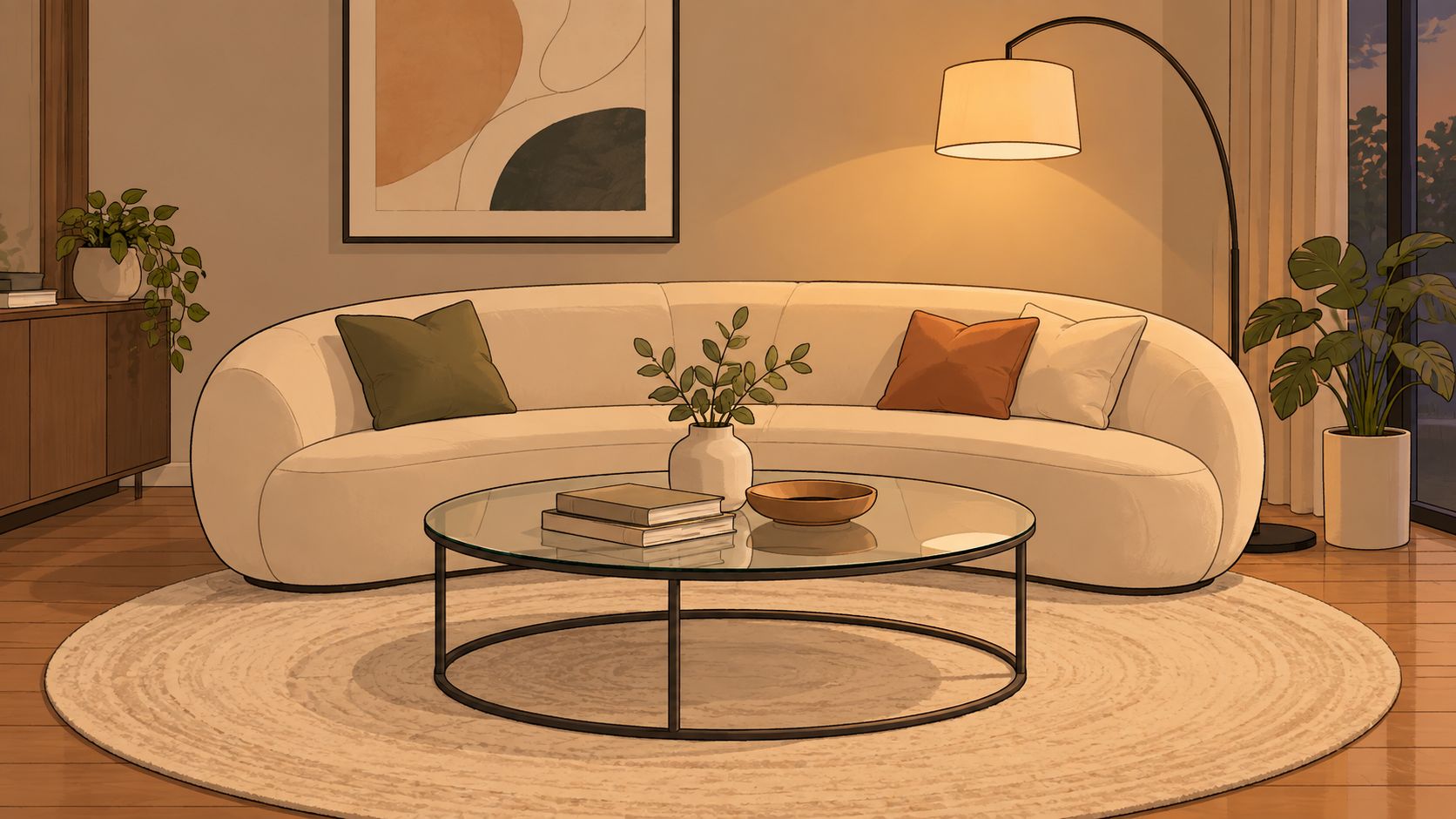
A softer sofa, whether curved or generously upholstered, gives a glass table a warmer presence. A more structured sofa gives the round shape a crisp contrast. Both can work, but the balance has to be intentional.
Lighting should be calm, not harsh. Glass reflects, so overhead glare will make the table feel fussy. Side lighting, shaded lamps, and warm ambient layers let the top catch light without turning the room into a mirror.
For rug placement, this guide is worth keeping open while planning the room, rug placement in the living room.
| Pairing Element | What to Look For | What to Avoid |
|---|---|---|
| Sofa | Enough visual weight to anchor the transparent top | Ultra-delicate upholstery that makes the table feel floating |
| Rug | Clear framing around the seating area | A rug that is too small to define the conversation zone |
| Lighting | Soft, layered light that flatters the glass | Direct glare that makes reflections distracting |
A styled glass table should look like it belongs in the room, not like it was dropped in from another project. That usually means one strong textile, one grounded seating choice, and one light source that behaves politely.
Styling Approaches for Different Design Aesthetics
The same round glass table can go in four different directions, depending on what sits around it. The shape stays the same, but the base, the accessories, and the surrounding finishes change its personality. That flexibility is exactly why it's such a smart centrepiece for a curated room.
Contemporary minimalist
This is the cleanest reading of the form. A simple glass top with a slim metal base keeps the room open, especially when the upholstery is low-profile and the palette is restrained. Styling should stay spare, with one stack of art books, one sculptural object, and nothing else competing for attention.
Transitional
Transitional rooms need softness and control. The table can still be glass, but the base should feel a little warmer, perhaps with quieter curves or a more grounded finish. On top, a small vase and a book stack are enough, because the surrounding room is already doing a lot of the work.
Modern industrial
Here, the glass softens what can otherwise become a heavy room. Metal, darker finishes, and more architectural lines give the table presence, while the transparency keeps it from feeling blunt. Keep the styling edited and structural, with a tray, a candle, and one object with strong form.
Curated traditional
The table becomes unexpectedly elegant. The glass top brings lightness to richer upholstery and classic silhouettes, and the round shape keeps the room from feeling too formal. A traditional room can handle a more decorative base, but the tabletop should stay composed, not crowded.
For a closer look at pared-back interiors, what is minimalist interior design is a useful reference.
Designer's Insight: the transparent top is not an excuse to decorate lightly by accident. It rewards restraint, and it punishes clutter.
Across all four aesthetics, the styling rule stays the same. Use a small number of pieces with clear purpose, and let the glass do the visual work. A curated selection always reads better than a busy surface.
Maintenance, Safety, and Everyday Durability
Glass gets treated like a fragile material because people fear the maintenance more than the material itself. In reality, a round glass coffee table can be perfectly practical in a family home if the construction is right and the care routine is sensible. The goal is not to baby the table, it's to keep it looking clear, stable, and safe.
Cleaning should be simple. Use a soft cloth and a cleaner that won't leave residue, and keep abrasive products away from the surface and edges. Smudges show on glass, which is why this material rewards quick, regular care instead of occasional heavy scrubbing.
What matters most in active households
Rounded shapes help because they reduce corner conflicts and improve circulation in rooms where children, pets, or frequent movement are part of daily life. That said, round does not automatically mean safe. The table still needs a stable base, sensible weight distribution, and polished edges, especially if the room sees a lot of traffic.
Independent design guidance notes that glass brings openness, but it also needs careful use in busy households, and it recommends tempered glass around 10–12 mm for a more sturdy feel glass coffee table guide. That guidance aligns neatly with the thicker residential sweet spot already covered above. For family living, that combination of thickness and edge quality matters more than a decorative base finish.
A few practical checks make sense every time:
- Test the base first. A table should feel planted, not tippy, when touched from the edge.
- Inspect the edges. Polished edges are a basic expectation, not a luxury upgrade.
- Use felt pads where needed. They help protect both the base and the floor surface.
- Keep the top clear of hard clutter. Heavy objects placed carelessly can create unnecessary impact risk.
A glass table becomes problematic when it is underbuilt, not because it is glass. Choose the right thickness, keep the base steady, and treat maintenance as part of ownership rather than a chore.
Working with Design Professionals to Curate Your Selection
A round glass coffee table should not be chosen in isolation. It should be selected as part of a complete room concept, with the rug, seating, and lighting already in view. That's where design consultations earn their place, because the right advisor looks at the whole space, not just the product thumbnail.
Professional guidance is especially useful when a table needs to be more than standard. Custom base details, specific glass thickness, and finish coordination all affect how the piece lives in the room. In a polished home, those details matter as much as the silhouette.
Critelli Furniture's design studio approaches furnishings as part of a complete room concept, and its collection includes round coffee-table-style pieces such as the Reuleaux Large Cocktail Table and the Reilly Marble Round Coffee Table. The point isn't novelty, it's coherence, which is exactly what a well-curated room needs in a market like Luxury furniture Niagara and across Interior design services St. Catharines projects.
Why white-glove service changes the experience
White-glove delivery removes the awkward middle ground between showroom and home. The piece arrives, is inspected, assembled if needed, and placed where it belongs, which matters when the table is part of a carefully planned room. That kind of service is especially valuable for homes across the Greater Niagara, Hamilton, and Toronto markets, where a room often needs to be ready the same day it's installed.
A good design process also respects the rest of the house. The right table in the wrong room is still the wrong table. A design professional helps prevent that mistake by matching the scale, surface, and base to the actual way the household lives.
The strongest purchase is the one that fits the room on day one and still makes sense after the furniture is arranged around it.
For homeowners looking for Custom furniture Southern Ontario solutions, that is the advantage of curated selection. It turns a coffee table into a considered part of the home, not a separate shopping decision.
Critelli Furniture can help shape a living room around the right table, the right rug, and the right proportions for how the home works. Visit Critelli Furniture to explore a curated selection and book a complimentary design consultation, then experience the craftsmanship in person at the King Street Showroom.