
Burl Wood Coffee Table Guide: Look, Materials and Sizing

The sofa is measured and the rug is chosen. What's left is the table in the middle of the room, and the one that keeps catching your eye on a screen doesn't look like anything in the room yet: a slab of wood with a grain that loops and pools instead of running straight. Before you fall for it, there are four things worth knowing, and only one of them is about the pattern.
A burl wood coffee table is a room decision before it's a showpiece. The species decides the colour, the figure decides how the room reads, the construction decides whether the piece survives fifteen dry winters, and the provenance decides whether you can feel settled about owning it. Get those in order and the table stops being a gamble.
What follows moves in the order a designer would take a client through it: look first, then fit, then build, then care, then the paperwork that separates a collectible from a compromise.
Burl Wood Types and Their Looks at a Glance
Start with the material, because the species does most of the work before shape or size enters the conversation. Five burl sources turn up most often in coffee tables, and each has a personality that either settles into a room or fights it.
| Burl source | Grain and colour | Best-suited room | Points to check |
|---|---|---|---|
| Redwood burl | Reddish-brown with dense swirls; takes a fine polish | Traditional or eclectic rooms with warm woods | Legal, documented provenance |
| Walnut burl | Deep chocolate brown with dark, contrasting swirls | Transitional, modern or library-style rooms | Whether the top is solid or veneer |
| Maple burl | Tight bird's-eye figure in pale honey tones | Light, airy, Scandinavian or coastal rooms | Colour stability under strong sunlight |
| Elm burl | Wavy, rippling grain in warm reddish-brown | Large living rooms that can carry bold movement | Slab size and any filled voids |
| Olive burl | Greenish-gold with a tight, irregular figure | Small rooms or accent-led spaces | Availability and how the slab was dried |
Burl is a rounded growth on a trunk or root, a mass of woody tissue the tree builds in response to stress. Cells multiply in dense, disordered clusters rather than in long fibres, which is why the figure loops, pools and closes into small dark eyes instead of running in straight lines. A tabletop cut from that growth is a cross-section of a shape that took decades to form.
The table above is a filter, not a ranking. A pale maple burl in a room of dark walnut panelling will read as a bright rectangle from across the space, while a chocolate walnut burl can disappear into a dark room unless something light sits near it. Match the species to the room's undertone first, then start comparing shapes and sizes. For the broader picture of how solid timber is selected, graded and joined, the solid wood furniture guide covers the fundamentals.
How Burl Grain Reads in a Living Room
Set a burl top in a room and the first thing people do is lean over it. The grain behaves like marble veining or a river delta seen from above: lines that split, rejoin and pool around a knot the way water eddies around a stone. Straight-grained oak sends the eye along the plank. Burl stops the eye and makes it travel in circles.
Proportion is the other half of the impression, and it's easier to see than to describe.
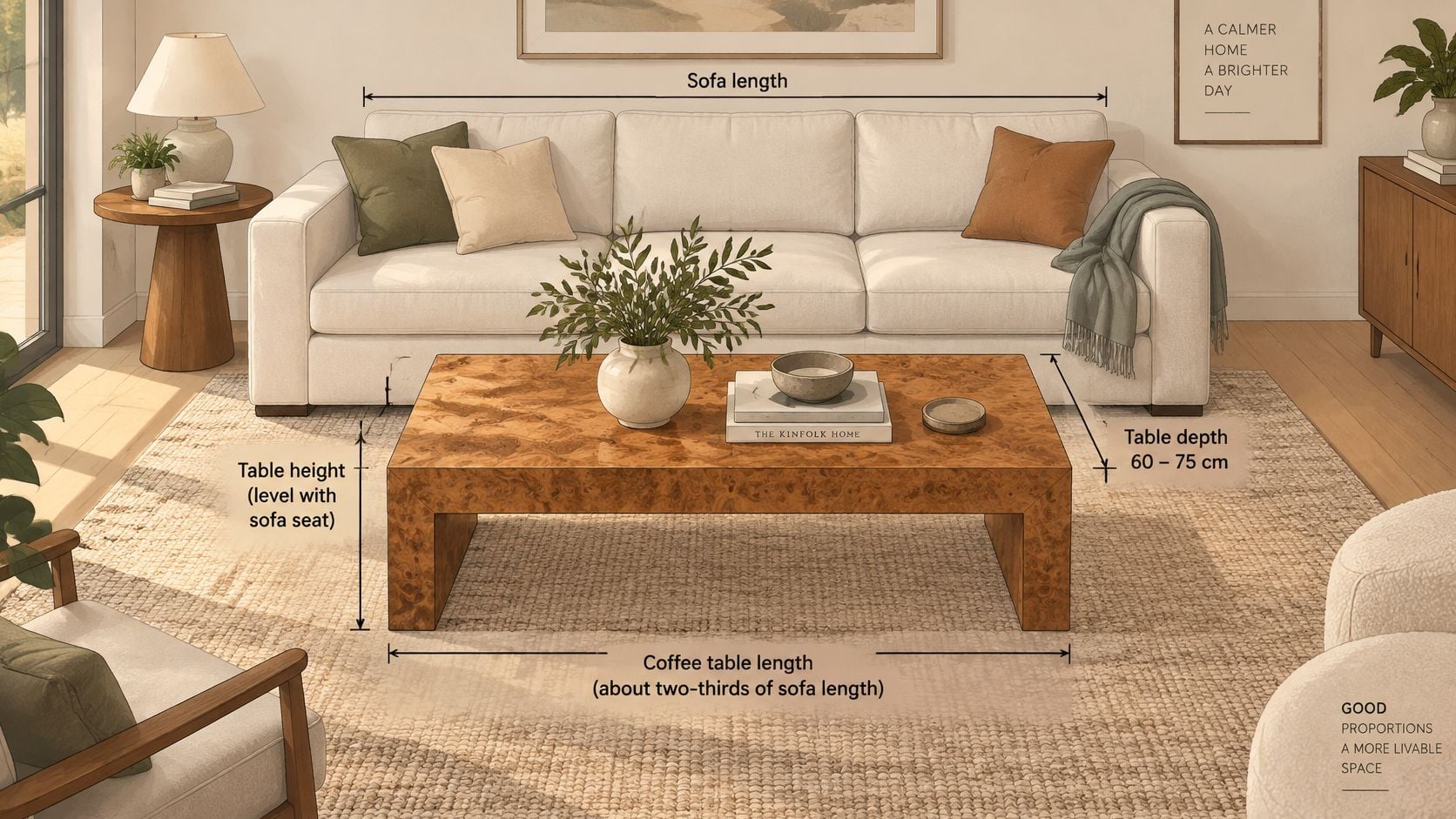
Three things drive what you see. Figure density decides how busy the surface feels, and a tight swirl pattern often reads calmer across a room than a sparse one with big open fields. Colour contrast between darker heartwood and lighter outer wood decides whether the top looks dramatic or quiet. The small voids and knots, those tiny holes and eyes that look like pinpricks, decide whether the piece reads as wild or refined.
Then the finish changes everything. An oil finish keeps the grain warm and matte, close to raw timber. Lacquer adds depth and a soft reflection that pulls the figure forward. Clear epoxy makes the surface glassy and magnifies every pattern, which is spectacular in a bright room and a fingerprint magnet everywhere.
Designer's Insight: Pair a bold burl top with a neutral hand-knotted wool rug to balance the room's energy, so the grain becomes the focal point rather than competing with everything around it.
Light matters as much as finish. A burl top under warm bulbs deepens toward amber, while the same top in daylight from a west window flattens and cools. That shift isn't a defect, it's the material responding to the room, and it's why a photograph can never settle the question.
Judge a sample in person. Look at it from sofa height rather than standing over it, hold it under a lamp and then near the window, and decide in advance whether voids are a feature you want or a flaw you'd rather avoid. The rule of thumb holds across every species: the more movement in the grain, the quieter the surrounding textiles and walls should be.
Sizing and Placing a Burl Table in Your Room
Most burl tables fail on size, not looks. A slab that photographs beautifully can crowd a walking path or float in a room that needs more weight, so settle the dimensions before you fall for a figure.
| Seating length | Table length | Table depth | Table height |
|---|---|---|---|
| 180 cm (two-seat sofa) | 120 cm | 60 cm | 40 cm |
| 210 cm (three-seat sofa) | 140 cm | 70 cm | 43 cm |
| 240 cm (large sofa) | 160 cm | 75 cm | 45 cm |
| 300 cm (sectional) | 200 cm | 75 cm | 46 cm |
Table length tracks roughly two-thirds of sofa length. Depth settles between 60 and 75 cm, and the top sits level with or slightly below the sofa seat, around 40 to 46 cm. Then check the walk-around: leave 35 to 45 cm between the sofa edge and the table so a guest can set down a glass or reach a plate without stretching. Anything tighter looks generous on a floor plan and feels mean in real life.
Working through a real room
Take a 210 cm sofa in a room 4 by 5 metres. A 120 to 140 cm burl table fits with room to spare, and the rug underneath should run about 2.4 by 3.4 metres so the front legs of the sofa and chairs rest on it rather than hovering at the edge.
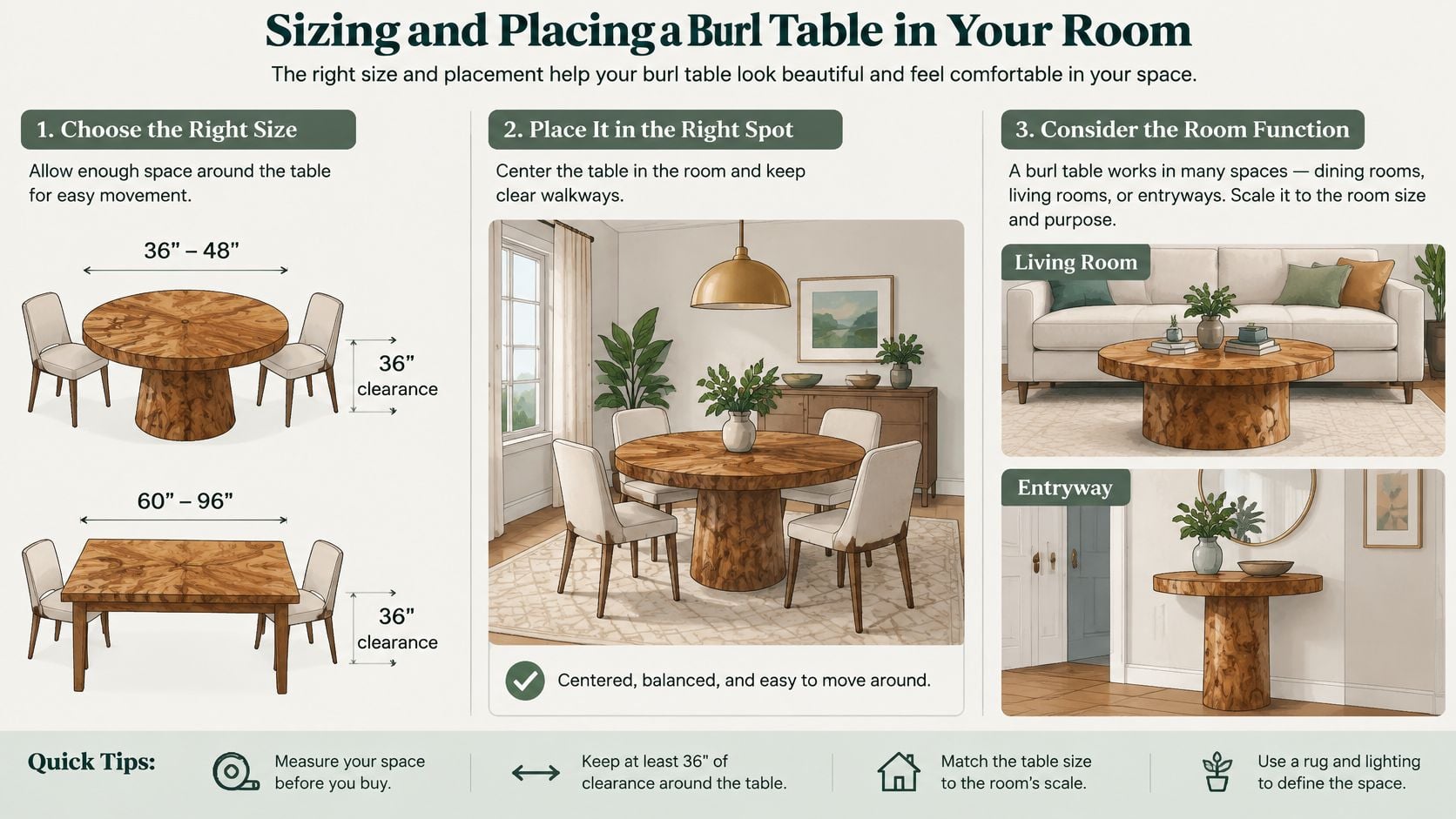
That number isn't arbitrary. Front legs on the rug anchor the seating group as one composition instead of a set of islands. The coffee table size guide walks through the same logic for narrower rooms and corner arrangements.
When the room is small
- Choose a round or oval top. Curves keep the walkway open at the corners, which matters more than surface area in a narrow room.
- Lighten the base. A dark, heavy grain balanced on a pale or slim base keeps the mass from dominating.
- Give a big slab breathing room. A large piece needs clear wall or a single art piece nearby, otherwise the room reads as crowded even when the floor is empty.
The rug is the part buyers underestimate. Treat it as art for your floor and the foundation of the room, the surface the table is composed against rather than an afterthought under it. Visit the Rug Market to find your room's foundation.
Materials and Construction Behind the Top
Two tables can look identical in a photograph and behave completely differently after a year in a heated room. The difference lives under the surface and in the base.
| Construction | Appearance | Durability | What to ask the seller |
|---|---|---|---|
| Solid burl slab | Figure runs through the full thickness | Heavy; can move with humidity | Drying method and any resin fills |
| Burl veneer on engineered core | Burl face over plywood or MDF | Stable; core edges can show if banding is thin | Core material and composite-wood compliance statement |
| Resin-stabilized slab | Voids and cracks filled with clear epoxy | Hard, sealed surface; check heat tolerance | Resin type and heat tolerance rating |
| Burl top on steel or iron base | Dark metal contrast under natural wood | Base is sturdy; top depends on how it is built | Base finish and how the top attaches |
A solid slab carries the figure through its full thickness, which means it can be sanded and refinished years later. It's also heavy, and it moves as indoor humidity shifts, which is normal behaviour rather than a fault. Two people to lift it, and a woodworker's number saved in your phone.
Veneer over an engineered core is how most dramatic burl reaches a living room at a sane price. The face looks flawless, and it stays flat across seasons. The tell is the edge: thin banding shows the core at a glance, and a veneered top can only be refinished once or twice before the face wears through.
A resin-stabilized slab turns cracks and voids into a feature and gives you a sealed, wipeable surface. The trade-off is heat. Some epoxies soften under a hot mug, so a trivet stops being optional.
A burl top on a steel or iron base gives the dark metal contrast that makes natural wood read warmer. The base is rarely the weak point. Ask how the top attaches, because a slab bolted rigidly to metal can crack as the wood expands while the steel doesn't.
What the base and joinery add
Base materials set the room's register: solid hardwood frames suit traditional and transitional rooms, matte black cast iron or steel leans modern, and a stone pedestal adds weight plus a sculptural note. Joinery decides how long any of it holds together, and the wood joinery techniques guide explains the difference between a joint that allows wood to move and one that fights it.
Three checks work in any showroom. Knock on the edge and listen for a hollow ring that suggests a thin core. Follow the grain across every joint and look for matched figure rather than an obvious seam. Ask for the drying method and, if any engineered panel is involved, the compliance statement in writing.
Practical rule: the top decides the look, while the core and the base decide whether the table is still level in ten years.
The indoor-air question
Ask what's under the burl. Boxes, drawer runners and support panels are often plywood, MDF or particleboard, and California's composite-wood rule treats all three as regulated in finished furniture, with emission limits set at 0.05 ppm for hardwood plywood, 0.11 ppm for MDF, 0.13 ppm for thin MDF and 0.09 ppm for particleboard (California Air Resources Board consumer FAQ). Sealed rooms amplify whatever comes off those panels.
Finishes count too. A Sacramento green-code summary of VOC and formaldehyde limits names furniture adhesives, paints, lacquers, coatings and composite wood as potential formaldehyde sources, and recommends looking for CARB Phase 2 or TSCA Title VI compliance labelling.
Caring for Burl Wood Through Daily Life
Burl asks for less than people expect, but it does ask for consistency. Keep indoor humidity roughly between 35 and 55 percent, because dry winter air is what opens small cracks in a slab that was stable all summer.
- Control the light. Strong direct sun fades pale maple burl and darkens oil finishes unevenly, so rotate decor and close blinds on the west side in late afternoon.
- Use coasters and felt pads. Rings and scratches come from repeated contact, not from one accident.
- Wipe spills immediately. A damp cloth followed by a dry one handles almost everything.
- Skip silicone polishes and harsh cleaners. They cloud oil and lacquer finishes over time, and the haze is hard to reverse.
On a resin top, set a trivet under hot mugs and heavy candles. Heat softens some epoxies, and a pale bloom in the surface doesn't buff out. For a deeper clean, use a wood cleaner approved by the maker rather than a general household spray.
Refreshing an oil-finished top is a twice-a-year job: a thin coat worked in, left to sit, then buffed dry. Deep scratches belong with a professional, because sanding through the figure to chase one mark costs more than the repair. The guide to protecting wood furniture from scratches and stains covers the products worth keeping on hand.
Watch for three signals that a table needs attention: dull patches where the finish has worn, pale rings from a wet glass, or a tacky feel that means a finish hasn't cured or has broken down.
Sourcing, Compliance and Choosing Your Table
A burl table can look responsibly sourced and still leave an important question unanswered: did the wood come from a fallen tree, or was a living tree cut to supply it? Ask about provenance before you choose a slab.
Burl is dormant bud tissue, which a tree can draw on to produce new growth. Removing it from a living tree can leave an open wound and expose the tree to disease, insects, fire and rot. California's conservation record shows the pressure on redwoods: roughly 95% of the original coast redwood forest had been cut since the 1840s, leaving about 120,000 acres of ancient forest, and more than 106 reported burl-theft incidents occurred in state and national parks between 2010 and 2014 (reporting on old-growth value).
Redwood burl has a documented history as furniture material. National Park Service records describe burl sections up to 8 feet across and note that tables and other furniture made from them commanded high prices (National Park Service history of the Sequoia and Kings Canyon area). A seller claiming California redwood burl should be able to provide documentation of its origin.
Reclaimed wood can reduce the need to harvest a living tree, but the whole table matters. Extensive epoxy filling, lengthy kiln drying, long-distance freight and a slab that cracks in transit all affect the material's footprint and useful life. For a broader look at the materials and sourcing questions to consider, see this guide to sustainable furniture materials.
One checklist for the seller
- Species: Is it stated plainly and consistent with the figure?
- Geographic origin: Can the seller name a region?
- Tree condition: Did the burl come from a dead, fallen or living tree?
- Harvest or recovery documentation: Can the seller provide it in writing?
- Drying method: Was it air-dried or kiln-dried, and for how long?
- Resin-filled voids: Are they disclosed?
- Composite-wood compliance: If the base or underside contains MDF, plywood or particleboard, can the seller provide the relevant compliance information before delivery to Southern Ontario?
Clear answers help you judge whether the table's history and construction suit your priorities. If some details remain unknown, factor that uncertainty into your decision rather than relying on the grain alone.
Joe Critelli is the Owner of Critelli Furniture, which offers in-home design services and custom furniture orders suited to customers' needs. Its White Glove Delivery service can help carry a heavy table from delivery to placement in your home.
A burl table is a room decision as much as a wood choice. Check the documented origin, the substrate beneath the top and the dimensions against your space before committing. At Critelli Furniture, in-home design services can help you consider how the table will fit your room. Visit Critelli Furniture to explore your options.