

Luxury Recliner Armchair: How to Choose One That Lasts


A familiar evening prompts the search. The reading chair has started to sag, the lower back aches after an hour, and standing up takes more effort than it should. Replacing it with a luxury recliner armchair sounds simple until showroom models blur together, each claiming deeper cushioning, finer leather, and more motors than the last.
A calmer method works better. Judge the hidden construction first, then the mechanism and body fit, then ease of rising, room placement, customisation, and delivery access. That order protects comfort on the first evening and years later.
What Makes a Recliner Armchair Truly Luxurious
The short answer is straightforward. A luxury recliner is defined by the parts a buyer cannot see, not by surface softness or leather alone. Frame strength, seat suspension, upholstery quality, and mechanism control determine whether the chair stays supportive or gradually loosens, creaks, and loses its shape.
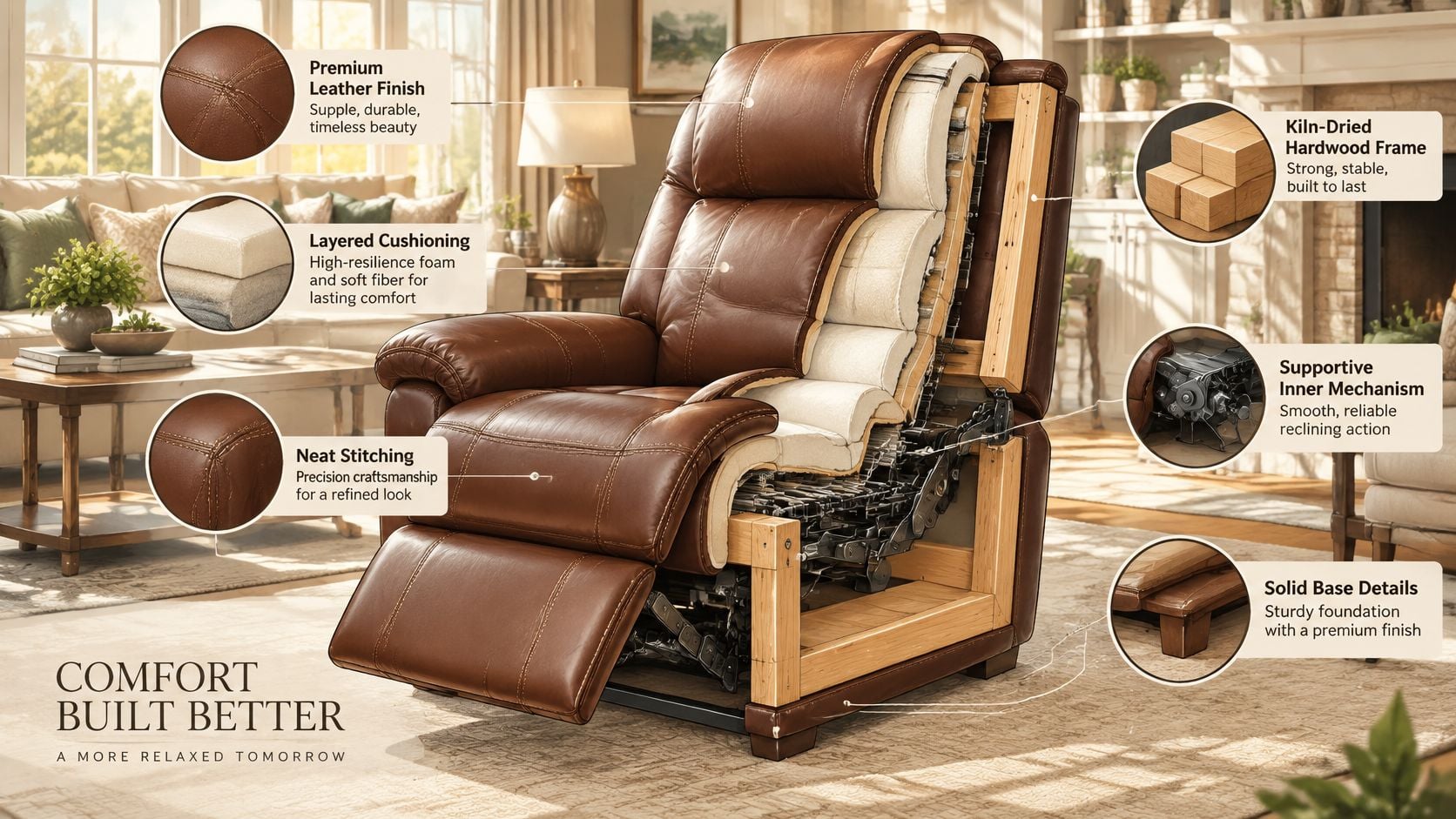
The Structure Under the Upholstery
A frame made from kiln-dried hardwood or strong engineered plywood resists warping and keeps the joints square through repeated reclining. Under the cushion, sinuous springs or pocketed coils spread weight instead of letting one area sink. Deep, resilient foam over that suspension should recover promptly after pressure is released.
| Component | What to look for | Why it matters |
|---|---|---|
| Frame | Kiln-dried hardwood or engineered plywood | Stays square and quiet through years of reclining |
| Seat suspension | Sinuous springs or pocketed coils under deep foam | Keeps support even after long daily use |
| Upholstery | Full-grain or aniline leather, or tightly woven performance fabric | Resists wear and develops patina rather than cracking |
| Mechanism | Torque-rated motor or manual linkage with smooth, even travel | Reclines without jolts or strain on the frame |
| Finish and stitching | Even seams, matched grain and hand-finished edges | Shows the craft that defines heirloom quality |
Full-grain leather earns its place because the natural surface remains largely intact, allowing the material to soften and develop character. Aniline finishes show more variation and need thoughtful care, while tightly woven performance fabric may suit a busier household. Neither choice compensates for weak joinery underneath.
A Simple Showroom Check
Three questions reveal more than a feature list. Does the frame feel solid when the chair is gently rocked from the arms? Does the seat recover its shape after firm hand pressure? Does the recline begin, pause, and return without a jolt or uneven pull?
Heirloom quality is not a plush first impression. It's the same balanced support, quiet motion, and tailored fit after years of ordinary evenings.
Those standards reflect the timeless craftsmanship behind a curated selection of luxury furniture in Niagara, where construction is evaluated before colour or styling. Buyers comparing the broader room can also review guidance on best quality living room furniture before narrowing the shortlist. A design-forward recliner should look composed, but its enduring luxury comes from disciplined structure.
Choosing a Recline Mechanism and Checking Fit
Choose the mechanism around the daily routine, then choose upholstery. A chair used for long reading sessions needs stable intermediate positions. A television chair may need a supportive headrest at a deeper recline, while a conversation chair should also feel balanced upright.
Manual, Power, Lift, Swivel, and Glider Options
- Manual recline: A lever, handle, or body-weight system changes the angle without a nearby outlet. It suits quiet rooms and simpler maintenance, but adjustment takes more physical effort and positions may be less precise.
- Power recline: A motor and switch or remote allow small, controlled changes to the back, footrest, head, or lumbar area. It needs outlet access and tidy cord routing so the cable is not pinched or left across a walkway.
- Power lift: The base rises and tilts to reduce effort when standing. It suits limited mobility, but the chair is often heavier and needs careful clearance.
- Swivel or glider base: Rotation or gentle forward motion helps in an open-plan room where the sitter turns toward conversation. Surrounding furniture must leave room for the base and reclined back.
A detailed comparison of power recliner and manual recliner options can clarify the tradeoffs before measurements begin. Motor count alone doesn't prove comfort. Smooth travel and support at every stopping point matter more.
Fit the Chair to the Body
Record the principal user's popliteal height, hip width, and seated elbow height. Compare those measurements with the chair's seat height, seat depth, arm height, and fully reclined footprint. The Canadian Centre for Occupational Health and Safety chair guidance recommends a seat width of at least 45 cm, approximately 5 cm of clearance between the seat edge and the calves, and firm lumbar support without pressure points.
Posture should also be able to change. The Canadian Centre for Occupational Health and Safety sitting guidance cites alternating among sitting, reclining, forward-tilting, and semi-standing postures rather than remaining in one position for prolonged periods. It also gives the useful benchmarks of elbows at roughly 90 to 120 degrees, a trunk angle of about 110 degrees, and approximately 5 degrees of seat tilt when appropriate.
| Measure | Target | How to check |
|---|---|---|
| Seat width | At least 45 cm | Sit fully back and confirm the hips have room to shift |
| Seat-edge to calf clearance | About 5 cm | Sit fully back with both feet supported |
| Feet supported | Flat on the floor or on a footrest | Adjust seat height or add a footrest |
| Elbow angle at rest | 90 to 120 degrees | Rest forearms on the armrests in a neutral setting |
| Trunk recline in reading position | About 110 degrees | Test in intermediate recline, not only full recline |
| Seat tilt | About 5 degrees when appropriate | Check that the pelvis does not slide forward |
| Wall and walkway clearance when fully reclined | Walkway of at least 90 cm plus full recline room | Measure from the back of the chair to the nearest wall and walkway |
The Three-Position Test
Sit upright with the back fully against the backrest. Then move to an intermediate reading position and finally to full recline. The lumbar cushion should stay aligned with the natural lower-back curve, the headrest shouldn't push the chin forward, and the footrest should support the calves without forcing the knees straight.
Cause and effect is easy to miss. Excess seat depth prevents lumbar contact, excess height leaves feet hanging, and high armrests lift the shoulders. Controls must remain reachable while seated, because a technically adjustable chair fails if every change requires twisting or standing.
Designing for Aging in Place and Easy Rising
Softness can be misleading. A deep, low, very soft seat may feel indulgent during a brief showroom sit, yet make standing difficult later in the day. For a luxury recliner armchair expected to serve the same household for many years, ease of rising is a design criterion, not an afterthought.
The need is already widespread. A Statistics Canada health report states that approximately 19% of Canadians were aged 65 or older in 2022 and that home adaptations were used by 25.0% of people aged 65 to 79 and 51.9% of those aged 80 and older. Those figures explain why furniture choices increasingly sit within a broader plan for independent living.
Questions That Matter More Than Softness
- Safe rise: Can the user stand without pulling on the footrest or mechanism?
- Stable push-off: Do the arms stay firm when both hands apply downward pressure?
- Reliable footing: Do both feet land flat before weight shifts forward?
- Clear transfer space: Can the user move beside the chair without navigating a table, rug edge, or power cord?
Seat height must suit lower-leg length, while cushion firmness should provide a stable platform rather than a hammock effect. Armrests need enough width and structural strength for repeated push-off use. Families planning broader changes may also find practical context in resources about helping ageing parents stay independent at home, alongside advice from qualified health professionals where mobility is changing.
Test the complete sit, recline, return, and rise sequence at least three times. Fatigue on the third attempt is useful information.
A power lift model can remain visually elegant when its scale, upholstery, and placement are handled with care. That is universal design in practice, meaning a product usable by people of diverse ages and abilities. An ergonomic recliner chair guide provides a useful next reference when balancing support, appearance, and transfer effort.
Placing Your Recliner in a Styled Room
The best place for a recliner is where its full movement, the sitter's routines, and the room's layout work together. Before choosing a spot, measure the existing room and mark the chair's footprint in both upright and fully reclined positions. This makes it easier to check the relationship between the chair, nearby furniture, the rug, lighting, and power outlet.
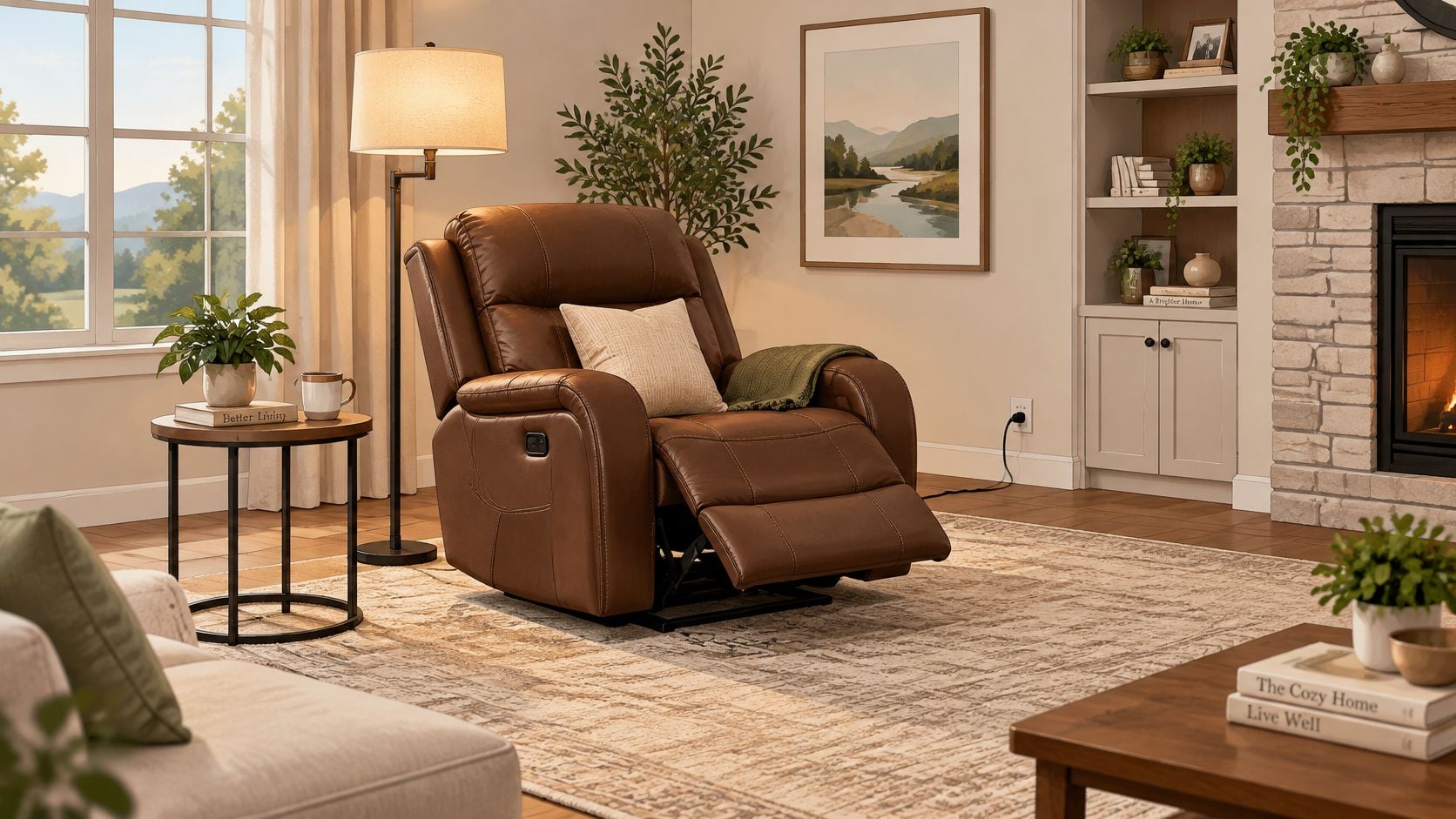
A recliner can anchor a room refresh without requiring a full layout change. Use residential space-planning guidance to consider how the chair will fit into the room's existing arrangement.
Clearance, Light, and Reach
After checking the earlier clearance guidance, focus on how the chair relates to nearby objects. Confirm that its back and footrest can move without striking a wall, shelf, radiator, or table. Keep the power cord routed safely behind the chair, clear of the base and the walking route.
Place a side table close enough for a book or drink without requiring the sitter to twist. Aim a reading lamp at the page from the side or slightly behind the shoulder, so light falls where it is needed rather than into the sitter's eyes. Check the television sightline from the preferred reclined position; raising the head can change the viewing angle.
The Rug as the Room Foundation
A rug gives a seating group a visual boundary and helps connect the chair to surrounding furniture. Choose a size that lets the recliner sit comfortably within the arrangement, then check that the pile does not impede a swivel or glider base. A neutral wool rug can balance the visual weight of a substantial leather chair.
Designer's Insight: Pairing a bold leather recliner with a quieter rug can help the chair stand out without making the whole room feel busy.
In a compact condo, a well-scaled recliner can serve as a focal point beside a slim table and floor lamp. In an open-plan room, angle it toward the conversation area. For a formal sitting room, consider how the chair's arms and back profile look from multiple viewpoints.
Customisation and Care That Protect the Investment
Bespoke choices should improve daily use, not just lengthen the order form. Upholstery, cushion firmness, arm height, exposed-base finish, and swivel function all change how the chair feels and how it sits in the room. Samples should be viewed beside existing flooring, drapery, and upholstery, in daylight and under evening lamps.
Choosing Materials With a Purpose
Aniline leather shows natural markings and develops a rich patina, but it's more open to marks and fading. Semi-aniline leather adds a light protective finish while keeping a softer appearance than heavily corrected leather. Performance fabric can be the calmer choice for pets, frequent guests, or a sunny family room.
Critelli Furniture offers custom furniture orders suited to customers' needs, allowing leather, fabric, finish, and configuration decisions to be coordinated. Bring measurements and room photographs to the selection appointment. A fabric code, leather grade, cushion specification, and finish name should be recorded with the purchase documents for future repairs.
A Manageable Care Rhythm
- Weekly attention: Vacuum fabric with an upholstery attachment and treat spills promptly with a cleaner suited to the fibre.
- Leather conditioning: Use a pH-balanced conditioner two to three times a year, following the product directions and testing it in an inconspicuous area first.
- Sun and heat control: Keep leather away from prolonged direct sun and close radiator heat, both of which can dry or fade the surface.
- Cushion care: Rotate or plump cushions where the design permits, so one sitting place doesn't carry all the wear.
- Mechanism checks: Inspect visible bolts and linkages, listen for new noises, and never force a recline past its stop.
Practical detail on how to care for leather furniture helps distinguish routine cleaning from problems that need professional attention. Monthly quick checks and a yearly professional inspection form a sensible rhythm. Custom furniture in Southern Ontario represents a long-term purchase, and consistent small acts of care preserve both comfort and appearance.
Warranty, Financing and Delivery Access
Purchase terms deserve the same care as upholstery samples. Ask for separate written warranty terms for the frame, mechanism, motor, and upholstery. Confirm whether service includes a home visit, which linkage or electrical parts are covered, and what conditions could limit a claim.
Put Every Term in Writing
Critelli Furniture offers financing, but each household still needs the deposit, payment schedule, interest or fees where applicable, and balance timing confirmed before signing. Align those dates with the expected production and delivery schedule. A clear written record prevents an enjoyable artisanal purchase from becoming an uncertain transaction.
Warranty language can be confusing because one headline term may apply only to the frame. Request a simple breakdown in writing. Ask who arranges repair, how damage is documented, and whether replacement parts can be matched to the original specification.
Measure the Entire Delivery Route
- Entry points: Measure exterior and interior door widths, including the frame and any door that cannot open fully.
- Vertical travel: Record staircase width, landing depth, ceiling height, and handrail projections.
- Condo access: Measure elevator width, depth, height, and the turn from the corridor into the suite.
- Room entry: Check tight hallway corners, archways, and the final turn into the intended room.
- Final position: Confirm the fully reclined footprint, outlet location, and clearance beside neighbouring furniture.
Older homes around Greater Niagara, Hamilton, and Toronto can have narrow stairs or compact landings. The delivery team needs route measurements before arrival, along with notes about parking, elevator booking, and protected flooring. Ask whether the chair can be tilted safely or partly disassembled, and who reassembles and levels it.
A white-glove handover is smoother when access questions are settled in advance. Send photographs of difficult turns and the prepared placement sketch with the booking, then clear the route before the appointment.
Book a Consultation to Choose Your Recliner
A chair can feel comfortable in a showroom and still crowd a room or prove difficult to rise from at home. Bring your body measurements, room dimensions, delivery-route notes, and photographs of the intended setting to help narrow the options to chairs that suit both you and the space.
Three Practical Steps
Start by checking each option's seat height and depth, recline clearance, and ease of rising. Then try sitting upright, settling into a reading position, and reclining fully. Practise standing from each position. Before ordering, confirm the upholstery, mechanism, and intended placement.
Critelli Furniture offers In-Home Design, Custom Order, Style Guides, Design Advice, and Meet Your Designers. An in-home appointment lets you assess samples in the room's natural light and consider how the chair relates to its architecture and furnishings. Critelli also invites customers to a final presentation before their home is complete, where leather, fabric, and configuration are tuned to their style.
A recliner is part of a room's overall design, not an isolated purchase. A consultation can help connect the chair's proportions and finish to the surrounding furniture, while keeping body fit and ease of use at the centre of the choice.
Critelli Furniture offers White Glove Delivery. Review the service details when booking, alongside your access measurements and placement plans.
Explore the options at Critelli Furniture's King Street showroom, or book a design consultation to discuss a recliner suited to your home and daily routines. For a luxury recliner armchair chosen around body fit, room composition, and long-term ease of use, visit Critelli Furniture.