
Teak Dining Tables: An Heirloom Buyer’s Guide for 2026

A great dining table usually enters your life during a practical decision. You need more seating. You want something that fits the room. You’re tired of living around a temporary solution that never quite feels settled.
Then life gathers around it. School projects spread across the top. Holiday platters land with more enthusiasm than delicacy. Someone stays after dinner with a second cup of coffee and a conversation that matters. That’s why teak dining tables deserve a closer look indoors, especially in Southern Ontario homes where climate, craftsmanship, and long-term value all matter.
For many families across Greater Niagara, Hamilton, and Toronto, the right table isn’t a short-term furnishing. It’s a piece that should feel relevant today and still feel right after the room has been repainted, renovated, and lived in for years. That’s the lens I’d use as a designer, and it’s the lens a family business learns over generations.
The Heart of the Home A Table Built for Generations
A winter Sunday in Southern Ontario often tells you what a dining table is really for. Boots dry by the door. Coats are draped over chairs. Someone is finishing homework while another person sets out soup bowls, and by evening the same surface holds dessert plates and the kind of conversation that runs longer than expected.
That is why the right dining table is never just a room filler. It works hard, day after day, through changing seasons, shifting routines, and the small rituals that make a house feel settled. In a home with real family traffic, beauty matters, but steadiness matters just as much.

Why longevity matters more than trend
Styles change faster than family habits. The table stays.
A well-made teak dining table earns its place the way a good wool coat or a cast-iron pan does. It becomes more convincing with use, not less. You stop noticing it as a purchase and start relying on it as part of the home itself. That shift matters in Southern Ontario, where dry winter heat, humid summer air, and everyday use can expose the difference between furniture built for a few years and furniture built for decades.
Longevity also changes how you buy. Instead of asking whether a table suits this year’s paint colour or chair style, you begin asking better questions. Will it still feel right after a renovation? Will it suit the house when children are older, or when gatherings grow larger, or when it is passed to the next household in the family? Those are heirloom questions, and teak invites them.
A family business recognises family furniture
In a multi-generational furniture business, you see this pattern often. Families rarely remember the side table they bought in a hurry. They remember the dining table where birthdays were marked, hard decisions were discussed, and holiday traditions took shape.
That long view has guided Critelli since 1914 in St. Catharines and the surrounding region. The perspective is less about selling a single piece and more about helping families choose furniture that will still feel grounded years from now. You can see that thinking in Critelli’s approach to heritage-inspired home furnishings, where the focus stays on how a piece lives in a home over time.
Teak fits that philosophy especially well indoors. Many people first hear about teak through outdoor or marine settings, which is understandable. The material earned respect in demanding conditions, and the history behind selecting and caring for boat teak helps explain why. Indoors, that same strength reads differently. It feels calm, substantial, and refined rather than precious.
A dining table earns its place over time. The best ones look settled on day one and more convincing every year after.
For homeowners across Niagara, Hamilton, and the GTA, that is the enduring appeal of a teak dining table. It is not an impulse buy or a trend piece. It is an heirloom-minded choice for an indoor room that carries more of family life than almost any other space in the house.
The Enduring Allure of Artisanal Teak Wood
Teak’s reputation didn’t appear by accident. It comes from a combination of history, material structure, and real-world performance that few woods can match.
From Southeast Asia to premium interiors
Teak (Tectona grandis) originates in Indonesia and Myanmar. It became a status material after European colonizers established it as the mandated wood for Royal Navy ships by the 17th century, a role that helped define its long-standing reputation for strength and endurance. In Canada, that legacy carried into furniture, where teak accounted for 25 percent of high-end dining sales by 2000, as outlined in this history of teak wood furniture and its enduring status.
That shipbuilding history matters because it explains why teak still commands respect. Craftspeople trusted it where failure wasn’t an option. Centuries later, homeowners value it for similar reasons, even if the setting is a dining room rather than a deck or hull.
If you enjoy understanding teak through its maritime roots, this practical guide to selecting and caring for boat teak gives useful context for why the wood developed such a formidable reputation in demanding environments.
What makes teak different from other hardwoods
People often hear that teak contains natural oils, but they’re not always sure what that means in practical terms. It means the wood has built-in characteristics that help it manage moisture and resist decay more effectively than many alternatives.
A few qualities shape teak’s appeal:
- Natural oil content: Teak’s oils help the wood stand up to moisture exposure over time.
- Silica content: Silica contributes to teak’s toughness and resistance to wear.
- Dense grain: A close, substantial grain structure supports durability and a refined finish.
- Calm visual character: Teak tends to look rich without looking fussy, which is why it works in both pared-back and traditional rooms.
The result is a wood that feels grounded and composed. It doesn’t ask for attention through ornament. It earns attention through material integrity.
Why this matters in Southern Ontario homes
Indoor furniture in Southern Ontario has to cope with real seasonal shifts. Heating systems dry the air in winter. Summer can bring humidity, especially in homes near the lake or in older properties with uneven climate control. A wood that handles change gracefully makes daily ownership easier.
For clients comparing hardwoods, I often recommend learning the broader differences before falling in love with a finish alone. This guide to choosing the right hardwood for longevity and style is useful because it frames wood selection as both a design and performance decision.
Teak isn’t prized simply because it’s exotic. It’s prized because beauty and resilience arrive together in the same material.
That’s a rare combination. It’s also why teak dining tables continue to hold their place in design-forward interiors rather than being confined to outdoor settings.
Discerning Quality Teak Grades and Construction
A dining table can look beautiful on delivery day and still disappoint five winters later. In Southern Ontario, that difference often comes down to two things buyers do not always see at first glance: the grade of the teak and the way the table is built.
In our family business, we have seen this pattern for generations. A client falls in love with colour and shape first. That is natural. But the lasting value of an indoor teak table, especially one meant to become part of family life, begins much deeper in the board selection and joinery.
Why Grade A matters
Grade A teak is cut from the mature heartwood, where the grain, colour, and natural oil content are most consistent. For an indoor dining table, that consistency matters. It helps the top read as one intentional surface instead of a patchwork of boards with competing tones, and it gives the finished piece a steadier, more settled character over time.
Lower grades still have uses, but they do not usually belong at the centre of a home where a table is asked to serve daily meals, holiday gatherings, school projects, and years of movement through changing indoor conditions. If your goal is an heirloom piece rather than a short-term furnishing, Grade A is usually the standard to ask for first.
A helpful companion read is this article on Understanding teak quality, which explains why buyers who want a long-term piece tend to focus on Grade A from the outset.
Teak Grade Comparison
| Attribute | Grade A Teak | Grade B Teak | Grade C Teak |
|---|---|---|---|
| Source within the tree | Heartwood from mature sections | Inner material with lower oil content | Outer sections and less mature material |
| Colour and appearance | Rich, even tone with refined grain | More variation in tone | More inconsistent appearance |
| Oil content | Highest natural oil presence | Lower than Grade A | Lowest of the three |
| Strength | Typically chosen for premium dining tables because of its density and stability | Lower performance than Grade A | Not typically associated with heirloom indoor dining use |
| Long-term suitability | Best choice for heirloom quality teak dining tables | Better suited to less demanding uses | Generally not what a discerning buyer wants for a primary dining table |
Questions worth asking before you buy
You do not need to become a wood expert to judge quality well. A few direct questions will usually tell you whether a maker has built the table to last.
- What grade is the teak? A clear answer should come quickly.
- Is the table solid teak or a combination of materials? Both can have a place, but you should know exactly what you are buying.
- How is the base joined? Good joinery helps the table stay steady through years of daily use.
- How is seasonal wood movement accounted for? This matters in Ontario homes, where indoor air can shift noticeably between January heating and August humidity.
- What should I expect the top to look like as it ages indoors? An experienced maker should explain that plainly, without vague promises.
Joinery deserves real attention. The tabletop gets the compliments, but the structure underneath does the hard work. Mortise-and-tenon joints, well-fitted supports, and properly attached tops allow the wood to respond to seasonal changes without turning that movement into wobble, gaps, or stress on the frame. A well-built teak table feels calm and planted the moment you rest your hands on it.
Designer’s Insight
In a carefully assembled room, material quality is never incidental. Our designers favour top-grade woods because the room only feels cohesive if the foundation is sound. A beautiful finish cannot make up for weak construction.
For homeowners who want to shape those details more precisely, customized dining table options can help clarify how size, finish, board selection, and construction come together in a bespoke piece that suits both the home and the climate it lives in.
Curating Your Style A Table for Every Aesthetic
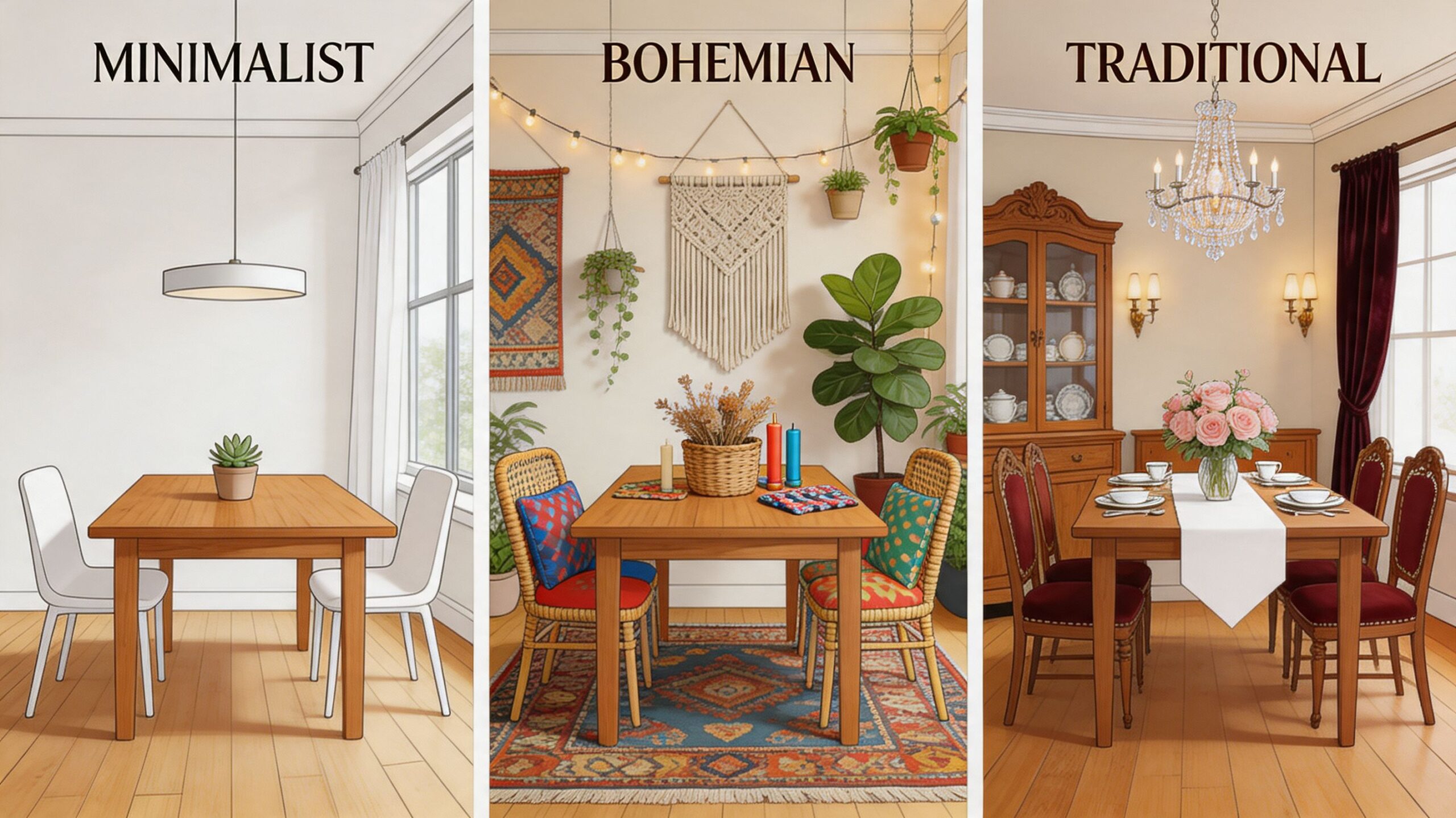
One of teak’s most appealing qualities is that it doesn’t force a single look. It can feel crisp and architectural in a modern setting, grounded and collected in a traditional home, or relaxed and textural in an eclectic room.
In modern rooms
A teak table with a clean profile works beautifully in contemporary interiors because the wood adds warmth without clutter. If your home has large windows, pale walls, and strong architectural lines, teak keeps the room from feeling cold. It introduces organic depth while preserving visual simplicity.
At a certain point, many people make a smart shift in thinking. They stop asking, “Which table do I like?” and start asking, “What role should the table play in the room?”
In traditional and transitional homes
In more classic interiors, teak can act as a stabilising element. It pairs comfortably with paneled walls, refined upholstery, antique brass, and layered textiles because its tone has presence without stiffness. The room feels collected rather than matched.
That’s especially useful in Southern Ontario homes that blend eras. Many properties across St. Catharines, Hamilton, and Toronto carry a mix of inherited architecture and newer renovations. Teak bridges those worlds with ease.
The complete room concept
A dining table should rarely be chosen in isolation. The better approach is a complete room concept, where the table, seating, rug, lighting, and art all support the same atmosphere. That’s where Interior design services St. Catharines become less of a luxury and more of a practical advantage.
A design studio helps answer the questions people often struggle with on their own:
- Should the chairs contrast or blend?
- Does the room need a statement pendant or something quieter?
- Will the wood tone fight with the floor?
- What keeps the room from feeling too heavy?
Designer’s Insight
Our designers suggest pairing the warm tones of a solid teak table with the rich texture of a Hancock & Moore leather chair and a neutral hand-knotted wool rug to create a layered room that feels sophisticated rather than overly styled.
In that setting, teak becomes more than a table surface. It becomes the anchor that allows the rest of the room to make sense.
Perfecting Placement Sizing for Your Space
You walk into the dining room with painter’s tape on the floor, trying to picture Sunday dinner, everyday breakfasts, and the path from the kitchen to the sideboard. That moment matters more than many people expect. A teak table may stay with your family for decades, so sizing it well is less about filling a room and more about giving the room a rhythm that still feels right years from now.
Start with the room, not the table
Seat count is often the first question. The better first question is, “How does the room need to work?”
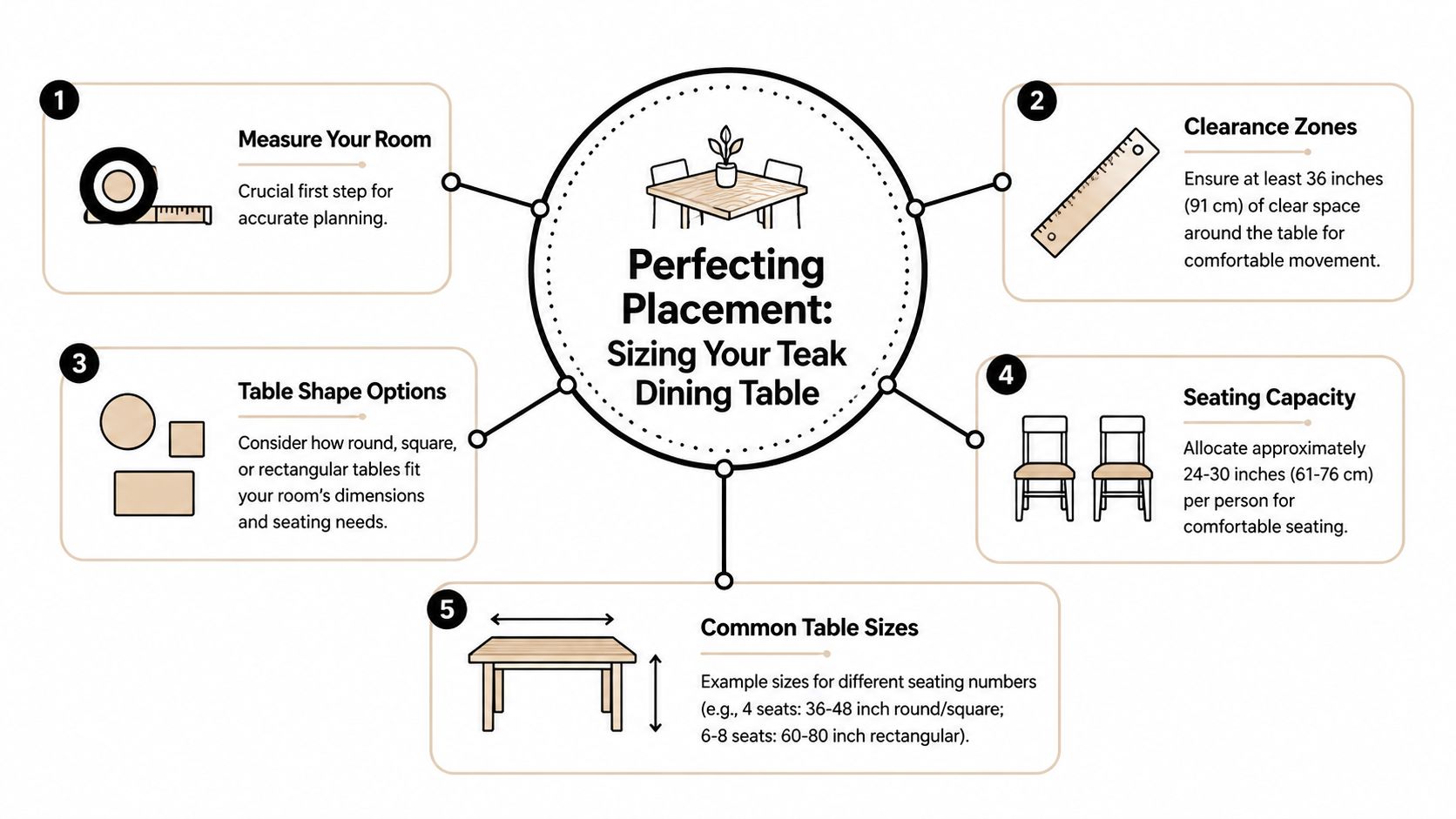
Measure the full width and length of the space, then mark the interruptions that affect daily use: door swings, radiators, vents, windows that reach low, and storage pieces that need clearance. A dining table never stands alone. It shares the room with chairs pulling back, people passing through, and serving pieces moving in and out.
That is why a taped floor outline helps. It gives you a life-size trial before any wood is ordered.
The infographic above offers useful planning guidelines for clearances and seating allowances. Those rules are especially helpful in Southern Ontario homes, where room sizes can vary widely from older, narrower dining rooms to newer open-concept layouts.
Match shape to architecture
Shape changes how a room behaves.
Rectangular teak dining tables usually suit long rooms and open plans because they carry the eye in the same direction as the architecture. Round tables calm square rooms and make conversation easier because every seat feels equally connected. Oval tops often solve an awkward middle case. They give you the capacity of a rectangle with softer circulation around the corners.
For families who entertain at holidays but want breathing room the rest of the year, dining tables with extension options make practical sense. You keep the table scaled for ordinary days, then expand it when the house is full.
Size for the life of the piece
As noted earlier, teak is chosen with a long horizon in mind. That changes the sizing question.
A shorter-term purchase can be sized only for the room you have today. An heirloom table deserves a broader view. Consider whether it may one day move into a renovated kitchen, a larger home, or a different generation’s dining room. I often tell clients to size for their true pattern of living, then test whether that choice will still feel balanced if the setting changes later.
Custom work helps here. In our family business, we have seen how a few inches in width, pedestal placement, or extension design can make the difference between a table that merely fits and one that continues to serve beautifully through life’s changes.
Let the rug and circulation finish the plan
The rug sets the boundary of the dining area, but it also affects comfort in a very practical way. Chairs should remain on the rug even when pulled out, or the whole arrangement starts to feel unsettled. The table, chairs, rug, and pendant need to read as one composition, not four separate decisions.
A strong plan usually considers these layers together:
- The table as anchor: It gives the room weight and purpose.
- The chairs in motion: They need space to slide back without crowding walls or casegoods.
- The rug as frame: It should support both the table and the chairs in use.
- The light above: It should be centred to the table’s final position, especially if extensions will be used.
If you are researching finishes while planning the room, outdoor advice can muddy the conversation. A teak oil guide for boat owners reflects a very different setting than an indoor heirloom dining table in Southern Ontario. Inside the home, placement and proportion usually matter far more at the buying stage than aggressive surface treatment.
Indoor Care for Year-Round Beauty in Ontario
Many people still think of teak as outdoor wood that can happen to come inside. I’d challenge that. Teak is one of the most capable indoor woods for homes with changing seasonal conditions, but it still deserves informed care.

Why teak performs well indoors here
In Southern Ontario’s variable climate, teak dining tables show a tangential shrinkage rate of only 5.2 percent, compared with oak at 8 to 10 percent, and teak’s oils reduce water absorption by 60 to 70 percent, according to this technical reference on teak stability and moisture performance. That’s the practical reason teak handles humid summers and dry winters with such poise.
Still, “stable” doesn’t mean “ignore it.” Good care preserves both appearance and confidence.
What owners often misunderstand
The biggest misunderstanding is colour change. Teak naturally evolves. Indoors, it can deepen, mellow, and develop a more settled character. Some owners love that. Others want to preserve the fresher honey tone they saw at purchase.
Neither preference is wrong. The mistake is assuming you should treat teak aggressively. Usually, the opposite is true. Gentle care is better than constant intervention.
Teak rewards restraint. Clean it consistently, protect it from avoidable extremes, and let the wood do what it’s designed to do.
For readers who want a broader primer on wood surface protection, this guide to protecting wood furniture from scratches and stains offers practical habits that apply well in dining spaces.
A sensible indoor care routine
Use a simple routine rather than a complicated product collection.
- For weekly care: Dust with a soft dry cloth. If needed, wipe with a slightly damp cloth and dry the surface afterward.
- After meals: Don’t leave spills to sit, especially wine, oil, or acidic foods.
- For seasonal awareness: Keep the table away from direct heat vents, fireplaces, and intense prolonged sun when possible.
- For surface protection: Use felt pads, placemats, and trivets where everyday wear is predictable.
If you’re curious about oiling methods from a technical perspective, especially how finish products are applied and controlled, this teak oil guide for boat owners is a useful reference. Boat care is a different context, but the discussion helps readers understand why moderation and proper application matter.
When to do less
Some owners over-clean because they’re nervous about damaging an expensive table. That instinct is understandable, but over-treatment can create more problems than neglect.
A few habits to avoid:
- Don’t use harsh household sprays: They can leave residue or interfere with the wood’s natural character.
- Don’t let moisture pool: Teak tolerates moisture well, but standing water still isn’t good practice.
- Don’t chase every tonal shift: Natural variation is part of the appeal of real wood.
- Don’t drag heavy objects across the top: Use protective layers and lift whenever possible.
Practical rule
If your care method feels aggressive, it’s probably too aggressive for indoor teak.
A teak table should become easier to live with as you understand it. That’s one of the pleasures of owning a material with this much integrity.
Your Investment in Timeless Craftsmanship
A teak dining table asks you to think differently about furniture. Not as a quick answer to a room in transition, but as a long-term expression of how you want to live.
The case for teak indoors rests on several qualities working together. It has a history that supports its reputation. It has material properties that suit Southern Ontario homes. It offers design flexibility across modern, traditional, and transitional interiors. And when chosen well, it carries the dignity of something made to remain.
That’s why the best teak dining tables feel personal without being fragile, and substantial without being heavy-handed. They suit everyday life, but they also rise to significant moments. Over the years, that balance becomes more valuable, not less.
The experience of acquiring a table of this calibre should also feel complete. White-glove delivery matters because a serious piece deserves more than a curbside handoff. Professional placement, careful assembly, and a room left orderly make the final stage feel consistent with the quality of the piece itself. For a design-led home, that transition from showroom to dining room isn’t a minor detail. It’s part of the standard.
Critelli Furniture offers that kind of process in Southern Ontario, along with access to dining collections, design consultation, and coordinated room planning for clients furnishing homes across Niagara, Hamilton, and Toronto.
If you’re choosing among teak dining tables now, my advice is simple. Buy for the life of the room, the life of the house, and the life of the family. Short-lived furniture becomes expensive in the end. Timeless craftsmanship usually proves itself calmly, year after year.
Experience the craftsmanship in person at Critelli Furniture. Visit the King Street Showroom to explore a curated selection of heirloom quality furnishings, or book your complimentary design consultation today if you’d like guidance on a complete room concept with bespoke dining, artisanal rugs, and white-glove delivery.