
Traditional Style Sofas: A Guide to Timeless Elegance

A familiar decision often starts this search. The room has good bones, the architecture has character, and the homeowner wants a sofa with presence, but not one that makes the house feel frozen in another era. In Southern Ontario, that tension shows up often in heritage homes, established neighbourhoods, and newer homes that need warmth rather than stark minimalism.
That's why traditional style sofas continue to matter. They carry history, comfort, and proportion in a way many trend-led pieces do not. They've also held their place in real homes, not just magazine spreads. Over 34% of Southern Ontario homeowners selected traditional furniture for their primary living spaces between 2020 and 2024, with especially strong preference in places such as St. Catharines and Hamilton, according to the verified market data provided for this topic.
Table of Contents
- The Enduring Allure of Traditional Design
- Defining the Essence of a Traditional Sofa
- Curating Your Space Selecting the Perfect Sofa
- Styling Your Sofa for Modern and Timeless Interiors
- Ensuring Longevity Maintenance and Artisanal Care
- Investing in Timeless Craftsmanship Your Buying Guide
The Enduring Allure of Traditional Design
Traditional design lasts because it answers a deeper need than fashion. A well-made traditional sofa doesn't just fill a wall. It gives a room rhythm, softness, and a sense of permanence. In homes with crown moulding, original millwork, brick façades, or older window casings, that kind of grounding matters.
Many homeowners aren't looking for “formal” in the old sense. They're looking for warmth with polish. They want comfort that feels established, not casual to the point of forgettable. That's the space traditional style sofas occupy best.
In Southern Ontario, that preference hasn't disappeared under modern trends. Over 34% of homeowners chose traditional furniture for their main living spaces between 2020 and 2024, with stronger demand in established communities such as St. Catharines and Hamilton. That consistency says something important. Traditional design still feels relevant when the architecture around it calls for substance and continuity.
Traditional works best when it respects the room's history without trying to recreate a period set.
There's also a reason this style remains strong in the luxury furniture Niagara market and among clients seeking interior design services St. Catharines homeowners tend to value. Traditional forms age gracefully. They welcome layered lighting, books, art, rugs, and collected objects. They don't need the room to be stripped back to make sense.
For anyone trying to understand where this style sits today, traditional design style guidance is helpful because it shows that “traditional” and “dated” are not the same thing. The distinction comes down to curation. A room feels old-fashioned when every element repeats the past without editing. It feels timeless when classic forms are balanced with present-day scale, lightness, and restraint.
What still resonates in today's homes
A traditional sofa usually brings three things that trend-led seating often misses:
- Visual steadiness: The silhouette has enough weight to anchor a room.
- Decorative flexibility: It can sit comfortably with antiques, newer lighting, or contemporary art.
- Emotional ease: It feels familiar in the best sense, especially in family homes meant for daily living.
That's why this category keeps its place. The appeal isn't nostalgia alone. It's the enduring comfort of furniture with soul.
Defining the Essence of a Traditional Sofa
A traditional sofa is easy to recognise once the eye knows what to look for. The line of the arm, the shape of the leg, the posture of the back, and the finish of the fabric all work together. These pieces aren't defined by ornament alone. They're defined by proportion and construction.
What makes the silhouette unmistakable
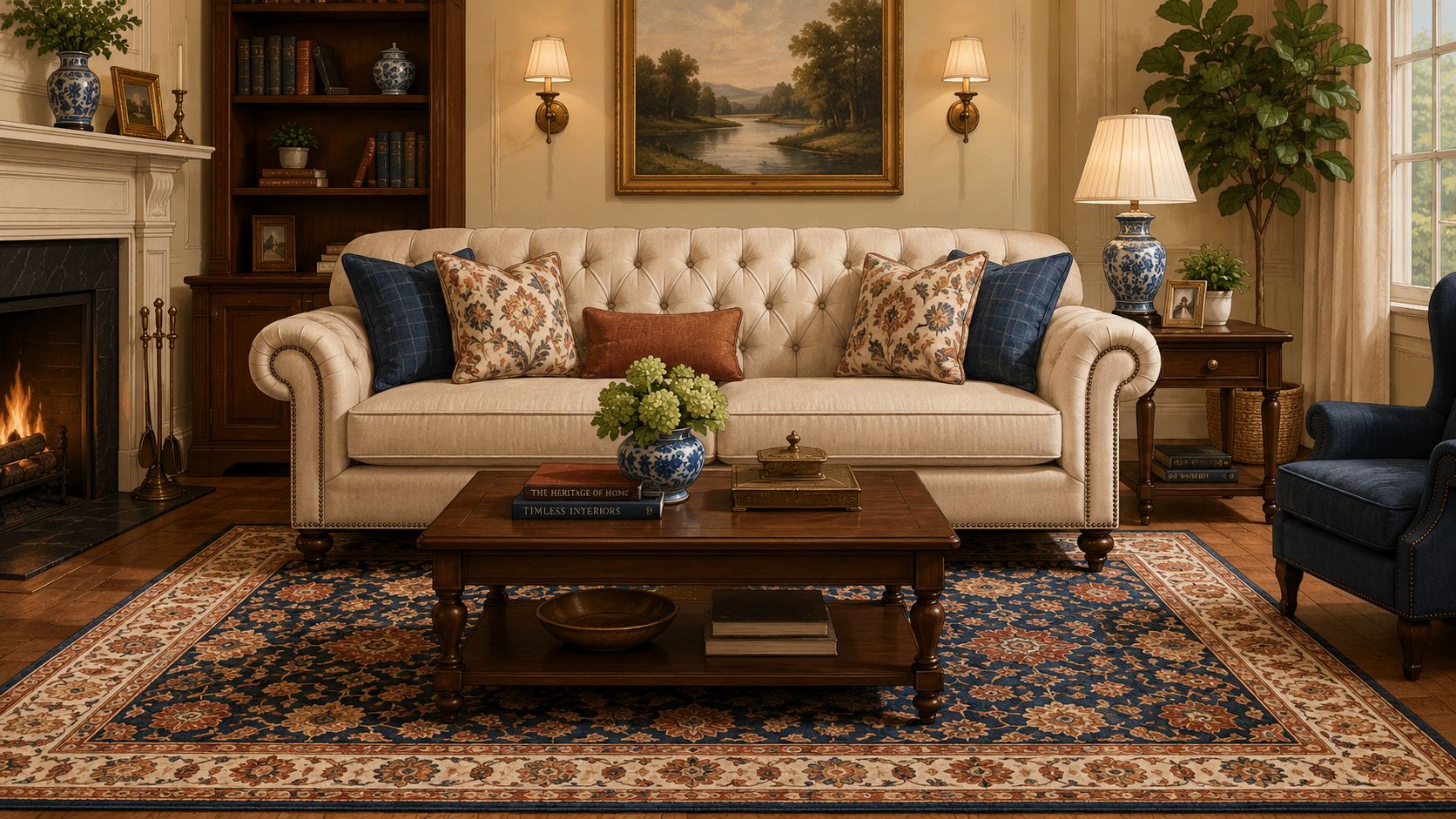
The most recognisable feature is often the rolled arm. In verified trade language, traditional style sofas are technically defined by elements like a 180-degree turned leg assembly and a minimum 45mm rolled arm curvature. That geometry gives the frame a sense of fullness and calm. It softens the profile, but it also creates visual authority.
Deep tufting, turned legs, cabriole influences, dark wood accents, and fine detailing all belong to the vocabulary. Some pieces lean more formal, others more relaxed, but the shared language is clear. Traditional sofas are meant to look complete from every angle. They don't rely on novelty.
Practical rule: If the arms, base, and back all feel visually interchangeable with a modern box sofa, it isn't truly traditional. It may be transitional, but it won't deliver the same architectural character.
Educated selection matters. A sofa can carry traditional cues without becoming heavy-handed. That's often the difference between a room that feels collected and one that feels themed.
For homeowners comparing finishes and performance, this upholstery materials guide helps clarify how fabric choice affects both appearance and day-to-day use.
Why materials matter as much as shape
The frame and upholstery decide whether a sofa merely looks traditional or earns the label of heirloom quality. Hand-finished wood details, richer fabrics, and dense supportive cushioning create the tactile depth people associate with timeless craftsmanship.
Verified product data for this topic notes that sofas from curated collections like Century often use a 12-pound density foam core under high-thread-count velvet or damask, reducing wear by up to 40% compared to standard blends. That matters because traditional seating asks more of its materials. Tufting pulls fabric inward. rolled arms require shape retention. Decorative details need structure behind them.
A strong traditional sofa usually includes several of these qualities:
- A substantial frame: It should feel stable, not hollow or light.
- A disciplined silhouette: Curves should look intentional, not overstuffed.
- Meticulous upholstery: Pattern matching, welting, tufting, and seam placement should be clean.
- Finishes with depth: Wood, metal accents, and fabric should read as artisanal, not flat.
The details that often separate strong choices from weak ones
Some traditional sofas fail because they overplay the style. Excessive ornament, shiny finishes, or busy fabrics can make a piece feel theatrical. The strongest examples are more controlled.
Look for balance in these areas:
Arm shape
A rolled arm should have grace, not bulk for its own sake.Leg design
Turned or carved legs should support the silhouette rather than distract from it.Fabric character
Velvet, damask, and richly woven textiles suit traditional forms because they hold colour and light well.Back profile
Tufting can be beautiful, but it should fit the room's scale.
A good traditional sofa doesn't just reference history. It translates it into a form that still feels design-forward in a current home.
Curating Your Space Selecting the Perfect Sofa
Choosing a sofa well has less to do with falling in love on a showroom floor and more to do with reading a room accurately. The right traditional sofa should complete a composition. It shouldn't arrive as an isolated statement piece that the rest of the room is forced to obey.
That's why strong interiors are built as a complete room concept. The sofa is the heart of the arrangement, but it has to speak to the rug, the coffee table, the lighting, the circulation path, and the architecture around it. In custom furniture Southern Ontario projects, this is usually where the best results are won or lost.
Start with the room, not the showroom
Scale comes first. A tall-backed, rolled-arm sofa can look magnificent in a principal living room with generous ceiling height, but cramped in a narrow den. On the other hand, a smaller Lawson-style silhouette may feel underdressed in a large formal space unless it's paired with substantial supporting pieces.
Before style names enter the conversation, evaluate three practical conditions:
- The wall length available: Leave breathing room at both ends.
- The traffic pattern: People should move around the sofa naturally, not squeeze past it.
- The room's visual weight: Fireplaces, large windows, and millwork all affect how much presence the sofa needs.
A sofa should answer the architecture. It shouldn't compete with it.
The same logic applies across the Greater Niagara, Hamilton, and Toronto markets. A gracious Niagara-on-the-Lake sitting room asks for different proportions than a compact Toronto living area, even when both owners want a traditional language.
For planning layouts before ordering, living room furniture arrangement guidance is useful because proportion mistakes are much harder to solve after delivery.
A guide to traditional sofa styles
| Style | Key Features | Best For |
|---|---|---|
| Chesterfield | Deep tufting, rolled arms, strong presence, tailored form | Formal rooms, libraries, statement seating |
| Camelback | Arched back profile, elegant line, refined silhouette | Heritage homes, symmetrical arrangements |
| Lawson | Softer profile, looser comfort, understated traditional character | Family rooms, casual traditional interiors |
This table matters because homeowners often use “traditional” as a single category when it includes very different personalities. A Chesterfield has gravity. A Lawson is gentler and easier to relax with. A Camelback offers more formality and visual lift.
Custom choices that change the result
Once the silhouette is right, the bespoke decisions begin. These are the details that prevent a traditional sofa from feeling generic or stale.
A few choices have the biggest influence:
- Fabric selection: A solid velvet reads differently from a woven pattern. Both can work, but the room should dictate which one leads.
- Wood finish: Darker finishes deepen the classic character. Medium tones often make the piece easier to place in mixed interiors.
- Seat feel: A firmer seat supports a more structured style. A softer seat changes the sofa's posture over time.
- Trim and detailing: Nail-head accents, skirt choices, and welt contrast can all shift the piece from reserved to decorative.
Not every room wants all of them. Restraint is often what keeps a traditional sofa current.
A curated selection should always solve for the life of the room, not just its first impression. That's especially true when buyers want luxury furniture Niagara homes can live with every day, rather than admire from a distance.
Styling Your Sofa for Modern and Timeless Interiors
The biggest misunderstanding around traditional style sofas is semantic. Many homeowners hear “traditional” and picture something stiff, dark, and overly formal. What they're after is depth, comfort, and visual heritage without a museum mood.
That gap is where styling matters most.
Traditional doesn't have to feel old-fashioned
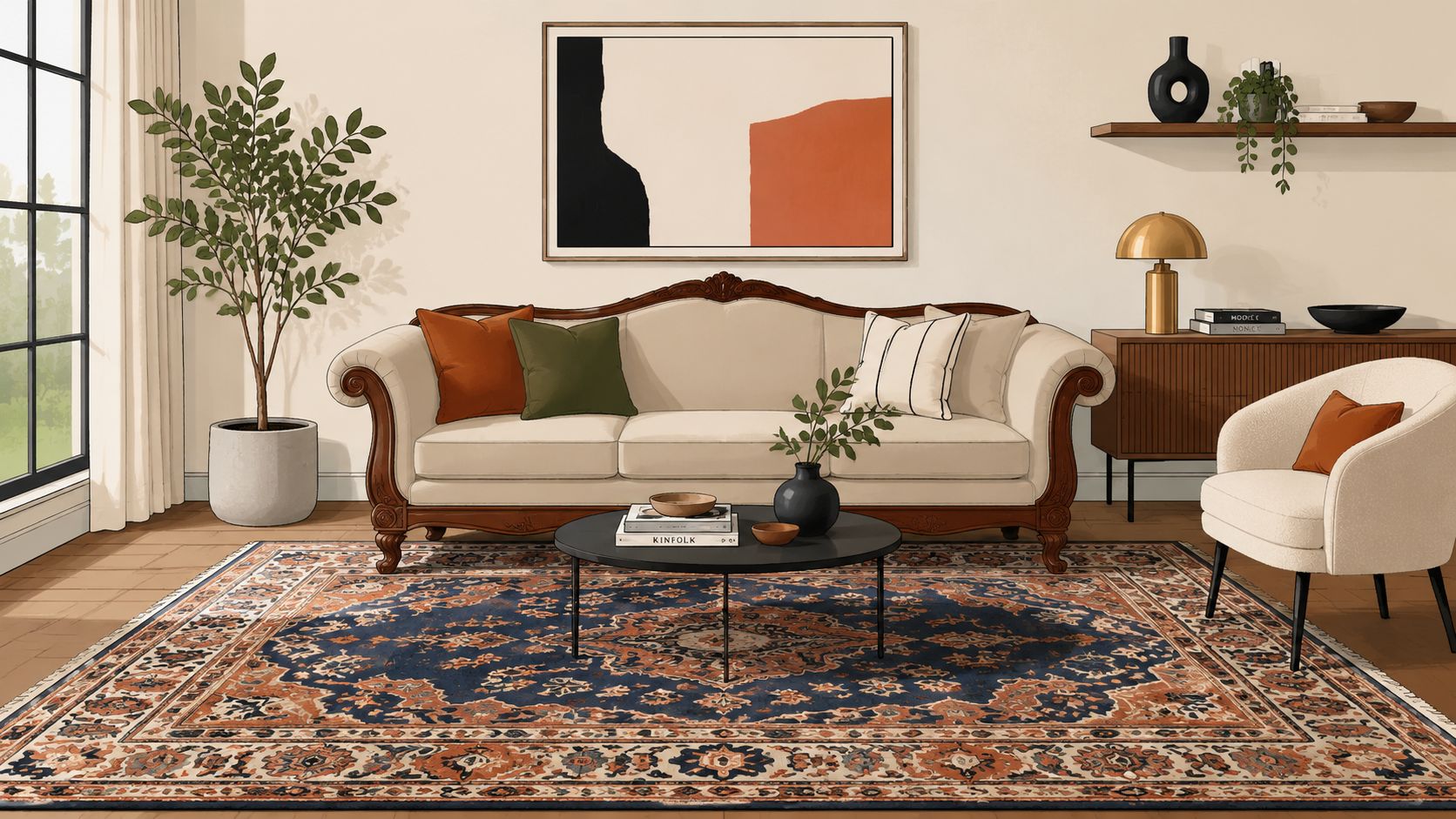
A room feels dated when every element speaks in the same historical voice. Matching dark wood, heavily patterned drapery, ornate lamps, and a formal sofa can flatten the space into costume. A room feels timeless when classic upholstery is edited by cleaner companions.
That usually means pairing the sofa with at least a few counterpoints:
- Contemporary lighting: Cleaner lines help lighten the composition.
- Simpler tables: The room doesn't need carved detail on every surface.
- Modern art or photography: This keeps the space alive in the present.
- Controlled accessories: Fewer, better objects create polish.
The goal isn't contrast for its own sake. It's balance. A traditional sofa should be the room's anchor, not its entire personality.
Build from the floor upward
One of the most effective ways to modernise a traditional sofa is to begin with the rug. Through the rug, the idea of Art for your Floor becomes more than a phrase. It's a design method. A rug sets the palette, softens the architecture, and gives the sofa a context that feels intentional.
According to the verified data for this topic, rooms with hand-knotted wool rugs have a 40% higher perceived value in aesthetic cohesion, validating the use of a rug as the room's foundation, as noted in this traditional sofa and rug discussion. That's why hand-knotted rugs Ontario clients choose often do more than finish a room. They organise it.
A practical approach looks like this:
- Choose the sofa silhouette first.
- Select a rug that broadens the palette rather than matching it exactly.
- Introduce one modern material such as glass, metal, or linen nearby.
- Keep the accent pillows edited, not crowded.
For homeowners working through palette questions, Set The Stage's color guide offers a useful look at how colour affects mood and perception in interiors. That kind of thinking helps traditional spaces feel composed rather than heavy.
A further reference point is transitional style interior design, especially for homeowners who want classic lines with a lighter, more current mix.
Designer's Insight
Pair a bold leather or tufted sofa with a quieter hand-knotted wool rug, then let contemporary lighting do the lifting overhead. The room keeps its heritage character, but it won't feel trapped by it.
The most successful rooms rarely lean entirely in one direction. They layer. A velvet sofa can sit beneath modern art. An antique table can live beside a pared-back lamp. Traditional style sofas thrive in that conversation because they bring enough substance to hold the room together.
That's what separates “old-fashioned” from design-forward. One imitates the past. The other edits it.
Ensuring Longevity Maintenance and Artisanal Care
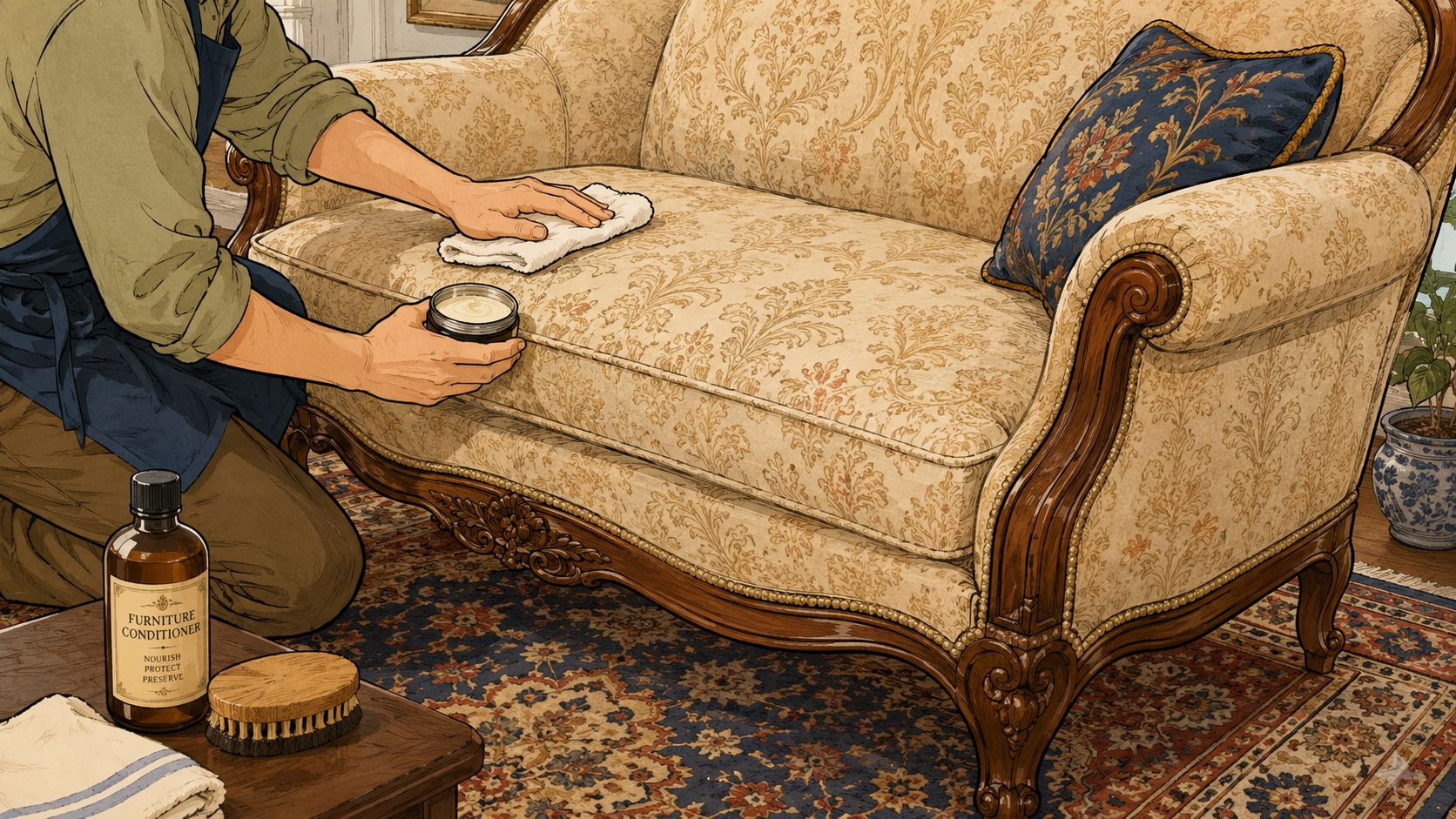
A traditional sofa earns its value over time. It should soften slightly, settle beautifully, and develop character without losing structure. That doesn't happen by accident. It comes from material quality, correct care, and a willingness to treat the piece as something worth maintaining.
What owners should expect over time
Fine upholstery isn't maintenance-free, especially in Southern Ontario. Seasonal humidity, indoor heating, sunlight, and everyday use all affect fabric, leather, and wood. That's not a flaw. It's part of living with natural materials.
The good news is that traditional sofas are often built for repair rather than disposal. Verified data for this topic shows that traditional sofas are repaired or reupholstered at a rate 2.3 times higher than modern counterparts, supporting a local artisan economy valued at approximately $18.7 million annually in Southern Ontario. That repair culture is one of the strongest arguments for choosing timeless craftsmanship in the first place.
A sofa that can be reupholstered has a second life built into it.
This matters in practical terms. When fabric ages, the frame may still be excellent. When cushions soften, they can often be renewed. When a finish picks up wear, it may gain patina rather than becoming unusable.
Care habits that protect heirloom quality
A few steady habits preserve both comfort and appearance:
- Rotate cushions regularly: This helps seating wear more evenly.
- Keep direct sun in check: Rich fabrics and wood finishes both benefit from protection.
- Treat spills quickly: Blot first, never scrub aggressively.
- Schedule professional care when needed: Delicate weaves and quality leather deserve proper treatment.
Wood trim and exposed legs deserve attention too. For households dealing with surface marks from cups or moisture, expert methods for wood water stain removal offer useful guidance on what to do, and what not to do, before damage becomes permanent.
Owners should also accept one truth that marketing often avoids. A more decorative sofa requires more attentive stewardship. Velvet, damask, tufting, and carved wood are beautiful because they're expressive materials and details. They aren't meant to be treated like disposable seating.
What works and what doesn't
What works is simple. Choose quality. Maintain it consistently. Repair rather than replace when the core piece deserves it.
What doesn't work is assuming “timeless” means invulnerable. A traditional sofa rewards care. That's part of its artisanal nature, and part of why it can remain in a home for years with dignity.
Investing in Timeless Craftsmanship Your Buying Guide
A traditional sofa is rarely an impulse purchase, nor should it be. The best ones ask for judgement. They need to feel right in the hand, correct in proportion, and honest in construction. Online images can introduce a piece, but they can't tell the whole story of comfort, finish, and scale.

What to evaluate before committing
At the buying stage, the most useful questions are practical ones.
- Does the sofa suit the architecture? A strong piece should belong to the room, not overpower it.
- Does the upholstery fit daily life? Formal beauty and real use have to coexist.
- Is the construction worthy of future care? A sofa should be worth reupholstering, not replacing.
- Can the retailer support a bespoke process? Customisation matters in rooms that need nuance.
This is especially true for buyers exploring custom furniture Southern Ontario options or seeking luxury furniture Niagara homeowners can integrate into full-room projects. Seeing brands such as Stickley, Hancock & Moore, Century, Stressless, and Magniflex in person brings clarity that spec sheets can't provide.
For those considering made-to-order seating, custom couches in Toronto is a useful starting point for understanding how customisation shapes comfort, scale, and finish.
The final step matters more than many buyers realise
Delivery is often treated as an afterthought. It shouldn't be. Verified data for this topic states that 95% of clients in the Greater Niagara and Hamilton markets rate a “smooth transition from showroom to home” as a top priority, and that expectation reinforces the role of white-glove service in the full ownership experience, as noted in this sofa style and delivery discussion.
White-glove delivery protects more than the furniture. It protects the design intent. Placement, inspection, handling, and room readiness all matter when a piece has real visual weight and artisanal detailing.
That's one reason century-old, family-run firms still hold trust in this category. A traditional sofa isn't only about purchase. It's about selection, guidance, preparation, and final placement. The full process should feel coherent from first consultation to last adjustment in the room.
For homeowners seeking a curated selection of heirloom quality traditional style sofas, bespoke design guidance, hand-knotted rugs Ontario clients can build a room around, and a white-glove experience rooted in a family-run legacy since 1914, Critelli Furniture offers a refined next step. Experience the craftsmanship in person at our King Street Showroom. Book your complimentary design consultation today. Visit the Rug Market to find your room's foundation.