
Recliner with Lumbar Support: An Expert Buying Guide

A great many readers arrive at the recliner category after a familiar evening. The back feels tired, the neck feels oddly tense, and the sofa that once seemed soft now feels vague and unsupportive. They aren't looking for a bulky medical chair. They're looking for a piece that belongs in a beautifully composed room and supports the body properly for years.
That's where the conversation needs more nuance. A well-made recliner with lumbar support is more than adding padding to the lower back. It's about preserving alignment through the full spine, from the pelvis to the headrest, while still honouring proportion, materials, and timeless craftsmanship. In a design-forward home, comfort and elegance should never be asked to compete.
Table of Contents
- The Foundation of Comfort Understanding Lumbar Support
- Key Ergonomic Features for Holistic Support
- How to Personally Evaluate a Recliner for a Perfect Fit
- Materials and Mechanisms That Define Heirloom Quality
- Integrating Your Recliner into a Cohesive Room Design
- The Critelli Advantage From Our Showroom to Your Home
The Foundation of Comfort Understanding Lumbar Support
A recliner either respects the body's structure or it asks the body to adapt. Most discomfort begins with that simple distinction.

Why the lower spine needs support
The lower spine isn't meant to sit flat. It has a natural inward curve, and that curve acts much like the arch of a bridge. When the arch is supported, weight travels cleanly through the structure. When the arch collapses, strain appears elsewhere.
That's why lumbar support matters so much in a recliner. An adjustable lumbar support system fills the natural 15–30° inward curve of the lower spine (L1–L5), helping prevent spinal flattening and reducing muscle strain by up to 50% when properly engaged, as noted in this ergonomic review of recliner back support.
A standard sofa often leaves a hollow space behind the lower back. At first, that may feel harmless. After an hour of reading or television, the body usually responds by slumping, tightening the hips, and pulling the shoulders forward.
Practical rule: If the lower back has to “search” for support, the chair isn't doing its job.
What proper lumbar support changes
Good lumbar support doesn't feel aggressive. It feels present. The back meets the chair fully, the pelvis settles into a more stable position, and the rest of the spine has a better chance of stacking naturally above it.
Three details help readers separate genuine support from generic softness:
- Continuous contact: The lumbar area should remain supported without leaving a gap when the chair changes position.
- Controlled pressure: Support should feel gently shaped, not like a hard lump pushing the body forward.
- Adjustability: The chair should adapt to the sitter, not the other way around.
Among design-led ergonomic options, Stressless recliners and seating are often considered when clients want a recliner with lumbar support that pairs refined form with body-conscious engineering.
For anyone who has assumed “soft” means “comfortable,” this is often the first important correction. A chair can feel plush in the first minute and poorly fitted by the tenth. Proper support usually feels calmer than dramatic. That quiet precision is what protects comfort over time.
Key Ergonomic Features for Holistic Support
Many buying guides stop at the lower back. That's an incomplete view of comfort.
The overlooked headrest-lumbar relationship
A recliner can support the lumbar region beautifully and still leave the sitter uncomfortable if the headrest is wrong. This is the blind spot many shoppers miss.
When a headrest pushes the chin downward, the neck loses its easy, neutral position. That strain doesn't stay in the neck. It can travel downward through the shoulders and back. A chiropractic-focused guide on recliner support notes that chiropractors emphasize full back-to-neck alignment, warning that chin-forward pressure from a poorly aligned headrest creates radiating strain. The same source states that 32% of CA-based back-pain patients report neck-to-lumbar discomfort escalation due to misaligned headrests, even with perfect lumbar support.
That single fact changes how a recliner should be judged. The question isn't only, “Does the lower back feel supported?” It's also, “Does the head stay comfortably balanced without being forced forward?”
A recliner should let the neck soften. If the chin drops, the body starts compensating immediately.
Mechanisms that support the whole body
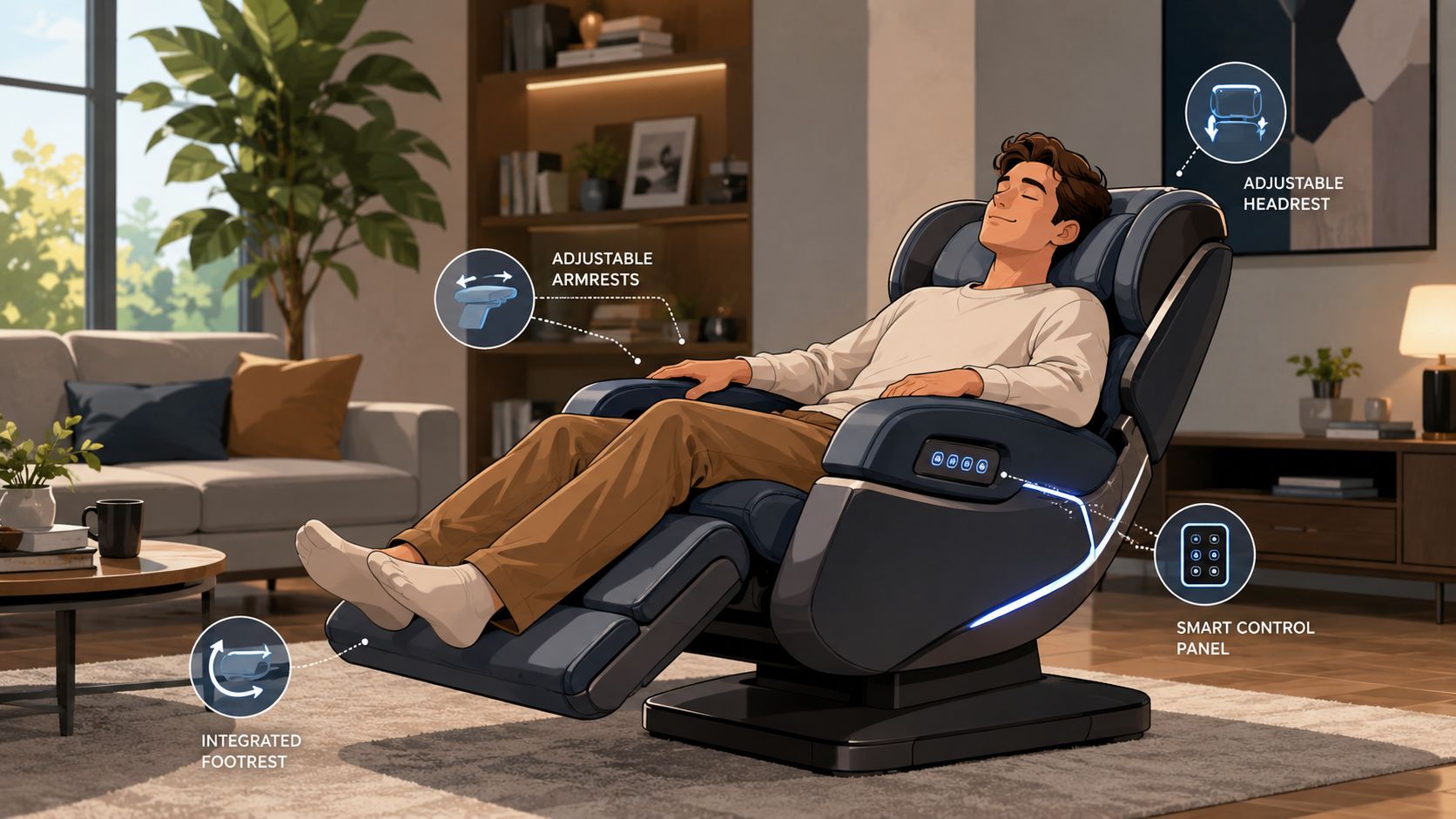
Support comes from a system of moving parts working together. The strongest ergonomic recliners tend to offer more than a basic back-and-footrest motion.
A shopper comparing models should pay attention to these categories:
- Dual-motor control: This allows more precise positioning of the body instead of tying every movement to a single action.
- Independent headrest articulation: Helpful for reading, television, and relaxed conversation, since the head doesn't stay in one fixed relationship to the backrest.
- Lumbar adjustment: This can appear as a manual control or powered adjustment in more advanced chairs.
- Thoughtful recline geometry: Slight recline often feels more natural than either bolt-upright sitting or lying too flat.
Some readers find it useful to compare layouts and feature groupings before visiting a showroom. A structured recliner comparison page can make those distinctions easier to spot.
A refined recliner with lumbar support should create one uninterrupted line of comfort. The seat supports the pelvis. The lumbar area fills the lower back. The upper back settles without collapse. The headrest meets the neck without forcing it. If any one of those links fails, the body notices, even if the failure is subtle.
How to Personally Evaluate a Recliner for a Perfect Fit
A showroom test should last longer than a polite sit-down. The right chair reveals itself when the body has time to settle.
A showroom fit test that reveals the truth
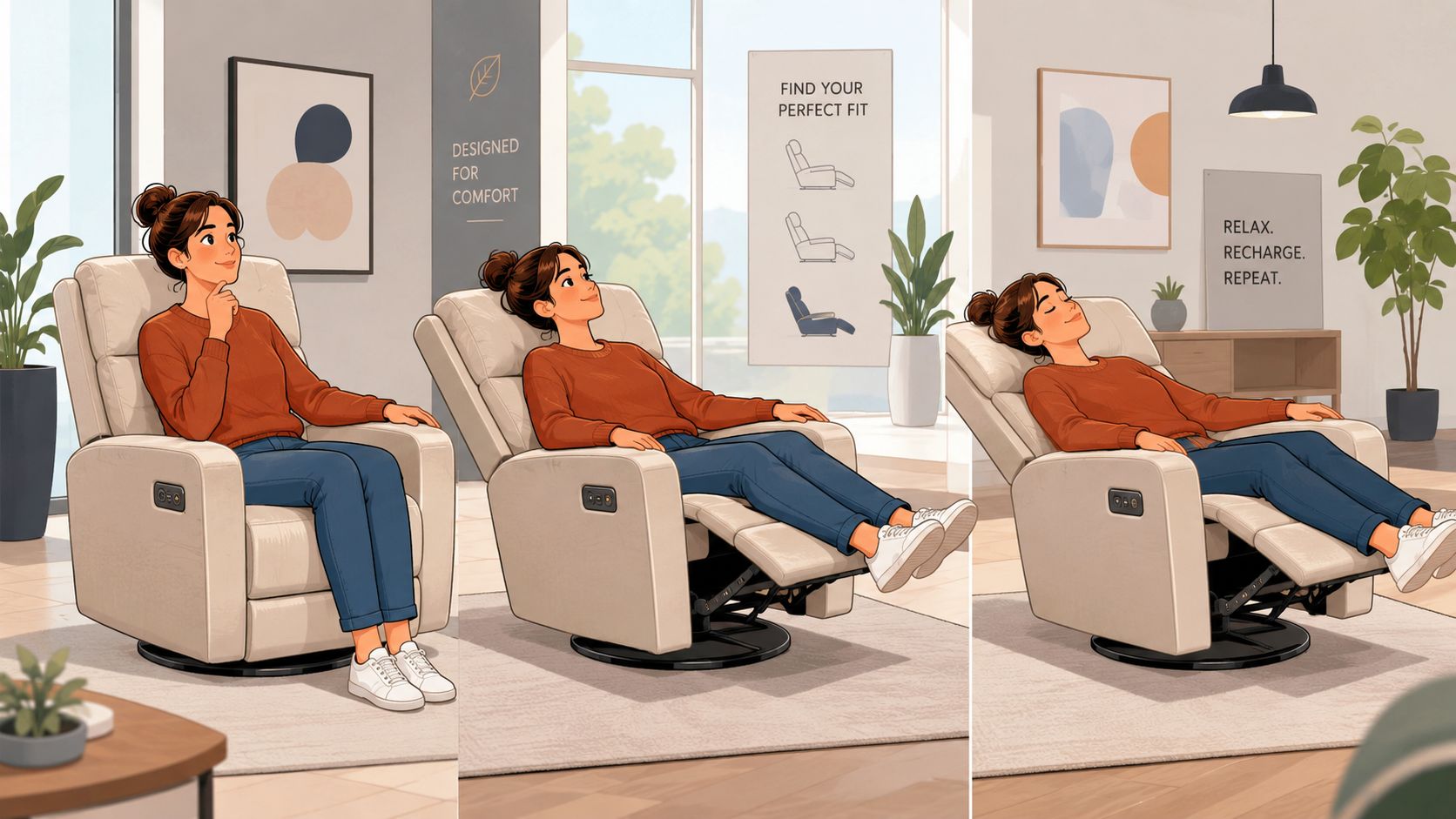
The first checkpoint is posture before the chair reclines at all. A proper fit starts in the seated position, not only in the fully relaxed one.
Guidance on therapeutic recliner design notes that physiotherapists recommend dual-motor recliner chairs for optimal alignment. The same source states that the armrest height must allow the shoulders to relax completely, while the overall width should create a snug, secure fit rather than the feeling of “swimming in a sea of cushions,” which is important for proper head and neck alignment.
A practical fitting routine in the showroom looks like this:
- Start with the feet. They should rest comfortably on the floor when seated upright.
- Check seat depth. There should be a small gap between the front edge of the seat and the back of the knees.
- Rest the arms naturally. If the shoulders lift or hunch to meet the armrests, the proportions are off.
- Notice the side-to-side fit. A chair that's too wide often feels plush at first and unstable later.
What to notice as the chair moves
A recliner shouldn't only fit at one angle. It should support the body through its full range of motion.
Watch for these signs while moving through several positions:
- Stable lumbar contact: The support should stay with the lower back rather than disappearing as the backrest lowers.
- Neck ease: The head should feel held, not tipped.
- No pressure points: The seat and back should cradle rather than pinch.
- Quiet control: The mechanism should feel deliberate, not abrupt.
The best test is time. Sit long enough for the body to stop being impressed and start being honest.
For readers planning a more considered purchase, complimentary interior design guidance can also help place fit, scale, upholstery, and room layout into one decision rather than treating them as separate problems.
Materials and Mechanisms That Define Heirloom Quality
Ergonomics may begin the conversation, but construction determines whether the chair still performs beautifully years from now. That's where heirloom quality becomes more than a marketing phrase.
What lasts beyond the showroom floor
A well-made recliner should age with dignity. In leather, that often means a surface that develops character rather than peeling or looking tired. In fabric, it means texture, resilience, and a hand that still feels inviting after regular use.
The same is true inside the chair. Quality reveals itself in the hidden places: a strong frame, a dependable motion system, precise tailoring, and cushioning that keeps its shape instead of collapsing into weak spots. An elegant room deserves materials that don't merely survive daily life, but mature within it.
For leather selections in lighter tones, maintenance matters. Homeowners who want practical care guidance may find this resource on white leather furniture cleaner useful, particularly when evaluating how a pale upholstery choice will live in a real household.
Why bespoke details matter
A reclining chair becomes more compelling when it's suited to the room rather than chosen in isolation. That may mean a warmer wood finish to echo case goods, a quieter leather to soften a formal interior, or a performance textile that balances elegance with daily practicality.
A design studio approach is especially valuable here because the chair's success depends on more than comfort alone. Scale, silhouette, seam placement, and upholstery all affect whether the piece feels integrated or intrusive.
One relevant example within the category is the Highland II Power Swivel Gliding Recliner with Power Headrest and Lumbar, available through Critelli Furniture. It includes both headrest and lumbar adjustment, which makes it a useful reference point for shoppers comparing how holistic support is built into a design-led recliner.
When craftsmanship, mechanism, and material all align, the result doesn't feel temporary. It feels settled, bespoke, and worthy of staying in the room for a very long time.
Integrating Your Recliner into a Cohesive Room Design
The old idea that a recliner must look purely functional no longer holds. In a well-composed interior, it can read as sculptural, inviting, and entirely at home among bespoke furnishings.

From functional seat to complete room concept
The strongest rooms don't treat seating as a standalone purchase. They build outward from a central mood, balancing proportion, texture, and colour so each piece supports the whole. That's why a recliner with lumbar support should be chosen as part of a complete room concept, not slotted into an empty corner.
In practice, the foundation often begins underfoot. Critelli's Rug Market presents one-of-a-kind hand-knotted artisanal rugs as “art for your floor,” giving a room its visual anchor and helping shape the palette around the seating arrangement. For homeowners exploring broader aesthetic references, this article on mid-century modern design inspiration can help clarify how lines, wood tones, and accent pieces work together.
A design-forward recliner might sit within a reading corner, opposite a sofa, or angled slightly toward a fireplace with a fitting side table beside it. The point isn't to hide the recliner. It's to integrate it so gracefully that comfort looks intentional.
Designer's Insight
| Designer's Insight | Why it works |
|---|---|
| Pair a refined leather recliner with a neutral hand-knotted wool rug. | The rug softens the visual weight of the chair and gives the seating area a grounded, artisanal base. |
| Use a slender floor lamp and compact drink table beside the recliner. | Smaller companions keep the arrangement elegant and prevent the chair from feeling oversized. |
| Repeat one material elsewhere in the room. | A leather tone, wood finish, or metal accent echoed nearby creates cohesion rather than visual isolation. |
Lifestyle imagery tells the story best. A recliner should be shown in a fully styled room, where texture, lighting, and surrounding pieces reveal its place in daily life.
The Critelli Advantage From Our Showroom to Your Home
A thoughtful recliner purchase combines three disciplines. It requires ergonomic intelligence, material discernment, and an eye for how the piece will live in the room over time. When any one of those is ignored, the result often feels compromised.
A heritage approach to comfort and design
That's where heritage matters. Critelli Furniture was founded in 1914 and has served St. Catharines and the Niagara region for over 110 years as a family-run business, according to this business background and service overview. That long view tends to shape a different standard. The emphasis shifts from quick turnover to curated selection, timeless craftsmanship, and choices that still feel right years later.
For homeowners searching for Luxury furniture Niagara, Interior design services St. Catharines, Custom furniture Southern Ontario, or Hand-knotted rugs Ontario, that perspective is especially valuable. A recliner isn't only a seating mechanism. It's part of the home's architecture of living.
The benefit of a design-led showroom is that clients can evaluate comfort, proportion, upholstery, and surrounding pieces in one setting. A chair can be considered alongside lighting, tables, cabinetry, and rugs so the final decision serves the whole room rather than solving only one problem.
A seamless finish at home
A carefully chosen piece still needs a careful arrival. The same business background notes that Critelli's White-Glove Delivery serves the Greater Niagara, Hamilton, and Toronto markets, with professional assembly and placement. That final step matters more than many people realise.
A premium recliner often has visual weight, moving parts, and precise placement needs. White-glove handling protects both the piece and the room around it. It also preserves the sense that a considered purchase should end in a settled, showroom-ready result, not a pile of packaging and guesswork.
Details on that process are available through Critelli's delivery service. For clients furnishing a new space or refining an existing one, the value lies in continuity. The same level of care that begins in the showroom should continue through to final placement at home.
For readers ready to choose a recliner with lumbar support that balances ergonomic health, heirloom quality, and a complete room concept, Critelli Furniture offers a thoughtful next step. Experience the craftsmanship in person at our King Street Showroom. Book your complimentary design consultation today. Visit the Rug Market to find your room's foundation.