

Find Your Perfect Recliners in Canada


You’re probably looking at a corner of your living room, family room, or finished basement and feeling the tension between comfort and appearance. You want a chair that invites you to settle in after a long day, but you don’t want the room to suddenly feel heavy, dated, or disconnected from the rest of your home. That hesitation is sensible. A recliner is one of the most personal furniture purchases you’ll make.
In well-designed homes, recliners in canada have changed dramatically from the oversized, purely utilitarian chairs many people still picture. The best ones now sit comfortably within a complete room concept. They offer support, elegant scale, refined upholstery, and a silhouette that works with the architecture around them. When chosen well, a recliner doesn’t interrupt the room. It completes it.
For a family-run firm founded in 1914, that distinction matters. Over a century of furnishing Southern Ontario homes teaches you that comfort on its own isn’t enough, and style without comfort quickly disappoints. The right recliner should feel restorative on a quiet evening, look composed in daylight, and hold its place in the home for years with timeless craftsmanship.
An Invitation to True Comfort and Timeless Design
A modern recliner earns its place by doing more than leaning back. It should support how you live. That might mean a reading chair near the window, a discreet power recliner in a formal sitting room, or a very comfortable seat that helps you recover after long days on your feet.

In practice, many homeowners arrive with the same concern: they want genuine comfort, but they don’t want a chair that looks as though it belongs in a separate category from the rest of their furnishings. That’s where design-forward recliners have become so compelling. They combine ergonomic function with refined lines, better materials, and details that allow them to sit beside a fine sofa, a sculptural lamp, or a hand-knotted rug without apology.
There’s a clear reason this matters in the market. Recliner ownership exceeds 50% in most North American regions, and 74% of furniture purchases in Canada in 2024 were made in physical stores where buyers can properly assess comfort and customisation, according to recliner market reporting from Pristine Market Insights. For a piece that must fit both body and room, that showroom habit makes sense.
A recliner should feel like a private refuge, not a compromise parked in the corner.
The room around the chair matters just as much as the chair itself. In lower-level lounges and family spaces, for instance, lighting, ceiling height, and traffic flow can change what feels proportionate. If you’re refining a relaxed entertainment area, these basement decorating tips offer practical ideas for making comfort pieces feel integrated rather than improvised.
What a refined recliner does well
- Supports daily rituals: Reading, watching a film, recovering after travel, or taking pressure off the body.
- Holds visual discipline: The profile, arm shape, and upholstery should relate to the rest of the room.
- Rewards long-term ownership: Better construction and better materials age with dignity.
That’s the difference between buying a chair and selecting an heirloom quality piece. One fills a spot. The other becomes part of how the home lives.
The Evolution of Recliners in Canadian Homes
A Southern Ontario sitting room often asks one chair to do several jobs at once. It may need to suit a bay window in the afternoon, face a fire in winter, and still hold its place in a room arranged for conversation when guests arrive. That pressure has changed the recliner’s role in Canadian homes.
Recliners used to be chosen as utility pieces first. Today, discerning homeowners expect them to carry the same visual discipline as a precisely proportioned sofa or a well-scaled club chair. The category has responded with quieter proportions, finer upholstery work, and motion systems that interfere less with the line of the room.
That change sits comfortably within Canada’s furniture tradition. Industry Canada notes that furniture and related product manufacturing remains a defined domestic sector, with a substantial base of Canadian-owned firms and regional production expertise in places such as Manitoba and Quebec, as shown in this Government of Canada industry profile for furniture and related product manufacturing. For the client, that usually means better access to knowledgeable retailers, clearer warranty support, and more credible custom-order programs.
Why Canadian production still matters
Domestic manufacturing changes the standard buyers should expect. A well-made recliner is no longer judged only by how far back it leans. It is judged by how the frame is built, how the seat recovers after daily use, how the leather is matched across panels, and whether replacement parts can still be sourced years later.
That is one reason Canadian makers have helped shift the category away from the old oversized stereotype. Winnipeg-based Palliser and Montreal-based Elran are familiar names in the trade because they helped normalize cleaner silhouettes, broader cover options, and better tailoring in motion furniture. For homeowners comparing manual and powered designs, this overview of types of power reclining seating is useful background before stepping into a showroom.
The same evolution has also made recliners more relevant for multigenerational households. A chair may need to support relaxed reading today and easier standing assistance later. For that conversation, this guide to safe, comfortable seating options gives a practical look at lift chairs and related considerations.
What has actually improved
The strongest progress is visible in the details, not in novelty.
- Arms are better resolved: many profiles are slimmer, shaped, and proportioned to sit comfortably beside refined sofas and occasional tables.
- The base reads more cleanly: some recliners now resemble refined lounge seating rather than bulky mechanism-driven pieces.
- Upholstery selection is more disciplined: better leather finishing, textured woven fabrics, and restrained colour palettes make the chair easier to place within a complete scheme.
- Motion is less intrusive: the chair remains visually settled in both upright and reclined positions.
A practical rule applies here. If the chair looks unresolved once the footrest is out, the design was never fully considered.
Where homeowners still make costly mistakes
The most common error is choosing on function alone. A mechanism may perform perfectly and still feel too deep for the user, too heavy for the room, or too casual beside the surrounding furniture. I see this often in Southern Ontario homes where the room itself is doing double duty as a reading space, television room, and entertaining area.
The stronger approach is to evaluate the recliner as part of the whole composition. Sightlines matter. So do arm height, leg finish, fabric hand, and the amount of visual weight the chair adds when viewed from the hall or adjoining kitchen. In a well-designed interior, the recliner should support the body, respect the architecture, and age with grace.
That is the evolution. The recliner has moved from a tolerated comfort piece to a considered part of the room’s permanent furniture plan.
Understanding Recliner Types and Mechanisms
Mechanisms matter, but only because they change how the chair behaves in daily life. Most disappointment comes from choosing the wrong motion for the wrong user. A chair can be beautifully upholstered and still be inconvenient if the controls, clearance, or seating posture don’t suit the person who uses it.
This comparison helps clarify the market.
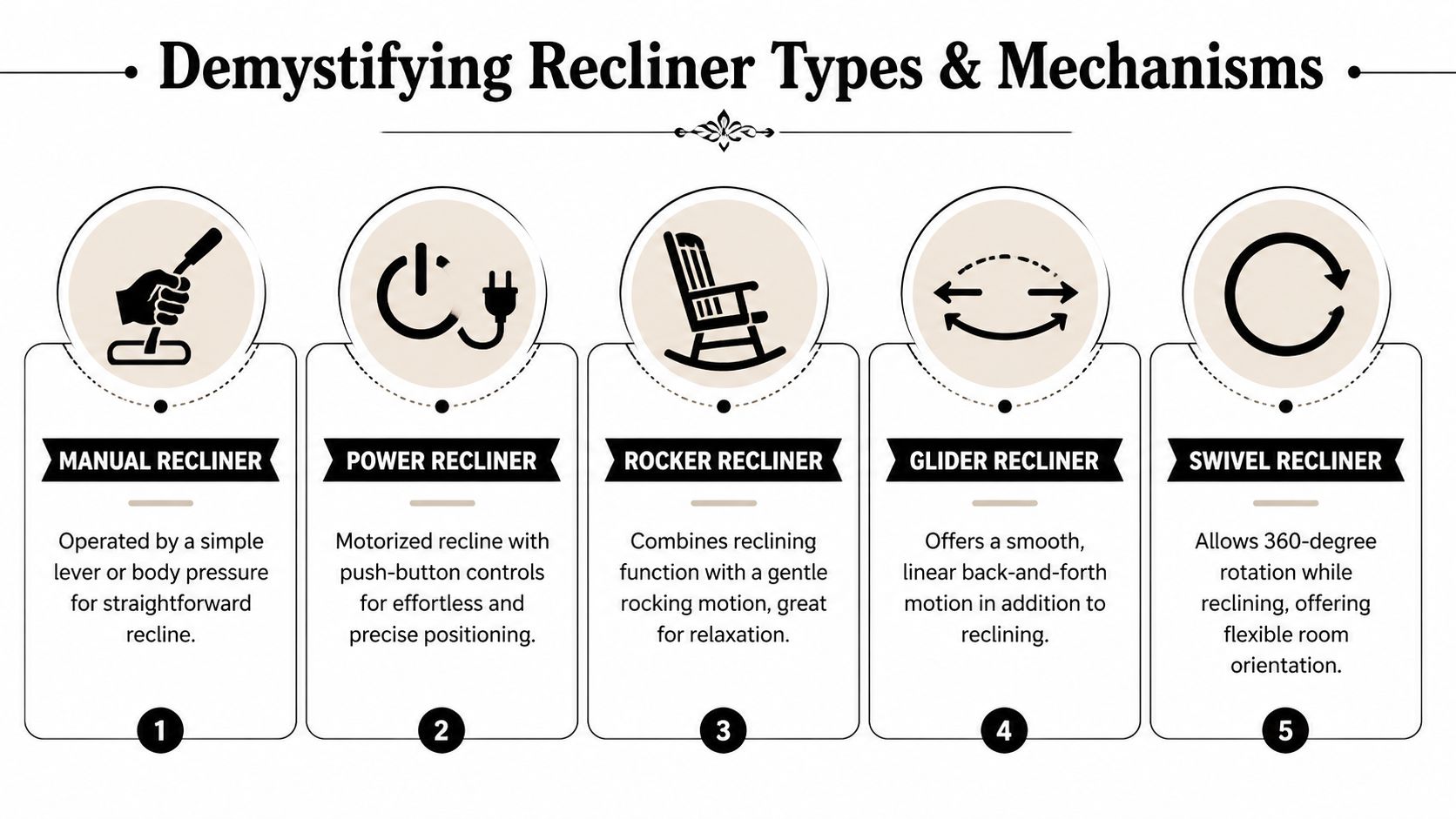
Comparing Recliner Mechanisms
| Mechanism Type | How It Works | Best For | Considerations |
|---|---|---|---|
| Manual recliner | Uses a lever or body pressure to release the footrest and recline the back | Guest rooms, occasional use, buyers who prefer simplicity | Requires more effort and offers less precise positioning |
| Power recliner | Uses motorised controls for smoother, incremental adjustment | Daily lounging, reading, media rooms, users who want precision | Needs power access and introduces more mechanical complexity |
| Rocker recliner | Combines a recline function with a rocking base | Relaxed family rooms, soothing movement, casual seating | Can look more casual and needs careful placement within the room |
| Glider recliner | Moves in a smooth back-and-forth glide while also reclining | Nurseries, reading spaces, gentle motion without full rocking feel | Style selection can be narrower in more formal interiors |
| Swivel recliner | Rotates while offering recline functionality | Open-concept spaces where orientation changes often | Base design affects the visual height and overall profile |
Manual versus power
A manual recliner has a straightforward appeal. It’s often lighter in spirit because there are fewer components involved, and some buyers prefer the simplicity. In a secondary room or occasional seating area, that can be exactly right.
A power recliner offers finer adjustment. That matters more than many people expect. If you read, watch television, or rest for extended periods, being able to stop at a more exact angle often creates a better experience than the more fixed positions of a manual chair. You can explore more detail on types of power reclining seating if you’re weighing those options carefully.
Wall-friendly and small-space choices
Some rooms don’t have the depth for a generous recline path. In those cases, you need to ask how the mechanism moves through space, not just whether the chair reclines. A well-planned floor layout will account for traffic behind the chair, nearby casegoods, and the extension of the footrest into the room.
People often make an expensive mistake. They measure the chair upright, then forget to measure the room in use.
The correct clearance is the one that lets the chair move freely without crowding a side table, blocking a passage, or forcing the room to revolve around a single seat.
Lift recliners and therapeutic support
A lift recliner belongs in a different conversation from a standard lounge chair because mobility support is central to its design. The construction often reflects that purpose. Premium power lift recliners use engineered furniture-grade laminate and hardwood frames, fully padded chaise systems, and some models from Golden Technologies use microprocessors to move a user from recline to standing in 10 to 15 seconds, as described in this Canadian product overview of lift recliner construction and operation.
That kind of motion assistance can be meaningful for aging-in-place households or for recovery after surgery. If mobility is a factor, this guide to safe, comfortable seating options gives a useful consumer overview of what to look for beyond appearance alone.
What works and what doesn’t
What works:
- Power controls for primary seating: especially when the chair will be used every day.
- Swivel bases in open layouts: they allow the chair to face conversation, fireplace, or television without dragging furniture around.
- Lift support when standing is difficult: dignity and ease matter more than stylistic hesitation.
What doesn’t:
- Choosing a rocker for a formal room without checking the visual tone
- Buying manual for someone with reduced grip or shoulder strength
- Treating all recline mechanisms as interchangeable
The mechanism should disappear into the experience. If you notice it constantly, it’s probably the wrong one.
A Curated Guide to Materials and Craftsmanship
The recliner’s long-term value lives in places many buyers never see at first glance. The hand notices the upholstery. The eye notices the silhouette. Time reveals the frame, the stitching, the resilience of the cushion, and whether the chair still feels composed after years of use.
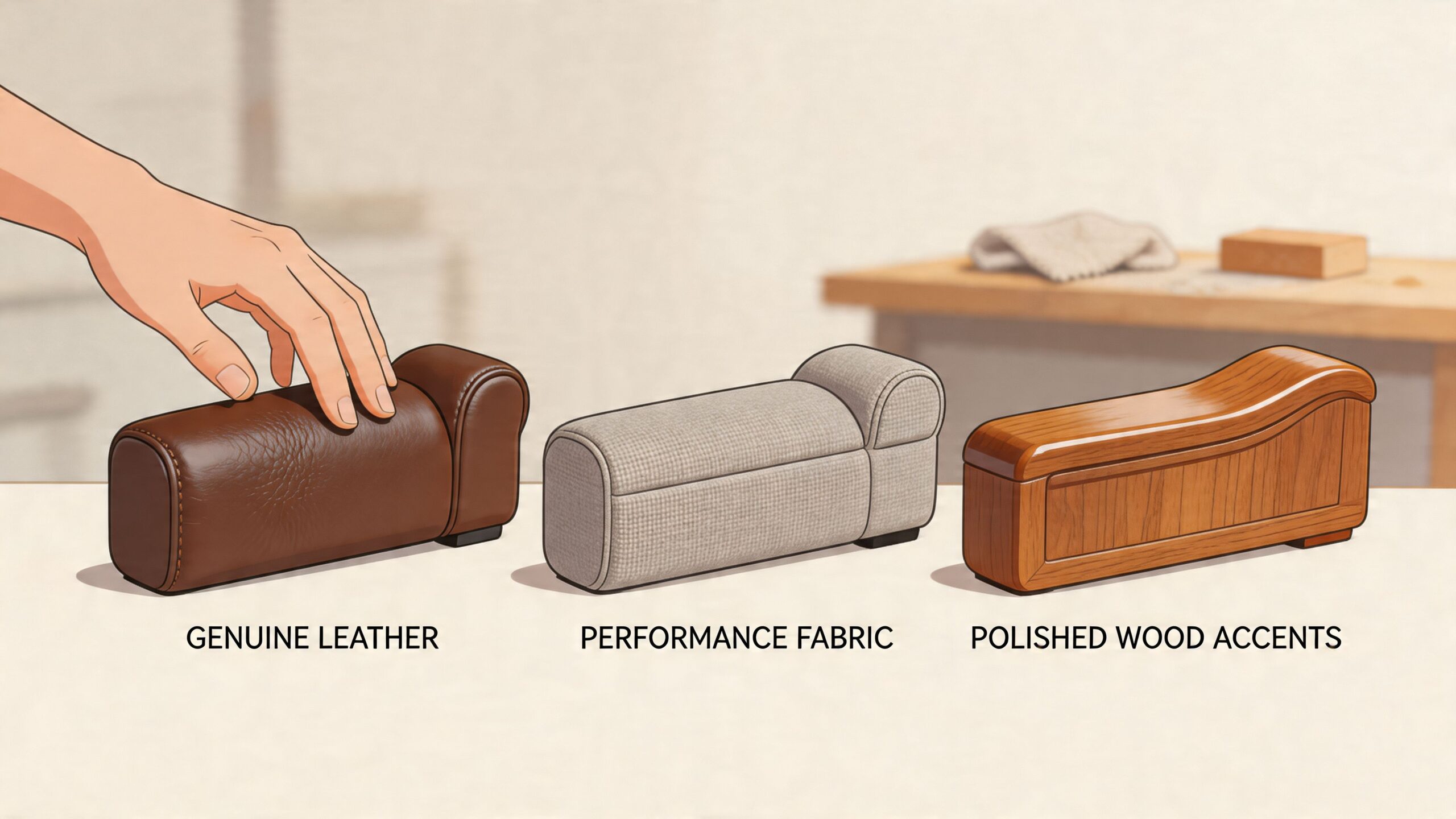
Leather, fabric, and the reality of daily living
Leather remains one of the most persuasive choices for an heirloom quality recliner because it develops character rather than wearing out. The key is selecting a leather that will age gracefully and suit how the room is used. Some leathers feel structured and architectural. Others feel more relaxed and softly broken-in from the beginning.
Performance fabric has earned its place in premium interiors as well. It’s often the better answer where softness, warmth, and everyday practicality need to coexist. In family homes, especially those with bright natural light or regular entertaining, a beautifully chosen textile can feel every bit as bespoke as leather. This guide to upholstery materials is helpful if you’re comparing tactile qualities and maintenance expectations.
What to inspect beneath the surface
Fine upholstery can still hide mediocre construction. Look closely at these elements:
- Frame integrity: hardwood or engineered structural components should feel stable, not flexible.
- Seat support: the chair shouldn’t collapse inward or feel hollow under the thighs.
- Padding continuity: a fully padded chaise offers a more continuous line of support from seat to footrest.
- Tailoring: welting, seams, and panel alignment should look disciplined from every angle.
A quality recliner also needs visual restraint. Overbuilt padding can feel comfortable in the first five minutes and tiresome by the fifth year. Better chairs tend to balance generosity with shape.
Buy the chair that still looks elegant when no one is sitting in it.
Designer’s Insight
Our designers suggest pairing a bold Hancock & Moore leather with a neutral, hand-knotted wool rug from The Rug Market to ground the room’s energy. This juxtaposition of textures creates a sophisticated, balanced space and allows the art for your floor to provide a timeless foundation.
That relationship matters. A recliner shouldn’t float as an isolated comfort piece. A rug can quiet its visual weight, define its zone, and tie it to nearby upholstery. In many rooms, the floor plane does more to dignify a recliner than a matching side table ever will.
What separates heirloom quality from disposable furniture
A disposable chair is built to satisfy the first impression. An heirloom-quality one is built to reward repeated use. You feel that difference in the consistency of the seat, the steadiness of the arm, and the way the upholstery remains handsome rather than rumpled.
Timeless craftsmanship isn’t only about prestige. It’s practical. It means fewer compromises, better ageing, and a chair that still belongs in the room after surrounding furnishings evolve.
Finding Your Perfect Fit Sizing and Scale
A recliner can be beautifully made and still be wrong for you. Fit is physical first. Then it becomes visual. The chair has to support your body properly and sit in proportion with the room, the rug, the side tables, and the surrounding seating.
Fit the person first
Start with how you sit when fully upright. Your feet should rest comfortably on the floor, and your back should meet the chair without forcing you to perch at the edge. If the seat is too deep, you’ll lose lumbar contact. If it’s too shallow, the thighs won’t feel supported.
When trying a chair in person, pay attention to these points:
- Seat depth should let you sit back comfortably without pressure behind the knees.
- Seat height should allow a natural, grounded posture.
- Back height needs to support the shoulders and head in a way that suits your height.
- Arm position should feel natural when reading or resting, not too high or too low.
Then fit the room
A recliner has visual weight. That’s true even in refined, modern forms. In a compact room, broad padded arms can consume more space than the floor dimensions suggest. In a larger room, a chair that’s too slight can look apologetic beside a substantial sofa or library cabinet.
For tighter footprints, these considerations often matter more than mechanism alone. A smaller-scale model may solve the problem more elegantly than rearranging the entire room around one piece. In these instances, a recliner for small spaces approach becomes useful.
Use a complete room concept
Good sizing is never only about tape measures. It’s about balance. A recliner placed on an undersized rug feels adrift. A recliner beside a side table that’s too low looks awkward. A generous chair pushed too close to a console makes the room feel cramped even before anyone sits down.
A design studio typically looks at the whole composition:
- Sightlines: what the chair looks like from the doorway and adjoining spaces
- Circulation: whether people can move comfortably around it
- Companions: how it relates to sofa arms, table heights, and lighting
- Foundation: whether the rug gives the chair a rightful place in the room
If the recliner fits your body but disturbs the room, it still doesn’t fit.
Common sizing mistakes
Some are easy to avoid once you know them.
- Buying by showroom impression alone: a large store can make a chair look smaller than it is.
- Ignoring reclined depth: the room has to accommodate the chair in use, not only at rest.
- Choosing oversized arms for a narrow plan: the chair may lose useful seat width while gaining bulk.
- Forgetting the adjacent pieces: lamps, ottomans, and tables all affect how spacious the chair feels.
The right scale feels almost inevitable once it’s in place. Nothing strains. Nothing shouts. The chair belongs.
Investing in Quality Recliner Brands in Canada
Not every premium recliner brand is trying to solve the same problem. Some focus on ergonomic precision. Some prioritise artisanal expression. Some excel in domestic manufacturing and practical customisation. Understanding that difference helps you shop with clearer expectations.

Ergonomic specialists
Stressless has earned its reputation by treating sitting as a dynamic act rather than a static one. The appeal is not only Scandinavian restraint. It’s responsive support. For buyers who want a recliner to feel light in appearance and intelligent in use, this category often makes sense. Their collection is worth reviewing if you’re considering Stressless recliners.
These chairs tend to suit clients who dislike bulk and want a more architectural profile. They often work especially well in rooms where the recliner must coexist with contemporary millwork, large windows, or a more edited furnishing scheme.
Artisanal and heritage-driven makers
Brands such as Stickley and Hancock & Moore speak to a different instinct. They appeal to clients who value refined detailing, richer material expression, and the sense that a chair belongs to a lineage of furniture making rather than a single trend cycle.
In these collections, the emotional quality of the material often carries as much importance as the mechanism. Leather character, wood accents, stitching, and scale all matter. A recliner from this world can sit comfortably in a library, a traditional living room, or a transitional interior where warmth and permanence lead the design language.
Canadian-made value for Southern Ontario homes
For buyers in Southern Ontario, domestic manufacturing adds practical advantages that are easy to underestimate until something needs service, customisation, or warranty support. The overall recliner market can range from $200 to $5,000, and for Southern Ontario buyers, Canadian-made recliners offer benefits in lead times, local service, supply chain transparency, and warranty support aligned with Canadian standards, according to this Canadian-made recliner market analysis.
That doesn’t mean every imported chair is wrong. It means local support has value. It often leads to clearer communication, fewer surprises, and a more grounded sense of cost-to-value.
A practical way to compare brands
Instead of asking which brand is “best,” ask which philosophy matches your home.
- Choose ergonomic leaders if you want lighter form, precise support, and a less conventional recliner profile.
- Choose artisanal makers if material richness and heritage styling matter most.
- Choose Canadian-made lines if service clarity, custom orders, and regional support are central to the decision.
- Choose design-led retail partners if you want the recliner evaluated within a whole room, not in isolation.
One local option in this category is Critelli Furniture, which carries recliners alongside broader room-planning and interior design services in St. Catharines. That matters if you’re furnishing beyond a single chair and want the recliner considered within a larger design scheme.
The right brand isn’t the one with the longest feature list. It’s the one whose priorities mirror your own.
The Purchase Journey From Showroom to Home
The final choice often becomes clear only when you sit in the chair, use the controls, and see the upholstery under real light. Online browsing is useful for narrowing style. It isn’t enough for judging comfort, proportion, or the character of a finish.
Why the showroom still matters
A recliner asks more of the body than almost any other occasional chair. The seat depth, angle of the back, arm height, and footrest position all need to feel right together. In a showroom, you can test whether the mechanism feels smooth, whether the scale suits you, and whether the upholstery has the right presence for your home.
This is especially relevant when comparing domestic and imported options. If you’re ever trying to understand why lead times, duties, and logistics can vary so much on internationally sourced goods, these steps for importing goods into Canada provide useful context. Even when you aren’t importing directly, those realities affect what reaches the floor and how quickly replacements or parts can be handled.
Delivery is part of the luxury purchase
A premium recliner shouldn’t arrive as a burden. White-glove delivery is the final design service, not an afterthought. It should include careful inspection, professional placement, and proper setup so the chair is ready to use and correctly positioned from the first day.
That matters even more with motion furniture. Power components, sectional assembly, room access, and floor protection all require care. For buyers who want that transition handled professionally, furniture assembly services near me offers a good example of what full-service support can include.
What makes the process feel seamless
- In-person testing: You leave knowing the chair fits your body.
- Material confirmation: Leather and fabric are approved in real light, not on a screen.
- Placement planning: The room is considered before delivery day.
- Professional setup: The chair is installed correctly, with packaging removed.
The showroom-to-home experience should protect your investment. That’s part of what distinguishes an heirloom-quality purchase from a rushed one.
Frequently Asked Questions About Recliners
Are recliners in canada still considered casual furniture
Not necessarily. The category now includes carefully crafted, design-forward silhouettes that work comfortably in formal and transitional rooms, provided the scale, upholstery, and placement are handled thoughtfully.
Is a power recliner always better than a manual recliner
No. Power recliners suit daily use, finer positioning, and buyers who want easier operation. Manual recliners can be sensible in guest spaces or for people who prefer simplicity and fewer components.
What matters more, upholstery or mechanism
Both matter, but in different ways. The mechanism determines how the chair functions. The upholstery and construction determine how it ages, how it feels to live with, and whether it belongs visually in the room.
Can a recliner work in a smaller home or condo
Yes, if you choose the right scale and plan the clearances carefully. Smaller-profile recliners and wall-conscious layouts can work beautifully where space is limited.
Are Canadian-made recliners worth considering
Yes, especially when after-sales service, customisation, and warranty clarity matter to you. For many Southern Ontario homeowners, that support is part of the value.
Should a recliner match the sofa
Usually, it shouldn’t match too rigidly. It should relate. A recliner often looks more elegant when it complements the room through shape, tone, or texture rather than copying every detail of the sofa.
For homeowners seeking luxury furniture Niagara, interior design services St. Catharines, custom furniture Southern Ontario, and hand-knotted rugs Ontario, a recliner deserves the same care as any other major furnishing. Critelli Furniture offers a setting where that decision can be made within a complete room concept, with attention to timeless craftsmanship, artisanal materials, white-glove delivery, and the foundation pieces that make a room feel whole. Experience the craftsmanship in person at our King Street Showroom, book your complimentary design consultation today, and visit the Rug Market to find your room’s foundation.