

Elevate Your Modern Lighting Kitchen Design


A kitchen can be beautifully finished and still feel unresolved once the sun goes down. The cabinetry may be exquisite, the stone may be perfectly chosen, and the hardware may have all the right restraint, yet one harsh ceiling fixture can flatten the entire room.
That’s usually the moment people realise lighting isn’t decoration added at the end. In a well-composed modern lighting kitchen, light shapes how the room works, how food looks, how surfaces read, and how comfortable the space feels from early breakfast to late evening conversation. In Southern Ontario homes, that challenge becomes more pronounced because daylight shifts so dramatically through the year.
Laying the Groundwork for Luminous Design
A strong lighting plan starts before fixture shopping. It begins with an audit of the room itself, how you move through it, where you prepare food, where you gather, and where the architecture naturally wants light.

Start with function, not fixtures
When I assess a kitchen, I look at the room in zones before I look at finishes. The sink wall behaves differently from the prep counter. A breakfast nook asks for a different mood than a pantry run or a family command centre.
Use a simple review like this:
- Identify your hardest-working surfaces. Counters used for chopping, baking, or reading recipes need the clearest, most direct light.
- Mark circulation paths. Walkways between island, range, and sink need even general illumination so the room feels effortless to move through.
- Note visual focal points. Open shelving, a tiled splashback, a hutch, or a dining connection may deserve a softer decorative layer.
- Record ceiling conditions. Bulkheads, beams, sloped ceilings, and vent locations often determine what is possible long before style enters the conversation.
This first pass prevents a common mistake. People choose a striking pendant, then try to make the rest of the room obey it.
Read the natural light honestly
Southern Ontario kitchens change character by season. Homeowners in St. Catharines and Niagara often struggle with regional daylight fluctuations, and short, cloudy winters can reduce natural light by up to 70% from November to February according to this discussion of kitchen lighting trends and daylight challenges. A kitchen that feels airy in July can feel dim and visually heavy in January.
That means your lighting plan has to perform well on a grey afternoon, not just on a bright spring morning.
Practical rule: Stand in the kitchen at three different times, morning, late afternoon, and evening. Notice where shadows fall on counters, where cabinetry darkens, and where glare bounces off stone or polished fronts.
In open-concept homes across the Greater Niagara, Hamilton, and Toronto markets, daylight from adjacent rooms can be misleading. A kitchen may seem bright because the space beyond it is bright. The work surfaces themselves often tell a different story.
Let the room guide the plan
Architectural character matters. Heritage homes in Niagara often have charming proportions, but they can also bring lower ceilings, fewer centred junction boxes, and layouts that weren’t designed around today’s kitchens. Newer builds may offer better symmetry, though they often need more restraint so the room doesn’t become overlit and clinical.
A useful reference for clients trying to understand the early planning sequence is this guide on where to begin with home design planning. It helps frame lighting as part of the complete room concept rather than a late-stage add-on.
If your renovation involves electrical changes, it also helps to review a practical example of a home lighting renovation project. Not for style direction, but for understanding how early coordination affects the final result.
Ask better questions before you buy
Instead of asking, “What light fixture should go here?” ask:
- What task happens here most often? Prep, serving, dining, homework, entertaining.
- What does this surface reflect? Matte oak absorbs light differently than polished quartz.
- What mood should the room hold at night? Crisp and efficient, soft and layered, or a balance of both.
- What should stay visually quiet? In many modern kitchens, the best lighting is present but not attention-seeking.
That’s how a modern lighting kitchen starts to feel composed. Not because every fixture matches, but because every decision has a reason.
Mastering the Three Layers of Light
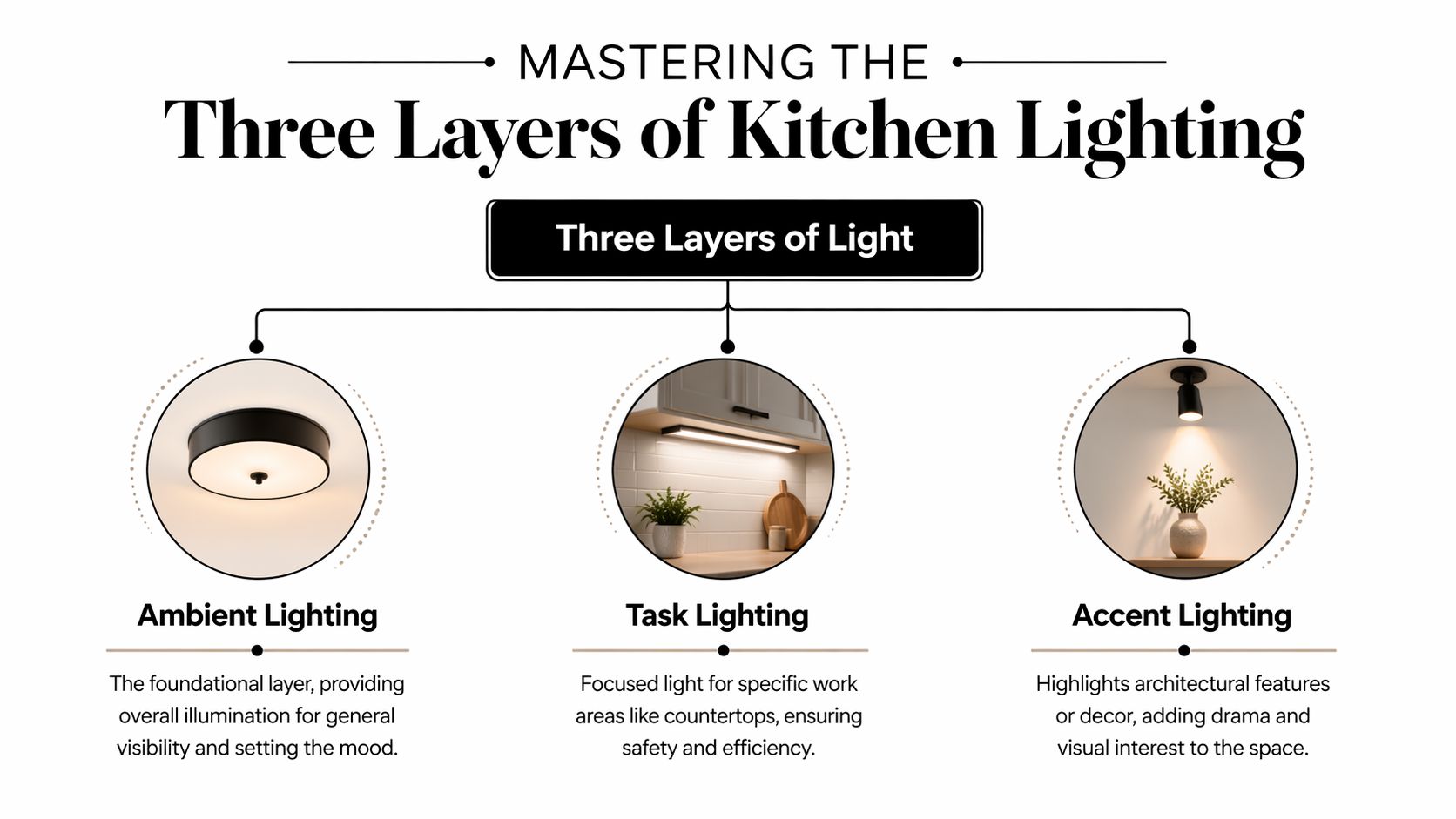
The kitchens that feel easiest to live in rarely rely on one source of illumination. They use three interdependent layers. Each does a different job, and the room only feels complete when all three are working together.
Ambient light sets the foundation
Ambient light is the room’s base layer. It gives the kitchen its overall brightness, supports circulation, and prevents the corners from disappearing after dusk.
For a medium 150 sq ft kitchen, IESNA standards call for 7,500 to 15,000 lumens for proper ambient lighting, and task areas should reach 50 to 75 foot-candles. The same source notes that this benchmark is achieved in over 92% of installations referenced there, which is a useful performance target when reviewing plans, as outlined in this article on the three-layer kitchen lighting system.
Ambient light usually comes from recessed downlights or a discreet ceiling fixture. In a modern kitchen, I prefer this layer to feel calm and evenly distributed. If you notice bright circles on the floor and dim worktops, the layout has missed the mark.
Task light does the real work
Task lighting is where safety and comfort are won. It belongs over the surfaces where hands, knives, ingredients, recipes, and appliances compete for attention.
Under-cabinet linear LEDs are often the most valuable fixture in the room because they place light exactly where the work happens. Pendants can contribute, but they shouldn’t be expected to solve task lighting on their own.
Look for task lighting that does three things well:
- Eliminates your body shadow. If the light is behind you, your own stance blocks the counter.
- Lights the full depth of the work surface. A bright backsplash with a dim front edge isn’t useful.
- Maintains visual comfort. Good task light is clear, not glaring.
The best task lighting almost disappears from notice. You don’t admire it directly. You notice that chopping, measuring, and reading feel easier.
For homeowners who want a broader design framework, this overview of the principles of architectural lighting design is a worthwhile companion. It explains why layered light creates comfort in ways a single fixture never can.
Accent light gives the kitchen polish
Accent lighting is the layer people often skip, then miss as soon as evening falls. It adds depth, hierarchy, and a sense that the room has been intentionally composed.
This might mean a gentle wash inside a glass cabinet, a focused beam on textured tile, or a carefully chosen pendant over a dining edge. Accent light shouldn’t compete with the room. It should make materials, craftsmanship, and silhouette more legible.
A helpful perspective is:
| Layer | Primary purpose | Common fixtures |
|---|---|---|
| Ambient | Overall illumination | Recessed LEDs, flush or ceiling fixtures |
| Task | Focused work light | Under-cabinet strips, adjustable downlights |
| Accent | Depth and emphasis | Pendants, cabinet lighting, directional spots |
Balance matters more than brightness
A kitchen with too much ambient light and no task layer feels washed out. A kitchen with only task lighting feels fragmented. A kitchen with decorative pendants and little else looks finished in photographs but often disappoints in daily use.
If you’re exploring statement fixtures, a curated collection of modern pendant lights can help clarify scale and style direction. The key is to remember that pendants are one voice in the room, not the entire conversation.
A refined modern lighting kitchen isn’t brighter everywhere. It’s better lit where it matters.
Selecting Design-Forward Fixtures and Finishes
Fixtures are the jewellery of the kitchen, but jewellery only works when it belongs to the outfit. In a carefully resolved space, the fixture’s shape, finish, and light quality all support the architecture instead of distracting from it.
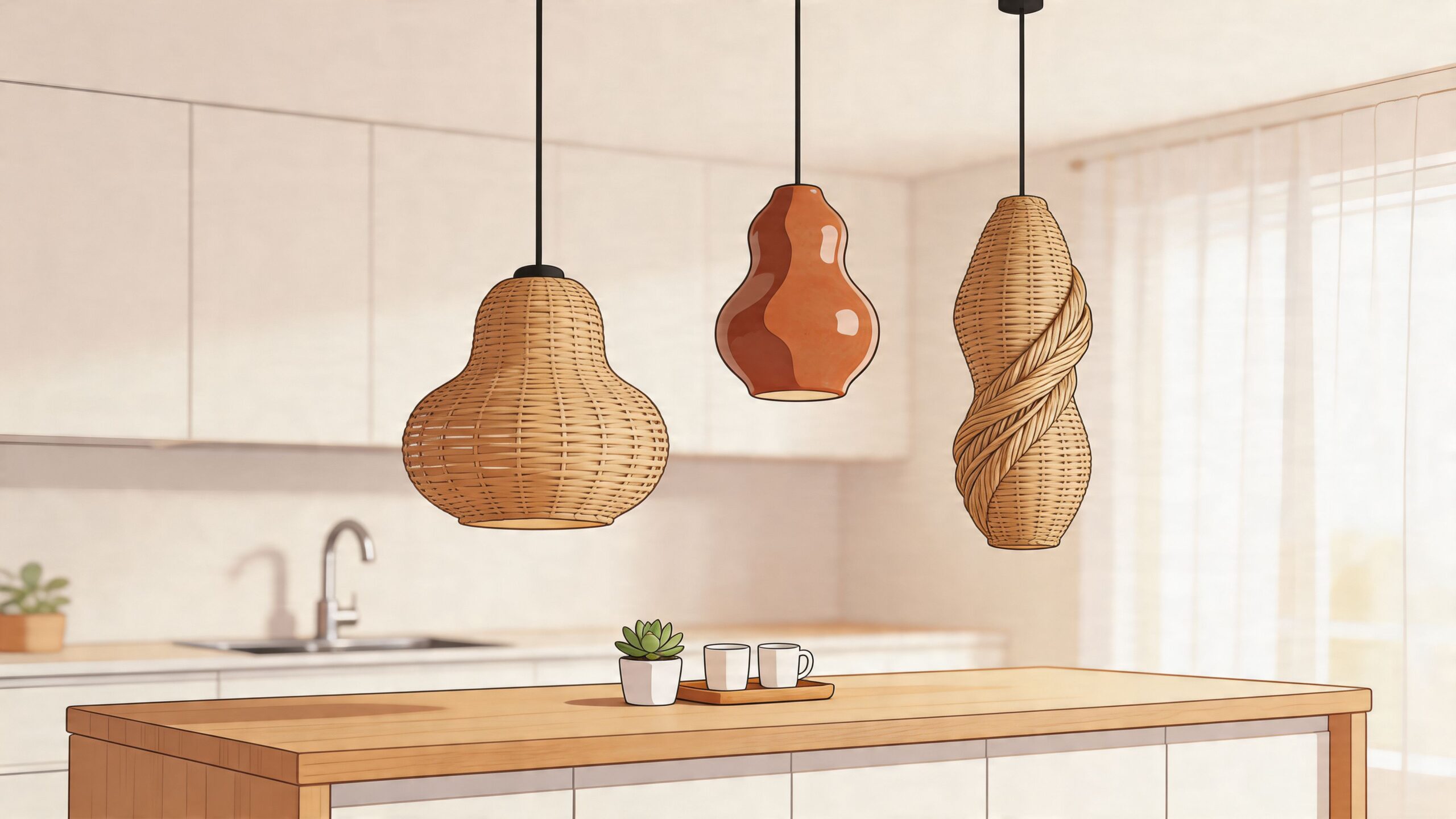
A kitchen with flat-panel walnut cabinetry, honed stone, and restrained hardware asks for a different fixture language than a painted Shaker kitchen in a heritage home. The mistake isn’t choosing something bold. The mistake is choosing something unrelated.
What today’s market tells us
In the North American kitchen lighting market, North America held 28.27% global market share in 2023, LED lights captured 65.58% of revenue share, and ceiling lights held 35.23% market share, according to Grand View Research’s kitchen lighting market report. That aligns with what designers see in practice. Homeowners want efficiency, longevity, and fixtures that can serve both visual and practical roles.
LED dominance also reflects a design reality. Modern kitchens need performance that older bulb types rarely delivered with the same consistency or restraint.
Choosing fixtures by character
Some kitchens want sculptural pendants. Others need near-invisible recessed lighting and a thin under-cabinet line. Both can be well-executed.
Consider these pairings:
- For a minimalist kitchen choose slim recessed LEDs, quiet linear under-cabinet lighting, and a pendant with clean geometry rather than ornate detail.
- For a transitional heritage space a gently aged brass pendant can bridge old millwork and updated surfaces without feeling forced.
- For an open-concept room treat the kitchen and adjacent dining area as one composition so the fixtures speak the same language, even if they don’t match exactly.
A thoughtfully edited range of dining room lighting pendants is often useful here, especially when the kitchen flows directly into entertaining space and the eye reads both rooms together.
Finishes should echo the room, not fight it
Finish selection is where many kitchens either become elegant or overly busy. Brass, matte black, polished chrome, and mixed metal combinations can all work, but only when repeated with discipline.
Designer’s Insight
Our designers suggest creating harmony by echoing finishes across the room. A brass pendant, for example, can be beautifully complemented by brass cabinet pulls and even the warm tones found in the art for your floor, a hand-knotted wool rug, to build a complete, layered room concept.
Heirloom quality matters. A fixture shouldn’t feel trendy after one season. It should feel as though it belongs to the room’s architecture and to the wider interior.
Know when utility matters more than statement
Not every ceiling point needs a decorative fixture. In fact, the most successful kitchens often reserve visual emphasis for one or two moments and let the rest of the lighting recede.
That same restraint applies when people consider a fan or dual-purpose fixture in adjacent breakfast areas. If you’re weighing comfort against aesthetics, a practical buyer’s guide on choosing the perfect fan light kit can help clarify what belongs in a utility-driven area and what should remain purely decorative.
Since 1914, heritage-minded interiors have always rewarded consistency over novelty. Timeless craftsmanship isn’t about avoiding modernity. It’s about choosing forms and materials with enough integrity to age gracefully.
The Geometry of Illumination Placement and Scale
A beautiful fixture can still fail if it’s badly placed. Proportion, spacing, and beam direction decide whether the room feels composed or awkward.
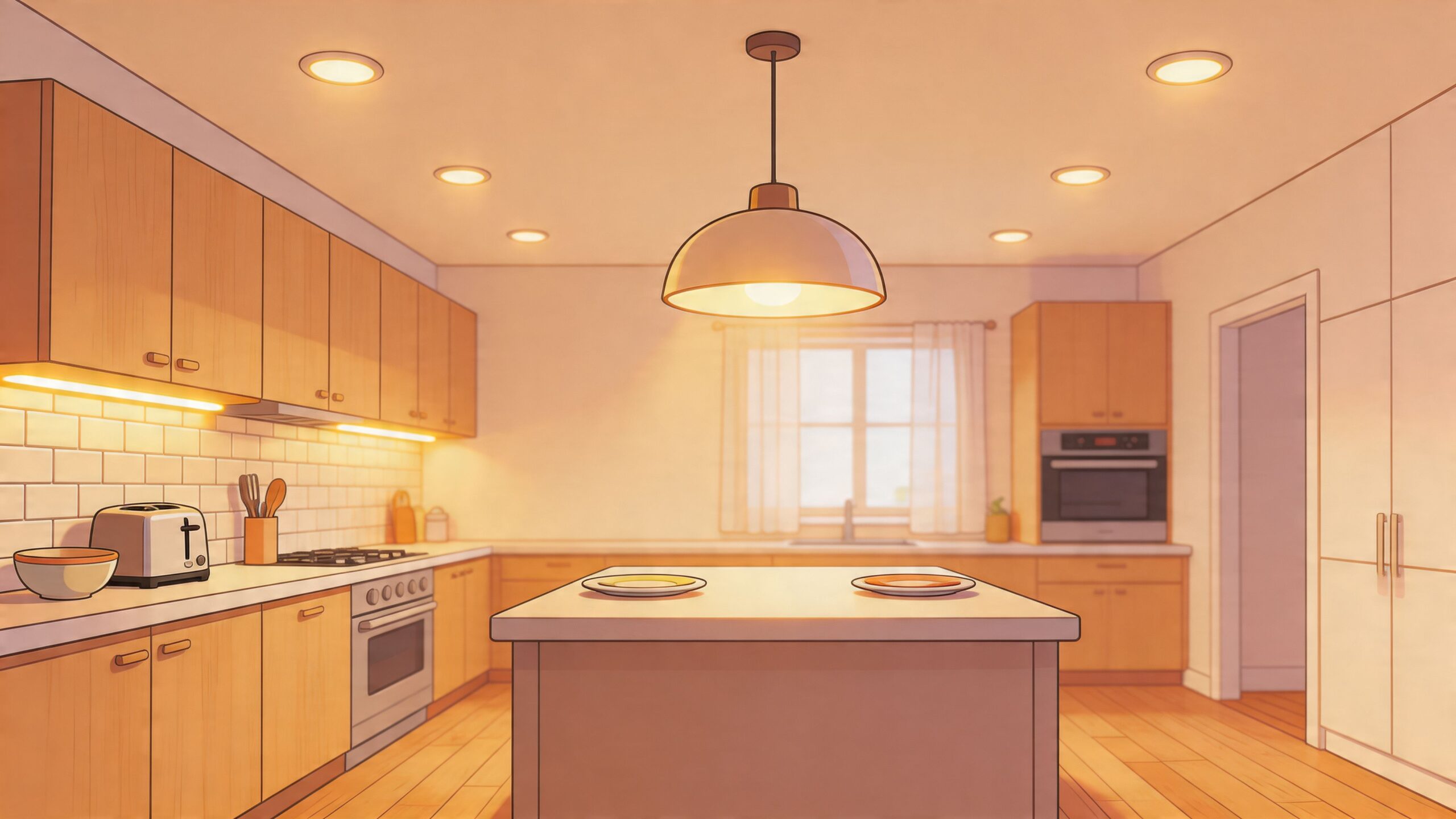
Placement is where lighting becomes architectural. The eye reads alignment quickly. If pendants drift off-centre from the island, or downlights ignore the cabinetry below, the room feels unsettled even when no one can immediately explain why.
Pendants need visual discipline
Over an island, pendants should relate to the island’s mass, not just the ceiling box. They must illuminate the work surface while preserving clear sightlines across the room.
A few rules help:
- Centre to the furniture, not the room. The island is the reference point.
- Respect visual rhythm. Multiple pendants should feel evenly paced and balanced against stools, faucet, and hood.
- Keep scale in check. Oversized pendants can be magnificent, but only when ceiling height and island depth support them.
If the pendants are too small, they look apologetic. If they’re too large, they dominate every other material choice.
Recessed lighting should follow work zones
Recessed lighting works best when it’s planned from the cabinetry layout backward. Too many layouts are drawn as tidy ceiling grids that ignore where the actual counters begin and end.
What works better is a layout that considers:
| Placement issue | What happens | Better approach |
|---|---|---|
| Lights centred in the room only | Counters fall into shadow | Align with key work surfaces |
| Fixtures too close together | Ceiling looks busy, glare increases | Space for even coverage and calm rhythm |
| No adjustment for tall cabinetry | Vertical surfaces appear heavy | Add light where millwork needs relief |
No-island kitchens need a different strategy
This matters especially in older homes. For 42% of Greater Niagara homes pre-1980 that lack a kitchen island, pendant-focused advice fails. The better solution is 12-inch offset adjustable downlights with 40-50° beams to illuminate counters properly and avoid the shadows created by direct overhead lighting, as noted in this article on modern island lighting ideas and no-island alternatives.
That recommendation is especially relevant in heritage kitchens where the room may be narrower, the ceiling may be lower, and the architecture doesn’t offer a natural pendant location.
Don’t force island logic into a kitchen that doesn’t have an island. A bespoke plan respects the room you have.
In small or no-island spaces, adjustable downlights and discreet puck or linear solutions often produce a cleaner, more useful result than trying to mimic a showroom vignette built for a different floor plan.
Scale should serve the whole room
Good lighting geometry isn’t just about one fixture. It’s about how the fixtures relate to cabinetry, appliances, windows, and adjoining furnishings. In a complete room concept, the kitchen never stands alone. It speaks to the dining area, the flooring, the upholstery nearby, and even the rug that anchors the transition into the next space.
That’s why placement is part engineering, part composition. Precision matters, but so does restraint.
Choosing the Perfect Glow with Colour and Control
Two kitchens can use similar fixtures and still feel entirely different because of the lamping. Many otherwise handsome projects lose their refinement due to this aspect. The form may be right, but the glow is wrong.
Colour temperature and CRI decide whether the room feels inviting, clinical, muddy, or beautifully clear.
CRI is not optional in a kitchen
A Colour Rendering Index below 80 can cause a 41% misjudgment in food ripeness, and high-quality CRI 90+ LEDs are preferred because they improve the appearance of food and have been associated with reduced fatigue by 28% in task areas, according to this kitchen lighting guide on CRI and colour quality.
That matters more than many homeowners expect. If tomatoes look dull, herbs look greyed out, or wood finishes lose depth at night, the room won’t feel appetising or luxurious no matter how elegant the fixture appears.
Use Kelvin with intention
Colour temperature, measured in Kelvin, shapes mood and function. Warmer light tends to flatter dining and evening use. Crisper neutral light supports prep work and reading detail accurately.
The best modern lighting kitchen usually mixes temperatures by purpose rather than forcing one setting everywhere.
| Light Layer | Recommended Kelvin (K) | Mood & Function |
|---|---|---|
| Ambient | 2700K to 3000K | Warm, welcoming general glow for evenings and everyday living |
| Task | 4000K | Clearer light for food prep, reading recipes, and detailed work |
| Accent | 3500K to 4000K | Focused emphasis that still feels refined and balanced with adjacent layers |
Where homeowners often go wrong
The most common errors aren’t dramatic. They’re subtle choices that accumulate into discomfort.
- Everything is too cool. The kitchen feels sterile, especially at night.
- Everything is too warm. Stone, paint, and food lose definition during prep.
- CRI is ignored. Expensive finishes read flat and ingredients look less fresh.
- No dimming control is added. The room has one mood only, and it’s usually too bright for evening.
A kitchen should be able to support a weekday breakfast, focused prep, and a late dinner with friends. One fixed light level can’t do all three well.
Dimmers complete the picture
Dimmers are not an indulgence. They are part of proper specification. Without them, even a carefully layered lighting plan becomes rigid.
A dimmer lets ambient light recede when pendants and under-cabinet lighting are carrying the room. It softens contrast, improves comfort, and gives polished materials a more gracious presence after dark. In practical terms, it’s the easiest way to make a kitchen feel less like a workspace and more like part of the home.
Smart Controls and Seamless White-Glove Service
A modern kitchen should feel advanced without feeling complicated. That’s where smart controls earn their place. They allow a layered plan to behave with the same nuance it was designed with in the first place.
Smart control makes good design usable
A well-lit kitchen has several lighting groups. Recessed ambient lights, under-cabinet task lights, pendants, and accent features all deserve independent control. If everything turns on from one switch bank at one intensity, the design loses much of its sophistication.
Lutron Caseta is a strong example of a system that suits residential kitchens because it allows scenes rather than simple on-off behaviour. That means you can create settings for prep, dining, evening clean-up, or early morning use without manually adjusting every circuit each time.
A useful smart setup often includes:
- Scene control for cooking, entertaining, and night-time wind-down
- Dimming by layer so task lighting can stay bright while ambient light softens
- App-based access for convenience when schedules shift
- Consistent operation that everyone in the household can understand quickly
Technology should disappear into comfort
The best smart systems aren’t flashy. They make the room easier to live in. Lighting should respond to daily rhythms without asking the homeowner to become a technician.
That’s also why installation matters so much. Fine materials and carefully selected fixtures can be undermined by poor alignment, careless handling, or a rushed finish stage.
Service is part of the final design result
In premium interiors, delivery and installation aren’t logistical footnotes. They’re the last design step. Proper receiving, assembly coordination, protection of finishes, fixture placement review, and packaging removal all shape how successfully the vision arrives in the home.
For homeowners who value that fluid transition, professional furniture assembly services near you help illustrate what a white-glove standard should look like. The principle applies beyond furnishings. A bespoke kitchen lighting plan deserves the same level of care in its final execution.
That matters across Southern Ontario, especially for clients balancing renovations, trades, and furnishing timelines across St. Catharines, Greater Niagara, Hamilton, and Toronto. True luxury isn’t only the fixture itself. It’s a process calm enough that the homeowner can focus on the finished room rather than the friction required to get there.
Bringing Your Luminous Vision to Life
A memorable kitchen isn’t defined by cabinetry alone. Light decides whether the room feels calm, capable, flattering, and complete. When ambient, task, and accent layers are planned with care, when fixtures are selected for both character and performance, and when colour quality is handled properly, the kitchen begins to support daily life with quiet precision.
That’s the difference between a room that photographs well and a room that lives well. Thoughtful lighting turns preparation into pleasure and gives the entire interior a more resolved presence.
For clients who want that level of cohesion, professional interior design services bring the lighting plan into dialogue with furnishings, rugs, finishes, and flow. The result is a complete room concept rather than a series of isolated purchases.
Book your complimentary design consultation today to begin your journey.
Experience the craftsmanship in person at our King Street Showroom.
Critelli Furniture has been family-run since 1914, helping homeowners across Southern Ontario create rooms of depth, comfort, and heirloom quality. From a design-forward lighting plan to custom furniture, hand-knotted rugs Ontario clients treasure as art for your floor, and white-glove service that carries every detail from showroom to home, the experience is curated to feel effortless. If you’re exploring Luxury furniture Niagara, Interior design services St. Catharines, or Custom furniture Southern Ontario, Critelli Furniture offers the kind of bespoke guidance that makes a home feel fully considered.