
Wall to Wall Shelving Units a Complete Design Guide

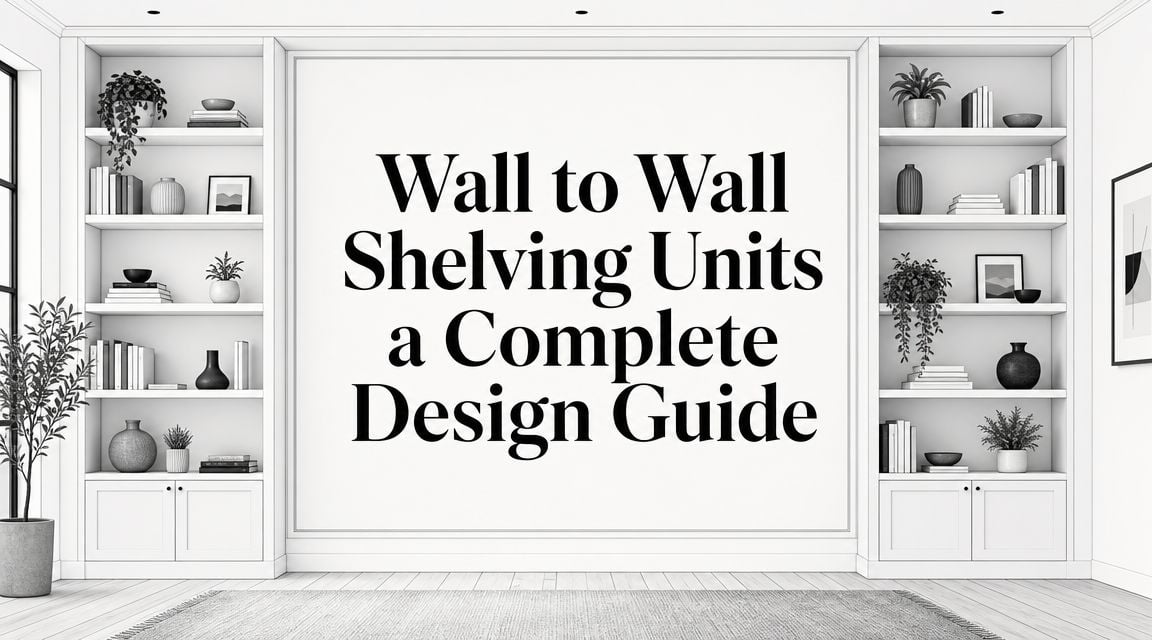
A long, empty wall often unsettles an otherwise well-furnished room. The seating may be handsome, the lighting may be resolved, and the rug may already ground the space beautifully, yet the room still feels unfinished because one architectural plane is doing nothing at all.
That's where wall to wall shelving units change the conversation. Done well, they don't read as extra storage. They read as architecture. They give a room rhythm, purpose, and a place for books, art, ceramics, and family objects to live with dignity instead of drifting from surface to surface.
In homes across Southern Ontario, that blank wall is rarely just a decorating issue. It's usually a sign that the room needs a more complete design concept. A shelving run can soften a long living room, organise a home office, frame a fireplace, or turn an awkward alcove into something intentional. In a family-run firm with roots going back to 1914, that's how the best millwork decisions have always been understood. Not as isolated products, but as part of a home's lasting character.
Table of Contents
- The Promise of a Beautifully Considered Wall
- Three Paths to Wall-to-Wall Elegance
- Selecting Materials for Timeless Craftsmanship
- Planning Your Bespoke Wall System
- From Showroom to Sanctuary The Installation Process
- Styling Your Shelves A Curator's Guide
- Begin Your Home's Next Chapter
The Promise of a Beautifully Considered Wall
A beautifully resolved wall does two jobs at once. It improves how a room works, and it improves how a room feels. That balance is why wall to wall shelving units have such staying power in good interiors. They organise daily life, but they also create the visual weight that many rooms lack.
There's a long design lineage behind that idea. The history of flexible, wall-based storage is often traced through milestones such as Dieter Rams' 606 Universal Shelving System, introduced in 1960, which remains an early benchmark for wall-based storage as both furniture and architecture, as noted in Harvard Design Magazine's history of the bookcase. That lineage matters because shelving has never been only about holding objects. It has always been about shaping space.
In practice, the most successful walls are the ones that feel inevitable. The shelving looks as though it belongs to the house, even if it was added much later. The proportions relate to the ceiling height. The finish speaks to the floor, trim, and upholstery. The display isn't crammed, and the room gains calm rather than clutter.
A long wall rarely needs more decoration. It usually needs better structure.
That's especially true in mature family homes, city condominiums, and renovated properties where every square foot must work harder. A wall of shelving can provide storage, yes, but its deeper value lies in giving the room a centre of gravity.
A few qualities tend to separate a considered wall from a merely filled one:
- Architectural presence means the unit relates to baseboards, windows, ceiling lines, and adjacent furniture.
- Personal relevance means the shelves hold books, objects, and art that reflect the household, not generic filler.
- Visual discipline means there's enough open space for the eye to rest.
- Longevity means the design still feels right when accessories change over time.
That's the difference between a storage purchase and an heirloom-quality room decision.
Three Paths to Wall-to-Wall Elegance
Different homes call for different approaches. Some walls ask for permanent millwork. Others benefit from a lighter system that can evolve with the household. The right choice depends less on trends and more on how fixed, flexible, and architectural the result should feel.
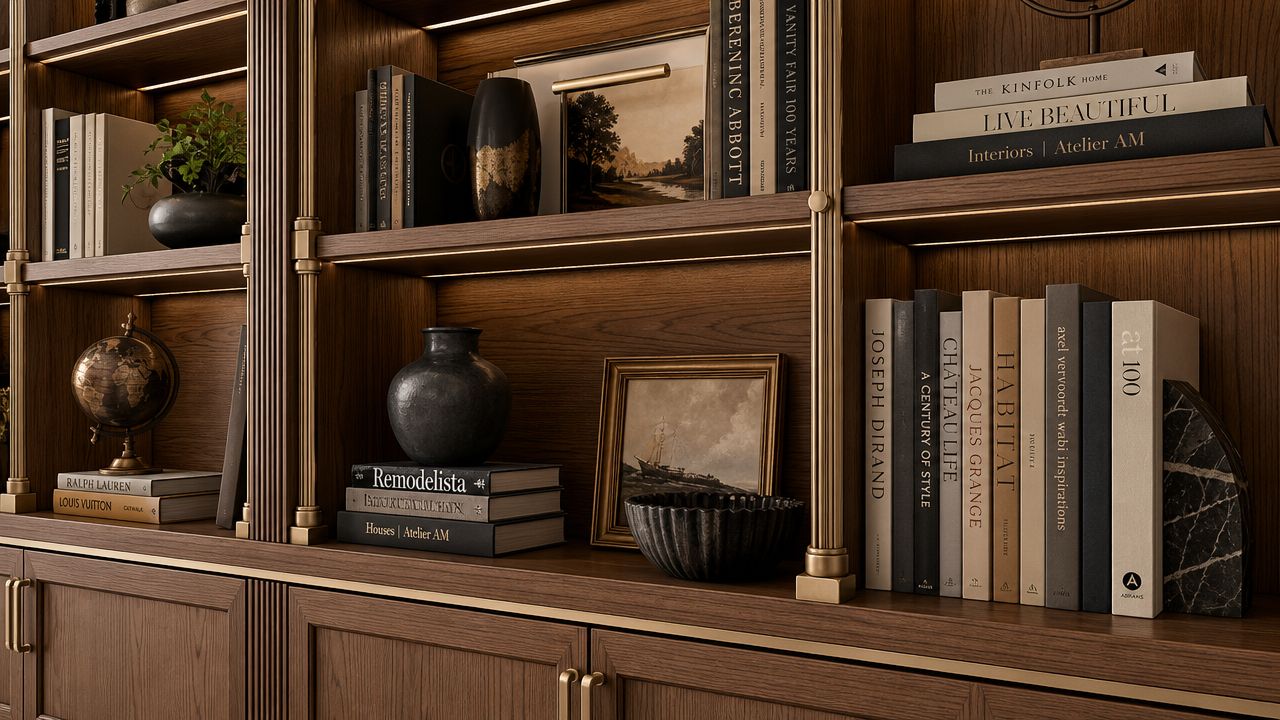
Built-in millwork
Built-ins are the most integrated option. They're designed to meet the room precisely, often wall to wall and floor to ceiling, with fillers, scribing, and trim details that make the unit feel native to the architecture.
This route suits homeowners who want permanence and a custom finish. It's often the strongest answer for alcoves, uneven walls, sloped ceilings, and rooms with awkward interruptions where standard pieces leave distracting gaps.
Best for
- Architectural rooms where the shelving should read as part of the home itself
- Irregular spaces with angles, bulkheads, or imperfect plaster
- Long-term plans where the family intends to stay and invest in bespoke work
Trade-off
- It's the least flexible if the room's function changes later.
Modular systems
Modular shelving sits between custom millwork and movable furniture. It carries a more design-forward spirit, and its history is tied to the idea that storage can behave like both architecture and furniture. That concept has deep roots, and the milestone often cited is Rams' 1960 system, referenced above.
The practical advantage is adaptability. Heights, bays, shelf positions, and accessories can be adjusted over time, which is useful in rooms that need to evolve from study to family room to library. A well-considered modular shelving system can also achieve a bespoke look without requiring every element to be site-built.
Designer's Insight
A modular wall works best when it's treated as a room-wide composition, not a collection of separate parts. Consistent spacing, repeated finishes, and disciplined styling are what make it feel bespoke.
Curated freestanding compositions
This approach uses a series of matched or closely related bookcases aligned across a wall. It can be surprisingly effective when the room needs presence but doesn't justify full built-in work.
Freestanding compositions are often the gentlest intervention. They preserve flexibility, can move with the homeowner, and may suit heritage properties where permanent alteration isn't desirable. They also pair well with layered interiors where furniture should feel collected rather than fixed.
Here's the simplest way to compare the three:
| Approach | Strength | Limitation | Visual effect |
|---|---|---|---|
| Built-in | Exact fit and strongest architectural presence | Least adaptable later | Seamless and tailored |
| Modular | Flexible and design-forward | Needs careful planning to avoid a pieced-together look | Light, refined, adaptable |
| Freestanding | Movable and easier to rework | Usually less integrated with the room envelope | Collected and furniture-led |
A room doesn't need the most permanent solution to become memorable. It needs the solution that respects the architecture, the family's habits, and the desired sense of finish.
Selecting Materials for Timeless Craftsmanship
Materials determine whether a shelving wall looks crisp in ten years or tired in two. The choice of materials dictates whether projects endure unobtrusively or fail visibly. Shelves that bow, veneers that chip, and finishes that feel thin almost always begin with poor material choices rather than bad styling.

What holds its line over time
For long spans, thickness and stiffness matter. Guidance on wall shelving identifies 18 mm birch or hardwood plywood as a strong baseline material because the added thickness improves bending stiffness and helps reduce visible deflection, especially over longer runs, as explained in this shelving material guide.
That's not a small technical detail. A shelf that performs well over a short opening may look entirely different when stretched across a broad wall. The eye catches sag immediately, especially in rooms with clean sightlines and minimal ornament.
When reviewing materials, these questions matter more than surface appearance alone:
- Core stability determines whether the shelf stays straight under real household use.
- Edge treatment affects durability at the most visible line of the shelf.
- Finish depth influences how well the material resists daily abrasion.
- Span planning should be considered alongside material choice, not afterward.
For homeowners comparing options, a useful companion read is this guide to choosing the right hardwood for longevity and style, particularly when the shelving must relate to existing wood furniture in the room.
Where beauty meets structure
Solid wood offers warmth, grain variation, and a sense of artisanal permanence. It's often ideal for face frames, doors, and visible trim where tactility matters most. Veneered plywood can be equally refined when the veneer is well selected and the construction is sound. It often provides better dimensional stability for broad components.
Metal introduces another layer of character. Slim uprights, brackets, or supports can make a shelving wall feel lighter and more contemporary. In traditional interiors, metal is often best used sparingly so the room still feels grounded in warmth rather than utility.
Good shelving materials don't just survive the load. They preserve the line.
A practical selection process usually follows this order:
- Choose the room mood first. Quiet oak, richer walnut tones, painted finishes, or mixed materials all change the room's voice.
- Match the structure to the span. Long shelves need sturdy material and thoughtful support.
- Select finishes for use, not only colour. A library, family room, and home office each wear differently.
- Check how the shelving speaks to neighbouring pieces. The wall should belong to the room's broader furniture story.
Timeless craftsmanship isn't a style. It's the visible result of sound construction, disciplined detailing, and materials chosen with patience.
Planning Your Bespoke Wall System
A strong shelving wall begins long before fabrication. Planning is what separates an elegant installation from an expensive compromise. Most frustrations with wall to wall shelving units come from assumptions made too early. The wall looks flat until someone measures the baseboard projection, the outlet placement, the ceiling drift, or the slight lean in an older plaster surface.

Measure the room that exists, not the room on paper
The first responsibility is accuracy. That means measuring wall width in more than one place, checking ceiling height at several points, locating vents, switches, returns, thermostats, and door swings, and noting every obstruction that could affect the final design.
This becomes even more important in homes with irregular geometry. Practical guidance for rooms with angled walls, alcoves, and sloped ceilings shows that a custom-built unit or a scribed frame is often the right answer rather than an off-the-shelf installation, as seen in this discussion of shelving for irregular spaces. Clean drawings matter, but so do templates and site verification.
A helpful habit during planning is to remove loose clutter before measuring. Temporary paper files and keepsakes can be packed into sturdy archive boxes so the wall and floor lines remain visible while dimensions are taken.
Plan around what the shelves must hold
Not every shelf has the same job. Books are dense. Ceramics create point loads. Decorative objects often need less strength but more breathing room. A library wall, a media wall, and a display wall may all look similar at first glance, yet they require different depths, spacing, and support logic.
Professional guidance for Ontario homes places the emphasis where it belongs. The assembly should be anchored directly to wall studs so the load is carried by the home's structure, not by drywall alone, as outlined in this built-in shelving installation guidance.
A design review should answer these practical questions:
- What belongs on the wall. Books, framed art, baskets, files, sculpture, or concealed storage all ask for different dimensions.
- How deep should the shelves be. Greater depth adds utility, but it also increases visual weight.
- Where should closed storage sit. Lower cabinets often calm a room by hiding necessary but unattractive items.
- How should cables and lighting be handled. These details are easier to solve before fabrication than after installation.
The safest shelving wall is the one designed as a single structural idea, not a decorative afterthought attached to drywall.
Treat the room as a complete composition
A design studio adds value. Shelving should never be decided in isolation from seating, lighting, traffic flow, window treatments, and the rug that anchors the room. In a complete room concept, the wall isn't competing with the furniture. It's supporting it.
That's why many homeowners benefit from professional interior design services in Toronto, particularly when the room must satisfy more than one purpose. A living room may need to display books, conceal technology, hold family photographs, and still feel gracious enough for entertaining. Those priorities affect proportions, finishes, and where visual emphasis belongs.
A well-planned shelving wall often includes three layers of thinking:
| Layer | What it solves |
|---|---|
| Architectural | Fit, alignment, anchoring, and relationship to the room envelope |
| Functional | Storage needs, item types, cable management, and maintenance |
| Aesthetic | Proportion, finish, symmetry or asymmetry, and how the wall supports the whole room |
When these layers are resolved together, the final wall feels calm. It doesn't strain for attention. It completes the room.
From Showroom to Sanctuary The Installation Process
Installation is where intention becomes reality, and it's where shortcuts become obvious. A beautifully specified unit can still disappoint if it isn't level, properly anchored, or carefully fitted to the imperfections of a real home.
What professional installation actually solves
Walls are rarely perfectly plumb. Floors often drift. Corners may be out of square. A successful installer accounts for those conditions through shimming, scribing, and adjustment so the finished piece sits cleanly against the architecture rather than exposing every irregularity.
Load also becomes real at this stage. Professional wall-mounted systems are often rated for up to 100 lbs of static load per bracket, and shelf depths can range from 4 inches to 24 inches, but that performance depends on fastening quality and attachment to structural members, as described in this technical overview of wall-mounted shelving. The headline number means little if the bracket spacing is wrong or the wall condition hasn't been assessed properly.
For homeowners outside Ontario who are comparing service expectations, a market example such as Sydney furniture assembly services can be useful because it highlights how much precision large-piece assembly really requires.
Why white-glove service matters
White-glove delivery isn't about formality. It's about continuity of care. The team that brings a large shelving system into the home should protect floors, manage packaging, place components accurately, complete assembly, and leave the room ready to live in.
That standard matters across the Greater Niagara, Hamilton, and Toronto markets, where many homes contain tight stair runs, finished surfaces, and architectural details worth protecting. For substantial pieces and room-scale systems, professional furniture assembly services help ensure the transition from showroom to home feels smooth rather than disruptive.
- Placement precision protects sightlines and circulation.
- Structural fastening protects the household.
- Site cleanup protects the experience of the room itself.
A shelving wall should arrive as an enhancement to the home, not as a construction problem left behind for the homeowner to solve.
Styling Your Shelves A Curator's Guide
Once the structure is complete, the wall becomes personal. This is the moment when shelving stops being joinery and starts becoming narrative. Good styling doesn't mean filling every opening. It means deciding what deserves presence, what should recede, and how the eye should travel across the room.

Build the arrangement in layers
A well-styled wall usually combines books, objects, framed art, and negative space. Books establish rhythm. Objects provide relief from straight lines. Art softens repetition and introduces a more intimate scale.
The wider design context matters too. Shelves don't float independently from the rest of the room. They should speak to the upholstery, lamps, and especially the rug. In a design studio setting, rugs are often approached as Art for your Floor, because they establish palette, movement, and emotional tone. Shelves then become the vertical continuation of that story.
For homeowners refining a broader renovation, these essential design tips for renovations offer a useful framework for keeping proportion, balance, and cohesion in view.
A simple styling sequence works well:
- Start with the largest visual anchors. Stacks of books, framed pieces, or a substantial vessel give the wall structure.
- Add medium-scale objects. Boxes, ceramics, or sculptural forms prevent the arrangement from feeling flat.
- Edit aggressively. Empty space is part of the composition, not unused real estate.
- Step back often. Shelving is read from across the room, not from six inches away.
Use restraint to create presence
A common mistake is even distribution. When every shelf carries the same visual weight, the wall becomes static. Better rooms allow variation. One bay may be book-heavy, another object-led, another mostly open.
This is also where practical value intersects with aesthetics. The global shelving units market is projected to reach $21.6 billion by 2034, according to this market outlook on shelving demand, which reflects a larger reality in high-value real estate markets. Homeowners want storage that earns its place by improving both organisation and the quality of the room.
Shelves should hold enough to tell a story, but not so much that the story becomes noise.
Those who want a more room-by-room approach can explore practical ideas for how to decorate shelves in any room.
A curated wall often benefits from these finishing choices:
- Vary book orientation with some upright rows and some horizontal stacks.
- Repeat one or two materials such as ceramic, brass, or dark wood to create continuity.
- Use closed storage below if the room carries everyday clutter that shouldn't remain on display.
- Let one shelf stay quiet so more expressive groupings have room to breathe.
A beautifully styled shelving wall doesn't look busy. It looks considered.
Begin Your Home's Next Chapter
Wall to wall shelving units are rarely just about storage. At their best, they bring order to a room, dignity to personal collections, and architectural character to a surface that once felt unresolved. That's why they endure. They answer practical needs while deepening the emotional quality of the home.
The most successful examples share the same foundations. They're planned carefully, built from materials with integrity, installed with precision, and styled with restraint. They belong to a complete room concept rather than standing apart from it.
For homeowners in St. Catharines and across Southern Ontario, that's where a century-old, family-run perspective still matters. Timeless craftsmanship isn't created by rushing to fill a wall. It comes from understanding how millwork, furniture, rugs, lighting, and daily life must work together.
Experience the craftsmanship in person at Critelli Furniture through a visit to the King Street Showroom, book your complimentary design consultation today, or visit the Rug Market to find your room's foundation.