
What Is Hand Tufted Wool Rug Mean in a Home

A hand-tufted wool rug is wool yarn pushed through a stretched fabric backing with a hand tool, then secured with adhesive and a secondary backing, not tied knot by knot. Wool supplies the fibre you see and touch, and tufting names the method that holds that fibre in place.
So why does a handmade rug have glue in it?
That question is the one most showroom conversations skate past, and it's the one that decides whether a rug survives a decade of Sunday mornings and dining chairs. Tufted construction is mainstream rather than niche: Canada imported approximately US$416 million of tufted carpets in 2024, according to IndexBox's figures on the Canadian tufted carpet trade. That total covers every tufted build rather than hand-tufted wool alone, which is exactly why the words deserve a precise meaning.
Four rugs can wear the same pattern and share almost nothing underneath. Learning to read the construction takes a few minutes and pays off for the life of the piece.
What a Hand-Tufted Wool Rug Means
Memorise one sentence and the rest of the showroom gets easier. Wool yarn is pushed through a taut foundation cloth with a handheld tool, then locked from behind with adhesive and a second backing. Nothing is tied. That single detail separates the rug from hand-knotted work, where a weaver builds the pile knot by knot and the knots themselves become the structure.
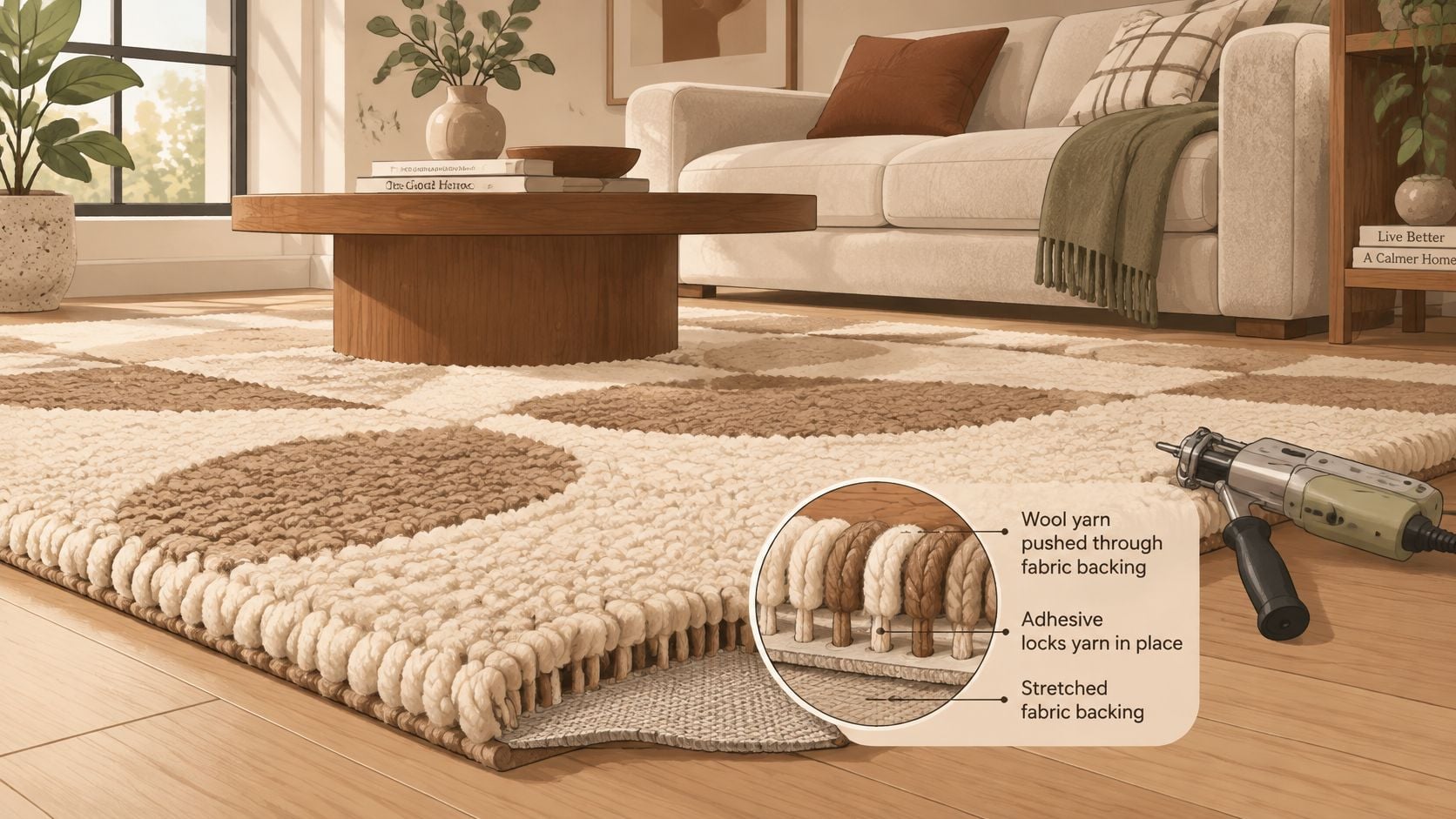
The canvas analogy. A stretched painter's canvas is the closest comparison on the floor. Each pass of the tufting tool plants a loop or a cut tuft exactly where a brush would lay colour, and the maker follows a pattern drawn on the cloth rather than a grid memorised over years. Fill the outline, fill the field, shear the top so the surface reads evenly. The foundation cloth works like the canvas and the wool works like the paint, which is why a tufted rug can carry a large-scale medallion or a sweeping abstract that would take a knotted loom far longer to produce.
That speed is also where buyers get tripped up. A client who falls for a bold medallion in hand-tufted wool shouldn't be told it's the same animal as a loom-tied heirloom, and she shouldn't be told it's a factory rug either. It sits between those two poles, and the price position reflects it: real handwork in the tufting, real machinery nowhere in sight, and a construction that trades knot-count prestige for pattern freedom.
What the hang tag leaves out
A tag that reads "wool" describes only the face you walk on. It says nothing about the layers doing the structural work underneath, and those layers are what decide how the rug ages once the new-rug smell fades.
The same caution applies to origin language. A rug sold in Ontario may have been tufted on another continent from fleece grown somewhere else again, because wool growing, wool processing and rug making are three separate economies that rarely share an address. When provenance matters to you, ask where the piece was built rather than where it was bought, and treat the answer as one fact among several rather than a verdict.
Heirloom quality is decided by construction, and the hang tag rarely shows it.
How Artisans Build a Hand-Tufted Wool Rug
The first decision happens before any wool enters the cloth: the primary canvas is pulled tight across a frame, because slack fabric lets tufts land at uneven density and the finished face records every wobble.
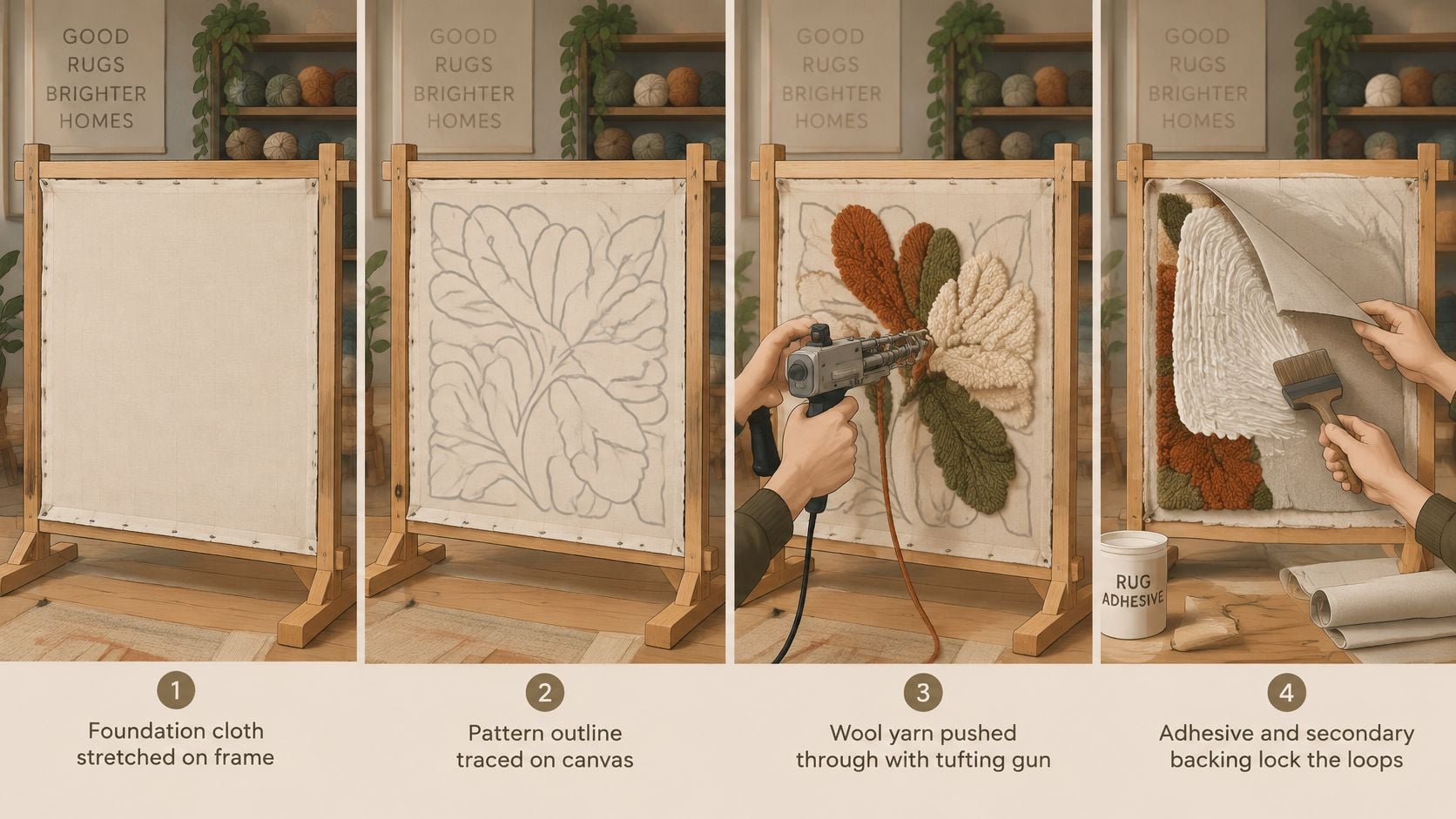
- Stretch the primary canvas on a frame. Tension is what keeps the rows even, so the maker checks the cloth the way a upholsterer checks a seat before covering it.
- Trace the design onto the cloth. The tool follows a drawn line rather than memory, which is what makes an intricate repeat possible in a tufted build at all.
- Push the wool through with a hand-operated gun. Loop pile, cut pile or a mix, chosen because pile type decides how light sits on the surface and how the rug feels in bare feet.
- Shear the face and carve the heights. Even shearing keeps the pattern crisp, and where the design calls for it the maker cuts shallower and deeper channels so contours read as texture instead of flat colour.
- Apply adhesive to the reverse. This is the step that turns threaded yarn into a rug, since without the bond a chair leg or a vacuum head can pull a tuft free.
- Add a secondary backing, often cotton canvas. It stabilises the sheet and cushions the pile, and it is the layer that later decides what cleaning the rug can survive.
- Bind the edges and finish the face. Edges take more abrasion than any other part of a rug, so the binding is where a well-made piece announces itself.
A finished hand-tufted area rug is the sum of those layers: yarn arranged as loops, cut pile or a combination, then locked in place rather than knotted. That single choice explains the range of textures a tufted face can hold, and it explains why the materials underneath matter as much as the wool on top. The pile gives a room its colour and softness. The adhesive and backing decide how long it keeps them.
What the reverse should show in person
Turn the rug over before it becomes the foundation of a room. A properly finished piece shows an even secondary backing with no ripples and no soft spots, plus edges that sit flat and bound tight. Lift one corner. The whole sheet should move as a single unit, never as a face parting company with its backing.
Where a glued build does not suit the space, flatweave is the other route: hand-woven area rugs interlace warp and weft, so the face holds without a layer of tuft adhesive at all.
How Hand-Tufted Wool Compares with Other Rugs
Four constructions cover almost everything standing on a showroom floor, and the differences that matter are visible from the back.
| Construction | How the face is made | What holds it | Time and price position | Durability and care limit |
|---|---|---|---|---|
| Hand-tufted wool | Wool pushed through a backing with a hand tool as loops or cut pile | Adhesive plus a secondary backing | Faster and usually lower priced than hand-knotted, still manual | Density and backing decide wear, never soak-washable |
| Hand-knotted | Individual knots tied on the warp | The knots themselves | Slowest and typically the highest price, heirloom quality | Often repairable, no glue layer holding the pile |
| Power-loomed or machine-tufted | Machine inserts the yarn | Factory backing system | Fastest and usually the lowest price | Quality varies widely, limited hand repair |
| Hand-woven flatweave | Warp and weft interlaced with little or no pile | The weave | Moderate time and price | Strong for traffic, care differs because there's no tuft adhesive |
The purchase-changing difference sits in what holds the face. A maker working on backing cloth traces or fills a pattern, so a detailed design arrives sooner and usually costs less than fully hand-knotted work while still being made by hand. A hand-knotted rug works the other way around, with the knots carrying the structure and nothing to separate later. The trade draws the same line: tufted floor coverings sit in a category of their own, distinct from woven, non-tufted carpets, and wool or fine animal hair tufted products are identified separately under heading 57.03 in the Statistics Canada carpet classification table.
The ten-second reverse-side test
Flip the rug. A hand-tufted piece shows a glue layer and a secondary backing, no rows of knots, and a front pattern that often doesn't mirror through to the back. A hand-knotted rug shows rows of individual knots and a reverse that echoes the front. A power-loomed rug usually shows the pattern faintly plus a machine-woven grid. One look tells you more than a paragraph of marketing copy.
A homeowner furnishing a formal living room meant to last decades weighs the decision differently from one refreshing a dining room before the next design update. Walking through the comparison in hand-knotted rugs versus hand-tufted rugs makes it easier to decide which room earns which construction.
What to inspect before you commit
Trust the face and the paperwork rather than the phrase on the tag. Press your fingers into the pile. A dense tufted face resists opening down to the foundation cloth, springs back after a chair leg has sat on it, and resists the appearance change that sparse piles show under furniture and feet. Check the shearing next: an even finish reads clean across the room, while patchy height points to rushed finishing unless the carving is deliberate in the pattern. Then ask what the warranty covers, because a guarantee that addresses pile wear but stays silent on the materials underneath tells you where the main risk sits. Loose yarn and a visible foundation point to construction or finishing problems that announce themselves early in daily use.
Practical rule: Read a hand-tufted rug's construction from the back and its quality from the face.
Wool Pile Versus the Materials Underneath
Wool earns its reputation: it buffers moisture, springs back after a heavy chair and holds dye with depth. None of that is what keeps the tufts in place. In a hand-tufted rug the yarn travels through a chain of materials rather than rows of knots: the yarn itself, the primary canvas, the adhesive and the secondary backing, the layer that gives the rug its stability and cushioning underfoot. Four materials, one chain, and the weakest link sets the lifespan.
That chain also decides how the rug behaves around water and how it sits in a room's air. Excess water, steam or lingering damp can soften latex and other bonding materials, separate the backing, leave odour behind or release fibre, so a hand-tufted wool rug should never be treated as washable whatever its pile content says. Emissions deserve the same attention, since indoor air quality is among the factors worth checking when bringing a floor covering into a home, as the Health Canada indoor air quality guidance for professionals explains.
Questions worth asking before the rug is rolled
- Is the pile 100 percent wool? A wool face blended with synthetic fibre behaves differently under a hot iron, a pet accident or a professional wash.
- What is the primary backing made from? Cotton canvas and synthetic scrims age differently and tolerate different cleaning.
- Which adhesive and secondary backing are used? That pair decides whether a rug survives a spill that soaks through, more than the pile fibre does.
- What does the care label permit? A label reading only "professional cleaning" is telling you the bond isn't built for water.
- Is the labelling clear, and does the rug meet Canadian flammability requirements? Floor coverings sold in Canada must meet the flammability requirements set out under the Hazardous Products Act.
Those checks are what separate a curated selection from an impulse purchase, and they support a design-forward room that still works in five years.
Where a Hand-Tufted Wool Rug Belongs
A rug does a job in every room, and the job changes with the furniture standing on it. Three Southern Ontario rooms show how the same construction behaves differently.
A St. Catharines living room, in a New Traditional or Casual Traditional key. A neutral hand-tufted wool with a quiet figure lets a wood cocktail table sit on something warm and lets the upholstery carry the colour, rather than having the floor and the sofa argue across the room.
A Hamilton dining room. Dining chairs move twice a day, so a denser, low-to-medium pile makes more sense than a deep luxurious one, which crushes along the chair line within a season. If texture is what the room wants, a carved pattern supplies it without the height.
A Toronto study. A smaller hand-tufted piece works as a design-forward accent rather than wall-to-wall coverage, and a quiet palette keeps the eye on the bookshelves and the desk. The rug finishes the room instead of anchoring a whole seating plan.
Designer's Insight: A bold leather chair pairs well with a neutral hand-tufted wool rug because the two materials divide the work. The leather carries the visual weight, and the wool keeps the space from becoming a collection of competing statements.
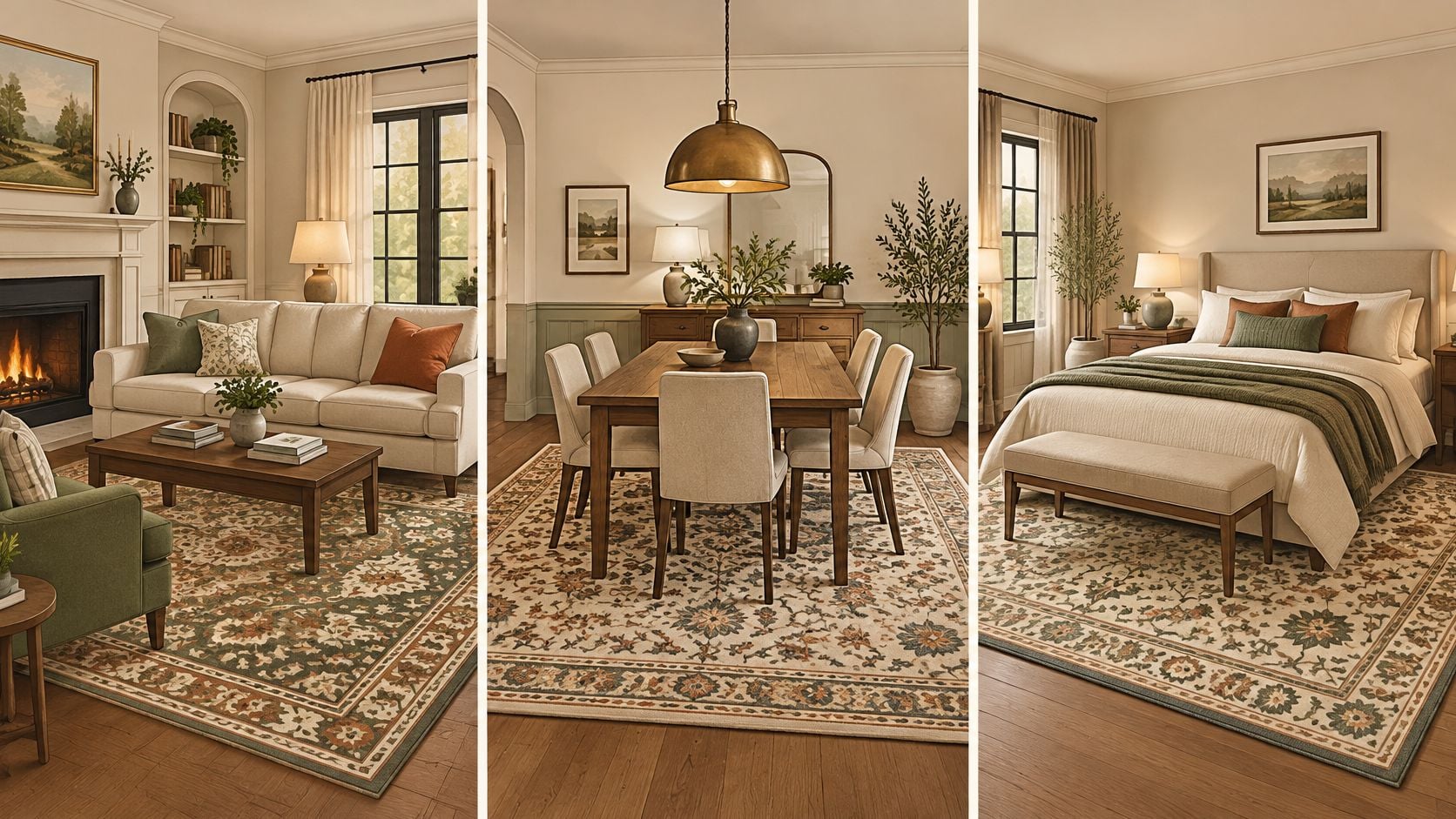
Scale decides as much as colour does. The right rug sits under the front legs of the main seating or defines the whole conversation area, so a sofa never floats half on and half off the edge. The practical test is area rug placement, and a rug that only appears in front of the sofa like a large mat is too small for the room it's in.
Match the rug to the room's traffic, then let pile height and palette follow. A dining room asks for density, a study asks for quiet, and a living room can afford the plusher face because nothing scrapes across it twice a day.
Shedding Spills and Everyday Wool Care
A new hand-tufted wool rug will shed at first. Cutting the yarn leaves short ends on the face, and ordinary foot traffic works them loose during break-in. Construction trouble looks different: long strands drawing out, canvas or latex showing through, thinning patches, edges lifting, or shedding that stays heavy after the early period. Those signs call for a professional assessment and a pause on aggressive vacuuming.
| Sign | What it usually means | Action |
|---|---|---|
| Loose fibres in the first weeks on a new cut-pile face | Normal break-in from cut yarn ends | Vacuum with suction only and no power brush |
| Long strands pulling out of the face | Construction warning | Stop aggressive vacuuming and seek a professional assessment |
| Visible backing or thinning patches | Construction warning | Stop cleaning and seek a professional assessment |
| Loose or lifting edges | Construction or finishing problem | Have the edge checked before the rug goes into use |
| Severe shedding that continues | Possible construction failure | Seek a professional assessment |
Break-in varies with pile type, yarn quality, traffic and vacuum settings, so treat early fluff as a settling stage and watch the pattern. A wool face still tells only part of the story. The backing, the adhesive and the way the rug handles Canadian humidity, winter grit and summer sun decide durability more than the fibre label.
The routine that protects the rug comes from conservation practice. Wool absorbs an exceptional quantity of water, and once wet its fibres are easier to distort or break, so spills get blotted immediately and never rubbed. Vacuum with a standard head, low suction and no power brush, moving slowly in the direction of the pile. Heat strips the natural oils that keep wool supple, and high humidity can damage fibres and contribute to colour bleeding, as the Canadian Conservation Institute textile care guidance explains.
In a Southern Ontario home that means a pad cut to the rug's exact footprint, rotation every few months so traffic and furniture crushing are shared, shade from prolonged direct sun, and professional cleaning once soil works down into the pile.
Never soak a hand-tufted rug or put it through a machine without checking the backing. The face survives water far longer than the bond does.
Where feet never stop, construction chosen for the job beats thickness every time. Choosing the best rug for a high traffic area comes down to how securely the face is held and whether the backing can take cleaning. The fibre logic carries over from clothing: the principles behind how to clean a wool coat, from CleanOnline, North York's premium dry cleaners, apply to a wool rug face: blot, keep heat away, and dry with moving air.
See the Rug Before You Decide
A screen cannot show pile density. In the hand, a dense tufted face springs back, the edge binding reveals whether it is tight enough to resist fraying, and the reverse shows whether the adhesive coat is even, fully covered and firmly bonded.
Set a hand-tufted wool rug beside a hand-knotted piece and turn both over in the same daylight. The tufted reverse presents a continuous backing over adhesive, while the knotted reverse mirrors the pattern knot by knot. That quick flip explains the key divide: a wool face can still rely on glue underneath, so backing and bond decide how the rug ages.
Critelli Furniture's designers can place that rug inside a full-room plan, from architectural lighting and fabric to layout, for homes across Greater Niagara, Hamilton and Toronto. White-glove delivery covers inspection, assembly where needed, precise placement and packaging removal.
Choose colour after those checks, because a pile that reads warm under showroom spots can sit cooler beside north-facing windows or oak floors. These rug colour selection guidelines keep a bespoke scheme steady once the samples come home.
Critelli Furniture has furnished Southern Ontario homes from its King Street showroom in St. Catharines since 1914, and its Rug Market is arranged for exactly this decision, with hand-tufted wool beside hand-knotted work and the backing under your hand. Bring room dimensions, fabric samples and questions about traffic, pads and cleaning, and the design team will place the rug inside a complete room concept. Visit Critelli Furniture to plan the visit.