
Design Custom Dining Room Tables for Your Home

You’ve likely had the same experience many of our clients describe. You find a dining table with the right proportions, but the timber feels flat. Or the wood is beautiful, yet the finish fights with your flooring, your lighting, or the architecture of the room. By the time you’ve visited a few showrooms, compromise starts to feel built into the process.
It doesn’t have to be.
A well-designed custom dining table solves a very specific problem. It lets the room, the way you live, and the character of your home lead the decision. That’s why custom dining room tables remain one of the most meaningful commissions in a home. They are not merely functional surfaces. They become the setting for holidays, ordinary weeknight dinners, work sessions, school projects, and the conversations that define a family.
The Heart of the Home An Heirloom in the Making
The dining table tends to carry more emotional weight than almost any other piece in the home. Sofas offer comfort. Beds offer rest. A dining table hosts life in motion. It gathers people repeatedly, often for years, and that’s precisely why a bespoke piece deserves more thought than a quick purchase.
Since 1914, our family has worked with homeowners who wanted something more enduring than a short-term trend. The strongest commissions always begin the same way. A client isn’t asking for “a table.” They’re asking for a room that feels settled, personal, and complete. In Southern Ontario, where heritage homes, newer builds, and urban layouts all sit side by side, a custom piece often resolves tensions that ready-made furniture can’t.
A dining table should feel as though it belongs to the house, not as though it was squeezed into it.
That sense of belonging comes from proportion, material, and intention. A round form may soften a rigid room. A long plank top may add gravitas to a newer interior that needs a bit of depth. For some homes, a custom-built solid wood round dining room table creates the right balance between intimacy and ease of movement.
If you’re also thinking about presentation and how a dining room reads at first glance, the visual principles used by designers and stagers often overlap. These tips for real estate dining room staging are useful because they show how strongly a table influences the mood and perceived value of a space.
Establishing Your Design Foundation
A custom commission starts with the room, not the wood species. That’s the distinction many first-time buyers miss. The finest table in the wrong scale will still feel wrong.

Measure the room as people use it
Take the dimensions of the room, but don’t stop there. Note where doors swing, where sideboards sit, where a chandelier hangs, and where traffic naturally passes when guests arrive or children move in and out. A table lives in relationship to all of that.
A practical way to begin is to mark the proposed footprint on the floor with painter’s tape. It’s far more revealing than a sketch on paper. You’ll see immediately whether chair backs intrude into a walkway or whether the table leaves too much empty perimeter and feels adrift.
Consider these points before settling on a size:
- Entry path: Watch how someone enters the room carrying serving dishes, shopping bags, or a child on one hip. If movement feels tight during a quick walk-through, it will feel worse during a dinner party.
- Sightlines: Look from adjoining rooms. The table should hold visual presence without blocking the room’s architecture.
- Companion pieces: Buffets, display cabinets, and even built-in cabinetry in Toronto homes can affect what shape and scale feel natural in an open-plan layout.
Think in complete room concepts
At our Design Studio, we don’t treat the dining table as a standalone purchase. We build a complete room concept. That means the table must work with dining chairs, lighting, drapery, art, and nearby finishes. In many homes across St. Catharines, Greater Niagara, Hamilton, and the Toronto market, the dining area is visible from at least one adjoining space. The table has to hold its own from every angle.
This is also where the rug becomes essential. The Rug Market has long shaped the way we approach dining spaces because rugs do more than soften acoustics. They establish the room’s boundaries, introduce texture, and often decide whether the entire setting feels formal, relaxed, refined, or contemporary.
Practical rule: Choose the rug first when the room needs identity. Choose the table first when the architecture is already doing most of the talking.
Let the room tell you what’s missing
Some rooms need warmth. Others need order. A custom table can provide either, but only if you’re clear on what the room lacks. If the space already has heavy millwork and strong architectural lines, a lighter base and softer edge profile often bring relief. If the room feels scattered, a stronger silhouette can give it centre.
That’s why the early planning phase matters so much. It makes every later decision easier.
Curating Materials and Artisanal Finishes
Material selection is the point where a custom table stops being an abstract idea and starts becoming part of your home. Clients often arrive focused on colour or species. In practice, the better question is how the table needs to live. A surface that looks beautiful under evening light may also need to stand up to weekday breakfasts, holiday serving pieces, and years of regular use.

What each wood brings to the room
Walnut has depth and restraint. It suits dining rooms that already carry a sense of permanence, especially in heritage homes where richer tones feel at home.
Oak reads more architectural. Its grain gives a table presence, which can be a gift in a room that needs structure, but it needs careful company. Pair oak with heavy flooring, dark cabinetry, and substantial chairs, and the room can start to feel overburdened.
Cherry has a quieter warmth. It matures beautifully and rewards patience, which is one reason it continues to appeal to clients furnishing long-term homes rather than chasing a short-lived look. Maple offers the opposite kind of clarity. It brings lightness and discipline, especially in interiors that need brightness but still want natural character.
For many Southern Ontario homes, locally sourced hardwoods make sense for reasons beyond sentiment. They connect the piece to regional craftsmanship, they are often easier to source consistently during production, and they suit the balanced, layered rooms we see across Niagara, Hamilton, and the Toronto area. Provenance matters in bespoke furniture because it shapes the whole commission, from timber selection to the story you tell when the table has been in the family for twenty years.
Some clients want a cleaner grain or a material with a more international character. In those cases, curated pieces such as solid teak dining tables with heirloom appeal can suit a more bespoke, modern room.
Local wood versus imported drama
There is no correct answer here. There is only the answer that fits the house.
Ontario hardwoods usually bring steadiness and familiarity. They work well in complete room schemes where the table must sit comfortably with older case goods, classic upholstery, or inherited pieces. Imported species and highly figured slabs create more drama. They can be stunning, but they ask the rest of the room to stay disciplined, particularly with rugs, lighting, and artwork.
A simple comparison helps clarify the trade-offs.
| Material direction | What works well | What to watch |
|---|---|---|
| Local maple or black walnut | Strong regional character, easier coordination with Canadian interiors, dependable choice for timeless rooms | Better for clients who value nuance over a bold statement |
| Oak with visible grain | Strong presence in heritage and design-led spaces, forgiving for regular family use | Can feel too weighty with dark floors, large chandeliers, and substantial seating |
| Highly figured live-edge slabs | Memorable focal point in restrained interiors, especially where surrounding finishes are quiet | Can dominate smaller rooms and compete with patterned rugs or expressive millwork |
The best table is the one that still feels right after the room has changed around it.
Finishes determine how the table ages
Finish affects far more than sheen. It decides how the table feels to the hand, how easily it marks, and whether daily use leaves visible history or very little trace.
A protective finish suits households that want easier maintenance and less worry during everyday meals or larger family gatherings. Hand-rubbed oil finishes offer warmth and depth that many clients love, particularly on walnut and oak, but they ask for a bit more care and a willingness to accept patina over time. Neither approach is superior. I usually advise clients to choose based on temperament as much as aesthetics. Some people want a table that shrugs off use. Others want one that records it gracefully.
Edge treatment and stain tone deserve the same attention. A softened edge can make a substantial top feel more inviting. A low-sheen finish often reads richer and more believable than a high gloss surface, especially in rooms built around heritage references. These details sound minor on paper. In person, they are often what make a bespoke table feel calm, convincing, and built to last.
Defining Your Style Through Shape and Form
Once the material direction is clear, the table’s shape begins to define how the room behaves. Shape influences conversation, circulation, and visual rhythm more than most clients expect.
Round, rectangular, oval, or square
A round table tends to feel welcoming and conversational. It removes hierarchy. No one sits at the “end,” and movement around it is often more fluid. That makes it especially effective in rooms that need softness or in homes where everyday use matters more than formal entertaining.
Rectangular tables bring order. They suit long rooms, larger gatherings, and spaces where the dining area needs a strong architectural line. They also sit naturally in more traditional rooms.
Oval forms often bridge the two. They retain the length of a rectangular table but soften the perimeter. Square tables can work beautifully in compact or symmetrical rooms, though they require careful scaling to avoid feeling blocky.
For anyone comparing options in a more detailed way, this guide to maximizing your dining space with table shapes and seating arrangements is a useful companion.
The base changes more than the silhouette
Many people choose a top shape first and treat the base as secondary. In practice, the base affects legroom, visual weight, and the emotional tone of the piece.
- Trestle base: Strong, established, and ideal when you want presence. It often suits farmhouse, transitional, and heritage-inspired interiors.
- Four corner legs: Familiar and versatile. This approach usually feels lighter and can be easier to pair with a wide range of dining chairs.
- Pedestal base: Elegant and practical in the right setting. It simplifies seating and works especially well on round tables.
Details that signal bespoke quality
Joinery, edge profile, and apron detail are where custom dining room tables begin to separate themselves from generic options. A softly chamfered edge can make a substantial top feel refined. A straight edge reads cleaner and more contemporary. A gently eased profile often feels timeless because it never tries too hard.
Brands such as Stickley have long demonstrated how joinery itself can become part of the table’s identity. That lesson applies broadly. Bespoke quality often shows in restraint. The table doesn’t need ornament everywhere. It needs conviction in the right places.
If you’re torn between two styles, choose the one that still feels composed when the room is empty. Flowers, tableware, and guests should enhance the table, not rescue it.
Navigating the Bespoke Journey Budget and Process
A first custom table usually feels expensive until the client can see what the investment is solving. The right piece settles scale, circulation, seating, and material continuity in one decision. It also sets the tone for the rest of the room, which matters even more in homes where the dining area connects directly to the kitchen or great room.
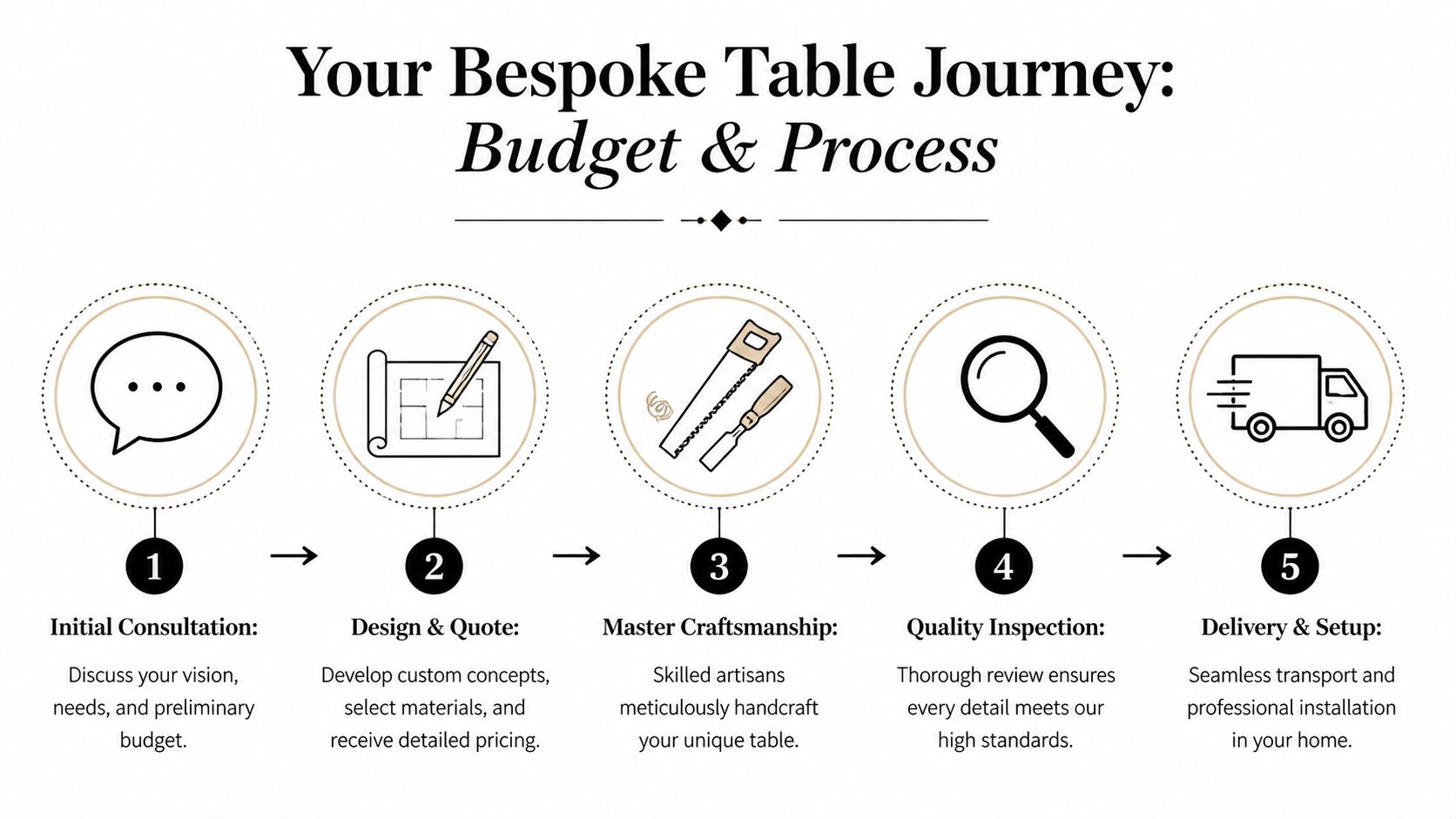
What drives the investment
Custom pricing varies widely, and it should. A solid-wood table built in Southern Ontario will be shaped by four practical factors: size, wood species, base construction, and finishing work. White oak with a straightforward base will price differently from walnut with hand-applied stain matching, a more involved pedestal, or reinforced extension leaves.
The better question is not "Why does custom cost more?" It is "What am I buying that stock furniture cannot solve?" In a well-run commission, the answer includes proper proportion, stronger construction, finish control, and a table made to suit the room instead of forcing the room to accommodate the table.
I often advise clients to budget for the piece they want to keep for decades, not the one that merely gets the room furnished this season.
The process works best when decisions happen in the right order
Order matters. When clients rush to wood colour before confirming dimensions, or approve a shape before discussing chair count, revisions become expensive and the project feels harder than it needs to.
A clear custom sequence usually looks like this:
Initial conversation
Bring room measurements, photographs, inspiration images, and notes on how you use the space. Daily family meals, holiday hosting, and open-concept sightlines all affect the brief.Design refinement
Proportion, material, finish, and construction details become specific. In many projects, the table is considered alongside lighting, flooring, casegoods, and upholstery so the room reads as one composed plan rather than a set of separate purchases.Quote and approval
The quote should reflect the agreed build, including dimensions, wood species, finish direction, and any special features such as extensions or wire brushing.Drawings or visual review
This step helps confirm scale and presence. Clients commissioning their first bespoke piece often need this reassurance, and it is a sensible part of the process.Production
The piece moves into the workshop for construction, finishing, inspection, and scheduling.
For clients at the beginning of that conversation, guidance on getting started with a custom dining furniture order can help frame the early decisions.
Spend where it lasts
The budget should protect the parts you touch and see every day. Put money into sound joinery, a durable finish, the right top thickness, and timber with character worth preserving. Save on unnecessary ornament if the choice comes down to decoration or construction quality.
That approach usually produces the better room as well. A well-proportioned custom table does more than fill the dining area. It anchors nearby lighting, relates to millwork and flooring, and gives the surrounding chairs, rug, and storage pieces a clear centre of gravity. In homes across Southern Ontario, that is often what turns a dining room from functional to settled.
Critelli Furniture offers a custom dining table program with adjustable specifications, which gives clients a made-to-order path rather than limiting them to standard showroom dimensions.
From Our Workshop to Your Home The Final Touch
Delivery day should end with the table in place, level on the rug, centred to the light above, and ready for that evening’s meal. For a first bespoke commission, that final handoff often shapes the client’s memory of the whole process as much as the design itself.

Lead time affects the room, not just the calendar
A custom dining table rarely arrives in isolation. Chairs may be on order. A rug may already be installed. Painters, electricians, and window treatment installers may be working to the same schedule. Because of that, timber availability and workshop timing influence more than delivery week. They can affect how confidently the whole room comes together.
Locally sourced materials often offer better predictability than imported stock, particularly when a renovation, move, or holiday deadline is fixed. In Southern Ontario, that matters. A table built closer to home also keeps the making of the piece tied to regional craftsmanship, which suits a heritage interior far better than treating the table as a disconnected purchase.
Prepare the room with installation in mind
Good delivery teams ask practical questions before the truck arrives. They confirm door widths, stair turns, floor protection, elevator access, and whether the top will travel separately from the base. I always advise clients to decide the table’s exact position in advance, including chair spacing, rug borders, and sightlines from adjoining rooms. Those details are easier to resolve before installation than while a crew is holding a 10 foot top in a front hall.
A short check before delivery prevents the usual problems:
- Measure the route: Check entry doors, hallways, stair landings, and tight corners.
- Clear the approach: Remove side chairs, lamps, artwork, and anything fragile along the path.
- Mark the placement: Confirm the table location in relation to the chandelier, rug, and nearby casegoods.
- Protect the finish early: Keep care guidance on hand for the first weeks of use and cleaning.
Why the final placement matters
Professional delivery and setup protect both the furniture and the house. A large custom top can be damaged by poor handling, and finished walls, stair rails, and stone floors can be damaged just as quickly. Proper installation also means the table is assembled correctly, checked for stability, and placed with enough room for chairs to move comfortably.
For larger bespoke pieces, professional furniture assembly and in-home setup services should be arranged as part of the original plan. In homes across Niagara, Hamilton, and the Greater Toronto Area, that final step is often what makes a custom commission feel complete. The table arrives as part of a finished room, with the proportions, materials, and placement all working together the way they were intended.
Begin Your Legacy Piece Today
The moment usually comes after the room is nearly finished. The walls are painted, the light fixture is in place, and the question becomes clear. What table deserves to sit at the centre of all of it?
A custom dining table changes that decision from a purchase into a commission. The focus shifts to long-term fit: how the piece will serve weeknight dinners, holiday gatherings, and the daily look and feel of the room over many years. Good bespoke work solves dimensions, seating, and finish requirements. Great bespoke work also gives the room its gravity.
In Southern Ontario homes, that often means looking beyond the tabletop itself. The strongest result comes from treating the table as the anchor for the full space, with chairs, rugs, lighting, and storage working in proportion and in character. That is how a dining room gains continuity. It feels settled, personal, and built to last.
I often tell first-time clients that the best custom pieces do not call attention to the ordering process once they are in the home. They feel right, as if the room had been waiting for them all along.
Critelli’s family heritage in St. Catharines, established in 1914, reflects that standard. The work has always been about helping clients furnish rooms with permanence, craftsmanship, and a clear point of view.
Visit our King Street Showroom to see materials, finishes, and scale in person. If you are ready to commission a bespoke table as part of a complete room concept, book your complimentary design consultation today. If the room still needs its foundation, visit the Rug Market to begin with the layer that often sets the palette and proportion for everything else.