
Custom Book Shelving: A Guide to Bespoke Design

Books have a way of announcing when a room has outgrown its furniture. They begin in one neat bookcase, then spread to side tables, window ledges, baskets, and careful stacks on the floor. What began as a collection starts to feel like overflow, even when every volume deserves to stay.
That's usually the moment when homeowners stop looking for another shelf and start looking for a permanent answer. Custom book shelving answers a different question than freestanding furniture does. It isn't only about where books go. It's about how a room should live, how architecture can support daily rituals, and how storage becomes part of the home's visual language.
That shift matters. Built-in shelving has increasingly become part of integrated interior design rather than simple storage, with systems measured to the room, anchored securely, and finished to match the interior, making them a true craftsmanship investment, as noted in this design renovation example on custom bookcases. In homes across Southern Ontario, from St. Catharines to the Greater Niagara, Hamilton, and Toronto markets, that approach often makes more sense than trying to force standard furniture into irregular rooms.
Table of Contents
- From Collection to Centrepiece
- Envisioning Your Space The Art of Planning and Measuring
- Defining Your Aesthetic Styles Materials and Finishes
- From Concept to Creation Working with Design Professionals
- The Finishing Touches Installation Styling and Care
- Your Custom Shelving Questions Answered
From Collection to Centrepiece
A well-read home rarely struggles with character. It struggles with containment. One wall may be lined with paperbacks and biographies, another with art books, albums, and family keepsakes. Over time, the room asks for more than furniture. It asks for order, proportion, and a sense that the collection belongs exactly where it is.
That's where custom book shelving becomes architectural furniture. It holds books, of course, but it also frames sightlines, settles a room, and gives permanence to a personal collection. A thoughtfully built library wall can quiet visual clutter in a living room, turn a landing into a purposeful destination, or make a home office feel established rather than improvised.
For a family-run firm with roots reaching back to 1914, that distinction is familiar. Heritage homes and newly refined interiors alike benefit from pieces that feel made for the room rather than placed into it. Shelving done well has that effect. It reads as part of the house.
A room with books shouldn't feel crowded. It should feel considered.
In many homes, the strongest solution isn't a larger stand-alone case. It's a custom installation that aligns with trim, works around outlets and baseboards, and supports both storage and display. That's why clients often begin by thinking about books and end by rethinking the whole corner, window wall, or reading alcove around them.
A personal library also rarely stands alone stylistically. The shelving has to relate to seating, lighting, wall colour, and whatever invites a person to stay awhile. For homeowners shaping that atmosphere, this guide to a perfect reading nook offers a useful companion perspective on how a shelf wall and a reading corner work together.
Envisioning Your Space The Art of Planning and Measuring
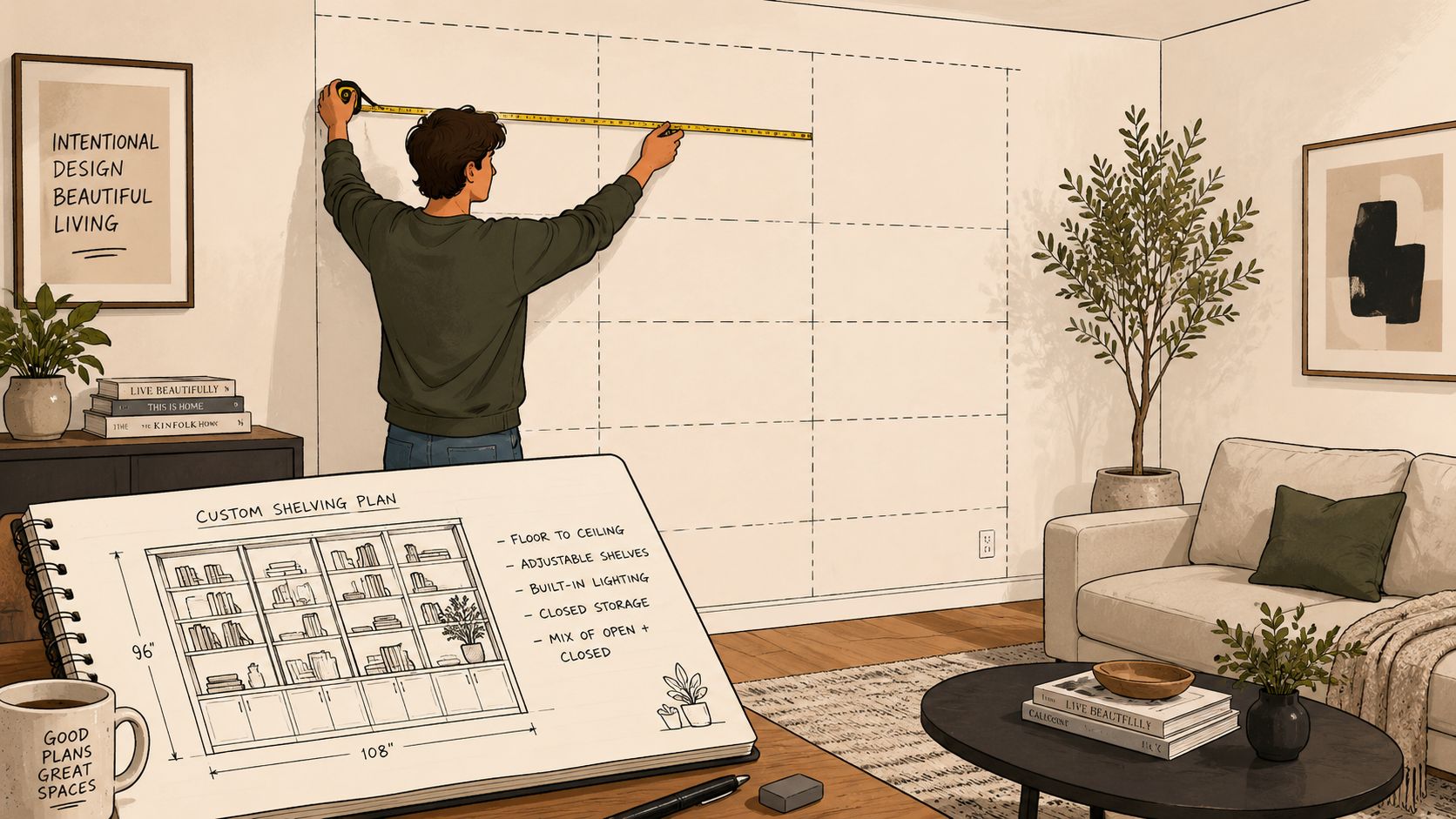
The finest shelving projects are solved before any material is ordered. The planning stage determines whether the finished piece feels effortless or awkward. Scale, storage mix, room geometry, and daily use all have to be resolved on paper first.
Start with what the shelving must hold
A beautiful elevation means very little if the shelf depths don't match the collection. A sound practical rule is to keep shelves intended for books at about 12 inches deep, while deeper lower storage can be designed at 18 to 24 inches and upper display zones at 12 to 15 inches, based on this custom built-in bookcase guidance. That mix allows a unit to function as both library and display wall.
Adjustability matters just as much. Homes change. Children's books become novels, board games replace baskets, and decorative objects rotate with the seasons. Shelves that can be repositioned support a more curated selection over time rather than locking the household into one arrangement.
A planning conversation usually works best when it starts with these questions:
- Books first or mixed use: Will the wall carry mostly hardcovers, or also framed art, ceramics, baskets, and media?
- Open or concealed storage: Would lower cabinets help absorb visual noise in a family room or office?
- Room function: Is the shelving supporting reading, entertaining, display, work, or all of them?
- Future growth: Does the collection need space to expand without forcing a redesign later?
Measure the room like a designer
Standard rooms are easier. Many Southern Ontario homes aren't standard. Upper-storey rooms, older plaster walls, attic conversions, and quirky corners often require a more careful survey. In homes with sloped ceilings or attic walls, detailed measurement means taking dimensions from multiple ceiling points, allowing for baseboard clearance of 2 inches, and planning trim that can be scribed to uneven surfaces, as shown in this slanted-wall shelving build example.
That's the difference between shelving that merely fits and shelving that looks built with the house.
Practical rule: Measure the same wall more than once, and never assume the floor, ceiling, or corners are perfectly true.
For homeowners exploring full-width built-ins, these wall-to-wall shelving units illustrate how a continuous installation can turn an awkward wall into a complete room concept rather than a patchwork of separate pieces.
Designer's Insight
Shelving should be planned from the floor up. The rug, seating layout, lighting, and circulation path all affect where a bookcase should begin, how deep it can be, and whether it should read as quiet backdrop or focal point.
That's why strong planning rarely treats shelving as an isolated purchase. It belongs in the room's full composition.
Defining Your Aesthetic Styles Materials and Finishes
A shelving wall can feel traditional, custom, modern, or transitional. The style comes from proportion and detailing, but the material choice determines how that style wears over time. A painted built-in and a stained wood library may serve the same function, yet they create entirely different emotional tones in a room.
Style should follow the room's architecture
Rooms with heritage trim, panelled doors, or warmer woods usually respond well to shelving with more visual weight. That might mean framed uprights, crown integration, or a finish that celebrates grain rather than hiding it. In newer interiors, a flatter face, finer reveal, and cleaner paint finish often make more sense.
What doesn't work is forcing a dramatic library treatment into a room that needs restraint. Shelving should feel rooted in the architecture already present. It should also support the broader furnishings story. In a complete room concept, the shelf wall sits in dialogue with upholstery, lighting, and the foundation underfoot. That's especially true when rugs are treated as Art for your Floor, because colour and texture from the rug often guide the shelf finish and the objects placed upon it.
Material choices that age well
Not every material belongs in load-bearing shelving. For durable bespoke work, a common technical baseline is 3/4-inch plywood with a 12-inch-class depth and an adjustable shelf-pin layout, while 1/2-inch stock should generally be avoided for book-heavy shelves because sagging risk increases, according to this bespoke shelving configurator and build guidance.
That doesn't mean every visible surface must look utilitarian. It means the structure should be engineered properly first, then refined.
A practical way to think about materials:
- Premium plywood core: Excellent for painted built-ins and stable cabinetry-grade cases. It offers reliable consistency and accepts a broad range of finishes.
- Solid hardwood details: Often best used where the eye and hand notice them most, such as face frames, trim, edges, and feature shelves.
- Paint-grade assemblies: Ideal when the goal is architectural integration and a perfect match to millwork.
- Stain-grade woodwork: Better when the shelving should read as a furniture statement with visible figure and warmth.
For readers also weighing broader home organisation decisions, these storage ideas for homeowners are useful because they show how built-in thinking can improve more than one room. The principle is the same. Storage works best when it's suited to the way a home is used.
Custom Shelving Material Comparison
| Material | Best For | Durability | Finish Options |
|---|---|---|---|
| 3/4-inch plywood | Built-ins, painted cases, adjustable shelving | Strong when properly supported | Paint, veneer, selected clear finishes |
| Solid hardwood | Visible trim, feature shelves, furniture-style details | Durable and character-rich | Stain, clear coat, hand-rubbed looks, paint |
| Paint-grade woodwork | Seamless architectural installs | Good when built on a sound substrate | Custom-matched paint colours |
| Mixed material construction | Heirloom-quality bespoke work balancing structure and appearance | Strong and versatile | Combination of painted casework and stained accents |
Finishes that support timeless craftsmanship
The finish should reinforce the room's intent. A stain can bring out grain and lend depth to a den or library. A lacquered or painted surface can sharpen the outline and make shelving feel more integrated with the envelope of the room.
Choose the finish based on what the shelving should become in the room. Background architecture, or the feature that defines it.
A design-forward project also benefits from restraint. Too many finish ideas at once can make a bespoke installation look restless. One dominant finish, one accent material, and a disciplined approach to hardware usually produce the strongest result.
Homeowners who want flexibility rather than a fully fixed built-in sometimes look at systems that can be configured more openly. A modular shelving system can be one practical route when the room may evolve, though it still benefits from the same discipline around scale, material integrity, and visual balance.
From Concept to Creation Working with Design Professionals
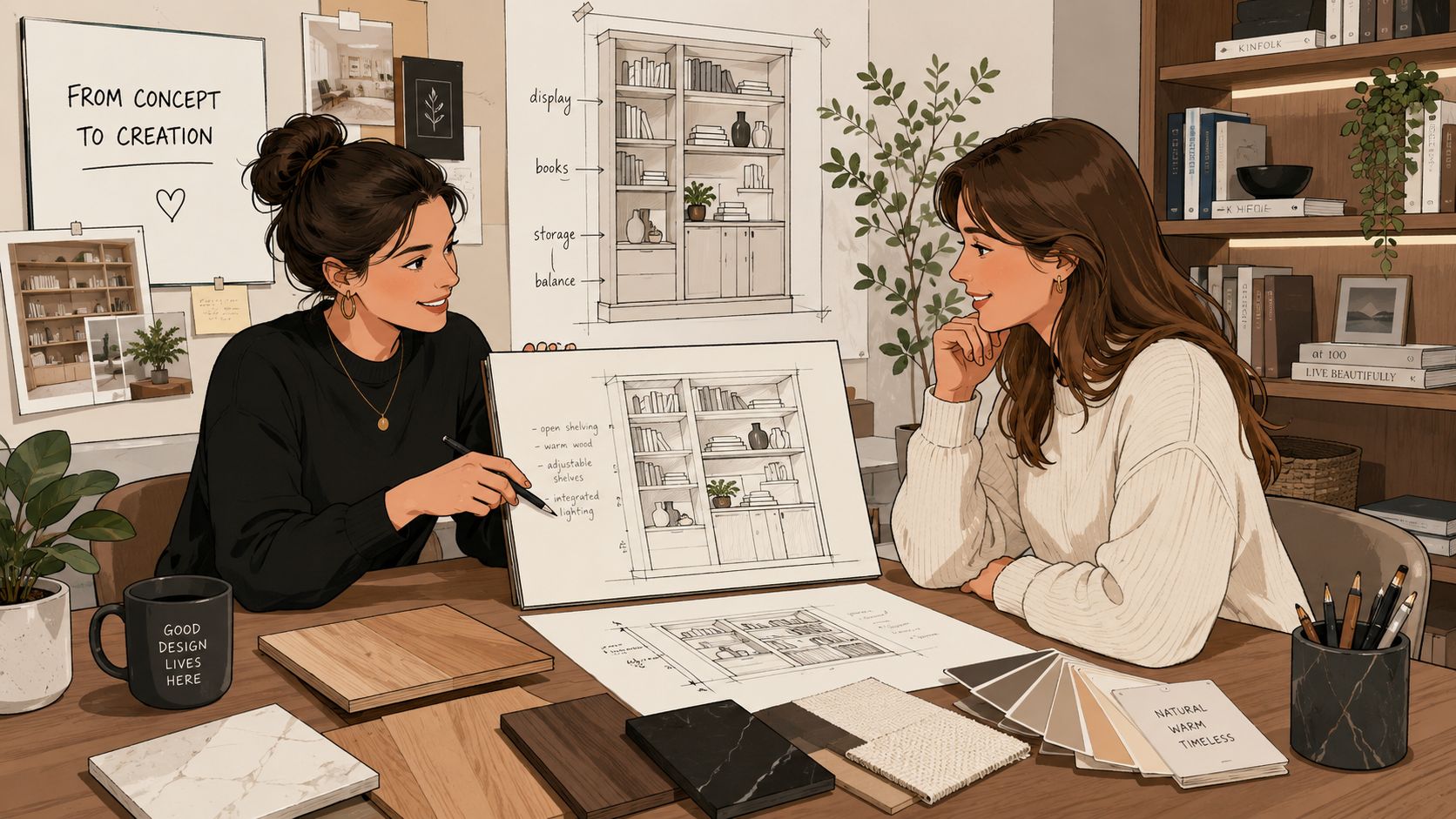
Custom shelving asks for more than good taste. It asks for translation. A homeowner may know the feeling they want. Calm, collected, library-like, lighter, more architectural. Someone still has to convert that instinct into dimensions, joinery, clearances, and a buildable plan.
Where professional process changes the outcome
Design professionals tend to see the room in layers. They're not only asking where the books go. They're weighing visual mass, traffic flow, ceiling lines, symmetry, sightlines from adjoining spaces, and how the shelving should relate to the rug, the sofa, and the lighting plan.
That's where a Design Studio approach becomes valuable. The shelving can be developed as part of a whole room concept rather than as a single isolated commission. A consultation may lead to in-home measurements, drawings, finish review, and revisions that make the final piece feel inevitable in the room.
For homeowners comparing renovation pathways, this explanation of Turning Point Ventures, LLC custom homes is a useful companion read because it outlines how coordinated design-and-build thinking helps prevent disconnects between vision and execution. The same logic applies at the furniture and millwork scale.
Why build details matter more than most clients expect
A shelf wall can look beautiful in a rendering and still fail in service if the structure is underbuilt. High-end custom shelving depends on 3/4-inch material, shelf depth kept near 12 inches, and mechanical support such as dados or pocket joints. Proper installation also means levelling the unit and fastening it into studs with 2 1/2-inch screws, as described in this custom bookcase build method.
Those details determine whether the installation resists racking and carries weight over time.
A professional workflow usually protects against common mistakes:
- The room is measured precisely. Not approximately. Out-of-plumb walls and uneven floors are accounted for early.
- Shelf spans are reviewed structurally. Long runs are broken up or reinforced before aesthetics are finalised.
- Materials are chosen for use, not only appearance. Decorative trim never substitutes for actual support.
- Installation is treated as part of the build. Anchoring, levelling, and final fit are part of the design outcome.
For clients seeking formal design support in urban or regional projects, these interior design services in Toronto reflect the kind of coordinated planning that helps bespoke shelving land properly within a larger interior scheme.
One factual example of product relevance is that Critelli Furniture offers bookcases and a modular shelving system that can be adapted as part of a bespoke storage plan. In practice, the right route depends on whether the room calls for fixed architectural millwork or a more flexible furnishing-based solution.
The Finishing Touches Installation Styling and Care
The final stage decides whether the project feels complete. A shelving wall can be beautifully designed and still lose its impact if installation is rushed or styling is treated as an afterthought.
Installation should feel calm and precise
Large bespoke pieces deserve a white-glove handoff into the home. That means careful delivery, controlled placement, protection of surrounding finishes, and a final result that looks settled rather than merely assembled. Clients notice the difference immediately. The room stays orderly, and the piece enters the house as finished architecture rather than a disruptive project.
That level of care matters most with larger installations, especially when walls are painted, floors are newly finished, or shelves have integrated lighting and trim details that need thoughtful handling.
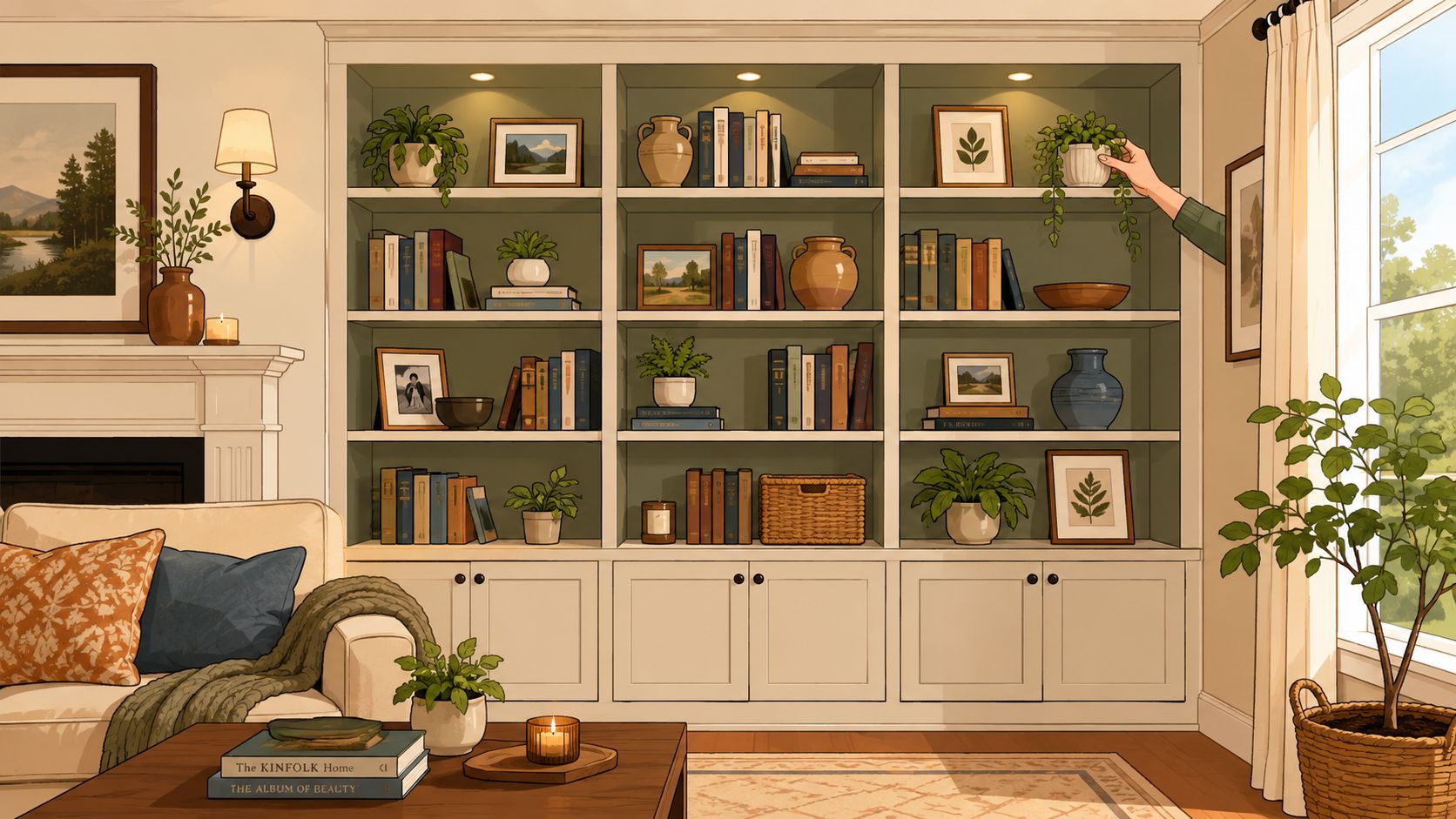
Styling turns storage into a design statement
Premium built-ins now often include dimmable library lighting and sliding ladders as integrated features in high-end work, transforming a storage wall into a more dynamic display surface, as reflected in this custom library lighting and ladder example. Those features only reach their full effect when the shelves are styled with rhythm.
A refined shelf rarely places something on every surface. It balances density with breathing room.
Consider this approach:
- Anchor with books: Group by height, tone, or subject rather than forcing strict uniformity.
- Add punctuation: Use a small sculpture, framed photograph, or ceramic piece to interrupt long rows.
- Vary orientation: Some stacks can lie horizontally to support smaller objects.
- Protect negative space: Leaving select shelves partially open helps the whole wall feel composed.
- Echo the room's foundation: Pull accent colours or textures from nearby textiles, especially a hand-knotted rug, so the shelving belongs to the wider interior story.
Shelves look richer when every object doesn't ask for attention at once.
Homeowners who want more visual guidance can explore these ideas on how to decorate shelves in any room, where styling principles are applied across different spaces and shelf types.
Care that protects the investment
Books are heavy, and shelf walls work hard. The best care routine is simple. Dust regularly, avoid overloading a single long span, and review lighting or ladder hardware as part of periodic household maintenance. Painted finishes benefit from gentle cleaning. Wood finishes benefit from restraint rather than aggressive polishing.
If a household is moving books into a newly completed installation, careful packing helps preserve both volumes and the final styling process. These Australian removalist tips for books are worth reviewing because the handling advice is practical even outside a full move.
The strongest shelf wall doesn't end with installation. It matures as the collection does.
Your Custom Shelving Questions Answered
Is custom book shelving worth it over freestanding units
It often is when the room has awkward dimensions, when the collection is substantial, or when the shelving needs to feel like part of the architecture. Freestanding units still have their place, especially where flexibility matters most. Custom work makes more sense when permanence, fit, and finish are the priority.
How long should homeowners expect the process to take
The answer depends on the room, the detailing, material decisions, and how much coordination is involved with the wider interior. Bespoke work usually moves through measurement, drawing, approvals, production, finishing, delivery, and installation. The more customized the result, the more important it is not to rush those stages.
Can shelving work in older or awkward rooms
Yes. In many cases, those rooms benefit the most from custom design. Sloped ceilings, uneven walls, and existing trim conditions are exactly where made-to-measure solutions outperform standard furniture. Good planning allows the shelving to absorb those irregularities so the finished piece looks calm and resolved.
What makes a shelving project feel design-forward instead of heavy
Proportion, restraint, and integration. The best projects balance books with open space, relate to the room's materials, and consider lighting from the outset. Shelving should support the room's atmosphere, not dominate it without purpose.
A final practical question often sits underneath all the others. Will this still feel right years from now. That is usually the best test of all. If the answer points toward timeless craftsmanship, organised living, and a more complete room story, custom book shelving is rarely just storage. It becomes part of how the home is experienced every day.
For homeowners refining a library, living room, or reading corner, Critelli Furniture offers a design-led starting point grounded in heritage, complete room thinking, and seamless service across Southern Ontario. Experience the craftsmanship in person at our King Street Showroom. Or book your complimentary design consultation today to explore a bespoke shelving plan that feels fully integrated with your home.