
Farmhouse Kitchen Tables: Your Guide to Heirloom Quality

The search often starts the same way. A household has outgrown a flimsy dining set, or a recent move has left the kitchen feeling unfinished. Breakfast happens at one corner, laptops spread across another, and by evening the same surface is expected to host family supper, school projects, and visiting friends.
That's why farmhouse kitchen tables continue to hold such appeal. They are not just decorative pieces. They answer a real need for warmth, durability, and daily usefulness. Their generous tops and grounded silhouettes feel familiar because they were shaped by practical living, and they still suit it.
A well-chosen farmhouse table also carries emotional weight. It becomes the place where routines settle in. Over time, the marks of use don't diminish it. They become part of its story. For households looking for a piece with presence and purpose, that combination is hard to replace.
Table of Contents
- Introduction The Heart of the Home
- Understanding the Soul of the Farmhouse Table
- Curating Your Style Farmhouse Variations
- Sizing for Your Southern Ontario Home
- Materials and Craftsmanship An Investment in Quality
- Building a Complete Room Concept
- The Critelli Experience From Vision to Home
- Your Family's Future Heirloom
Introduction The Heart of the Home
In most homes, the kitchen table carries more responsibility than any other piece in the room. It welcomes rushed weekday breakfasts, late-night conversations, holiday baking, and the quiet moments in between. Even in beautifully designed homes, it's often the least formal surface and the most used.
Farmhouse kitchen tables have always understood that role. Their beauty comes from usefulness first. A thick top, honest joinery, and a shape that invites people to gather all speak the same language. They say, “This piece is here to be lived with.”
That's why the right table shouldn't be chosen in haste. The best one doesn't only match the cabinetry or echo the flooring. It supports the way a household moves through the day and how the whole room wants to feel. In a heritage showroom, that conversation starts with function, then craftsmanship, then the larger design story.
Understanding the Soul of the Farmhouse Table

What makes a table farmhouse in spirit
A true farmhouse table isn't defined by distressing or a particular stain colour. Its identity comes from purposeful construction. Historically, these tables were built to work hard. Meals happened there, but so did food preparation, sorting, writing, mending, and everyday family life.
California's agricultural history helps explain why the form became so enduring. The state became the 31st state in 1850, and the working logic of large, durable tables took hold in farming households as inland agricultural regions developed. That legacy still feels relevant because California agriculture remains vast, with $59.2 billion in agricultural commodities in 2023 and roughly 24,000 farms across about 25 million acres in recent USDA reporting, as discussed in this overview of farmhouse dining table history and regional relevance.
The design language followed that practical life:
- Substantial top: A thicker top gives visual weight and a sense of permanence.
- Simple joinery: Straightforward construction is easier to maintain and easier to trust.
- Useful apron and base: These parts aren't ornamental afterthoughts. They help support the table through daily wear.
- A welcoming footprint: Most farmhouse forms encourage shared seating and casual gathering rather than formal separation.
A farmhouse table should feel settled in a room, not fussy in it.
For readers weighing wood options, this guide to choosing the right hardwood for longevity and style helps connect appearance with long-term performance.
Why heritage still matters
The appeal of farmhouse kitchen tables isn't nostalgia alone. It's the continued relevance of furniture built with integrity. That's where heritage brands often bring useful perspective. As Critelli's story notes, the principle of heirloom-quality furniture is firmly woven into its history. Since its founding in 1914, the company has championed furnishings designed to be passed down through generations, much like the original farmhouse tables that inspired the style.
That idea matters because this category rewards restraint. The best examples aren't overloaded with detail. They rely on proportion, material honesty, and timeless craftsmanship. A well-made farmhouse table can feel equally at home in a traditional family kitchen, a quieter transitional interior, or a more design-forward open-plan space.
Curating Your Style Farmhouse Variations
“Farmhouse” is often used as though it names one look. It doesn't. The category is broad, and the differences matter. Some tables lean classic and collected. Others feel cleaner and more architectural. Some introduce metal and sharper contrast for a more urban edge.
A helpful way to choose is to start with the room's mood. Should the table soften a crisp interior, add order to a busy family kitchen, or bring texture to a pared-back space?
Traditional farmhouse
Traditional farmhouse tables usually feel the most rooted in history. They favour visible grain, warm finishes, and familiar silhouettes. Turned legs, trestle forms, and straightforward plank-style tops all belong comfortably here.
They suit homes that already carry a sense of character. Older architecture, painted cabinetry, natural stone, and mixed seating often work beautifully with this style.
Modern farmhouse
Modern farmhouse pares things back. The lines are cleaner, the finish is often lighter or more restrained, and the detailing is quieter. The table still feels grounded, but not heavy.
This is often the right choice when a household wants warmth without overt rusticity. In newer homes or renovated open-plan interiors, it can bridge classic comfort and contemporary order.
Practical rule: If the room already has strong texture in the floor, backsplash, or beams, a simpler farmhouse table usually creates better balance.
Industrial farmhouse
Industrial farmhouse introduces stronger contrast. Metal accents, darker finishes, and more graphic bases appear here. The result still has farmhouse familiarity, but the attitude is sharper.
This style works well when the kitchen includes exposed materials, black hardware, or a loft-like sensibility. It can also anchor a room that needs more visual structure.
Farmhouse Table Style Comparison
| Style | Key Characteristics | Common Woods | Best For |
|---|---|---|---|
| Traditional | Plank tops, turned or trestle legs, warm and time-worn feel | Oak, pine, maple | Character homes, family kitchens, layered traditional spaces |
| Modern | Cleaner lines, restrained finish, simpler profile | Oak, maple | Open-plan homes, transitional interiors, design-forward kitchens |
| Industrial | Wood paired with metal, stronger contrast, more architectural base | Oak, maple, mixed materials | Urban-inspired spaces, rooms with black accents or exposed finishes |
A table doesn't need to announce its style loudly to feel right. Often the most refined farmhouse kitchen tables borrow from more than one variation. A clean rectangular top with a traditional wood tone, for example, can feel both current and enduring.
Sizing for Your Southern Ontario Home
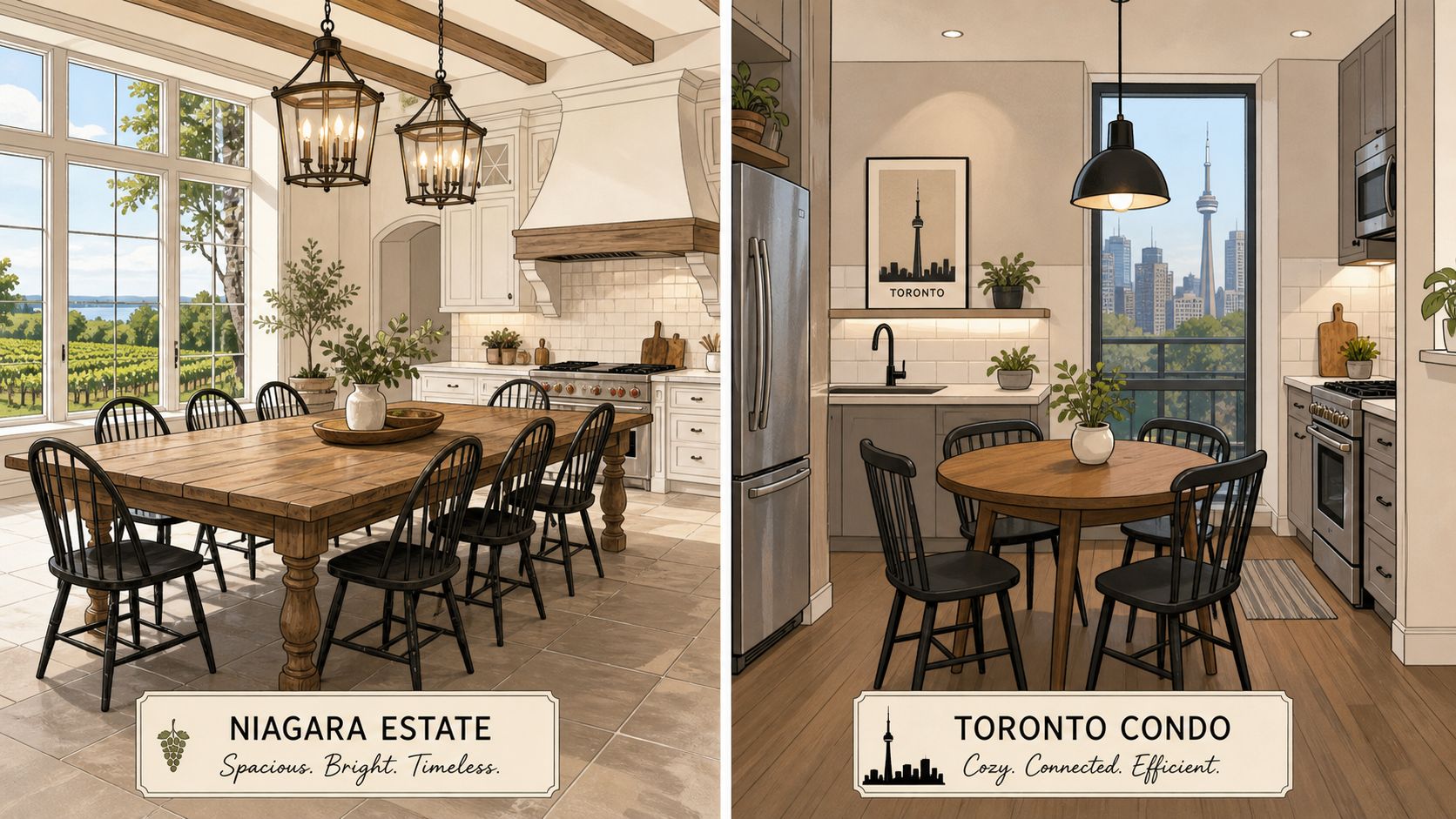
The most common sizing mistake isn't buying too small. It's buying too large for the room's daily traffic. A farmhouse table can be visually generous, but if people have to sidestep around every chair, the room never feels settled.
That concern is especially relevant across Southern Ontario. As this discussion of farmhouse furniture practicality notes, household space is valuable from the GTA to Niagara. In multigenerational or smaller homes, one durable surface often needs to handle dining, homework, and work-from-home use.
Shape first, then scale
Before looking at finishes or leg styles, settle the shape.
- Rectangular tables: Usually the most natural farmhouse expression. They suit longer rooms and open-plan layouts well.
- Round tables: A strong option when circulation is tight or the room needs softer geometry.
- Square tables: Best in square rooms or compact eat-in kitchens where symmetry helps the layout feel organised.
A visual reference helps here. This collection of table and chairs with bench ideas shows how seating style can affect the footprint and feel of the whole arrangement.
How to avoid an oversized table
Many buyers focus on how many seats a table can hold at holidays. Designers usually focus first on how the table behaves on an ordinary Tuesday. That's the better test.
In many modern Southern Ontario homes, especially those with open-plan layouts or smaller footprints, an oversized farmhouse table can overwhelm the space. Choosing a round version or a narrow rectangular table can preserve traffic flow and visual balance, as outlined in this article on farmhouse table sizing for modern homes.
A few practical checks usually prevent regret:
- Walk the room: Pull chairs out mentally before choosing the table, not after delivery.
- Check sightlines: In open-plan rooms, the table should relate to the kitchen and living area without blocking either.
- Match the household's habits: If the table doubles as a work surface, a narrower rectangle may serve better than an extra-wide top.
- Respect the room's scale: A spacious Niagara home may welcome a heavier trestle form. A Toronto condo kitchen usually benefits from a slimmer silhouette.
If a room feels pinched when no one is seated, the table is already too large.
Materials and Craftsmanship An Investment in Quality

The surface beauty of a farmhouse table matters, but the lasting value sits underneath it. Material choice, joinery, and the way the top is attached to the base determine whether the piece improves with age or becomes troublesome after a few seasons.
How solid wood behaves
Solid wood is alive to its environment. That's one reason it feels so rich and natural. It's also why quality construction matters so much in Southern Ontario. Indoor air shifts with the seasons, and wood responds by expanding and contracting.
For a solid wood table in Southern Ontario, managing moisture-driven movement is critical. Quality construction anticipates seasonal expansion and contraction, using techniques like floating-top attachments to prevent splitting or cupping as humidity changes between dry winters and humid summers, as described in this build-focused guide to classic farmhouse table construction.
That principle often confuses buyers. They assume a heavier table is automatically a better table. Weight can suggest substance, but it doesn't tell the whole story. If a wide top is rigidly locked to the base with no allowance for movement, problems can appear even in a handsome piece.
Common wood choices each bring a different personality:
- Oak: Pronounced grain and traditional character.
- Maple: A finer, quieter grain that suits cleaner interiors.
- Pine: Softer and more casual, often chosen when a gently worn look is welcome.
For households seeking specific dimensions or finish control, custom dining room tables offer a more exact route than trying to force a standard size into a difficult room.
Joinery that earns its keep
A farmhouse table experiences more racking and side pressure than many buyers realise. People lean on one end, children push back from the side, and chairs knock the base day after day. The structure has to handle all of that without loosening.
The strongest tables usually reveal their quality in details buyers don't always see at first glance:
- Aprons with proper depth: These contribute to stiffness and help support the top.
- Sound leg-to-apron joinery: Strong connections keep the base from wobbling over time.
- Stretchers where appropriate: These add stability, especially on larger tables.
- Durable finish build-up: A kitchen surface has to tolerate repeated wiping and regular use.
A table should be judged from the underside as seriously as from the top.
That's the difference between trend-led furniture and heirloom quality furniture. One is built to photograph well. The other is built to serve.
Building a Complete Room Concept

A farmhouse table rarely succeeds on its own. It needs the room around it to support its scale, texture, and tone. At this point, design moves beyond a single purchase and becomes a complete room concept.
The table is the anchor, not the whole room
Start with the base and the seating. The table's structural integrity depends on more than the top alone. A base with wide-spread legs and a sturdy stretcher, connected with strong joinery like mortise and tenons, resists the racking forces of daily use and helps the piece stay stable for decades, as shown in this guide to kitchen table base construction and joinery.
Once the structure is right, the surrounding choices should create balance rather than repetition.
- Wood chairs: Keep the look honest and architectural.
- Upholstered host chairs: Add softness at the ends of the table.
- A bench on one side: Useful where flexibility matters and visually lighter than a full row of chairs.
This gallery of dining table chair bench combinations is helpful for seeing how mixed seating changes the room's rhythm.
Start from the floor and build upward
A dining rug does more than protect the floor. It visually gathers the table and chairs into one composed setting. In a design studio, rugs are often treated as Art for your Floor because they establish colour, texture, and mood before the eye settles on smaller details.
Lighting should do the same job overhead. A more traditional farmhouse table may welcome a lantern form or a chandelier with softer lines. A cleaner table can carry a simpler pendant with ease.
For readers thinking more broadly about how kitchens connect to adjacent living zones, this Templeton Built kitchen guide offers useful planning ideas around cohesion and function.
Designer's Insight
A rustic Stickley table often looks more refined when paired with a neutral hand-knotted wool rug and quieter side chairs. Contrast creates sophistication. Matching every element too closely can flatten the room.
The most successful rooms feel curated, not themed. A farmhouse table can absolutely live in a design-forward home. It needs thoughtful company.
The Critelli Experience From Vision to Home
The purchase of a farmhouse table often stalls for one reason. The household knows the mood it wants, but not the exact proportions, finish, or shape that will make the room work. That's where guided selection changes the outcome.
Why guided selection matters
A design studio approaches the table as part of the architecture of living. The conversation includes sightlines, flooring, chair scale, natural light, and how the room functions when guests arrive or work spills into the kitchen. That's different from choosing from a grid of product thumbnails.
This is especially valuable in homes where scale is tricky. As noted earlier, an oversized farmhouse table can dominate an open-plan or compact interior. The better answer is often a round top or a narrower rectangle that preserves movement through the space without losing warmth.
For clients who need a specific size, wood, or finish, custom order options can turn a close-enough solution into a bespoke one.
From bespoke order to final placement
The service experience matters almost as much as the construction. Large dining furniture can be difficult to assess online and difficult to handle once it arrives. A showroom-guided process reduces those unknowns.
One option in Southern Ontario is Critelli Furniture, which offers a showroom-led selection process tied to design consultation, custom order support, and white-glove delivery. In practical terms, that means the table can be considered within the room's broader furnishing plan rather than as an isolated object.
For households across Greater Niagara, Hamilton, and Toronto, white-glove delivery also solves the final and often overlooked stage. Placement, handling, and setup affect whether the transition from showroom to home feels effortless or stressful.
Good furniture deserves a calm arrival. Large pieces should enter a home with the same care used to choose them.
Your Family's Future Heirloom
Farmhouse kitchen tables endure because they answer both practical and emotional needs. They work hard, age gracefully, and bring people together in a way few furnishings can. The right one fits the room, respects the architecture, and is built with the kind of craftsmanship that rewards years of daily use.
When selected as part of a complete room concept, a farmhouse table becomes more than a dining surface. It becomes one of the home's defining pieces. Book your complimentary design consultation today. Experience the craftsmanship in person at our King Street Showroom.
A thoughtful farmhouse table deserves an equally thoughtful setting. Critelli Furniture offers a curated selection, bespoke guidance, and white-glove service for homeowners furnishing spaces across St. Catharines, Greater Niagara, Hamilton, and Toronto. Visit the Rug Market to find your room's foundation, or book your complimentary design consultation today.